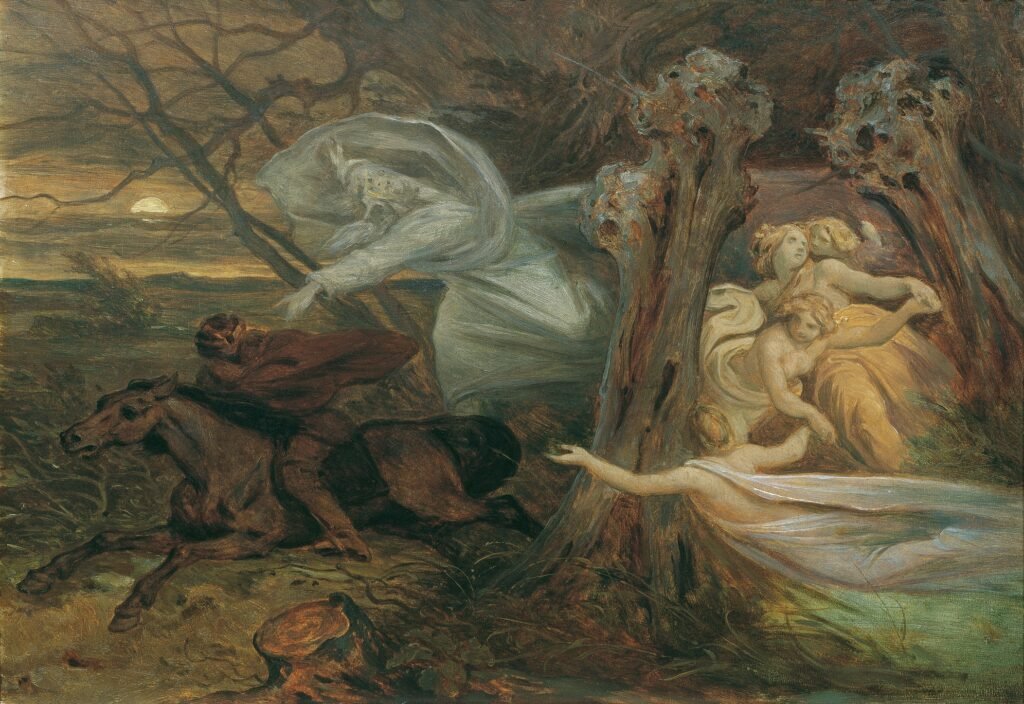
What does the pale arm at the tree know about Moritz von Schwind’s Der Erlkönig that the famous hovering king has kept from view? I approach that inquiry as the governing mystery, offering a thesis tested by the eye alone. Hidden partially by the trunk, Schwind renders a female shoulder and an arm reaching across the boundary between the phantom’s court and the rider’s desperate path. Such a slender appendage, usually swallowed by the reproduction, changes the core logic of the composition. The painting functions as a harsher vision where every earthly element and spectral figure merges into a single predatory organism. Goethe supplies the child with a cry of violated contact. The painter shifts that physical transgression. Hovering above, the sovereign extends his fingers, while the arboreal offspring physically grasps the victim. Malice strikes here through the ordinary shapes the father identifies as safe.
I start with the basest physical truth: the object possesses modest proportions. Housed currently at the Belvedere in Vienna, Schwind’s Der Erlkönig occupies a wooden support measuring 32 by 44.5 centimetres.¹ Those dimensions dictate the encounter ahead of any iconographic reading. Small proportions compel a viewer to draw near, abandoning the expansive posture demanded by towering academy scenes. Flesh must fold forward to bring the eye flush with the varnish. An observer retreats to gather the whole, then plunges forward to trace the local stroke. Compact scale constructs an enclosed theatre of dread. I approach this composition maintaining a close, folded posture, treating the artifact as a hazardous miniature. My lungs take shallower breaths while exploring the narrow field of movement. The artifact disciplines the observer through sheer proximity ahead of frightening the mind through theme.
Across the tight surface, the artist spreads pigment behaving like a wounded bruise. Varied earthy tones and jaundiced lunar yellows cross the wood in unequal densities. Atmospheric sections on the left appear rubbed clean, exposing the grain where bristles scraped scant oils across a resistant ground. Timber arcs slice through the gloom in nervous arabesques. Spectral drapery bears softer scumbles, the edges feathered until woven thread becomes raw weather. Central bark thickens by heavy accumulation, catching hot touches of ochre upon its knotted extrusions. Studying the reproduction, the upper register reveals slight pale scuffs. Those marks arise from either historical abrasion or the digital scan itself. Prudence restricts my claims to the visible surface, as the object record lacks a public conservation dossier. The image survives as a stable field thriving on friction between thin glazes and heavy, smoky drag. Any existing join in the wood keeps quiet in this photographic file.
Illumination operates across a dual register. Within the narrative, a descending moon offers the rider a meagre glow. Beneath the varnish, that lunar cast permits a heavier metaphysical labour: dividing the figures by their capacity to absorb glare. The fleeing family and their mount swallow the sheen greedily. Shadow consumes them. Heavy mass pushes forward like a clotted vein. Conversely, the sovereign phantom emits a stolen pallor. Woven layers catch the viewing plane as though lit from an internal wick. Feminine forms claim an intermediate zone where their skin gathers heat from the same dim beam chilling the ghostly king. Seduction and fatality share a single origin. That optical strategy operates as a moral proposition. Goethe assigns heat to the paternal embrace. Here on the wood, feverish flushed skin migrates treacherously into the daughters, abandoning the father to his rusted, funerary cloak. The painter compels the visible world to subvert the lyric’s promised shelter.
A central arboreal pillar anchors the composition. Thick bark rises near the median, splitting the visual field into two volatile theatres while binding them tight. Westward of the timber, the plunging stallion and bent paternal spine forge a rushing diagonal aimed outward. Higher up, the ghostly monarch swoops in a pale arc to counter the rider’s flight. Eastward, the alluring progeny claim a recessed enclave buried among roots and hollows. The wooden column functions to channel those territories. Canopy limbs snake across the heavens ahead of the phantom’s descent. Knots of bark already mimic human faces. My focal lower arm reaches from behind the timber straight into the mortal path. The brush therefore constructs an invasive continuity. Oak and ash serve as the ultimate accomplice.
Observed from a distance, the layout mimics a closing pincer. The fleeing equines form the leftward jaw. The opposing mandible consists of the pale king bearing down. Gathering the macro scale requires the eye to abandon local anecdote. Distance simultaneously obscures the finer horror. Essential details blur into mud unless the observer leans close enough to smell the varnish. Flesh standing before the easel oscillates between two physical obediences. Retreating teaches the broad assault. Closing the gap exposes the trap’s hidden gears. Few Romantic depictions of spectral pursuit train the human spine so aggressively.
The original ballad provides the narrative spine. The verses establish the ethical snare. The initial stanza locates heat firmly within the paternal grip:
Wer reitet so spät durch Nacht und Wind?
Es ist der Vater mit seinem Kind;
Er hat den Knaben wohl in dem Arm,
Er faßt ihn sicher, er hält ihn warm.
Those verses carry weight far beyond their fame. Goethe frames the elder male through physical custody. Security relies on tight physical limits. The journey commences steeped in protective phrasing ahead of any fright. The painted surface retains that armature of holding while corrupting its intent. A dark red-brown mantle swallows the bent man and his son, turning an embrace into an act of suffocation. Paternal custody shrinks the boy’s visual footprint. Guardianship takes shape and casts a suffocating shade. Lyric verse and heavy pigment inaugurate the identical crisis using divergent methods of touch.
Poetic dread relies heavily on paternal logic. Fog claims to explain the crown, howling air excuses the whisper, and pale willows stand in for the spectral girls. A desperate contest unfolds between the boy’s seeing eye and the older man’s rationalising voice. The lyrical architecture hits a fateful climax precisely where the right-hand painted figures cluster:
„Willst, feiner Knabe, du mit mir gehn?
Meine Töchter sollen dich warten schön;
Meine Töchter führen den nächtlichen Reihn
Und wiegen und tanzen und singen dich ein.“
A few lines down, the coercive seed splits wide:
„Ich liebe dich, mich reizt deine schöne Gestalt;
Und bist du nicht willig, so brauch’ ich Gewalt.“ —
Mein Vater, mein Vater, jetzt faßt er mich an!
Erlkönig hat mir ein Leids getan! —
The painting demands these exact verses to make sense. The female progeny function as the erotic economy of the poem made flesh. The extending fingers execute a calculated strike. Applied pigment captures the exact second when seduction morphs into assault.
Goethe seeded the ballad inside Die Fischerin, intending the lines for the singing voice well before Schubert found them.² That vocal genesis heavily influenced the visual artist. The lyrics drew their first breath in performance. The melody travelled through the intimate Austrian salons. The brush-worker inhabited that very same musical society. Joining the composer’s inner ring around 1821, he devoted his later years to finding visual translations for acoustic rhythms. An artist molded by song illustrates the terror as a sounding score. His ears catch the fatal crescendo. The shifting dark and pale zones echo a consciousness trained by Lied.³
At this juncture, the minor detail asserts immense evidential weight. Beneath the grouped daughters on the right, a female form streams low along the earth. Bark conceals the bulk of her torso. A shoulder and an outstretched hand emerge with stark clarity to point straight into the rider’s path. My exact reading hinges on that specific limb. The shape constitutes living tissue. Oil paint models the joint with heavy anatomical intent. An lifted palm executes a gesture of simultaneous offering and theft. The wrist breaches the woody boundary. Verse-bound daughters confined to a distant promise suddenly penetrate the rider’s immediate present via arboreal camouflage. Fatal touch erupts directly out of the feminine appendage rooted in the grove.
The visible anatomy rewrites the core logic of the wood. To merely stage the lyrical cast, the artist could have relied on the sovereign’s raised fingers alone. The brush multiplies the points of contact. A wooden core acts as a living conductor. The young women exist as a hybrid of wood and skin. The hovering lord wears a white mantle bleeding directly into the timber. The lowest arm weaves the eastern edge of the attack across the dividing line. The eye perceives a fused biological threat distributed across vapor and bone. Paternal rationalizations collapse instantly as a defensive shield. The painter twists the innocent foliage into the actual weapons of the assault. A trusted environment houses the killing strike.
An immediate counter-argument suggests itself. The lurking limb might simply function as a tool for narrative compression. A single frame must carry multiple temporal beats from the ballad simultaneously. Under that theory, the appendage serves pure utility. I acknowledge the weight of that reading. Historical canvases routinely flatten time. Time-flattening fails to clarify why the lowest joint breaches the timber while the king holds his own strike in reserve. Burial of the daughters deep inside the wood demands a different logic. An easier layout places the female attendants plainly beside their lord. The artist dismembers the threat, scattering the bodies. Such a choice carries deep semantic consequence. The brush locates the violence squarely inside the father’s trusted earthly domain.
A second critique argues from pure aesthetic convention. The grounded shape might exist merely to sweeten the gloom with graceful skin. The maker frequently indulged in lyrical curves and soft mythology. I concede a portion of the premise. The limb holds deep beauty, and that allure carries lethal weight. In the ballad, the trap opens with a whispered vow ahead of physical violence. Target acquisition requires deadly geometry alongside elegance. The joint aims westward, directly into the flight path. The exposed palm acts as a counterweight to the monarch’s reaching digits. The geometry behaves as a lethal vector. A welcoming wave doubles as a grabbing hook. Aesthetic charm smuggles the assault into the lower shadow, operating safely below paternal sight.
A final dissenting view confines the entire spectral event to the child’s fevered brain. Under that theory, paternal logic serves as the sane perimeter. The painter would simply be charting a delusion. Viscous pigment destabilises that comfortable hierarchy. Faces carved in the bark and the hidden wrist breaching the boundary render the environment wholly complicit. Delirium stands as a valid diegetic reading. Structurally, the panel binds the earthly and the phantom domains into an inseparable knot. The eye fuses the zones into a single mass while respecting the applied paint. Paternal logic loses its grip through the sheer weight of the painted masses.
Accepting that integration clarifies the surrounding marks. The wooden knots demand scrutiny. Deep cavities on the eastern timber form hollow masks ringed by pale moss. A casual glance reads the shapes as standard forestry texture. Visual rhyming binds the wood tightly to the daughters’ features and the monarch’s skull. The outer rind rehearses the haunting ahead of hosting it. Western canopy limbs map the wind while snaking ahead of the horse as a barricade. The sunken moon sheds its weak glow from a position of deep entanglement. Lunar light hangs snared within the atmospheric trap. The composition bristles with tight internal echoes. The accumulated visual logic compels the observer to abandon the safety of an objective distance.
Physical posture tightens the moral tension. The elder man folds forward, his eyes seeking only the exit. The paternal hands exert a crushing, possessive custody. Fear erases the boy’s features, reducing the youth to the dark core of a fleeing mass. The stallion thrusts its legs wide in a brutal, plunging stride. Opposing that animal velocity, the brush stages multiple levels of spectral welcome. The pale sovereign reaches down from the sky. Seated female shapes form a glowing knot behind the timber. A solitary hand sweeps upward from the roots. Tactile threat attacks from all elevations. Coercion envelops the target. Total environmental ambush replaces the cheap theatre of a single lunging ghost.
Fabric tightens the snare. The elder wears a dense wine-dark cloak acting as a heavy shell over the horse. The wool transforms from a shield into a choking weight. The phantom wears a sprawling gown woven from weightless air. The stark linen holds regal power for a brief second before exposing its true funerary nature. The younger women wear garments woven from a distinct logic. Creamy gold threads hug their skin, offering a heat the cold king lacks. The paint treats them as bait meant to coax the boy out of his father’s arms. The poet gives the king “gülden Gewand” through his mother; the artist assigns that glittering lure to feminine limbs. Enticement gains a textile weapon. Heavy wool suffocates the child. Spectral linen frightens the eye. Silk sirens pull the mind.
Timber backing joins the semantic labor. A cabinet piece maintains a proximity utterly foreign to the vast fresco. The young brush-worker absorbed oil methods from Kupelwieser, gathered atmospheric brooding from Schnorr von Carolsfeld, and adopted realistic habits from Krafft. Munich later provided Cornelius, who drilled the student in monumental wall painting.⁴ The haunted ride sits exactly at the joint between the commercial easel trade and the looming civic murals. The historical record conceals the original buyer. I read the artifact as a private instrument built by a mind mastering both the miniature line and the colossal wall.
The drawn mark exposes that dual training. An institutional registry accurately named the effect the “Gewalt der Linie,” the violence of line.⁵ The term holds the visual truth. The pencil commands velocity ahead of outlining shape. Jagged branches scrape the sky. Swirling fabrics drag the eye. The charging animal drives a wedge into the gloom. The lowest arm claims authority through an edge drawn sharp enough to cut through the surrounding storm. Aggression lives purely in linear thrust. The spectral court attacks first through weaponized contour.
Domestic origins clarify the emergence of the panel. The boy entered a Viennese household defined by civic duty. Franz von Schwind carried the seal of the Habsburg chancery. The maternal line shared similar ties to Hungarian governance. The childhood developed strictly within the rules of educated ambition and linguistic polish. The youth initially pointed his compass into the civil service while attending the University of Vienna. The administrative cradle casts a long shadow. Scholars routinely read the painting as raw hallucination. I find a mind raised on official proclamations, acutely alert to the weaponized nature of verbal clarity. The lyrical elder translates panic into neat files of logic. The instinct mimics the clerk’s ledger. The son of the chancery understood that sorting rhythm intimately.
Physical geography shaped the mind with equal severity. Historical archives trace a youth split between the Bohemian woods and the Viennese Schottenkloster, where friendships sparked with Eduard Bauernfeld and Nikolaus Lenau. The dense timberlands combined with monastic drill to furnish the vocabulary needed for a haunted ride. Entering the orbit of the Lukasbrüder, the student inherited a fierce spiritual seriousness. Schnorr trained the eye on northern woods, while Krafft forced the brush to record contemporary life. Dürer’s lines mixed freely with the folk tales of the Grimms and the heroics of the Nibelungenlied. The man preparing the wood had consumed the forest path alongside the salon song.
Coin dictates the stroke. Earning silver required the artist to cut Bilderbögen for local printers. Biographies typically whisper this economic truth. The ledger demands a booming voice. Cutting cheap prints trained the hand to master strict silhouettes and visual economy. The haunted ride carries the scars of the printing press. Every form holds a hard edge. The actors retain stark clarity inside the storm. The strict lines transcend the market. The same years bound the draftsman to the acoustic experiments of the Schubert circle. Letters verify weekly musical gatherings filled with a familiar cast. The music room built a microscopic public demanding art that bridged the page and the sung breath.
Departing for Munich in 1827, the painter followed Franz Grillparzer’s letter straight to Peter von Cornelius. Wall painting swallowed the days, leading to royal commissions at the Alte Pinakothek. Acoustic loyalties survived the relocation. The board sits exactly at the fertile crossroads. Austria provided the lyric and the miniature sheet. Bavaria taught the muscular arrangement of large masses. The oak distils the double schooling. The tight sizing echoes the printed page, while the heavy arboreal spine behaves like a civic monument.
The century stomps into the paint. Citizens of the Habsburg empire lived under the crushing weight of Metternich’s police. Open expression bent under the strain. State censors monitored the visual field with intense suspicion.⁶ Domestic music rooms flourished in direct response to the stifled streets. Hundreds of local piano makers fueled a culture of private listening. A frightened populace turned the parlor into a sanctuary for deep looking. The painted ride embodies the tension. The wood offers a private theatre for a suppressed dread.
The political climate clarifies the ethical stakes. Censored minds hide their fear inside medieval myth. A phantom stalking a boy functions perfectly well as a simple ballad. The image simultaneously records a deep cultural panic regarding failed patriarchal authority. The ghost operates as a distinct metaphysical threat independent of the Chancellor. The habit of euphemism explains why the natural environment turns so volatile. The fleeing man points to mist and leaves. The governing regime preaches order and safety. The brush demonstrates how logic shelters the very violence it denies.
Psychology functions as a sharp blade. The pigment stages the collapse of paternal defense. The elder exists to provide heat. The poet supplies the fire. The artist renders the embrace as a crushing weight. Panic reduces the son to a mute core. Lyrical lust takes physical form through exposed throats and creamy cloth. Carnal hunger acts as the vanguard of the grave. The reaching appendage carries immense consequence. The female limb grants the ambush an erotic base. The eye witnesses the lullaby turning into a trap.
I would read the wood as exceeding autobiography. Older generations marked the state papers; the younger drew the forest into consciousness. Surviving correspondence shows intervals of domestic strain, yet it also reveals a resilient and agile intelligence. A letter to Bauernfeld places health troubles beside a darkly playful remark about finishing a drawing. The artist knew how to laugh within the very act of labor. That wit carries interpretive weight. The jest reveals a mind capable of converting distress into formal geometry. Biographical strain lends edge to the viewing. The paint lifts the domestic wound into art.
The theology of the pigment occupies a zone beyond standard Romanticism. Standard encyclopedias summarize the ballad as a clash with blind natural powers. The definition holds true. The lyrical parent struggles to sever the spectre from the sensible world. The painted world smuggles the attack inside its very grain. Every branch acts as an exposed nerve. Bark morphs into a face. The alluring female shares DNA with the timber. The trusted willows betray the rider. The forest breathes a corrupt breath.
Spatial logic exposes the corruption. Traditional perspective fractures across the panel. A western sky opens. The plunging mount dominates the immediate earth. The phantom occupies a depthless middle altitude. Female shapes break the laws of physics by sitting simultaneously behind and before the bark. The reaching limb pierces the foreground while the attached torso vanishes. The distorted grid serves as a tool of compression. The air itself crushes the figures. The fleeing pair remain trapped upon the haunted ground. The terror has infected the path. The spatial collapse asks a massive philosophical question. Where does the danger hide? Does the trap lie on the dirt, or inside the very act of seeing? The artist locates the snare inside the fusion of the two.
The western moon requires close reading. Casual eyes dismiss the orb as mere atmosphere. I assign it massive weight. The glowing sphere declares a competing kingdom. The sunken circle drowns in the horizon haze. The painter sets the phantom’s erratic skull against that steady geometry. Two forms of light battle across the wood: the indifferent cosmic ember and the hungry ghost. Fleeing equines run beneath dual lamps. Only the ghost commands a reaction. The celestial body operates in total silence. The pale lord possesses total control. The arrangement isolates the crisis of heaven. God’s old lamp burns out on the fringe. The local demon takes the center. The paint chronicles a fallen heaven, replacing distant grace with an immediate tactile assault.
The spiritual allegiance of the maker demands a moment. The available papers demand a complex reading. The brotherhood trained his hand to treat the canvas as a moral altar. Later quarrels over iconography prove his deep attachment to symbolic weight. That seriousness anchors the current panel. The haunted ride transcends the cheap thriller. The board records a massive failure of the cosmic rules. Sire’s arms collapse as a shield. The earthly foliage lies. Erotic heat turns to murder. The boy suffocates inside the very grip meant to save him. Corruption eats every bond. A severe theologian operates behind the fairy mask.
The lifelong translation of song into paint exerts an immense weight. Museum commentary notes his obsession with finding visual bodies for acoustic shapes. The observation fits the early wood perfectly. The Schubert score drives forward on a galloping pulse interrupted by contrasting vocal registers. The bristles translate the galloping pulse into physical paint, driving the animal forward as a visual ostinato. The ghost drops in as a counter-melody. The grouped females sing the chorus. The bonded males operate as the heavy recurring bass. The secret lower arm acts as the hidden internal acoustic line twisting the chord. The tiny frame plays a massive orchestration.
The historical audience proves the thesis. The ensuing decades crowned the artist as the supreme architect of the haunted past. The printing press radically alters the sociology of panic. An isolated panel infects a single chamber. A mass-produced engraving infects an entire generation. The visual catalogue of knights and spirits circulated wildly as a nostalgic currency. The haunted ride provided an extremely dense package of lure and dread. The print allowed the bourgeoisie to hang terror on the parlor wall. The domestication of horror guarantees a long lifespan. The framed boundary grants the abyss a manageable edge.
The accounting of profit and harm requires a strict audit. The ink merchants and the parlor owners drew immediate comfort. The tight theatre ensured easy transmission. The viewing public extracted a grim stability from the composition. The wood translates the chaos of a dead son into a readable tragedy. The observer must respect that translation. The brush offers balance by acknowledging the permanence of the dark. The draftsman calibrates the abyss. The true danger lies in the beauty. The pigment coats the assault in heavy grace. Skin acts as bait. The boy vanishes into the dark. The grave dresses itself in silk. The eye falls in love with the killing machine. All heavy mythologies carry that poison. The master understood the poison and drove the brush straight into the wound.
The crab apple joke echoes across the years. The aging hand understood the fermentation of memory.⁷ The haunted ride operates on the exact same yeast. The poem bred the song. The notes infected the capital. The friendships aged in the cask. The paint always sought the acoustic chord. The timber represents an era of slow distillation. The artifact marks the exact station where the breath froze into a national emblem.
A final geometric truth seals the reading. The ghostly monarch’s reaching fingers hover inches from the boy. The claw waits a fraction of an inch from the target. The grounded female wrist has already completed the invasion. The artist displaces the visible strike into a hidden ambush. The lord threatens. The root kills. The eye verifies the claim. Track the lowest limb into the bark, then compare the sky. The visual evidence proves a delegated murder. The phantom delegates his touch. The foliage provides the weapon. The girls pull the trigger. The fleeing man rides blindly into the jaws.
The block of wood assumes a terrifying weight. The painted surface sheds the label of simple illustration. The artifact operates as a ruthless autopsy of failed shelter. The stifled century handed the painter the exact tools to encode a collective panic inside a parlor ornament. The civic bloodline tuned his ear to the lie of official safety. The acoustic evenings taught his hand to build a crescendo. The pencil became a scalpel. The tight dimensions forced the observer to step into the snare.
I circle back to the first inquiry. What truth lives inside the grounded wrist? The limb understands the wood as a document of total environmental betrayal. The paint chronicles the erasure of the line between the safe path and the killing ground. The reaching appendage exposes the forest as the primary assailant. The central bark holds the true gospel. The artist fuses the botanical and the spectral into a unified engine of ruin. The archivist spoke accurately regarding the brutal geometry. The pencil requires the aid of distribution to complete the trap. The ultimate cruelty rests in delegation. The grave claims the boy through the very leaves the rider trusted. The fatal blow strikes from the roots. The murdering fingers branch directly from the oak.
Scholia:
¹ For exact dimensions, support material, and curatorial records regarding the physical condition of the piece, see the Österreichische Galerie Belvedere Collection Archive (Vienna: Belvedere).
² The text first appeared as part of a Singspiel, placing its origins firmly within a performative context. See Nicholas Boyle, Goethe: The Poet and the Age, Volume I: The Poetry of Desire (Oxford: Clarendon Press, 1991), 322.
³ The transition of the poem from silent printed page to communal vocal performance profoundly shaped Schwind’s visual architecture. This culture of private recitation, often occurring in cramped bourgeois parlors such as those hosted by the Sonnleithner or Enderes families, operated as a subterranean channel for emotional and political resonance during a period of intense public suppression under Metternich. Schwind’s own correspondence, alongside the diaries of his contemporaries like Eduard von Bauernfeld, frequently returns to these evenings, suggesting that the rhythm of the Lied functioned not merely as social accompaniment but as a primary structural blueprint for his narrative compositions. By mapping acoustic crescendos onto visual massing—translating the piano’s driving ostinato into the physical plunge of the painted horse—he effectively painted the bodily experience of listening to Schubert’s score. See Christopher H. Gibbs, The Life of Schubert (Cambridge: Cambridge University Press, 2000), 55–72.
⁴ The transition from the Lukasbrüder’s ascetic spiritualism to the monumental demands of Munich fresco work under Peter von Cornelius created a severe structural tension in Schwind’s early panel paintings. While Ludwig Schnorr von Carolsfeld instilled a deep reverence for the brooding, atmospheric landscapes of the north, and Krafft demanded rigorous contemporary observation, Cornelius imposed a rigid, architectonic discipline. This collision of intimist landscape sentiment with the heavy, tectonic demands of public mural making explains the peculiar spatial pressure within Der Erlkönig. The viewer witnesses a private, folkloric terror engineered with the heavy, unyielding machinery of civic art. The central oak trunk functions precisely as a fresco pillar, dividing the emotional registers of the composition with the cold efficiency of a state commission. See Keith Andrews, The Nazarenes: A Brotherhood of German Painters in Rome (Oxford: Clarendon Press, 1964), 110–125.
⁵ Katalog der Österreichischen Galerie Belvedere (Vienna: Belvedere, 1998), 112.
⁶ For an overview of the pervasive surveillance and the resulting turn toward domestic interiority in Biedermeier Austria, see Alice Freifeld, Nationalism and the Crowd in Liberal Hungary (Baltimore: Johns Hopkins University Press, 2000), 22–26.
⁷ Schwind’s correspondence in his later years reveals a profound reliance on dark humor as a defensive mechanism against recurring bouts of physical illness and professional anxiety. Writing from Munich, the artist frequently deployed metaphors of organic decay and fermentation to describe his own creative process. The reference to the completed Schubertiade drawing improving by “lying around like crab apples” demonstrates a conscious understanding of artistic maturation as a process of necessary neglect and atmospheric aging. This late reflection casts a vital retrospective light on his earlier, feverish works. It suggests that Schwind viewed the translation of memory into image not as an instantaneous flash of inspiration, but as a slow, often bitter chemical breakdown, where private agony is gradually distilled into a stable, legible form. See Moritz von Schwind, Briefe von Moritz von Schwind, ed. Otto Stoessl (Leipzig: Bibliographisches Institut, 1924), 312–314.