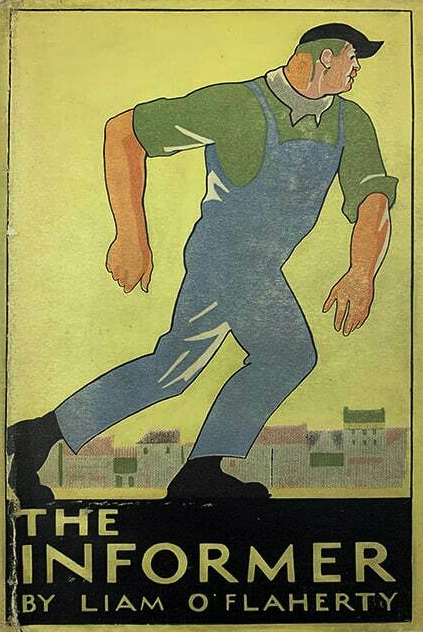
A turf cutting tool resting beside a hearth projects a distinct theology of exertion. The ash shaft rises bearing the patient uprightness of a farm servant seasoned by violent weather; an iron footrest juts out as a practical insult to soft hands; the iron blade, blackened by repeated entry into wet earth, keeps the memory of weight more faithfully than many consciences retain the memory of action. I observe how one severs peat by leaning muscle into resistance, by turning human heft into a sentence the bog finally agrees to accept. Severed from its bed, the block comes free, leaving a clean wound in the soil where water shines blackly from the hollow. Lifting fuel from what looked, a moment earlier, like a continuous surface, the cutter breaks the visual plane. Born on the Aran Islands, O’Flaherty takes us into a Dublin where another form of severing sustains itself with equal plainness alongside far fouler consequences. In the designated fiction, a man carves a living from another man’s name. He leaves a cavity to fill, as cavities always do, with dread, rumor, memory, along with all the slow black seepage an action invites once entering the world.
Historical climate surrounding the book holds immense weight, for the author writes in the afterheat of a country recovering from the War of Independence. Tearing itself apart during the Civil War, the nation suffered with the capital serving as both symptom alongside workshop of that fracture. Those Irish revolutionary years had trained citizens in a hard civic art: reading signs, prizing silence, growing wary at a stray cough in a dark hallway, measuring loyalty by habits scarcely showing on the face. Then the split over the Treaty turned comradeship into a knife-edge distinction. Men treating compromise as a step advancing to statehood stood against men treating the same pact as a surrender of the republic for which fighters had already died. Within such an atmosphere, shared details carried the lethal charge of munitions. The fellow carrying names across a threshold carried, tucked in his coat, the power to destroy houses, flesh, alongside entire chains of obligation. I argue the prose architect understands secret politics as the origin of a harsh theology of speech. The tongue becomes an organ of treason as easily as of testimony, turning the metropolis into a beast breathing through suspicion. Politics alone falls short of explaining O’Flaherty’s ferocity, seeing as he plants betrayal in material need long before letting ideology supply a formal costume. Dublin enters the text through poverty having, by the early twentieth century, acquired an almost geological permanence. Decayed Georgian grandeur converted into crowded tenements, families packed into single rooms, casual labor setting the rhythm of hunger, with every small commodity encircled by degradation. Demanding a deposit for cutlery, a lodging house already teaches its own catechism of mistrust. Humiliating an elderly pensioner over pennies, a clerk performs, in miniature, the exact moral transaction appearing later in heroic or patriotic dress. One existence grows inside the other, as the slum teaches the uprising its tone of vigilance, while the rebellion gives the gutter a fresh grammar of menace. Under both conditions lies the quest for subsistence, an urge barren of all romance yet governing more actions than banners manage to sway. I see the creator, who had witnessed political passion from within alongside misery from close range, actively discarding the consoling fantasy of a noble cause purifying the social medium through which it moves. Slum air retains its odors. Human souls retain their appetites. Fingers gripping the pistol often reached, a little earlier, for bread, rent, or drink.
Here the iron cutting implement proves a better guide than every abstract lecture on ethics. A bog rewards labor digging into common earth, turning what lies below into warmth shared by a household. Such severing damages the surface, certainly, though the wound enters a cycle of use, need, season. O’Flaherty invents a contrasting civic economy where extraction arrives by way of disclosure. Stripping value from a human relation, the giant watches the profit materialize as paper handed across a desk. Fuel translates to cash; communal trust converts to a reward; the night’s bed alongside the morning’s tea acquire a price fixed by the surrender of a comrade’s whereabouts. This narrative thrives on such conversion, asking, in every scene, what kind of life a male purchases when the medium of exchange carries another male’s death folded inside it. Answers grow uglier each hour. The brute buys food, liquor, women, noise, applause, a temporary enlargement of his own importance, while through every purchase the notes continue whispering their origin. Currency here behaves like a sacrament administered by a fallen priest. It changes the outward condition, it marks the receiver permanently, binding the taker to a fellowship from which he will henceforth remain exiled.
One of the book’s boldest achievements rests in how little grandeur it grants the initial decision. A lesser author would have inflated the betrayal into a blazing crisis of conscience, complete with thunder alongside perhaps a church bell for those enjoying their guilt with upholstery. Our author reveals something meaner, truer, therefore vastly more devastating. The outcast meets Frankie McPhillip, shares a meal, hears enough to realize the fugitive risks returning to the family house, then wanders with two brute facts colliding in his tired head. He has seen the wanted man, while his own pockets remain barren of coin. His reasoning grows out of physical strain with an animal slowness. Hunger, fatigue, wet weather, sheer vacancy do their grim work. Treason arrives through a dim mechanical relation between circumstances. The intellect congeals, leaving space only for cold calculation. That method shows how the text defeats melodrama. I read his portrayal of betrayal as a low form of intelligence generated by severe duress, like water finding a crack in stone.
Workshop value within that passage rewards close attention. The Aran islander lets the scene harden through outward detail, so the reader stays with the body while the act takes shape. Lampglow pins the wall. The street lies stripped and exposed. Rain drifts across the approach. Each step upward tightens the available world until motion accepts one course alone. Yet the prose retains a brutal plainness. Its strength comes from the union of concrete placement alongside rhythmic drag. The description hangs there with marvelous crudeness; the phrase measures time from inside a skull poorly equipped for subtle analysis, overly burdened for speed. One feels the thickness of the interval. Next comes the sigh, followed by the ponderous walk, culminating in the declaration at the desk, landing with a bureaucratic chill precisely given the informer speaks as though collecting wages owed after a week’s labor. Lyricism, when it arrives, rises from friction against plain language. O’Flaherty’s poetry often behaves in that manner. He allows prosaic syntax to carry the load, then somewhere inside that rough cart of words a metaphysical cargo begins to glow. Such an effect resembles weathered iron suddenly catching light. That slowness carries immense moral weight. The wanderer’s betrayal sprouts far from any satanic brilliance, for the prose architect rejects operatic devils; the decision emerges from what I call delayed animal reasoning. A relation forms between bedlessness along with reward, advancing with the blind certainty of an organism following a gradient. Here the text touches a hard truth many political fictions evade through sentiment. Men living under extraordinary ideological strain still commit their decisive acts through ordinary tissues: nerves, stomachs, skin, throats, habits. The wretched fellow requires a line of movement from lack to remedy. This fiction therefore places betrayal within a tactile intelligence preceding ethical speech, outpacing it. The betrayer feels the opportunity before he can articulate it, struggling afterward to master the deed with language adequate to its consequences. Later pleas carry such harrowing impact for exactly that reason. The informant inhabits an action larger than his power to describe it.
Within this context, the revolutionary network emerges as a system of dependence. A secret organization survives through distributed trust, resting on the assumption comrades will keep faith across houses, alleys, railway wagons, pub counters. Weapons hold value, certainly; courage carries weight; but information supplies the lifeblood of the body politic. Clandestine movements restrict speech, knowing the stray word in an enemy ear becomes arrest, ambush, or execution. O’Flaherty therefore grants the informer a status darker than the common killer. Taking a life, a murderer stops a single heart; puncturing the very medium within which collective action circulates, the rat destroys the entire body. A brigade may rebuild after a casualty. Fighters struggle to operate inside a fellowship believing any ear may serve another master. The organization responds with ritual severity, for the traitor’s act threatens time itself: the next meeting, plans laid in advance, trust held in common, courage for the days ahead. Once suspicion enters, every handshake arrives pre-poisoned. The comparison with Conrad arises almost of its own accord, serving the Irishman by making his peculiar strength visible. In Under Western Eyes, Razumov drifts into betrayal under the weight of autocracy, ambition, intellectual vanity; Conrad treats the whole business with icy irony, philosophical mist, alongside a fascination with divided consciousness so refined one suspects the conscience has acquired a university degree, a fur coat. Our author cuts rougher, cutting deeper. He grants the brute a mind stripped of elegance, lacking the vanity of a thinker. The giant carries thought in his shoulders as well as his appetites. A Conrad protagonist betrays through abstraction swollen to crisis; the fugitive betrays out of destitution, poor command of consequence, driving a frame lumbering bound for immediate remedy with the tragic majesty of a cart-horse heading for a cliff. Each writer knows modern politics turns speech toxic. Yet Conrad attends to intellect under duress, whereas the islander attends to the creaturely basis of moral collapse. I admire Conrad’s polished chill while preferring the native’s muddy hand, especially when the latter grips the reader by the collar, saying, in effect, history takes place among people whose rents have come due.
The massive fellow himself may look, at first glance, like a strange center for a serious book. He stands massive, crude, slow-witted, intermittently comic, perilously close to grotesque. Plenty of writers would employ such a figure as background color, a hulking fool whose sins provide a plot while subtler souls do the thinking. Giving him the central chamber of the text, the narrative performs a considerable artistic risk. Such a gamble succeeds given his limitations create a new mode of psychological fiction. Interiority here arrives through thwarted impulse, panic, physical sensation, fragmentary reasoning, sudden fixations, ending in a nearly geological heaviness thought must move through before reaching expression. Pity within the novel arises precisely at that junction where human consequence exceeds human vocabulary. Sensing what eludes his formulation, the brute grasps in the dark. He suffers what evades his narration. By committing an act whose meaning ramifies outward through systems far more elaborate than his own grasp, the informer becomes a conduit for disaster. Under the author’s hand, such disproportion becomes tragic, for tragedy often begins where the scale of action alongside the scale of comprehension fall out of joint.
Money then enters as a substitute for communal trust, exposing every weakness in the civic body. Twenty pounds sounds almost comic in its blunt exactness, like the sum an accountant might jot after pricing a dead pig or a disputed cartwheel. Using that very bluntness to murderous advantage, O’Flaherty calculates the damage. Assigning betrayal a fixed market value, the author exposes the transaction. Compressing the vast language of loyalty, cause, friendship, memory into a number, the reward shrinks the world. Yet the digits fluctuate. In the wanderer’s pocket the notes begin to swell symbolically, leading him to treat them as though they could buy far more than food or shelter. The fugitive wants status, delight, power, admiration, sexual renewal, perhaps an hour in which he can feel expansive enough to drown the knowledge of origin. Wealth becomes counterfeit absolution. He hands it out with the wild largesse of a man trying to spend past himself. Each note leaving his palm briefly disguises him as benefactor. Every gift deepens the trail by which the underground will later judge him. O’Flaherty anticipates the logic of financial evidence with forensic cunning. A guilty sum narrates itself through expenditure.
What holds my attention most in this sequence is the care with which the writer traces paper’s passage through urban institutions. The notes pass from police desk to pub, then into the brothel district, onward to the chip shop, and from that counter into the hands and mouths of Dublin’s floating wreckage. Coin crosses classes with a speed faith rarely achieves. It draws around the giant a sudden public, a hungry court of temporary subjects cheering his bounty, understanding only its spending power. He enjoys them, naturally. A neglected giant discovers, for an hour, he can command a crowd by paying the bill. Yet the creator maintains a grim edge throughout the scene. Behaving like panic disguised as abundance, such generosity reveals true terror. Spending wildly because possession burns, the traitor attempts to rid himself of the evidence. He buys company to silence the notes. The informer feeds others to rehearse, on a crude social stage, the role of a man who belongs among men. That performance lasts precisely as long as the cash holds out, rendering it comic in one register, infernal in another. Dublin, like many cities, has always known how to applaud a spender. The capital also knows how quickly applause remembers its own hunger, changing key. The city itself therefore becomes a moral topography. Dunboy Lodging House, with its tickets, sawdust, deposits, corridors, crowds of the dejected, offers the perfect entry point. O’Flaherty makes the place feel administrative alongside animal at once, a machine for processing destitution where even utensils come wrapped in suspicion. Outside lie the lanes, the battered shops, the river wall, the streets of damaged grandeur turned into sexual commerce. Few elements in that geography support illusions about civic fellowship. The poor receive contempt from clerks, while clerks imitate authority with the zeal of men owning only its shadow. Women sell what the municipality has already wrung from them. Men drift through drink, odd jobs, petty hustles. One-room lives generate overheard speech, sudden intimacies, equally sudden betrayals. I see political idealism sinking deep into this polluted medium. The organization recruits from it, hides in it, punishes in it, therefore breathing its air. Such a metropolis creates revolutionaries carrying slum habits into the republic of secrecy. It creates informers understanding, with humiliating precision, what a bed costs when the night turns wet.
A useful detour opens here through Sean O’Casey, for O’Casey’s Dublin alongside this Dublin share certain materials while diverging sharply in moral temperature. O’Casey gives us rooms full of talk, swagger, tenderness, absurdity, songs half remembered, political slogans worn thin at the elbows. He adds that peculiarly local capacity to lace grief with a line so sharp laughter arrives before the wound has finished opening. Our author retains the talk but excises much of the cushioning warmth. He gives us a city where rhetoric survives, though it survives among people the world has rubbed nearly raw. The effect may explain why some readers find the current text both more primitive as well as more severe than O’Casey’s work. O’Casey stages community fraying under historical strain; the islander stages community after fraying has become habit. I could say, with affection, O’Casey’s people sometimes drink to remember they belong within a tribe, whereas the Aran men drink to survive the knowledge belonging has become unstable currency. Irish literature, in one of its darker jokes, frequently places national destiny within earshot of an owed bar tab.
Yet the creator possesses a lyric gift distinct from both stage wit alongside sociological description, appearing whenever he lets the material city flare into almost visionary intensity. Ruins, puddles, gaslight, huddled bodies, wet streets, sudden noises carry a weight beyond realism. The prose at such moments grows incantatory while maintaining its hard surfaces. I see how carefully he modulates scale. A note in a pocket feels as heavy as a sentence on the nation; a street of decrepit houses trembles with collective psychic residue; a corridor in a lodging house becomes a moral tunnel down which a man walks advancing to his own public naming. Earning the word poetic precisely for it favors grit over prettiness, O’Flaherty’s style stands out. Caked in use, these images arrive heavily textured. One notices the same quality in the bog metaphor with which I began. Peat, after all, is ancient vegetable life compacted into black fuel by time, geologic strain; betrayal in the novel feels similar, a dark combustible substance formed from older solidarities compressed under want. When ignited, it yields heat for an hour, leaving an odor for years.
The brothel district alongside the public-house scenes intensify this logic by showing the fugitive trying to convert money into atmosphere. He wants beautiful women, loud talk, special treatment, the flattering blur of liquor, the glow following spending in a crowd inclined to admire expenditure more than pedigree. The brute also craves escape from recognition. Those desires interlock beautifully, hopelessly. The giant seeks a quarter where he remains anonymous so he may reinvent himself as a man with means; yet the very extravagance of his spending makes him visible everywhere. His flight therefore produces publicity, publicity produces traceable memory, traceable memory helps construct the case later convicting him before his comrades. Showing, with grim comic exactness, how guilt becomes social through consumption, O’Flaherty masters the scene. Imagining money offers private freedom, the wanderer fools himself. Currency, by contrast, writes him into a series of witnesses. Each pour of whiskey enters the ledger. A purchased meal deepens the account. Distributed notes spread the stain. Swagger itself acquires documentary weight. I might say, with a smile edged by misery, the municipality keeps better books than the churches.
Here another literary kinship emerges, this time with Balzac alongside Dostoevsky, though the prose architect retains his own distinct voice. Balzac reads money as a social solvent, an adhesive at once, capable of dissolving inherited bonds while creating fresh forms of dependence whose elegance fools the inexperienced. Dostoevsky frames coinage as fever, as moral accelerant, as the metallic clink waking ideas of freedom alongside degradation in the same breast. The Irishman shares both intuitions, working with a blunter instrument. He cares less for convoluted social ascent than Balzac, less for metaphysical delirium than Dostoevsky, focusing more on the collision between cash alongside physical life at the level of streets, rooms, immediate appetite. Feeling both modern as well as ancient, those twenty pounds carry historical weight. Moving through an urban market of commodities, entertainments, the notes feel distinctly contemporary; reducing betrayal to weighed payment in a manner instantly recalling Judas, the coins feel utterly archaic. Yet the contrast with Judas proves illuminating. The biblical traitor delivers a teacher whose significance expands into cosmic drama; the brute delivers a comrade for bed money, temporary revelry. That drop in scale marks the islander’s modernity. The awful deed arrives barren of cosmic music. It shuffles through drizzle seeking a lamp.
That very shuffling grants the novel its hardest theological challenge. Which act sustains survival: the cut into the earth or the cut made into another man’s name? The question sounds almost folkloric when put aloud, evoking a countryman answering it with a shrug, a spit into the ditch, a sentence so concise it would shame a philosopher. Yet the text keeps the inquiry bleeding by showing survival commands multiple registers. The outcast secures physical continuance for a few hours. He buys warmth, drink, company, spectacle. At the same moment he annihilates the moral habitat within which his own life had possessed relation, memory, perhaps even dignity. Enduring as an organism while perishing as a comrade, the giant splits his own being. Surviving by making an example of him, the organization meanwhile adopts methods disturbingly close to the very state violence it opposes. Mary McPhillip later sees that cruelty with a clarity the men around her fail to sustain. Survival, then, keeps fracturing. Body strains against soul. The group bears down on the individual. Present need raids the store of future trust. Cause pleads its case before mercy. O’Flaherty keeps every compromised boundary under tension.
When the inquiry begins, the novel reveals its astonishing formal intelligence. Going beyond punishment to investigate, reconstruct, cross-examine, count, the revolutionary organization reveals astonishing formal intelligence. Through behaving almost like a prosecuting accountant of guilt, the rebel commander takes charge. He traces where the fugitive went, whom he paid, what he bought, which women saw him, how much currency changed hands, in what sequence the night occurred. I find here a flawless demonstration that cash has replaced trust as the narrative principle of the city. The giant’s expenditures become evidence. Broken loyalty leaves a ledger. That point deserves emphasis given it shows how the creator thinks structurally about betrayal. The act itself occupies only moments. Its social decipherment occupies a great deal more. Communities living by secrecy cultivate exceptional skill in reading anomaly. A jobless man suddenly spending freely invites diagnosis sooner than envy. Building suspense from accounting, O’Flaherty renders an effect far subtler than any conventional chase scene. Money tells the truth more ruthlessly than a traitor can lie, causing the brute to fall.
The commandant, in turn, stands among the novel’s great cold operators. Standing among the text’s great cold operators, the commandant commands attention. Fascinating precisely for O’Flaherty denies him a heroic halo, the man operates in shadow. Ambitious, controlled, theatrical, seductive, violent, perpetually alert to the uses of fear, the commander belongs to that recurring twentieth-century species treating ideology as both faith alongside career. He loves power with an intimacy almost erotic, though he dresses the passion in discipline, necessity. What makes the chieftain especially disturbing is his resemblance to the authorities he opposes. The rebel interrogates as a policeman might interrogate; he manipulates testimony as a prosecutor might manipulate it; he calculates reputation as any ambitious state-builder would calculate it. Shredding the sentimental division between revolutionary purity alongside institutional corruption, the narrative exposes the underlying rot. Changing the room fails to alter the procedures, which remain eerily familiar. One uniform gives way to another, leaving a table with a man behind it asking who spoke, where, to whom. History, with its coarse sense of humor, often changes flags faster than it changes furniture.
The naming scene then arrives with terrible certainty, allowing the prose architect to at once deepen, simplify everything. Betrayal, having begun as a secret relation between need, disclosure, must eventually become public language. A name once circulating within comradeship returns, severed from that intimacy, as accusation. Here the novel moves from exchange to inscription. One might betray with a whisper at a station desk, yet punishment requires a formal sentence spoken before others. The cut now passes into language itself.
—As you seem to have lost your voice, he whispered, I had better tell you myself who that man was… I am going to tell the court the very name of the informer… That is the man… the informer is the giant…
—Commandant, he cried, I did what I had to do… Is there a man here to tell him why I did it?
Artistic power within that passage lies partly in its alternation of whisper against proclamation. By staging revelation as though acting as both priest alongside hangman, the chieftain controls the room. Pleading for mediation, the wanderer seeks a voice. Beneath the strain, his own language collapses, leaving the ruined giant wanting another man to explain the motive. That request tears the heart. The informer seeks interpretation at the exact moment judgment has solidified. Accomplishing something rare in workshop terms, O’Flaherty converts a melodramatic confrontation into a study of linguistic insufficiency. Impulses and gaps avoiding arrangement into coherent speech define his action from the first, meaning the brute requires an interpreter. Once the deed becomes public, the audience demands clarity. Naming flattens motive. The tribunal wants the category; the soul wants an account. Offering the first option, the commander speaks. For the second, the outcast begs. Between them opens the black watery cavity the novel has been cutting all along.
I can feel here how exact the turf-spade analogy becomes. When one slices peat, the blade defines a block by separating it from the mass around it. Performing the same operation on the traitor’s name, the inquisitor uses language as a blade. Once embedded in comradeship, local memory, habitual association, the fugitive’s given title gets severed, held up as a discrete object: informer. Language here performs extraction. That process explains why the moment feels so terminal. Death may arrive later on the mountain road; in a deeper sense it has already occurred in the courtroom when identity is detached from relation, fixed under a sole condemning term. Such reduction belongs to political life as relentlessly as bureaucracy belongs to empires. The modern world adores classification, especially in moments of panic. Traitor, patriot, suspect, reliable, enemy, comrade: each word cuts along lines whose neatness flatters the judge, mutilating the person judged. The islander knows the necessity of such categories for organizations under siege, yet he also knows their cost. The novel’s pity begins exactly where the category becomes efficient. Mary McPhillip’s intervention opens an alternative moral economy, carrying rare force given it enters through grief. She had desired vengeance in the first convulsion of loss, yet once the actual man stands ready for execution she perceives what the male machinery around her eagerly forgets. Another killing adds itself to the original wound, extending the kingdom of death missing the restoration of the dead. Her pity disturbs the rebel leader for mercy interrupts the arithmetic by which organizations justify violence. Revenge counts equivalences. Clemency introduces disproportion. It says a poor fellow may remain culpable yet still call forth tenderness. The author keeps Mary clear of sentimentality. Desire, confusion, fear, love all complicate her response. Through her he allows the novel one of its deepest recognitions, namely communal survival purchased exclusively through terror may preserve the structure while hollowing its human center. The young woman sees, before the commandant does, the revolution can win its procedural case, losing something harder to name than legitimacy, something closer to the soul’s capacity to live with itself after the shouting ends.
Handling Mary in those scenes deserves scrutiny for it reveals the erotic dimension of power in the novel. Craving her love, certainly, the rebel nevertheless demands it as one more confirmation of mastery, one more refuge in danger. Rejecting the cheap simplification that would split the man into public monster alongside private lover, O’Flaherty embraces complexity. Public ambition, private desire interpenetrate. The commandant wants from Mary softness, trust, admiration at the very moment he plots, calculates, protects his own position. She, meanwhile, glimpses in him a gentler possibility, investing it with the passion of someone who believes fear has melted hardness into humanity. The creator handles the whole encounter with exquisite cruelty. Mary embraces a phantom. The chieftain uses tenderness as shelter while danger passes. Their intimacy becomes another scene in the economy of exchange, though here the currency operates emotionally. He gives vulnerability in fragments; she offers devotion in a flood; the transaction remains imbalanced from the first breath. Such imbalance echoes the brute’s bargain with the police. Everywhere in the novel, one party thinks a human relation may redeem necessity; everywhere necessity proves the shrewder negotiator.
At this point a broader historical reflection presses in. The Irish revolutionary period produced legends of sacrifice, fidelity, national rebirth, all of which possess their truth, yet the prose architect insists on another ledger running beneath the sacred text. Beds, wages, drink, sexual hunger, status, resentment, fear of exclusion, the thrill of command, the shame of dependency, the humiliation of poverty. A state emerges amid these motives, anti-state violence emerging amid them as well. I see why the novel resists patriotic embalming. It belongs to the same epoch making possible fierce rhetoric about freedom, equally fierce procedures of internal discipline. During the Civil War, the split over the Treaty converted arguments about national strategy into accusations of treachery carrying immediate physical consequences. The author writes out of that poisoned inheritance with a clarity sharpened by his own socialist, republican involvements. He understands political factions often inherit one another’s habits faster than they inherit one another’s ideals. Thus the book feels historical in a far stronger sense than mere costume. The narrative stages the transfer of coercive forms across a torn social body.
And yet the book avoids hardening into a tract. Its comic intelligence keeps flaring up in the margins, usually where human squalor, pretension meet. The clerk with the diamond sleeve links terrorizing paupers; the shabby multitude turning a drunken spendthrift into local royalty; the solemnity with which rough men administer procedure after hours of whisky; the continual Irish tendency to lace menace with chat, philosophy with physical complaint—all of that gives the novel an earthy mordancy. O’Flaherty knows a society under extreme strain continues to produce the ludicrous with heroic regularity. One may formulate it gently: the nation often chooses to discuss destiny in rooms where somebody owes for stout. That comic note resists weakening the tragedy. It strengthens the disaster by restoring the full density of social life. Catastrophe unfolds among absurd habits, vanity, gossip, flirtation, petty swagger. People continue to be people while history demands emblems. Our author rejects emblems. He gives us creatures.
Deepest among these questions, survival itself remains central. Securing hours, perhaps only minutes, of material ease, the informant’s act delays the inevitable. Retaliation by the organization secures its disciplinary credibility. Through his severity, the commandant cements his authority. Mary’s plea seeks to protect a remnant of moral humanity within the cycle. Which of these truly counts as survival? Taking fuel from the bog, a turf cutter enters a communal economy whose benefits endure beyond the cut. Value extracted from a social bond destroys the very medium within which the informer’s own life had meaning. To preserve the bond, the brotherhood destroys the informer, transforming the fellowship into something colder. Mary would preserve the human exempting the exemplary killing, though her mercy lacks institutional teeth. Every position emerges compromised. The novel’s greatness lies in keeping them all compromised while allowing distinct moral pressures to remain intelligible.
That complexity explains why the fugitive resists settling into the category of mere villain. His guilt stands plain. Killing Frankie, the betrayal stands as an ultimate offense. Commanding us to remember that fact, O’Flaherty allows no easy forgiveness. Yet culpability alone fails to exhaust him. He remains pitiable for his action came from a poverty of being wider than conscious malice, seeing as once he has acted he becomes the site where multiple systems impose their logic. The police reward, the city market, the crowd’s appetite, the organization’s discipline, the chieftain’s ambition, Mary’s pity, his own wordless terror. Carrying them all in his flesh until his bulk itself seems to become the last battlefield, the giant absorbs every blow. Often describing him as immense, animal, cumbersome, grotesquely alive, the creator then suddenly grants him moments of naked helplessness. Approaching the brutal compassion one finds in certain passages of Dostoevsky, the effect leaves a lasting scar, though the islander’s idiom remains harder, less feverishly verbal, more rooted in surfaces labor has thickened.
A memory attaches itself here, perhaps the turf spade has been asking for it from the start. Anyone watching turf cut in earnest knows the work carries a peculiar combination of violence, care. Entering with firmness, the blade requires a hand keeping intimate knowledge of depth, angle, grain; one bad thrust wastes fuel, ruins shape, sends water seeping where one wanted clean edges. Acting with a strike disciplined by familiarity, the cutter honors the earth. Betrayal in the novel perverts that same relation. The brute knows the ground he cuts. He maps Frankie, the house in Titt Street, the habits of the city, the organization’s codes, the rough cartography by which information becomes danger. His act therefore contains intimacy devoid of care, knowledge barren of stewardship, entry absent husbandry. That precision explains why the treason feels worse than mere disclosure to strangers. The man who informs cuts where he knows the flesh will split best. Every community fears such hands most, for they work from the inside with local skill.
I might push further, saying The Informer stages a crisis in the relation between labor alongside speech. Honest exertion transforms material. A turf cutter, a dock worker, a builder, a cook, even the clerk in his malign way: each acts upon the world through some medium external to persons. An informer turns speech itself into labor, converting another man into raw material. He extracts value by transferring knowledge. That economic mutation belongs to the modern city, where information grows convertible into payment with alarming ease. The islander sensed the horror early. He saw betrayal in a revolutionary era acted beyond merely a moral lapse or a political crime; it functioned as an emergent mode of work, a grimy little service industry of the trembling state. Once I see the situation in those terms, the reward becomes even uglier. The outcast has performed labor in the most abject of modern professions. He has sold actionable intelligence. Tomorrow’s breakfast therefore rests upon a completed task. Yet even here O’Flaherty’s imagination resists flattening into a sociological formula. He keeps returning to the mystery of how action lives afterward inside the doer. My own central sense of the novel turns on that interior afterlife. Each act of taking leaves a cavity memory must inhabit. Feeling true to the entire architecture, this line captures the book’s essence. Stripping value from Frankie’s name, the giant opens a cavity in friendship, then in the organization, finally in himself. Memory seeps into that hollow arriving unasked. Notes in his pocket fail to fill the gap. Drinks, women, food, acclaim, bluster, fantasies of restored status all fall short. The cavity persists, for the creator writes with such tactile awareness, one feels the persistence almost physically, as a sinking in the gut, a buzzing in the skull, a heaviness behind the eyes. Conscience here avoids taking the noble form of ethical reflection. It acts more like subsidence. Ground once cut begins slowly to give way underfoot. That subsidence gives the novel its final metaphysical reach. Betrayal appears first as a practical act serving immediate survival. Later the deed reveals itself as an ontological rearrangement. The self emerging after the act lives in altered relation to time, speech, presence. Approaching footsteps sound menacing. A passing face seems a possible reader of the hidden fact. Purchased pleasures carry a taste of their origin. Casual questions threaten disclosure. The wanderer’s world therefore narrows, though he tries by spending, swaggering to expand the perimeter. Such narrowing holds spiritual dimensions even for a man whose spirituality remains coarse, fragmentary. He has crossed into outcast being. Marking that crossing with extraordinary impact while avoiding all sermonizing, O’Flaherty reveals true mastery. Growing hostile in sound before it grows hostile in action, the city becomes a labyrinth of threats. An informer hears the world differently given he has changed the moral acoustics of his own life.
For that reason I keep returning, at the end, to the spade alongside the bog. The mountain road where the fugitive walks to his death runs between peat fields on either side, while the commander’s order demanding the corpse be dropped into black water closes the symbolic circuit with savage neatness. Earth yielding fuel for the living in one economy becomes, in another, concealment for the punished. Bog keeps memory in strange ways; Ireland knows that truth as well as any country on earth. Preserving bodies, tools, butter, violence, accident, sacrifice, the soil acts as a relentless archivist. Commanding that deep cultural association while keeping clear of making a museum piece of it, O’Flaherty brings the landscape alive. Waiting as mute accomplice, grave, solvent, witness, the mire absorbs all sins. I could say the city’s treachery seeks rural absorption, the human mess longs to vanish into older black substance. Yet vanishing fails to occur. Bogs preserve what men hope to hide. Memory, again, inhabits the cavity. The country keeps records in forms more patient than courts.
So the question persists, edged now with greater cruelty, greater tenderness. Which act sustains survival: the cut into the earth, or the cut made into another man’s name? Giving heat, the first asks labor. Money yields from the second, demanding the mutilation of relation. By wounding a shared ground, a spade ensures life may continue through winter. Poisoning every winter that follows, a whisper wounds the social body. Yet the author, who knew too much of poverty to idealize hungry virtue, also shows how tempting the second act becomes when the first has failed to provide enough. That collision contains the sting. Moral clarity lives easily on a full stomach; the brute dwells elsewhere. The text grants him zero acquittal, though it grants him a great deal of pity, perhaps that combination explains why the novel remains so hard to domesticate within patriotic or purely ethical readings. One leaves it with condemnation intact, superiority somewhat reduced.
Perhaps that reduction of superiority marks the most useful gain. The informer’s deed avoids becoming admirable, yet the economy producing it grows disturbingly legible. Bedlessness, reward, paper notes, drink, applause, fear, procedure, revenge, pity, the awful inadequacy of speech before one’s own act move together with the inevitability of weather crossing open ground. The creator’s achievement lies in making betrayal appear both common, deep. He drags the treason out of melodrama, setting it among the ordinary articles of urban life, where it proves both more comic, more terrifying than noble minds usually admit. The writer also discards the cheerful fantasy claiming revolutionary virtue alongside state coercion live in separate moral universes. They trade techniques. Factions share rooms. Opponents borrow each other’s voices. A people may win a republic, still carrying into that victory the habits by which it learned to survive. The turf spade remains where I left it, leaning against the wall in patient quietude, perhaps its posture now feels less innocent. Every tool acquires its ethic from the hand, the need, the world in which it works. The islander knew that truth well. He built a novel from a man who used another man’s life as a means of getting through one wet Dublin night, producing one of the fiercest meditations in Irish fiction on the price of making necessity one’s sovereign principle. The cavity remains. It gleams darkly. One can cover the hollow for a while with noise, paper, judgment, sex, patriotic language, or even the efficient righteousness of a court, yet the ground remembers the cut. Deep in the city, a lamp hangs above a station door. Out in the drizzle, a homeless wanderer stares at the light longer than he should. Inside his mouth, another man’s name waits like a coin already warming to the tongue.