
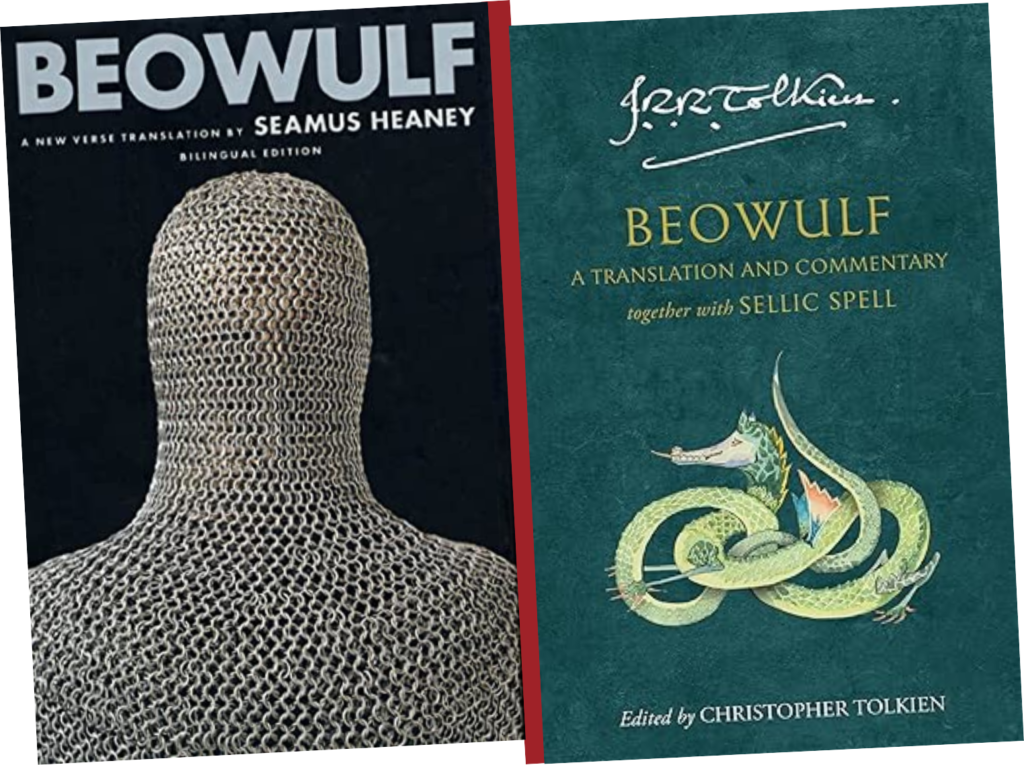
Lecture on Beowulf under the oath’s weather
What, in truth, passes from Beowulf into modern English when a translator bends over the old poem and begins the grave labour of carrying it across. While sense passes, narrative follows, ensuring formula endures. The hard furniture of heroic life survives. Rings bind allegiance. Nearby, benches order the space. Mail-shirts hold their iron. Upon the waves, ships trace the whale-road. Torches light the hall. Waiting for battle, swords rest bearing runes upon their hilts. Pyres consume flesh. Finally, mounds keep the ashes. Yet something else passes too. A fugitive spirit outlasts lexical content. Commanding presence exceeds atmosphere. Dangerous shadows overtake style. A translator carries across a doctrine of memory. He decides whether the poem shall reach the present as a voiced event, lit by the urgency of fresh utterance, or as an inheritance, lifted from an old chest retaining smoke within its grain. My preference for Tolkien over Heaney rises from that distinction. Accuracy alone leaves the matter open. Poetic greatness itself keeps the question pending as well. The true tribunal lies deeper, occupying the inward place housing poetry before its hardening into statement. Cadence begins its secret work there. Words first take form as melodies of thought¹ before submitting themselves to paraphrase.
Seamus Heaney’s translation possesses immense force, bearing tensile clarity as rhythmic confidence enters alongside the lines. An authority of a public voice emerges, demonstrating profound awareness of its own craft. It recognizes its restorative action. Grasping the method, the voice makes the old poem audible in the mouth of modern English. The achievement remains extraordinary. That version brought Beowulf out from behind the glass of specialist reverence and placed it again within the field of common literary hearing. Generations met the poem through Heaney with an intimacy having long seemed remote. Such service carries grandeur. Yet the very quality making the translation so commanding also alters its spiritual texture. Heaney often makes the poem sound as though it knows, with lucid and magnificent confidence, exactly where it is going. Tolkien lets the poem sound as though it has come from farther away than its own sentences can quite contain. Heaney gives speech, whereas Tolkien gives recollection². The former sets the poem before the ear. The latter lets the verses rise within the bones.
The difference appears almost at once. Heaney’s opening, with its famous “So,” strikes like a staff upon a timbered floor³: “So. The Spear-Danes in days gone by / and the kings who ruled them had courage and greatness.” The line comes forward in a strong present tense of address, even while speaking of deep antiquity. It presses ahead. Hovering belongs elsewhere. Permission evades its manner entirely. A hall of listeners gathers at once under that monosyllable. The narrative has already taken the floor. In that respect the translation stands as a triumph of voiced decisiveness. The ancient poem enters modern English as event. It arrives as declaration. Standing firm, the text becomes a public beginning. This confidence of the gesture remains bound to its success. One hears a poet who understands that transmission sometimes requires incision.
Tolkien’s impulse moves by another road. Even where his diction preserves Old English pressure with severe fidelity, the governing instinct remains ceremonious in place of declarative. His Beowulf often feels released instead of commenced. The poem under his hand resembles a thing long held in custody, now laid before the reader with a grave formal courtesy. Christopher Tolkien, when he described the work as an early translation from 1926, distinctive in mode and withheld from print during his father’s lifetime⁴, placed his finger upon more than circumstance. That belated publication almost allegorises the translation itself. One feels in Tolkien’s manner the pressure of decades of inward keeping. The story comes forward, though it also seems to arrive already accompanied by the silence through which it has travelled. Such silence matters. It gives the work a sacramental reserve that Heaney, for all his mastery, leaves aside.
A claim begins there, standing as the first of the new perspectives mattering most to me. Tolkien translates Beowulf as an inherited object before rendering it as a developing action, whereas Heaney prioritizes the developing action before treating the text as an inherited object. The distinction sounds slight when stated so baldly. It proves immense in practice. Under Heaney’s hand, the poem behaves like a performance whose ancientness intensifies the vividness of its present life. Guided by Tolkien’s direction, the work behaves like a relic whose survival intensifies the authority of its speech. One translation acts by arrival, while the counterpart acts through persistence. The former enters the room with lungs full of air. The latter arrives as though carried from a darker chamber before resting upon the table between living hands. The difference exceeds technical bounds, surpassing temperamental limits to establish itself as metaphysical⁵.
That metaphysical difference reveals itself most clearly in the treatment of objects. The world of Beowulf consists of far more than persons executing deeds. Persons matter there, moving among burdened matter. Rings bind allegiance, just as cups order the hall. Lineage travels in swords, while ships bear royal bodies alongside funeral cargo toward an obscure horizon. Hoards lie under stone with memory compacted inside metal. In such a poem the object-world remains entirely consequential. It stores law, gathers grief, absorbs prestige, housing doom simultaneously. Heaney knows this perfectly well, leading his translation to present the item in living functional relation to the action at hand. Tolkien more often presents the object as though it possessed a biography older than the scene in which it appears⁶. Here the emotional temperature shifts: Heaney’s things serve, whereas Tolkien’s things endure.
The sailing passage offers a severe little demonstration. In the excerpt from Tolkien’s translation having become widely cited, one reads lines like these⁷: “On went the hours: on / ocean afloat / under cliff was their craft,” followed by “they hove to the bosom of the bark,” concluding with “valiant-timbered / fleet foam-twisted.” Those phrases matter far beyond archaism. “Bosom of the bark” performs actions far exceeding mere ornamentation of the vessel. Such phrasing makes the ship a bearer. The hull becomes a chamber. The framing acts as a maternal enclosure. “Valiant-timbered” places courage into wood. Timber itself receives ethical charge. Under such diction the world participates in heroic action instead of merely hosting the deed. The ship functions as more than a vehicle alone, having already entered the moral life of the poem.
Heaney, by contrast, sharpens the same sort of passage toward kinetic clarity. The vessel becomes visible in movement, allowing the scene to clear before the eye as motion carries conviction. The reader feels sequence, experiences procedure, witnessing arrival directly. Such lucidity stands as one of the great strengths of the version. Yet the achievement also marks the point where my preference begins. Tolkien translates matter as memory-bearing substance, whereas Heaney renders matter as event-bearing instrument. The phrase may appear severe; I mean it as praise in both directions. Tolkien makes the world itself seem old, while Heaney leaves the world vividly activated. The former deepens elegy, just as the latter heightens drama. A reader whose inward ear forms itself around residue, attunes to witness, seeks liturgical cadence, valuing household objects touched by history, will often incline toward the first method. Another reader, seeking charged public utterance, may incline toward the second⁸.
That relation between poetic temperament and translational preference ought to be admitted with frankness. My reading always claimed to arise from an embodied tribunal. In the prose or poetry closest to my own practice, language arrives heavily burdened by its past instead of stripped for efficiency. A sentence appears weathered by use, carrying parish dust, gathering road grit, housing inherited grief. The line wants to feel occupied by time before it yields its full meaning. Such a poetic discipline will almost inevitably answer to Tolkien with unusual intimacy. His Beowulf lets old verbal matter continue to bear old pressure. Heaney’s version, magnificent though it stands, belongs to another economy. It partakes in the commerce of achieved speech, offering public release, providing lucid enactment, demonstrating mature control. Admiration comes easily there, though inhabitation poses another question entirely. The soul, once formed by certain cadences, frequently seeks a different house from the one the mind praises⁹.
Heaney himself supplied one of the keys to this whole matter. In his introduction he speaks of seeking an “aural antidote,” some word-hoard sunk deep in the Anglo-Saxon bed of English, and he speaks with special relish of “bawn,” the word borrowed from Ulster plantation history and carried into the description of Hrothgar’s enclosure. That choice has often received praise as a brilliant vernacular stroke, establishing its worth immediately. Yet it also performs another act whose full consequence remains only partially measured. “Bawn” achieves results far beyond localising the hall by juridically historicising the structure. The enclosure becomes thinkable through the memory of defended property, evoking border anxiety, projecting enclosed authority, suggesting settlement beneath watchfulness¹⁰. A Scandinavian royal dwelling enters the semantic weather of Irish colonial fortification. The gain stands immense, granting the old poem a fresh circuit of historical echoes, while the cost remains equally real. A portion of Heorot’s estranged sacrality gives way to recognisable social architecture. The hall grows more legible, assuming a far more familiar cast.
This leads toward a second original claim. Heaney’s precision operates procedurally, extending far beyond lexical boundaries. He translates institutions with astonishing intelligence. Rank stands clear under his hand, challenge enters plainly, reception takes definitive shape. Boasting speaks its piece while counsel orders itself. Inheritance appears alongside recompense, allowing legitimacy to settle fully into view. Even where the line sings, one senses the technical mind of a poet who knows how public language organises a world. His Beowulf demonstrates extreme alertness to the machinery of social order. That gift, however, carries a subtle risk. Heroic poetry derives much of its spell from the fact that law there remains incarnate in ritual, lodged deeply in objects, veiled heavily within custom¹¹. Heaney often lets the reader see the mechanism of order at work. Tolkien more often lets the reader feel that order from within the grain of the hall itself. One version explains the functioning of the timbered world, whereas the other permits the timber to continue its brooding.
For that reason I resist the simple statement that Tolkien is more poetic and Heaney more accurate, though I understand the impulse behind it. The matter runs deeper. Heaney commands immense poetics, just as Tolkien achieves fierce exactness. Yet Heaney’s poetry often advances through achieved command, whereas Tolkien’s poetry advances through burdened recurrence. Heaney composes toward disclosure, while Tolkien composes toward re-emergence. A reader feels in Heaney the pressure of a voice mastering difficult material, carrying the substance into memorable public form. Conversely, one feels in Tolkien the pressure of material having already passed through centuries, a weight that now partly masters the voice bearing it. Such mastery by the material itself occurs exceptionally in translation. Where it occurs, a peculiar spiritual authority follows. The text seems older than its own wording. That reality provides one reason Tolkien can feel closer to the “spirit” of the poem even where Heaney may seem more exact in local phrase or more arresting in line-by-line impact¹².
The name for this quality in Tolkien, I propose, remains belatedness. His sentences often arrive as though they had first sounded elsewhere. The line lands, though an after-echo seems already folded inside it. That effect has sometimes been dismissed as stiffness or lateness of style. I hear in it something more serious. Beowulf itself stands as a belated poem. Even at moments of triumph, it looks backward while glancing forward simultaneously. Future ruin lives within the joy of Heorot, just as funeral smoke persists within the strength of Beowulf. The opening praise of Danish kings bears the knowledge that kings vanish. A translation that lets the sentence arrive with a slight delay, almost as an echo of an older utterance, honours that structure of feeling. Tolkien does this instinctively. Heaney, by virtue of his magnificent steadiness, more often lets the sentence stand fully where it intends to stand. In one instance the reader hears the past inside the present, whereas in the counterpart the past becomes luminously present¹³. Both acts matter, though my own ear bends definitively toward the former.
The monsters make the issue harsher. Heaney’s Grendel moves with direct violence. Motion under his rendering appears bodily, remaining fully visible, striking with exactness, pressing hard against the nerves. An audience sees attack as event, hearing every impact clearly. Menace enters a world of exposed flesh. Tolkien tends to render monstrous presence as something broadly ontological instead of strictly forensic. The creature performs actions exceeding mere attacks upon the hall. It rises from an older darkness lying beneath the hall’s claim to order. The difference proves immense. Heaney stages assault, while Tolkien stages eruption. Under the first approach, the monster threatens the social body. Under the second method, the fiend threatens the very confidence by which the social body imagines itself sheltered. That distinction awaits the attention it fully deserves, touching the absolute core of the poem’s vision. Grendel operates as more than mere predator, standing as absolute judgement on human enclosure¹⁴. Tolkien keeps a far greater portion of that judgement alive.
A third new perspective emerges there. Tolkien translates Beowulf as architecture under pressure, whereas Heaney translates the epic as speech under pressure. In Tolkien, the hall feels thickened, the ship gains weight, the threshold broadens, the mere deepens, the barrow settles, the hoard becomes structural within the syntax. In Heaney, a challenge rings out, an answer strikes back, a command holds firm, an exhortation lifts the spirit, a lament draws tears, a report delivers news, a ceremonial greeting carries special brilliance. One can put the matter more plainly. Tolkien hears the poem with the ear of a builder of worlds, while Heaney hears the lines with the ear of a master of voiced relation. Both modes accommodate their counterparts. Each contains its fellow in part. Yet each maintains its own centre of gravity. The centre in Tolkien lies in burdened place, whereas the core in Heaney lies in enacted voice. My preference follows that gravitational difference. The poetry living most deeply in me has always begun from place, drawn upon objects, absorbed inherited pressure, moving toward utterance by necessity¹⁵. Heaney begins more confidently from utterance itself.
A fourth claim demands inclusion, though it will sound paradoxical. Tolkien’s translation proves more poetic than it appears precisely where it withholds lyric display, while Heaney’s translation demonstrates greater technicality than it appears precisely where it achieves lyric ease. Readers often mistake smooth public music for the whole of poetry. Yet verse in a work like Beowulf exceeds immediate musical pleasure alone. It also consists of ceremonial drag, relies upon appositional burden, utilises delayed disclosure, depends on formulaic gravity, maintaining the old roughness by which utterance still carries the grain of oral inheritance. Tolkien often leaves that burden intact, whereas Heaney frequently transforms the weight into modern poise. The transformation shines splendidly, even as it alters the spiritual chemistry of the poem. The old verbal mass grows more agile. The gain stands obviously apparent, while the surrendered element remains subtler¹⁶. The hall becomes brighter, forcing a shade of barrow-dark to recede.
The matter reaches beyond stylistics, directly touching ethics. My earlier lecture on Beowulf insisted upon the poem’s hall-glow always carrying doom-song within its borders, binding gift or expenditure together, forcing the warmth of the hall to count its own dead. Under Tolkien’s manner that troubled doubleness remains embedded in the sentence as weight, whereas under Heaney the duality becomes clearer, growing publicly apprehensible, emerging sharply dramatized. Again the issue concerns spiritual mechanism. Tolkien lets contradiction continue to smoulder inside inherited language, while Heaney clarifies the same contradiction through luminous rendering. One version burdens the conscience by atmosphere. Its counterpart instructs the conscience by vividness. My own poetics, shaped by witness culture alongside the stubborn afterlife of historical hurt in household speech, trusts smouldering pressure far more readily than brilliant disclosure¹⁷.
One sees the difference with especial force in those moments where Beowulf turns from action toward mortality. Heaney’s great strength lies in how fully the line lives when a figure speaks, as counsel steps forward, while warning takes flight, whenever grief sharpens itself into memorable phrase. He understands public eloquence to the roots. His version of the poem frequently resembles a supreme act of literary hospitality, opening the old hall to modern listeners and letting old authority breathe in a present air. Tolkien performs another act. He reopens the chamber in which the hall’s remains have been kept, bypassing mere hospitality. That distinction may seem severe, though it explains why Tolkien’s version can feel more inwardly haunting. Hospitality offers generosity, whereas reopening a chamber invites peril. A poem behaves differently under those diverging conditions.
Hence the dragon section acquires singular importance. Tolkien’s own critical writing on Beowulf had already taught generations to take the beast seriously, framing the monster alongside the hoard as a centre of poetic meaning, displacing any sense of embarrassing folkloric survival. When Tolkien translates the later movement of the poem, the old king appears. The barrow then rises. A cup travels outward from the hoard. The fatal wound opens before the pyre takes its stand. Finally, the mound closes the scene. The entire sequence feels thick with that prior conviction regarding treasure acting as history beneath enchantment. Metal in Tolkien almost always stores time. The dragon keeps compacted ages, hoarding far more than wealth. Heaney comprehends this reality perfectly, though his manner usually drives the narrative with stronger explicitness toward its terminal vision. The old king falls while Wiglaf stands firm. Fire climbs the pyre as the messenger foresees disaster. Such directness achieves magnificence. Tolkien lets those same elements remain heavily immersed in elegiac depth. Heaney compels recognition, just as Tolkien compels haunting.
I return, therefore, to the personal ground of the matter, executing the pivot with strict scruple. Preference always exceeds private taste, just as it continually surpasses pure abstraction. A poet formed by melodies that assemble inwardly before they become argument will recognise in Tolkien a kind of brotherhood. The sentence bears weight, doing far more than telling a tale. The line returns, achieving far more than mere arrival. Such language corresponds to an art taking memory as pressure, accepting objects as witness, treating rhythm as moral event. Heaney corresponds to another art, holding equally noble rank, though differently placed: the art of fully achieved public speech, drawing upon lucid authority, allowing verbal conscience to stand in the open while speaking with clean power. A reader can admire that art deeply while feeling their own grammar of poetry lives elsewhere. That reality forms the truth I wished to keep intact from the beginning. Heaney maintains absolute equivalence in stature. He simply inhabits another law of music.
Perhaps the most exact formulation shapes itself thus: Tolkien preserves Beowulf as heirloom, whereas Heaney secures the epic as performance. An heirloom enters the present carrying awkwardness, gathering dust, showing injury, demanding piety, risking embarrassment, revealing beauty, enforcing inherited obligation. Performance enters the present bringing urgency, displaying finish, projecting gathered force, maintaining conscious relation to an audience. A mind may treasure both modes, just as a spirit might need both. Yet they enter the soul by different doors. The poet in me, with the critic following behind him in slower steps, lives more intimately with the heirloom. I need the line sounding as though it has outlived an era. I trust the sentence arriving heavy with wear. Tolkien gives that quality with a steadiness requiring better description, an oversight stemming partly from the long habit of treating his Beowulf chiefly as a curiosity beside his criticism. The work deserves a far more exact gratitude.
A final image remains. At the poem’s end the Geats raise the mound by the sea. Smoke lifts as treasure enters the earth. Riders circle the barrow carrying words for their dead king. Under Heaney’s touch, the scene stands before the reader with indelible solemn clarity. Under Tolkien’s hand, the ritual seems already half withdrawn into remembrance even as it develops. That reality constitutes the deepest difference between them. Heaney renders event with majestic exactness, while Tolkien renders event as the beginning of memory. One translator leaves the reader before the pyre with eyes open. The opposing practitioner leaves the reader already hearing the wind over the mound generations later. My allegiance lies in that latter space. The spirit of Beowulf represents far more than courage to me, exceeding pure doom, surpassing splendour beneath sentence of death. It embodies survivance beneath heavy burden. Tolkien preserves that burden in the very gait of his English.
The matter may therefore find resolution through a firmness earned by comparison superseding prejudice. What passes across in translation surpasses basic meaning, exceeds mere metre, outstrips philological decorum, transcending even poetic beauty in the ordinary sense. A translator carries across a metaphysics governing how the past stays alive. Heaney’s Beowulf persists as utterance renewed in the bright air of the present, whereas Tolkien’s epic endures as inheritance still warm from long custody. For readers whose own art forms itself around inward melody, draws upon witness, trusts object-memory, valuing the secret labour by which language gathers its soul before mustering its argument, Tolkien will often seem closer to the old poem’s hidden weather. Heaney stands magnificent, while Tolkien feels deeply intimate. The former speaks before me. The latter speaks within me.
Scholia:
¹ J. R. R. Tolkien, Beowulf: A Translation and Commentary, together with Sellic Spell, ed. Christopher Tolkien (London, HarperCollins, 2014). The premise of the essay depends upon a distinction that criticism often gestures toward while leaving under-theorised: translation as transfer of semantic content, and translation as transfer of temporal pressure. Tolkien’s version remains indispensable here, primarily by virtue of its peculiar relation to historical weight. The translator’s prose repeatedly gives the sensation that the poem has endured before it has spoken. That sensation matters for a reader whose poetic practice grows from residue, witness, district, household object, inherited sorrow. A line in such a practice must feel touched by prior lives. Tolkien’s Beowulf often does. Hence the question of “better” dissolves into a harder question concerning the mode by which a poem remains alive.
² Seamus Heaney, Beowulf: A New Verse Translation (London, Faber and Faber, 1999).
³ Seamus Heaney, Beowulf: A New Verse Translation (London, Faber and Faber, 1999), opening lines.
⁴ Christopher Tolkien, ed., Beowulf: A Translation and Commentary, together with Sellic Spell (London, HarperCollins, 2014), introduction. The late publication of Tolkien’s translation matters symbolically even where it carries little direct interpretive force. A work composed in 1926, revised in later years, then released posthumously, arrives already marked by delay. That delay resembles the translation’s inward gait. Belatedness becomes more than flaw; it becomes a mode of being. In literary history, some works enter culture by public intervention; others enter by slow exhumation. Tolkien’s Beowulf belongs to the latter order. It feels recovered through exhumation. Such recovery suits a poem whose own emotional centre lies in retrospection, burial, ruin, aftermath, fame surviving flesh.
⁵ Tom Shippey, J. R. R. Tolkien: Author of the Century (London, HarperCollins, 2000), pp. 20–48. Shippey’s work on Tolkien’s philological imagination helps illuminate why the translation feels less like adaptive modernisation than like custodial transfer. Philology in Tolkien exceeded bare technicality. It carried a moral relation to the endurance of words. That relation is audible in the translation. Where another writer might give priority to momentum or contemporary ease, Tolkien tends to honour the resistant life of inherited diction. My essay extends that insight by arguing that such resistance produces a distinct metaphysics of transmission: the poem reaches the present as something surviving in place of something simply restated.
⁶ John D. Niles, Beowulf: The Poem and Its Tradition (Cambridge, Mass., Harvard University Press, 1983), pp. 128–171.
⁷ J. R. R. Tolkien, Beowulf: A Translation and Commentary, together with Sellic Spell, ed. Christopher Tolkien (London, HarperCollins, 2014), excerpted sailing passage.
⁸ Marcel Mauss, The Gift: The Form and Reason for Exchange in Archaic Societies, trans. W. D. Halls (London, Routledge, 1990), pp. 3–47. My claim concerning the object-world in Tolkien and Heaney grows from a broader conviction about heroic matter. In Beowulf, objects store relation. They carry prestige, debt, continuity, curse, memory. Mauss remains useful here, even though the poem exceeds anthropological model, for he helps restore the spiritual charge of exchange. Rings enter social life as moral actors. Cups bear the same office. Swords continue that burden. Ships complete the pattern. Tolkien’s translation often preserves such weight by giving things a density almost prior to action. Heaney more frequently clarifies their dramatic function within the scene. The distinction may be stated as one between ontological object and procedural object. The first bears history in itself. The second bears action forward.
⁹ Martin Smallridge, The Mills Kept Grinding (Portlaoise, Lyrics Editorial House, 2021), Author’s Note. The present preference becomes intelligible only against the background of a poetics already committed to residue. In that note, language appears as witness-bearing substance, history re-entering the present through altered speech, memory half-concealed in material image. A critic who writes from within such a poetics will inevitably hear translation according to more than accuracy. He will ask whether the line bears time within it. Tolkien answers that need with unusual intimacy. Heaney answers another need: the need for magnificent release into common speech. The difference belongs to inward law, not to a hierarchy of merit.
¹⁰ Seamus Heaney, introduction to Beowulf: A New Verse Translation (London, Faber and Faber, 1999). The word “bawn” deserves more than the familiar praise for local colour. It imports into the poem an entire semantic field of enclosure, defence, plantation history, territorial vigilance, social authority under threat. In doing so, it gives Hrothgar’s hall a new historical legibility for an Irish ear. That legibility is a brilliant gain. Yet it also alters the aura of Heorot. The hall grows more civic, more legally imaginable, more historically situated within a modern vocabulary of defended settlement. Some part of its estranged sacrality yields to that gain. My argument avoids accusing the choice. It measures its cost.
¹¹ John Hill, The Cultural World in Beowulf (Toronto, University of Toronto Press, 1995), pp. 147–178.
¹² Michael Alexander, review of Tolkien’s Beowulf: A Translation and Commentary, The Guardian, 29 May 2014. Responses to Tolkien’s translation often circle around terms such as archaic, rhythmic, accurate, stiff, peculiar, crabbed. Those terms describe surface behaviour while bypassing the central issue of spiritual effect. A translation may feel awkward and yet preserve more of a poem’s burdened temporality than a smoother rendering. It may resist easy praise while entering the inward ear more lastingly. My claim that Tolkien’s material partly masters his voice seeks to name that effect. The poem seems older than the act of translation.
¹³ Fred C. Robinson, The Tomb of Beowulf and Other Essays on Old English (Oxford, Blackwell, 1993), pp. 3–36.
¹⁴ J. R. R. Tolkien, ‘Beowulf: The Monsters and the Critics’, Proceedings of the British Academy, 22 (1936), 245–295. Tolkien’s critical revolution in Beowulf studies lay partly in taking monsters seriously as poetic centres instead of embarrassing debris. That critical stance returns, in altered form, within the translation. My distinction between assault and eruption rests upon that inheritance. Heaney renders the monsters with tremendous bodily force. Tolkien lets them remain tied to the metaphysical instability of human order itself. Grendel attacks bodies in both translations. In Tolkien, that attack also seems to rise from a darkness older than the hall’s confidence.
¹⁵ Kevin Kiernan, Beowulf and the Beowulf Manuscript (Ann Arbor, University of Michigan Press, 1996), pp. 1–58.
¹⁶ Martin Smallridge, Ink Weighs the Soul The distinction between public eloquence and burdened trace has occupied my own prose for some time. A sentence may govern its matter with admirable clarity. Another sentence may continue to bear the pressure of what it cannot wholly order. In relation to Beowulf, Heaney frequently exemplifies the first condition at the highest level of literary power. Tolkien frequently exemplifies the second. Readers formed by archive, testimony, parish speech, legal residue, war memory, familial reticence often trust the latter mode more readily. They seek a line that carries more history than it can comfortably explain.
¹⁷ Martin Smallridge, The Creditor’s Song . The old poem ends where almost every serious meditation upon community must end: at the pyre, at the mound, at the question of what survives the splendid expenditure of life. My reading of Tolkien and Heaney finally turns upon that eschatological pressure. Heaney makes the ending present with noble force. Tolkien lets the ending begin to turn into memory even as it occurs. Event becomes aftermath inside the sentence itself. That is the deepest reason the translation feels nearer to my own grammar of poetry. It does more than represent mortality. It preserves the slow weather by which mortality enters song.