
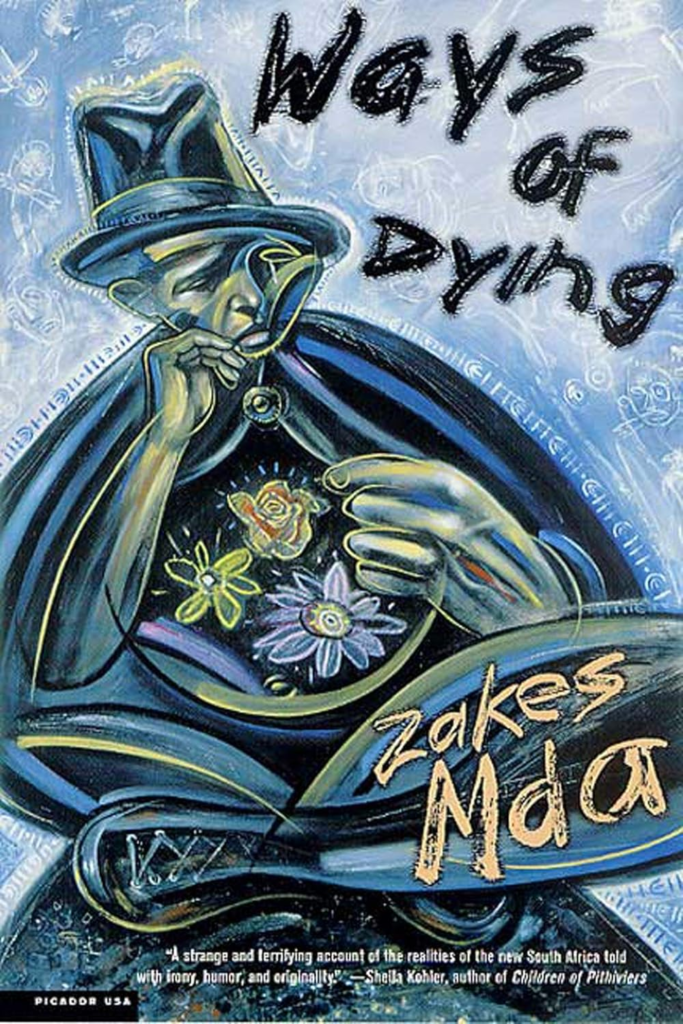
Lecture on Zakes Mda’s Ways of Dying
Rain pressed against the seminar windows as though the sky had wanted a chair among you, while the quadrangle beyond them shone with that Dublin sheen that turns puddles into small black mirrors. Coats steamed by the door, wool carrying its mild animal heat into the room, while your notebooks lay open with the obedient blankness of altar linen. I set a mine headlamp on the desk beside our copy of Ways of Dying, letting the rubber strap settle with a weary curl, for its stiffness had learned years of forehead-salt. The cable, coiled like a tired vein, still remembered the belt battery that once beat warm against a miner’s hip. Scratches on the lens caught the ceiling’s fluorescence, splitting it into thin slivers; those slivers, moving when my hand moved, looked like nervous scripture. A book about mourning beside a tool built for underground breath made an indecent couple, for each demanded a discipline of directed seeing, each carried the cost of that direction. Mda began the novel with a blunt flare—There are many ways of dying!—the sentence carried the heat of a shouted stage line, while it also carried the quiet instruction that grief belongs to streets and kitchens, to hunger and fear, to bodies forced to keep walking after burial.¹
A headlamp binds light to the brow, so attention travels through the neck’s turning; ethics arrives as muscle before it arrives as principle. You watched the object with the caution students keep for props, for a prop drags scholarship down into the hand, where consequence waits with hard nails. Zakes Mda began in theatre before he entered the long corridor of fiction; the novel carries a stage-trained ear for entrances, for breath, for the way a crowd alters a sentence’s temperature. When Toloki names himself Professional Mourner, the phrase arrives as costume and contract at once, for it promises service while it also hints at trade. The reader feels the double edge of dignity that can get bought with coins and courage. A headlamp carries the same refusal of innocence: batteries cost money, straps chafe flesh, light comes through a labour economy that asks bodies to descend into rock. Mda gives Toloki a vocation built from grief and hunger; he refuses to let the reader pretend that grief lives outside economy.²
Outside, a bell in the corridor rang for another class; the sound died quickly, swallowed by carpet and winter air. South Africa’s early transition carried its own strange liturgy, for the state promised renewal in official tones while the street kept producing funerals that demanded immediate rites. The Truth and Reconciliation Commission offered a civic theatre of testimony; the hearing-room, with microphones and cameras, trained citizens to watch pain as public speech, while those same citizens still feared the gunshot that ends debate.³ The country lived inside an interval that historians love to label while households kept counting graves; in such an interval a novel that treats mourning as practice, as work done by bodies in danger, begins to feel less like art placed on a shelf, more like a manual smuggled into the night.
I clicked the headlamp on, and a narrow cone of light landed on the chalkboard, where yesterday’s smears lay beneath today’s clean lines like an older scripture refusing erasure. The beam refused to fill the room, and the refusal carried its own theology: illumination selects. Selection carries a bill. Victor Turner wrote of liminality as threshold-work that remakes social bonds through enacted intensity,⁴ while Mda takes that anthropology into a township lane where the threshold stays permanently ajar. One death calls another. Repetition becomes habit. Habit becomes a kind of civic weather. Toloki enters those thresholds as specialist, while his very presence declares that mourning, when it stays communal, can keep a people from dissolving into solitary panic.
A hush held for the length of a breath.
Rain kept writing its thin handwriting on glass. The radiator ticked on with the patience of any parish clock.
When the beam crossed the page, the letters looked raised, as though each sentence carried grit under its nails. Mda’s prose keeps the texture of the ordinary close; that closeness honours Njabulo S. Ndebele’s insistence that the ordinary, once attended to, carries politics in its smallest gestures.⁵ A coffin sits among plastic chairs while paraffin smell drifts through a hymn, so that grief shares air with domestic labour; the scene refuses any separation between private pain and public struggle. Toloki’s theatrical mourning, with its stylised voice and deliberate posture, takes place amid such ordinary clutter. The clutter matters, for it resists the temptation to convert grief into pure symbol. The dead lie among the living’s petty needs; those petty needs keep interrupting the liturgy, so that community healing arrives as consequence of bodies continuing to eat, cough, quarrel, flirt, carry water.
Aoife, near the radiator, lifted her hand with the brave caution of someone who fears sentimentality.
—So he sold sorrow, sir?—she asked, while her pen hovered above the margin like a bird refusing a branch.
Her question deserved an answer given under imperfect light, for perfect light flatters certainty. I spoke of a wake in County Laois, where a rosary clicked like a small machine of time, where a neighbour, a man whose hands had learned spades and silence, began keening until the kitchen opened like a wound receiving air. The sound carried mercy, for grief voiced aloud taught strangers how to breathe together. Meanwhile the kettle kept boiling, tea kept arriving in chipped cups, and the dead lay in the next room as though they had listened. That keening belonged to performance and necessity, for a community sometimes needs a voiced grief to give permission for everyone else to feel what they fear to feel alone. The same logic governs Toloki’s work: he performs sorrow so the crowd can share it, and the obligation keeps bodies together when language fails.⁶ Toloki’s profession, seen through that lens, appears less as cynical commerce, more as a survival craft learned in a city where death arrives too often for private refinement.
The headlamp on my desk began doing its deeper work then, for its strap, shaped by years of pressure, forced my mind toward a detail in Mda that critical habit tends to treat as costume and colour. The novel keeps returning to the head, to what binds the forehead, to small architectures that hold a self together so a self can face the crowd. Toloki’s hat presses identity onto the skull like a crown fashioned from scarcity, while Noria’s scarf, tightened for labour and public mourning, holds her face steady when the day tries to break her. Children wrap cloth around brows during games that mimic soldiering and funerals alike; the play reveals how quickly ritual and violence share technique. The overlooked machinery here feels uncomfortable: community healing depends on constriction. The head carries the sign. The sign steadies the body. The steadied body can stand among the dead and keep breathing. That same steadying disciplines the wearer into role. Toloki’s hat behaves like a gentle shackle, and the novel keeps tightening that strap until the reader begins to sense the ethical price of coherence.⁷
A headlamp offers a theology of attention that matches the pattern. Light fastened to the forehead makes the bearer into a moving interrogator of darkness, so looking behaves as obligation carried in muscle. A funeral in Ways of Dying grants a parallel permission and obligation: people look at one another openly, grief sanctifies the gaze, the corpse authorises attention that might otherwise feel like intrusion. Such attention becomes care when hunger grows visible or a child near danger gets noticed, while the same attention can drift toward control when the crowd learns to read bodies as suspects. Mda turns post-apartheid grief into lived argument by forcing the reader to feel this double function in the gut, for the reader begins to crave the community’s protection while also sensing the discipline hidden inside the protection.
Richard Schechner described restored behaviour as framed repetition through which a group recognises itself,⁸ while Mda’s funerals depend on that frame. A mourner’s wail arrives at a socially legible pitch. A hymn begins where bodies expect it. A movement of the crowd signals safety to those who understand the code. The frame protects, for it gives fear a shape, gives grief a route through bodies. The same frame can also train a people to expect death as the day’s punctuation, for repetition, once sanctified, can become addictive. An audience can begin to require tragedy in order to feel communal. Mda keeps a playwright’s discipline here, allowing humour to cut through lament, while he also allows lament to return and thicken, for laughter alone would betray the dead, pure solemnity would betray the living who must keep trading and cooking after burial.
Mda’s earlier account of theatre as development communication insisted that a community learns through staged play when the stage belongs to its own bodies; that insistence bleeds into the novel’s funerals, where knowledge arrives as embodied rehearsal.⁹ A mother, fearing humiliation, accepts a bowl only after the giver bends low, for posture can save dignity. A man whose stomach has ruled his day finds that coins matter less than the eyes that meet his, for shame retreats when the gaze carries respect. A child, copying adults in the dust, discovers that a hymn can close ranks around a coffin, so the hymn becomes a wall. Such learning unfolds while Toloki moves among them, for his costume announces permission to feel, permission to endure.
Noria’s labour reveals another face of the argument. Her care functions as survival art, for it turns scarcity into refuge through daily practice, while her days tighten around other people’s needs until exhaustion becomes a second skin. Mda presents her actions through gesture—water carried, shelter offered, children gathered—so the reader feels ethics as work performed by hands. A reader may wish to place Noria on a pedestal, yet the headlamp insists on a harsher recognition: communal healing depends on people whose strength gets spent without applause. In such spending, the sacred appears as consequence: the bread shared, the roof mended, the child kept alive long enough to grow into a different day.
The lamp’s battery weakened while I spoke; the beam thinned, flickered, recovered, then thinned again, as though the object wished to teach fatigue as theology. A tool of light belongs to time, and time drains it, while each dimming forces a bargain between what gets seen and what stays half-hidden. When the beam falters, the room’s corners grow bold, the mind invents shapes there, so that fear makes its own theatre in the dark.
Achille Mbembe’s meditation on necropolitics names a power that governs through exposure to death,¹⁰ while Mda’s unnamed city breathes that governance whenever a child becomes fuel for politics and the street accepts the smoke as ordinary weather. Tenderness persists, yet tenderness carries bruises, for every funeral gathers bodies that might scatter into panic if the chorus breaks. Song can shelter, even while the same chorus can harden into threat; the novel keeps that double edge close to the throat.
Judith Butler wrote of grief as disclosure of precariousness, of how mourning reveals our exposure to one another,¹¹ while Mda turns that claim into lived pressure by showing how a hand on a shoulder changes a street’s moral temperature. Exposure, though, requires a frame if it hopes to endure; that frame appears in the novel’s repeated head-bindings. A scarf tied tight holds a face steady for public sorrow, while a hat worn as vocation steadies a man who fears collapse. The very act of steadying disciplines the wearer into role until the role begins to demand performance even when the soul longs for quiet.
Mark Sanders argued that ethical life in South Africa unfolds through complicity, through relation that carries risk and contamination,¹² while Toloki embodies that condition, for he serves the community while he draws his livelihood from death’s recurrence. His sincerity, practised daily, risks blending with technique until the difference grows difficult to feel, and the novel treats that risk with tenderness edged by satire. Toloki’s dignity arrives as both gift and performance; the performance becomes a social instrument that can heal, even while it can tempt the crowd into consuming grief as spectacle.
Toloki’s father, in his hunger for respectability, behaves as a minor theologian of shame. He teaches that the body must present itself as acceptable to deserve survival. The lesson carries cruelty that looks ordinary, for it hides inside advice about shoes and posture. Toloki’s later costume, though it serves as resistance, repeats the premise: appearance governs belonging. When Toloki mourns, he wears his role upon his head, and the community reads him through that sign, which means that grief, even in sincerity, moves through a system of visible markers that can turn humans into functions.
The economy behind that system reaches deep. Francis Wilson chronicled the South African gold mines’ labour regime with detail that reveals how extraction reorganised lives across decades, shaping cities through remittances, through absences, through crowded settlements at the edges of legality.¹³ A headlamp belongs to that world, its strap marks the body as surely as any uniform. Dunbar Moodie traced the masculine disciplines of mine labour, showing how compound life and danger and ritualised toughness formed a moral culture that travelled above ground with the workers.¹⁴
Piotr, near the door, asked whether forgiveness lives inside the book, his voice carried sea-salt and fatigue, as though the question had followed him from another room.
—Does Mda allow forgiveness, sir?—he asked, while his fingers pressed the desk’s edge as if he had sought proof of wood.
I answered through gesture, for Mda answers through gesture. Noria fed a child who had wandered toward danger, and the act functioned as mercy without rhetoric. Neighbours opened a shack to someone fleeing violence, and the door’s creak carried a kind of absolution. Toloki mourned someone whose politics would repel him, and the mourning worked as discipline, for discipline can keep a soul from hardening into revenge. Anger remains present, treated with respect, for anger keeps the living awake. The novel grants anger its rightful heat while it refuses to let heat consume the whole horizon.
Sarah Nuttall describes post-apartheid life through entanglement, through histories touching in awkward intimacy,¹⁵ while Ways of Dying enacts that condition through ritual, which pulls strangers into shared space, forces negotiation. The headlamp reading exposes a sting inside that braid: entanglement requires watching. People must look at one another long enough to recognise pain. Recognition becomes care, while recognition can also become discipline. Ritual sanctifies watching, granting permission to stare; the stare can heal while it can also police.
I turned then toward God, for grief calls heaven into any room as weather, as pressure, as question held behind the ribs. Psalm 130 begins in depths—de profundis clamavi ad te, Domine—and its endurance arises from the way it speaks from a place where breath fights for meaning.¹⁶ Toloki’s mourning carries a similar reaching, while his reaching stays communal: he mourns aloud so others can mourn, he performs grief so grief can travel through bodies that have forgotten speech. A sacred atmosphere appears by consequence, through shared breath, through a chorus held long enough to keep despair from taking the room.
Antjie Krog, listening within the Commission’s hearings, showed how public testimony strains language, for trauma presses against syntax until words begin to crack.¹⁷ Mda answers that strain with another kind of language, a language of gesture and repetition, where a song can carry what prose refuses to hold. The funerals in Ways of Dying carry comedy and grotesque tenderness, yet they also carry theological pressure, for each burial asks whether any community can endure so much loss without turning the heart into stone.
Consider one small moment that readers often pass over as though it served merely as flavour: Toloki adjusting his hat before he enters the space of mourning, while his fingers, careful as those of a sacristan, smooth the brim, settle the cloth as if he had been sealing a vow. Mda describes the outfit with a comic tenderness that keeps dignity and absurdity in the same breath. The prose allows a brief fragment to ring like a stage direction: Professional Mourner appears less as title than as pressure upon the skull.¹⁸ When the head carries the sign, the body receives permission to feel in public, while the same sign invites the crowd to read the wearer as function. A miner’s headlamp performs a parallel operation, for the strap tightens around flesh in order to keep the beam steady. The steady beam tempts the bearer into believing that whatever falls outside the cone carries less claim upon conscience. Mda’s funerals resist that temptation by letting the margins speak: a child’s hunger enters the hymn, a woman’s anger interrupts the prayer, a flirtation sparks beside a coffin. The scene forces the reader to admit that grief lives among other appetites. Yet the head-binding motif reveals the cost of such admission, for a community that survives by ritualised looking learns to strap attention to the forehead. Strapped attention can turn toward mercy while it can also drift toward control. The discomfort grows sharper when one remembers that the post-apartheid state had promised visibility to the unseen, for visibility, once achieved, always arrives with the question of who controls the lamp.
When the lamp clicked off as my sentence ended, the room held darkness with a calm that surprised me, as though you had learned, for an hour, to inhabit shadow without panic. Chairs scraped. Pens capped. Breath settled. The headlamp remained on the desk, blind again, yet witness all the same, for a tool remembers its service in the way it sits, its silence carries the echo of work.
An uncountably shaped end gathered when I admitted my own entanglement. A writer speaking of township funerals in an Irish library risks turning pain into aesthetic commodity as easily as Toloki risks turning grief into livelihood, and the risk demands vigilance that feels like prayer offered through clenched teeth. The headlamp resists that drift by demanding consequence, for batteries drain while straps chafe, the beam selects even while darkness persists. Mda turns post-apartheid grief into lived argument by forcing ritual and theatre to meet survival, while he lets communal healing arrive as consequence of work performed by weary hands. The head-binding motif, once seen as mere dress, reveals a harsher metaphysical engine: community coheres through shared constriction, for roles tighten around the head so minds can endure. The very tightening trains a gaze that hovers between mercy and discipline. When you leave this room, your own beam will follow your neck’s turning, the novel will keep asking which grief you will illuminate, which grief you will leave to gather strength in the dark, even while the day outside keeps raining its lessons into your sleeves.¹⁹
Scholia:
1 Zakes Mda, Ways of Dying, Oxford University Press Southern Africa, Cape Town, 1995, pp. 1–12.
2 Mda, Ways of Dying, op. cit., pp. 13–30.
3 Truth and Reconciliation Commission of South Africa, Truth and Reconciliation Commission of South Africa Report, Juta, Cape Town, 1998, Vol. 1, pp. 1–38.
4 Victor Turner, The Ritual Process: Structure and Anti-Structure, Aldine Publishing Company, Chicago, 1969, pp. 94–130.
5 Njabulo S. Ndebele, Rediscovery of the Ordinary: Essays on South African Literature and Culture, University of KwaZulu-Natal Press, Pietermaritzburg, 2006, pp. 37–57.
6 Weeping and keening in Irish wake practice offers a comparative frame for communal grief as performance. Lawrence J. Taylor, Occasions of Faith: An Anthropology of Irish Catholics, University of Pennsylvania Press, Philadelphia, 1995, pp. 157–182.
7 Mda, Ways of Dying, op. cit., pp. 31–52.
8 Richard Schechner, Performance Theory, Routledge, New York, 1988, pp. 28–55.
9 Zakes Mda, When People Play People: Development Communication through Theatre, Zed Books, London, 1993, pp. 1–64.
10 Achille Mbembe, “Necropolitics,” trans. Libby Meintjes, Public Culture, Duke University Press, Durham, 2003, 15:1, pp. 11–40.
11 Judith Butler, Precarious Life: The Powers of Mourning and Violence, Verso, London, 2004, pp. 19–49.
12 Mark Sanders, Complicities: The Intellectual and Apartheid, Duke University Press, Durham, 2002, pp. 1–29.
13 Francis Wilson, Labour in the South African Gold Mines 1911–1969, Cambridge University Press, Cambridge, 1972, pp. 1–44.
14 Moodie’s account of mine masculinity and compound discipline clarifies how tools such as cap lamps entered moral life as much as industrial routine. T. Dunbar Moodie, Going for Gold: Men, Mines, and Migration, University of California Press, Berkeley, 1994, pp. 65–104.
15 Sarah Nuttall, Entanglement: Literary and Cultural Reflections on Post-Apartheid, Wits University Press, Johannesburg, 2009, pp. 1–25.
16 The Holy Bible: Douay-Rheims Version, trans. from the Latin Vulgate, Baronius Press, London, 2007, Psalm 129–130, pp. 885–886.
17 Krog’s genre-crossing record of the Commission reveals how witness speech becomes a kind of national performance, while it also reveals the strain placed on language under pressure. Antjie Krog, Country of My Skull, Random House, Johannesburg, 1998, pp. 1–52.
18 Mda, Ways of Dying, op. cit., pp. 53–92.
19 The headlamp, treated as witness-object, frames an ethics of directed seeing that helps read Mda’s communal healing as consequence of attention under constraint. Mda, Ways of Dying, op. cit., pp. 93–124.