
Published +00:00
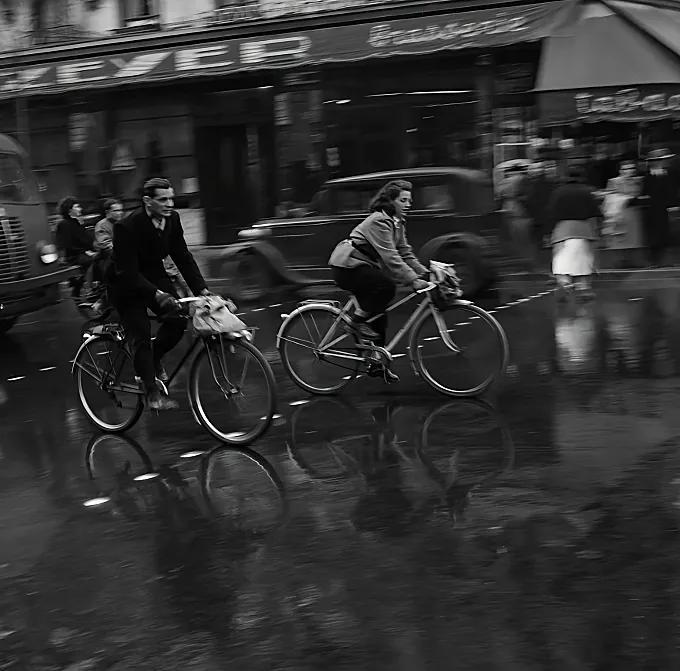
What does Molloy’s green bicycle know about the novel form once movement persists through jolts whose interruption gives travelling its measure? Beside my copy of Samuel Beckett’s Molloy, I place that question much as I might set a bent tool upon a workbench, turning it beneath the lamp until wear begins to explain design, for the bicycle enters as transport before repeated handling changes its status, making the machine an intimate gauge of Molloy’s weakening frame. Across each revolution its wheels promise distance while carrying him through detours whose recurrence gives recollection the circular rhythm of mechanical turning. From such friction Beckett draws the formal mastery that gives the book its peculiar authority: impeded motion becomes narrative advance once consciousness discovers its gait through physical resistance, leaving fiction able to travel after destination has surrendered command.
Molloy’s Irish residue strengthens that physical ethic. Ireland enters through remembered habit as the mother’s room leads into a provincial road where religious traces mingle with official authority, while domestic embarrassment acquires the cadence of speech remembered across linguistic distance. C. J. Ackerley with S. E. Gontarski have demonstrated the density of Beckett’s cultural memory, where Biblical fragments meet Dante before Dublin experience or school learning returns through local idiom carried into later writing.¹⁰ I approach those deposits as peat cut from differing depths, each stratum carrying another age beneath the spade. Beneath a modern French sentence an Irish road can remain firm enough to shape the footfall, while translation changes the upper surface as older ground keeps its give.
Halfway through Molloy, the book turns its weight. Jacques Moran takes the voice, receives an assignment through Gaber from the remote Youdi, then prepares to seek Molloy, bringing to the journey a household whose timetable expresses hierarchy through command. Such regulation gives Moran a different gait from Molloy. Andrew Kennedy’s reading of the first narrative as a sustained quest helps clarify the cunning of this second movement, where the apparent pursuer gradually acquires features associated with his quarry.¹¹ One man begins amid wandering disorder while another departs from domestic control; the road draws each figure into related forms whose resemblance grows through injury until fatigue makes dependence legible in both. Moran’s son bears part of the cost, for paternal authority speaks through commands while dependence gathers beneath those commands, making mastery increasingly fragile in practice. During travel, food becomes negotiation as discipline meets fatigue, leaving each decision to require another person’s labour before obedience can assume physical form. A man accustomed to directing his son discovers his own flesh changing the terms under which command operates. Here Beckett’s cruelty works through consequence more strongly than spectacle, for mastery survives in the mouth after the legs have begun teaching another doctrine.
The connection between Molloy with Moran tempts a reader into solving identity as a puzzle, yet I find greater value in the formal relation between them. Beneath each mission, its object keeps receding while both narrators write after the fact, their changing bodies reducing ease of movement as each mind tries to convert lived disorder into sentences. James H. Reid’s work on Beckett’s relation to Proust places forgetting beside invention within the irony of such first-person narration.¹² Memory therefore functions less like a storehouse than weather moving through flesh, for a remembered event arrives altered by the act that retrieves it. Through revision identity acquires shape, taking form as language repeatedly touches experience from another angle.
Such revision governs Moran’s report with ferocious economy. His section opens through an assertion of midnight rain, while the long expedition eventually carries him back to the house before writing returns him to the opening sentence itself; a closing correction changes the clock before clearing the window, thereby repositioning the remembered scene. Through that return, the circular structure reaches its starting point while the starting point changes status beneath the reader’s eye. Beckett turns the frame into evidence, allowing fiction to reveal its own procedure through a correction embedded inside the fiction. Here I locate one of Molloy’s finest formal achievements. A merely decorative circular structure would offer completion through the satisfying click of a latch finding its catch, whereas Beckett’s circle behaves more like a wheel on loose ground, whose returning spoke accompanies a vehicle already resting upon altered earth. Moran writes the line that began his narrative before revising its factual claim. Carrying the preceding pages through that revision, the reader receives every earlier assertion at a freshly altered angle even as the report survives through the act already performed. John Bolin’s account of Moran’s guarded relation to ‘literature’ sharpens the point, for Beckett lets narration distrust familiar literary satisfactions while continuing to produce them with extraordinary control.¹³ The English Molloy deepens that instability through translation. Beckett worked with Patrick Bowles on the English version, while later scholarship has treated Beckett’s bilingual prose as writing changed through linguistic passage, where a primary text acquires another verbal life through deliberate revision. Waqas Mirza’s study of the trilogy traces shifts in pronouns beside alterations in syntax, while verbs of mental activity alter with clause order across the two languages.¹⁴ Such variation belongs directly to my bicycle question, for translation resembles another revolution of the wheel: the text returns bearing the same title, yet its contact with language falls upon a fresh patch of road.
Manuscript study makes that motion physical. The genetic record reconstructed by Dirk Van Hulle, Pim Verhulst, Edouard Magessa O’Reilly follows French drafts through notebooks into English translation material before publication history fixes another stage of the work’s life, showing a novel that acquired form through successive acts of writing.¹⁵ For the same reason I value the stones, such evidence carries weight through contact. Revision leaves marks upon paper where crossings-out meet substitutions before phrases shift position under the labour of a hand, much as pebbles migrate through pockets while wheels mark roads. Beckett’s abstraction therefore grows from handled substance, each alteration retaining the trace of contact that brought the sentence into its present shape.
Comedy guards the prose from hardening into a sermon on diminishment. Molloy’s calculations enter his relations with objects while Moran’s officious habits turn minor procedures into absurd ceremonies, creating laughter where philosophical exposition might acquire too rigid a face. Georges Bataille’s early response recognised the strange conjunction between degradation with splendour in Molloy, reading exposure to cold as a return to elementary reality where hunger enters through the stomach before earth reaches the hand.¹⁶ I would add that comedy provides the joint permitting such confrontation to move, for the joke bends where doctrine hardens, keeping thought pliant enough to follow the damaged figure across the ground.
For this reason the book’s formal mastery lives less in austerity than in exact expenditure. Beckett spends immense verbal energy upon a stone before turning to a journey or report, while the bicycle gathers philosophical force through mechanics that already seem doubtful. His prose can extend a minor practical difficulty until mathematics touches memory while appetite enters agency, after which a coarse joke brings speculation back to earth. Philosophical height repeatedly meets the hand, allowing abstraction to receive correction from weight. I find the pattern humane through its chosen scale, as intelligence enters the common object while remaining answerable to friction with fatigue.
The first position in the trilogy therefore carries structural meaning beyond publication order. Molloy retains the road beneath its bicycle while woodland closes around houses where officials turn errands into trials, giving encountered things enough weight to interrupt thought. Malone meurt draws motion closer to the bed, then L’Innommable pushes farther into the conditions from which voice issues. Across that descent, Molloy preserves the richest zone of contact between locomotion with narration. Its figures retain enough reach to cross ground painfully, while the heft of encountered objects keeps philosophy answerable to touch; the wheel continues turning here before later prose carries reduction farther.
I return, then, to the green bicycle on my workbench of thought. What does it know about the novel form once movement survives through jolts whose interruption gives travelling its measure? Its answer lies in the work already performed: forward passage arises from circles when resistance gives motion shape, while limitation generates form once a compromised gait teaches syntax another measure; through prolonged handling, an ordinary object opens philosophical inquiry beyond the reach of abstraction alone. I keep Molloy among the fifteen for that reason, for Beckett makes the novel move by giving motion resistance. Beneath the turning wheel, the road answers.
Scholia:
1. Samuel Beckett, Molloy (Paris: Les Éditions de Minuit, 1951); Samuel Beckett, Molloy, trans. Samuel Beckett with Patrick Bowles (New York: Grove Press, 1955). In my reading, both publication events remain visible, for the French book came first while the English version entered print four years later through Beckett’s collaboration with Bowles. Library records confirm the 1951 Minuit edition beside the 1955 English publication while also recording Bowles’s role. Through that sequence the book’s form acquires further depth: Molloy already treats narration as repeated passage through altered conditions, so its movement from French into English belongs to the work’s history at more than bibliographical level. Each language gives the narrator a related yet separately weighted gait. Across close examination of both primary texts, the publication record keeps the English prose visible as a second act of writing whose differences retain literary force.
2. Andrew K. Kennedy, Samuel Beckett (Cambridge: Cambridge University Press, 1989), esp. discussion of the prose sequence; Dirk Van Hulle, ‘Samuel Beckett, Molloy, Malone Dies, L’Innommable (1951–1958)’, in Christoph Reinfandt, ed., Handbook of the English Novel of the Twentieth and Twenty-First Centuries (Berlin: De Gruyter, 2017), pp. 252–267. Established critical practice gives me the term ‘trilogy’, while the historical character of that label remains loose enough to preserve the individuality of each book. Through Van Hulle I read the three novels as closely related works whose bilingual history strengthens their formal kinship, whereas Kennedy allows me to trace progressive reduction of story beside dwindling resources available to the narrating self. From those arguments Molloy emerges in a distinctive opening position within the sequence. External travel retains exceptional reach there as physical contact remains comparatively abundant, while inherited quest-material stays active even as Beckett bends it into a harsher form.
3. James Knowlson, Damned to Fame: The Life of Samuel Beckett (London: Bloomsbury, 1996), pp. 300–380. For the wartime record surrounding Beckett’s Resistance service, flight from Paris, years near Roussillon, work at Saint-Lô, return to Paris, then concentrated post-war writing, I return to Knowlson. My use of that history stays deliberately close to physical habits of perception. Converting wartime event directly into fictional code would flatten Beckett’s prose into disguised testimony, whereas the biographical record gives firmer support for an attention shaped by concealment whose routines alter waiting before physical endurance changes the meaning of travel. Beckett’s later account of his artistic turn also belongs here, especially his sense that his own path required reduction after Joyce’s expansive example. Within my reading biography therefore rests beside the fiction as historical weight, giving density to whatever room or road the post-war narrator must cross.
4. José Francisco Fernández, Mar Garre García, eds., Samuel Beckett and Translation (Edinburgh: Edinburgh University Press, 2021), pp. 1–18; Waqas Mirza, ‘The Self-Translation of the Representation of the Mind in Samuel Beckett’s Trilogy’, in Fernández, Garre García, eds., Samuel Beckett and Translation, pp. 55–74. Within the French opening, Molloy’s claim upon his own beginning reaches me as a declaration whose intimacy acquires force from the surrounding machinery of payment with correction. Mirza’s study lets me follow both linguistic versions as active textual forms by tracing shifts in pronouns beside syntactic adjustment, while mental verbs alter under reordered clauses. Such scholarship proves especially useful for Molloy, where ownership of speech repeatedly passes among narrator, visitor, report, remembered scene. Translation gives another agency to that movement. Across the English version Beckett’s authority remains active while Bowles’s collaboration gives transmission a visible second hand, helping explain why the later prose carries its own cadence as a distinct literary performance.
5. Andrew K. Kennedy, ‘Molloy’, in Samuel Beckett (Cambridge: Cambridge University Press, 1989), later online edition, Cambridge Core, 2010. From Kennedy’s treatment of Molloy’s quest for his mother I take chiefly the distinction between laborious physical travel with lively narrative motion. That distinction gives the green bicycle its critical value for me. Circular wheel-motion produces passage while physical impairment produces verbal invention, leaving destination secondary to the gait by which the traveller approaches it. Kennedy’s account therefore strengthens my sense that Beckett’s formal severity carries comic velocity within it, for the damaged traveller continues to generate language precisely where locomotion becomes hardest. Through one handled machine the bicycle condenses that relation, allowing mechanics to teach the narrative its peculiar rhythm.
6. Daniel Katz, ‘Beckett’s Measures: Principles of Pleasure in Molloy and “First Love”’, Modern Fiction Studies, 49.2 (Summer 2003), pp. 246–260. From Katz I take the insistence that measuring in Beckett forms part of literary action itself, extending beyond description of a world already ordered. His discussion of the sixteen sucking-stones gives a firm base for my reading of the episode as physical thought. Four pockets holding sixteen stones establish arithmetic, yet mouth with coat keeps calculation attached to flesh once appetite makes memory serve transfer. Every attempted solution produces another condition requiring handling. For me, comedy grows from the disproportional relation between apparatus with appetite, while formal interest comes from repetition carrying minute alteration. Through this scene thought becomes manual labour, an idea Beckett leaves against the tongue with the mineral chill of the pebble itself.
7. William Davies, ‘Samuel Beckett’s Trilogy and the Revolution of the Body in Vichy France’, Twentieth Century Literature, 66.1 (March 2020), pp. 11–36. Davies gives me the historical relation between the trilogy’s degenerating male forms with Vichy ideology, especially its public cult of masculine fitness as productive health. From that context Molloy’s gait acquires a political edge. Beckett’s cyclist becomes a limper before crutches give way to crawling, placing narrative centrality upon a male figure far removed from the state’s preferred image of useful strength. Historical context enlarges the ethical force of that figure while his literary meaning continues through age or pain into agency expressed by comic persistence. Across my reading the damaged traveller stays concrete, moving through actual roads whose resistance gives political history contact with the flesh that bears it.
8. Arnold Geulincx, Ethics: With Samuel Beckett’s Notes, ed. Han van Ruler, Anthony Uhlmann, Martin A. Wilson, trans. Martin A. Wilson (Leiden: Brill, 2006), 360 pp.; Patrick Armstrong, ‘Going through the motions: natural science and movement in Samuel Beckett’s trilogy’, Textual Practice, 36.11 (2022), pp. 1932–1954. Beckett’s documented engagement with Geulincx gives philosophical depth to the recurrent problem of agency where intention meets motion. Armstrong widens that field through natural science, where atomism permits patterns of swerving or circular travel to enter the discussion. Bringing both studies back to the bicycle keeps philosophy close to mechanism. Molloy’s machine turns agency into distributed action, for desire enters muscle before stiffness meets wheel, then road answers through resistance. Through that relation I find a model for Beckett’s larger procedure: thought descends into physical contact, where intention gains meaning through what happens once flesh meets the world.
9. John Bolin, ‘Beckett’s Critique of Literature’, in Jean-Michel Rabaté, ed., The New Samuel Beckett Studies (Cambridge: Cambridge University Press, 2019), pp. 87–102. Bolin’s reading of Moran’s guarded relation to ‘literature’ gives me a key to Beckett’s wary engagement with explanatory narrative pleasure. Moran writes, corrects, withholds causal clarity, yet his prose continues to generate comedy before suspense settles into formal recurrence. Through that contradiction I read the closing revision of the midnight rain as more than a technical flourish. The report exposes its fictional procedure while retaining literary force. Beckett thereby converts suspicion of literature into prose of remarkable precision, letting doubt become a resistance through which narration gains movement. For me, the device returns again to the bicycle: friction gives the wheel purchase on the road, permitting motion through the same contact that limits ease.
10. C. J. Ackerley, S. E. Gontarski, The Grove Companion to Samuel Beckett: A Reader’s Guide to His Work, Life, and Thought (New York: Grove Press, 2004), pp. 1–686. Across its dense record of Beckett’s cultural references, I find support for reading Irish memory with philosophy as deposits carried within the prose.
11. Andrew K. Kennedy, Samuel Beckett (Cambridge: Cambridge University Press, 1989), pp. 100–140. Kennedy’s treatment of diminished narrative resources supports my reading of the two-part structure as a relation between changing bodies whose quests alter with their narrative voices.
12. James H. Reid, Proust, Beckett, and Narration (Cambridge: Cambridge University Press, 2003), pp. 79–98. Reid’s account of forgetting with invention allows me to treat Molloy’s memory as an active rhetorical process whose retrieval reshapes whatever it brings back.
13. Ruby Cohn, ‘Samuel Beckett Self-Translator’, PMLA, 76.5 (December 1961), pp. 613–621. Cohn’s early account provides an important historical basis for my reading of translation as a central part of Beckett’s literary labour.
14. Pim Verhulst, Dirk Van Hulle, Edouard Magessa O’Reilly, The Making of Samuel Beckett’s “Molloy” (London: Bloomsbury Academic, 2017). Through this genetic study I follow composition into manuscript development before translation gives each revision a recoverable physical history.
15. Pascale Casanova, Samuel Beckett: Anatomy of a Literary Revolution, trans. Gregory Elliott (London: Verso, 2006), 119 pp. Casanova’s emphasis on literary autonomy helps me place Beckett’s reduction of inherited fictional resources inside a sustained aesthetic project governed by deliberate formal choice.
16. Georges Bataille, ‘Molloy’s Silence’, in S. E. Gontarski, ed., On Beckett: Essays and Criticism (London: Anthem Press, 2012), pp. 103–110. From Bataille’s early response I take the weight he gives to degradation beside earth, with hunger carrying comic splendour into a book that resisted easy critical domestication from the beginning.