Published +00:00
What kind of formal rebellion occurs when a novel breaks its own clock, gives its characters the key to the works, then closes by placing a second-hand wristwatch in a student’s palm? Keeping that wristwatch¹ at the centre of my reading of Flann O’Brien’s At Swim-Two-Birds, I feel fiction pass through the hand like an object already worn by somebody else, its glass scratched while an inherited mechanism carries former owners inside every tick. Across the volume, narrative passes from mouth to mouth as earlier tales enter fresh speech, literary figures migrate between authors, medieval verse reaches a Dublin lodging-house, while writers discover that their creations possess appetites extending beyond assigned pages. Within such exchanges, authority acquires the temporary tenure of a hotel room whose occupant knows another key already circulates downstairs. By treating literary form as possession liable to seizure, O’Brien turns comic disorder into an inquiry concerning who owns a story once language begins to move beneath another hand. When the student receives that used watch near the close, social time returns through examination success before family approval opens a path into respectable adulthood. From its worn case I read the governing proposition: At Swim-Two-Birds rebels against inherited novelistic sovereignty by converting authorship into contested custody.
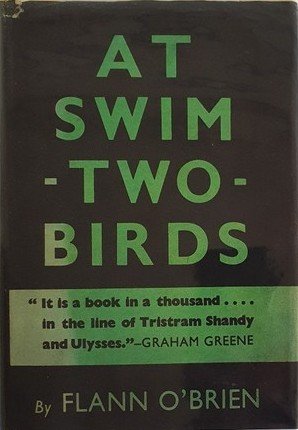
Published by Longmans, Green in March 1939,² the volume arrived at an Irish threshold crowded with literary ghosts whose presence gave formal experiment immediate historical weight. W. B. Yeats had died weeks earlier; James Joyce’s Finnegans Wake would reach print during that spring, while European war approached through headlines beside Dublin routines shaped by buses, public houses, university lectures, rented rooms, clerical employment. Graham Greene, reading for Longmans, supported publication through the ordinary commerce that carried O’Brien’s strange machine from manuscript into print. Initial sales reached only a few hundred copies, while surviving stock later met wartime fire in London, giving the first edition a material fate peculiarly suited to a work preoccupied with circulation followed by destruction, then recurrence. Such history lets the physical volume acquire a biography akin to fictional figures who enter one narrative carrying evidence from another. Paper itself gains a past through flame before scarcity yields to resale, then republication. Holding that material record close steadies my reading, for formal experiment often reaches criticism polished into conceptual vocabulary, whereas O’Brien’s earliest readers encountered cloth boards enclosing printer’s ink across stitched gatherings beneath a bookseller’s hand. Readers first met rebellion as an object capable of scorching.
Contemporary Dublin criticism registered the disturbance at once when a March 1939 review in The Irish Times called the work a jeu d’esprit, praised its technical virtuosity, then remarked upon its simultaneous existence on several planes.³ Such language interests me chiefly as evidence of an early reader feeling the floor shift beneath inherited narrative habits while searching for terms capable of naming that movement. Yet O’Brien keeps multiplying the joints between those planes, making location itself part of the joke as storyteller yields authority to writer before creature, source-text, commentary enter the same contest. My reading therefore begins with an architectural question: where may a reader stand while following a story whose storyteller writes a writer whose characters acquire pens capable of turning upon him? At the student’s table, one answer arrives through appetite as bread enters his mouth before literary speculation rises through the scene, fastening theory to ordinary consumption. High aesthetic declaration keeps crumb near tooth while digestion remains close beside speculation, grounding literary theory in substance that leaves grease upon the fingers.
Authorship carried divided signatures before the machinery of the plot began, for Brian O’Nolan published the novel as Flann O’Brien while another public voice, Myles na gCopaleen, would soon occupy The Irish Times for years.⁴ Reading these names as practical masks with separate social duties gives them greater force than an ornamental account of pseudonymity could supply. One civil servant could pass through official structures under a legal identity while literary mischief moved beneath another signature, each name opening a different door within public life. Under that arrangement, the mark placed at the foot of a document held institutional authority while the living hand travelled between roles with deliberate fluency. Paper identity mirrored civic identity, making authorship itself resemble one of Trellis’s rented characters, socially legible through inscription yet mobile across distinct kinds of work. Such division strengthens my argument concerning custody, for the writer who disperses his public selves enters a fiction where possession repeatedly changes hands.
Several openings give formal shape to that divided condition, each entrance claiming temporary command before another register unsettles its authority. MacPhellimey’s numerical meditation stands beside John Furriskey’s mature arrival, whereas Finn Mac Cool’s heroic enlargement occupies a third tonal chamber whose proximity disturbs any expectation of a single governing threshold. Tonally, pseudo-erudition rubs against folklore while popular narrative meets medieval material, leaving mock biography to converse with oral anecdote across visible seams. Listening closely, I hear those joins where styles meet, for O’Brien leaves the workmanship audible enough to make construction part of the pleasure. A realist promise of one stable gate yields to something closer to a lodging-house corridor where several doors open during the same hour, voices travel through plaster, footsteps alter the reader’s sense of occupancy. Form becomes social proximity under those conditions, while narrative unity assumes the character of an agreement reached among rival tenants.
Dermot Trellis gives the political implication its sharpest early statement when the student describes a theory under which fiction becomes a “self-evident sham” while characters receive private life, self-determination, decent living conditions, mobility between books.⁵ Beneath the comic diction lies a hard proposition concerning the customary power a novelist exercises over created lives from origin through punishment to death. Through Trellis, such authority takes grotesquely administrative shape as moral functions reach fictional people before experience has granted them any share in choosing assigned roles. His projected work requires characters to enact vice for didactic ends, making morality itself an instrument of compulsion when plot precedes consent. Reading the joke through this ethical angle, I find an attack upon literary proprietorship precisely where aesthetic command touches personal consequence. Once invented figures receive even comic claims to self-rule, plot begins resembling government while characterization approaches statute, leaving the anti-novel to emerge through redistributed jurisdiction.
John Furriskey embodies that proposition in flesh through an origin whose comedy exposes the concealed violence of conventional biography. Born “at the age of twenty-five,” he arrives carrying tobacco-marked teeth, dental repair, knowledge already lodged in his head, each feature supplying evidence of years installed at manufacture. Biography appears pre-aged, turning realist background into an absurd commodity stamped at source, much as a second-hand watch bears wear from years belonging to another wrist. Through Furriskey’s person, O’Brien makes visible a novelist’s hidden privilege: every apparently natural past has already been fitted by prose before a reader encounters its result. Childhood may condense into two sentences while a scar can bear decades inside a phrase, allowing knowledge to appear by authorial decree as grammar supplies the illusion of lived continuity. Pushed into farce, that ordinary capacity reveals fabrication as a process whose authority usually hides beneath fluency. Most sharply, I feel the trick in Furriskey’s teeth, whose stains beside fillings grant him evidence of duration while his actual life has scarcely begun.
Reused character extends the same economy beyond biography, as Trellis draws upon figures already circulating through popular writing while the student pulls legendary personages into his manuscript. Under the theory proposed inside the fiction, modern prose approaches a work of reference whose inhabitants may cross textual boundaries much as labourers cross an employer’s yard carrying tools marked by earlier jobs. Literature then resembles a crowded salvage yard where old timber keeps nail-holes from former houses while remaining capable of bearing another roof. Originality loses its priestly robe once handling takes precedence over immaculate origin, leaving the writer to choose old material before cutting, joining, placing it under fresh load. O’Brien’s comic procedures therefore anticipate later vocabularies of intertextuality while retaining a dirtier physical truth: books feed upon prior books through recollection, quotation, imitation, parody. My hand learns that truth whenever an earlier phrase rises beneath a newer sentence, carrying previous use like polish rubbed into wood.
Medieval Ireland enters through Sweeny, O’Brien’s spelling of Suibhne, whose wandering tale comes from Buile Shuibhne, while the title At Swim-Two-Birds itself grows from Snám dá Én, a place beside the Shannon associated with Suibhne’s passage.⁶ Such borrowing gives the volume a ford as its hidden emblem, an image whose physical action suits prose repeatedly crossing eras, registers, sources. Water keeps moving while stone offers intermittent purchase beneath the foot; literary motion follows a related pattern when medieval tale meets Dublin slang before heroic prose enters the wake of mock learning. Sweeny’s presence also complicates any reading in which parody merely strips inherited material of dignity, for his verse repeatedly brings another temperature into surrounding comedy. Exile among trees carries wound, distance, exposure, spiritual terror, granting lyric sorrow a durable place beside caricature. Reading that tonal alteration, I find reuse capable of carrying reverence through irreverent handling, with older material gaining renewed life through rough contact.
Ireland during the nineteen-thirties sharpened the stakes of such handling. The Censorship of Publications Act 1929 had created a state board empowered to prohibit books, while public culture carried active disputes concerning language, morality, national inheritance, Catholic social authority.⁷ O’Nolan worked inside the Civil Service, where naming shared daily labour with classification before permission passed through form-filling into official wording. Through his fiction, similar habits become comic material as descriptions receive labels while explanations arrive with bureaucratic solemnity, allowing pseudo-scientific definitions to grant absurdities an official coat whose stiffness sharpens the joke. Hearing the state office behind portions of the prose, I also hear those sentences slipping their files as classification breeds fresh disorder inside every attempt at administrative control. A character entered under one heading develops another life; moral categories loosen through experience while literary identity crosses the line drawn around it. The national appetite for making culture administratively legible meets a novelist who makes legibility itself produce mischief.
Joyce hovers near this machinery with a presence that early reception quickly registered, for Seán Ó Faoláin detected the “odour of spilt Joyce” while Joyce himself responded warmly to O’Brien’s comic gift.⁸ Both judgments hold part of the relation, though At Swim-Two-Birds develops its own mechanics through the contest over authorship. Joycean liberties concerning style or quotation feed O’Brien’s treatment of Dublin speech while literary allusion supplies another inherited resource, yet the younger writer directs his deepest structural joke into another chamber. Where Joyce enlarges consciousness until city meets myth within language carrying memory across a single day or dream, O’Brien fractures the author-function itself, distributing the pen across competing narrative levels. Reading the relation as quarrel gives inheritance its proper friction, for family furniture arrives heavy, useful, already marked by prior use while another generation shifts its position enough to change the room. O’Brien writes after Ulysses knowing Irish prose has survived one vast enlargement, then makes the book consume its own author.
The mechanics of that consumption appear most clearly whenever Trellis sleeps, for his characters discover that authorial command weakens during slumber, allowing them to prolong the interval through drugs while pursuing lives closer to their chosen desires. Furriskey moves into domestic existence as companions drink before card-play leads into arrangements extending beyond plots assigned to them, so ordinary leisure becomes a rebellion against scripted function. Sleep thereby works as a switch inside the fictional machine, creating a period during which creation continues while the governing eye closes. At first the device carries broad comic force, yet its ethical edge reaches Sheila Lamont with darker weight once Trellis creates her for a lurid scheme, then violates the person his imagination has produced. Through that act, authorship changes from ridiculous despotism into injury enacted through possession, as origin becomes a claim of access. O’Brien answers by allowing literary offspring to inherit the means of retaliation.
Orlick, born from that abuse already equipped with literary talent, becomes the sharpest instrument of revolt once other characters encourage him to write Trellis into punishment. Through the son’s prose, the father enters another fiction as an object subjected to trials whose judicial ceremony gives retaliation an appearance of ordered legitimacy. A created being acquires the pen, then writes suffering back into the creator’s body with an intensity that converts comic inversion into ethical difficulty. Such reversal carries enormous pleasure while leaving a thorn inside the victory, for victims who seize despotic instruments begin reproducing the form of command that shaped their own injuries. Pain changes address while the machinery remains recognisable through the same appetite for directing another person’s fate. From that escalation I read a larger proposition: redistributed authority alters ownership more readily than conduct, while freedom acquires ethical weight when literary persons learn a relation to others beyond imposed function.
Recent criticism has described this movement through metalepsis, the crossing of borders between narrative levels, with authorial justice repeatedly dissolving into another contest for control.⁹ Although the technical term usefully identifies the device, my hand returns to the physical image of doors whose hinges reveal passage where painted scenery had promised a wall. A character steps through such an aperture, enters the room where the painter sleeps, then lifts the brush that first outlined him, converting ontological hierarchy into trespass through an action pictured as readily as theorised. O’Brien makes that crossing comic by forcing registers to collide at the instant of entry, so cowboys participate in literary discussion while mythic beings share social space with Dublin types before courtroom language receives impossible defendants under procedural solemnity. Each crossing exposes the artificial partition it traverses, turning formal hierarchy into a surface vulnerable to movement. Metafiction here feels like plaster breaking beneath a boot whose owner has discovered the room beyond.
Jorge Luis Borges recognised the branching quality as early as 1939, placing O’Brien beside older forms of fiction folded inside fiction.¹⁰ That response carries historical force through its date, for later terminology can make At Swim-Two-Birds appear prophetic, as though its author had written with future critical vocabularies already spread across the desk. Borges demonstrates that a contemporary reader possessed conceptual means for understanding the game through older literary genealogies whose devices had circulated for centuries. Self-reflexive fiction had deep ancestry in Cervantes or Sterne, while framed tale yielded another route through inset play before false document supplied related means for exposing textual machinery. O’Brien inherits that ancestry while giving it a Dublin body stocked with stout, examinations, lodging-house furniture, public-house argument. His rebellion therefore belongs to an old comic lineage while entering a twentieth-century contest over artistic ownership, so radical form arises through reuse.
Critical accounts placing O’Brien at the threshold between modernism beside postmodernism gain force from that paradox. Keith Hopper’s study gave sustained attention to the postmodern question, while later game-centred readings have treated O’Brien’s fiction as a field where rules become visible through play.¹¹ I retain the historical usefulness of “proto-postmodern” with care, keeping 1939 close enough that later terminology cannot bleach the work of its original setting. The label identifies qualities now readily legible to readers trained by decades of self-reference, chiefly borrowed discourse moving through shifting narrative levels where exposed fictionality disperses authorship across several hands. Yet the date keeps older materials physically present as medieval narrative rubs against cheap popular forms, while scholarly antiquarian work meets newspapers under the inheritance of revivalism. Under O’Brien’s handling, prestige claims meet alien substances that scrape against them until hierarchy becomes difficult to sustain. A medieval king may therefore sit beside a pulp villain before the student’s voice passes into bureaucratic phrasing, producing humour through enforced proximity while each register retains its own historical burden.
Such adjacency governs paragraph rhythm as firmly as narrative design. Expository headings interrupt story while mock summaries compress action, after which swollen descriptive passages give way to lyric fragments cutting across public-house talk with another cadence. Through these switches, the customary ranking of literary registers loses authority as each voice acquires temporary competence through use. Scholarly diction may carry nonsense with impeccable posture, whereas vulgar anecdote can deliver acute criticism before ancient verse assumes emotional force after comic prose has trained the reader for mockery. Reading those transitions feels like crossing surfaces underfoot as tile gives way to boards before peat yields to paving stone at the next turn. Formal rebellion therefore occurs inside syntax as surely as within plot, for O’Brien keeps asking which diction possesses the right to seriousness. His answer travels across the prose, allowing each register temporary custody while every vessel retains stains from former use.
A further edge enters through the student’s own life, where drinking, bed-hours, literary speculation create a comic counterweight to the uncle’s world of employment, meals, examination, respectable progress. Eventually the student passes his examinations, family relations soften, civic time receives him through precisely the institutional sequence his manuscript has spent its pages disturbing. Near that stage, Trellis escapes the terminal force of his characters’ judgment when household fire consumes the papers sustaining their revolt. The parallel carries a sharp domestic irony as literary insurrection closes beneath examination success on one side while accidental burning restores another order across the fictional level. Grand revolution contracts into household routine, allowing compromise to enter wearing slippers while the rebel student receives approval from the uncle whose habits had represented civic discipline. O’Brien thereby keeps revolt attached to consequence, showing how rebellion may reach a threshold where ordinary life absorbs its energies into another arrangement.
Here the second-hand wristwatch returns with full force. Erika Mihálycsa reads the object in relation to the novel’s wider traffic in reused things, cultural debris, inherited forms. Through that interpretation, I press further into time, for a used watch gives its recipient an instrument whose previous duration remains physically inscribed in scratches, wear, perhaps a loosened strap-hole. It measures standardized hours through an object already carrying private history, making public chronology rest against the skin through somebody else’s former possession. Such a conjunction suits the student exactly as examination certifies him according to institutional sequence while his manuscript has spent the novel scattering sequence across several openings, nested authors, borrowed centuries, abrupt returns. The gift therefore produces a comic settlement between social chronology beside literary disorder. He can wear the clock after the narrative has already taught him how much every clock conceals.
Early commercial obscurity makes the later canonical position deliciously apt. After republication in 1960, readership widened as academic criticism accumulated while writers increasingly claimed the volume as an ancestor whose devices had become easier to recognise from later vantage points. By 2015 an Irish Times discussion of a major English-language novel list could call Ulysses, Murphy, At Swim-Two-Birds the Irish “old reliables.”¹² The phrase lands with exquisite irony, for a work built to trouble reliability has itself become reliable through repeated assignment in classrooms before collecting, quotation, secure placement inside national literary memory reinforce that status. Canonisation behaves here like the uncle’s watch as institutional value closes a strap around the rebel object while the mechanism keeps ticking eccentrically inside the case. I find that fate richer than marginal cult status, for a canon capable of preserving its irritants may keep criticism awake as long as familiarity leaves each burr intact.
The anti-novel label therefore names only one face of the achievement, for O’Brien attacks inherited expectations concerning continuity while originality, stable authorship, coherent fictional hierarchy all lose their customary privilege through redistribution. Stories migrate between owners as characters acquire working rights, allowing ancient material to enter modern mouths while popular prose trespasses upon literary prestige under the reader’s active labour of sorting levels. Through such movement, At Swim-Two-Birds becomes an affirmative theory of fiction carried inside parody, proposing that literature thrives through circulation where contest gives reused material fresh work. Returning to the feel of paper beneath my thumb, I recognise the ordinary truth behind that formal argument: every handled volume acquires creases carrying oil from hands while remembered passages gather around those marks through repeated reading. O’Brien converts that physical fact into narrative law.
What kind of formal rebellion, then, occurs when a novel breaks its own clock, gives its characters access to the mechanism, then closes with a used wristwatch resting in a student’s palm? From the evidence gathered through Trellis’s authority before Furriskey’s manufactured past leads into Sweeny’s borrowed route, Orlick’s retaliatory pen, the student’s return to civic time, I answer that At Swim-Two-Birds stages rebellion as the transfer of literary authority from proprietor to participant while the closing watch teaches the cost carried by that transfer. Freedom enters time through institution; inheritance marks compromise as each condition leaves a trace upon the wrist that receives it. Its decisive formal act lies in making those conditions materially visible, so authorship becomes custody while tradition assumes the status of reusable substance, leaving character to emerge as claimant while reading becomes handling. Beneath scratched glass, the second hand continues its circuit across a face already marked by another life, while each tick belongs to the present wrist bearing its weight. O’Brien’s novel keeps precisely that kind of time.
Scholia:
-
The wristwatch provides my central material clue when I read Flann O’Brien beside Erika Mihálycsa’s study of reused objects. O’Brien’s closing gift places the student inside ordinary civic chronology after a manuscript has spent its life scattering chronology across several narrative levels. Mihálycsa identifies the second-hand watch within a wider economy of reused objects, recycled texts, cultural castoffs, giving physical substance to the book’s traffic in inherited literary goods. From her argument I recognise that textual borrowing in At Swim-Two-Birds possesses a material analogue, for objects carry former ownership in their wear while characters transport earlier literary lives into fresh contexts. Such an object condenses social compromise through literary inheritance, allowing temporal discipline to settle upon one scratched surface already bearing biography. My own emphasis falls upon its mechanism, for standardized time reaches the student through a pre-owned instrument, making the gift conventional in function while historical in surface. Flann O’Brien, At Swim-Two-Birds (London: Penguin Classics, 2000), passim; Erika Mihálycsa, ‘Diminishing the Authorial Footprint: Objects and Texts of Reuse and Refuse in Flann O’Brien’s At Swim-Two-Birds’, Estudios Irlandeses, 19 (2024), pp. 140–53.
-
Publication history gives the first edition a physical life that deepens my reading of circulation. Biographical records place the Longmans connection beside the small initial sale before wartime destruction gave surviving stock an accidental scarcity peculiarly suited to this fiction. The figure of 244 copies matters to me as material history, locating a work now securely canonical inside the narrow circulation through which its first readers encountered it. Graham Greene’s work as reader also places the experiment within ordinary publishing labour where manuscript assessment leads through recommendation into contract, then printing. From O’Nolan’s 1938 correspondence concerning titles, another stage of negotiation becomes visible before the finished object reached a shop counter. Later second-hand copies therefore acquire peculiar aptness for a novel occupied by reused cultural goods whose previous ownership remains present through wear. Maebh Long, ed., The Collected Letters of Flann O’Brien (Victoria, TX: Dalkey Archive Press, 2018), pp. 11–13; Royal Irish Academy, ‘O’Nolan, Brian (“Flann O’Brien”)’, Dictionary of Irish Biography (Cambridge: Cambridge University Press/Royal Irish Academy, online ed.).
-
Contemporary reception supplies evidence for the book’s immediate legibility as formal experiment, since the reviewer’s language records a reader already registering simultaneous narrative planes during the first month of publication. I use that response chiefly as a historical witness to the formal disturbance: ‘At Swim-Two-Birds, by Flann O’Brien’, The Irish Times, 25 March 1939, reproduced in ‘They’re classics now, but what did we think of books by Yeats, Behan and Binchy at the time?’, The Irish Times, 23 April 2021.
-
Maebh Long’s account of O’Nolan’s public masks gives the Flann O’Brien signature an institutional life reaching beyond literary play. Her discussion includes the 1938 newspaper appearance of the name while tracing separation among public personae through print culture, civic employment, authorship; I draw upon that account when reading pseudonymity as practical movement between social roles. Maebh Long, Assembling Flann O’Brien (London: Bloomsbury Academic, 2014), pp. 1–24; Maebh Long, ‘Flann O’Brien: Man of (many) letters, man of many masks’, The Irish Times, 26 April 2018.
-
Trellis’s “self-evident sham” forms the political core of my reading through the student’s manifesto, which grants fictional persons private life, self-determination, material welfare, mobility between books. Patricia Waugh’s later account of metafiction helps me name the mechanism through which fiction exposes its own artifice while continuing to produce fictional experience. O’Brien pushes the device into comic political language, allowing the invented person to resemble a rights-bearing subject while the creator assumes the posture of proprietor, employer, legislator. Such an analogy prepares Trellis’s fall, for his moral plots depend upon coercion while his characters develop desires capable of exceeding assigned roles. My reading therefore places metafiction beside ethics, where exposed artifice raises a question concerning the use of invented suffering once creation acquires an intelligible claim upon the person who created it. Flann O’Brien, At Swim-Two-Birds (London: Penguin Classics, 2000), pp. 33–36; Patricia Waugh, Metafiction: The Theory and Practice of Self-Conscious Fiction (London: Methuen, 1984), pp. 1–14.
-
Snám dá Én gives the title a ford whose structural force extends beyond decorative Gaelic reference. Patrick O’Neill traces At Swim-Two-Birds to the place reached during Suibhne’s wandering, while J. G. O’Keeffe’s edition supplies the medieval textual basis available to O’Nolan. From those sources I read the title as a threshold planted inside the fiction before a reader understands its origin, giving movement a geographical body through water before footing turns passage into experienced form. Such an image suits prose where discourse crosses centuries while genre shifts between speakers, each transition leaving some trace of the previous bank. Sweeny’s verse also carries separate weight inside the comic machinery, as its pathos keeps medieval inheritance alive through parody. My own reading treats the ford as formal geography through which every narrative level may be crossed, with each passage altering the traveller’s position. J. G. O’Keeffe, ed. and trans., Buile Suibhne: The Frenzy of Suibhne, Being the Adventures of Suibhne Geilt: A Middle-Irish Romance, Irish Texts Society 12 (London: Irish Texts Society, 1913), passim; Patrick O’Neill, ‘Mylesean Titles: Intertextual Pleasures’, The Parish Review: Journal of Flann O’Brien Studies, 7.1 (2023), pp. 1–22.
-
The statutory culture of the young state enters my reading through the Censorship of Publications Act, 1929 (Dublin: Stationery Office, 1929), especially sections 3, 6, 11, 16, whose administrative language gives historical substance to my account of classification as permission passes into textual authority.
-
Joyce’s presence reaches O’Brien through an inheritance worked by comic alteration, allowing influence to retain historical friction. Contemporary commentary quickly heard Joyce in the debut, while later recollection preserved Joyce’s enthusiasm for the younger writer. Keith Hopper usefully situates O’Brien between the heavy achievements of Irish modernism beside inherited materials from revival culture. My reading keeps the distinction close to technique: Joyce stretches language, myth, consciousness across immense associative fields, whereas O’Brien converts the author-function itself into contested property. Within that relation, admiration shares space with rivalry while historical succession carries the weight of a common Irish literary inheritance. Seán Ó Faoláin’s phrase about “spilt Joyce” records an early anxiety of derivation, yet the structure of At Swim-Two-Birds already answers that anxiety through comic mechanics distinctive enough to alter the terms of succession. Keith Hopper, Flann O’Brien: A Portrait of the Artist as a Young Post-Modernist (Cork: Cork University Press, 1995), pp. 1–45; Fintan O’Toole, ‘The Fantastic Flann O’Brien’, The Irish Times, 1 October 2011.
-
Andreea Paris-Popa supplies the language of metaleptic justice that clarifies repeated crossings through which fictional levels acquire ethical force beyond technical display; I draw upon her account where Orlick’s authorship turns narrative hierarchy into contested authority. Andreea Paris-Popa, ‘Metaleptic Rewriting as Sham Authorial Justice in Flann O’Brien’s At Swim-Two-Birds’, University of Bucharest Review, 11.2 (2021), pp. 82–102.
-
Borges offers an unusually early witness to the book’s fiction-within-fiction architecture, since his response confirms that O’Brien’s recursive design already appeared legible through older literary genealogies in 1939. I use that testimony as historical evidence for a contemporary recognition of recursive form: Jorge Luis Borges, ‘When Fiction Lives in Fiction’, in Eliot Weinberger, ed., Selected Non-Fictions, trans. Esther Allen, Suzanne Jill Levine, Eliot Weinberger (New York: Viking, 1999), pp. 160–62.
-
The phrase “proto-postmodern” serves my argument as a historical convenience while 1939 remains firmly present. Keith Hopper gave sustained critical form to O’Brien’s position between modernism beside later postmodern practices, while Kimberly Bohman-Kalaja approached the fiction through games whose rules become visible through readerly play. From their work I understand more clearly why the book feels strikingly familiar after decades of self-reflexive prose, even as its materials remain rooted in older forms. My emphasis falls upon medieval narrative before Sternean inheritance enters through newspaper diction, bureaucracy, popular yarn, each appearing as material already carrying prior use. The future-looking quality therefore grows through rearrangement of existing goods, making historical doubleness central to O’Brien’s achievement. Such a reading keeps the work anchored in its publication moment while allowing later critical vocabulary to describe formal properties that subsequent fiction made easier to name. Keith Hopper, Flann O’Brien: A Portrait of the Artist as a Young Post-Modernist (Cork: Cork University Press, 1995), pp. 1–70; Kimberly Bohman-Kalaja, Reading Games: An Aesthetics of Play in Flann O’Brien, Samuel Beckett & Georges Perec (Champaign, IL: Dalkey Archive Press, 2007), pp. 1–62.
-
Anne Enright’s use of “old reliables” gives the later canonical irony its cleanest phrase, placing Ulysses, Murphy, At Swim-Two-Birds under a description that turns O’Brien’s old formal disturbance into an established feature of Irish literary memory; I use that formulation from ‘The 100 best novels in English? Irish writers and critics have their say’, The Irish Times, 24 August 2015.