
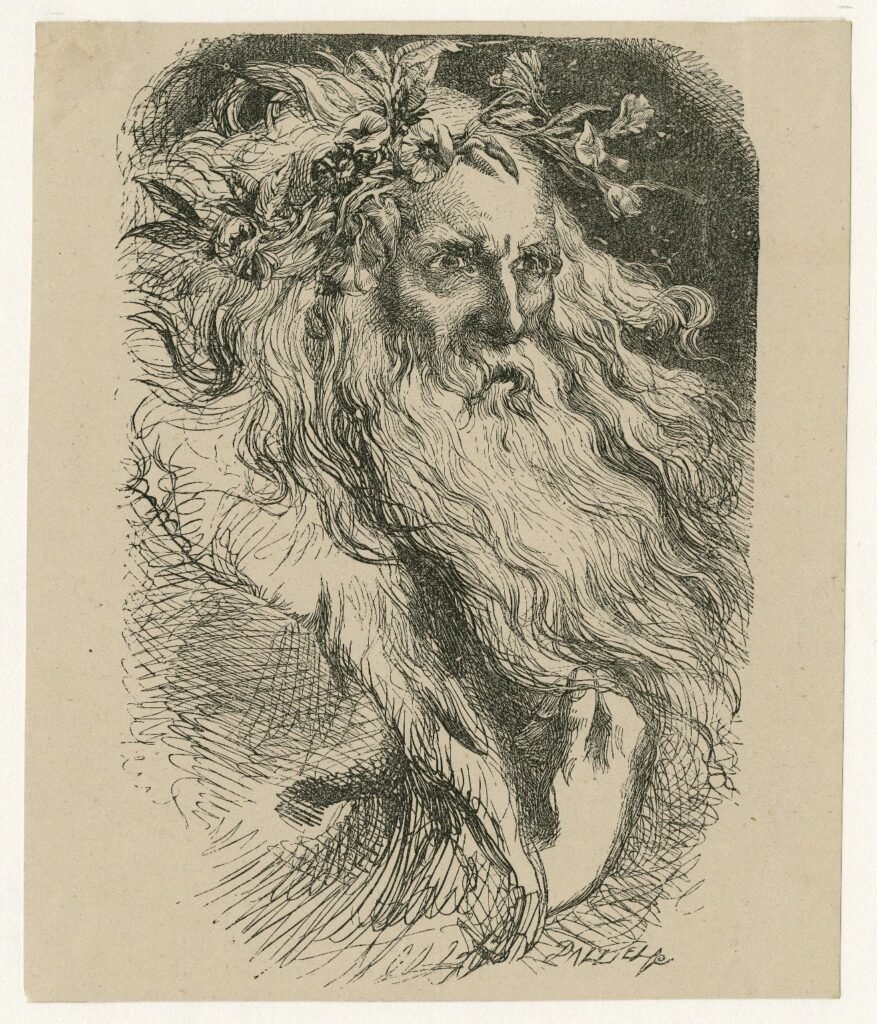
Lecture on King Lear and Mercy Through Exposure
A crown behaved, in every polity I had encountered with clean hands, resembling a proposition that wished to masquerade as flesh, although the skull beneath it maintained its own arithmetic, while the body—knees, gums, the thin skin above a knuckle—insisted upon evidence. Your eyes, Listener, tracked continuously from my face to the object I had brought, whereas the room’s lamp cast a weak shine upon the brittle stems, thus the smell of dried earth—fen muck baked into a wreath—rose whenever my fingers shifted. Woven for a mad king, a wreath of weeds held its quiet doctrine through the way it scratched the palm, seeing the world had composed a rejection in thistle alongside dock. I had conveyed the item wrapped in brown paper, the way a baker hauls loaves, feeling, upon the pavement, how pedestrians observed the parcel with a faint suspicion that always accompanied concealed food alongside secret sin. Placing the burden upon the lectern caused the stems to creak, whereupon a few crumbs of soil fell with such candour that the gesture became an ethics lesson, given that an ornament shedding dirt confessed the truth of kingship better than a sermon concerning authority managed. Shakespeare had understood such admissions; King Lear began where power desired weightlessness, whereas duty sought another’s shoulders, therefore an aging monarch’s urge toward flight—fleeing his own long manufacture of consequence—tightened around his family like cord.¹
Resting upon the stage, a map carried, within its inked borders, the hunger of a land that had fed upon rents alongside fines, together with the patient labour of hands remaining clear of parchment. Lear’s hand swept across the drawing with the impatience of a man who believed lines created reality, bringing the confidence of those who had spent years watching others obey. He aimed to “shake all Cares and Businesse” from age, while he simultaneously desired to retain the honour of command, hence his ambition—half senile, half cunning—acted as a blade severing duties from the self while sparing the self’s appetite for praise. Extracting speech from his daughters required treating affection as coin capable of being assessed, weighed, then portioned into estates; the love-test entered acting as a legal instrument pretending toward intimacy. Cordelia answered with the cipher of zero, accordingly the syllables—plain, small, stripped to the grain—fell into the hall like a stone into a well, considering a father demanding theatrical devotion received a rejection maintaining its dignity through quietness. During that moment, your breath, Listener, would have shifted had you stood at the Globe among apprentices alongside merchants, in view of the scene pressing a question into every chest: what kind of father tried purchasing virtue through threatening poverty? Lear’s fury, upon arrival, carried the cruelty of a man who had fed others upon his moods for decades; the court, having worn obedience as a collar, watched its own structure tilt. Ruin commenced within a sovereign’s family, while the kingdom—quiet in the wings—awaited the invoice.
Near my elbow sat the weed-crown; I observed you studying it, perceiving how your attention craved an argument, although your body desired a story. Operating at its best, a lecture functioned as a shared ethical event solely upon admitting the sweat of living; the play admitted sweat through dragging dignity across the ordinary. Lear’s elder daughters—each holding courtly language alongside a spine of iron—promised limitless devotion, their lips forming sentences always sounding devotional until a price arrived. Glowing words masked care remaining a performance capable of revision. Cordelia’s quietness, conversely, maintained the grain of truth, giving truth within a family a danger political theory often forgot: truth dismissed the theatre cruelty required. Banishing her, Lear ensured Kent’s protest earned exile, an act resembling, in miniature, what an early modern parish enacted upon a vagrant speaking out of sequence: distance became discipline, the road replacing the hearth. Belonging to Act IV in the Folio, the weeds in my hand held soil linking back to Act I, inasmuch as Lear’s initial violence had already begun growing its own vegetation. You could label it providence, although I felt, deep within my bones, a darker arithmetic: human action planted, time watered, then consequence harvested.
Serving us better than a flourish, a short hush fell.
You sat holding your coat still on, the cuffs looking frayed in a manner making my throat tighten, by virtue of frayed cloth carrying an entire economy.
As Lear’s train began shrinking, the violence changed its costume, while the hurt became bureaucratic. Goneril demanded he reduce his followers, Regan echoing the demand with a colder mouth, while the old man, having believed in his own indispensable grandeur, realised a roof could reject him. Humiliation arrived through details—numbers cut down, hospitality converted into conditions—so the pain felt akin to paperwork, the family’s cruelty wearing domestic manners. Shakespeare placed that cruelty beside the world’s poverty with a precision turning literature into lived argument, seeing a king losing servants began resembling the poor wanting them entirely. Controlling access to warmth, the elder daughters understood winter heat meant life, meaning their rejection mirrored a parish withholding relief from the desperate. Storming out, Lear carried the posture of injured authority, yet his body had already begun the slow lesson of exposure. Such instruction arrived exclusively as skin.
Shifting upon the bench, a man in the back—grey hair, hands folded resembling a small cage—reminded me of churches where I had spoken, where the impoverished sat nearest the exit seeing the threshold offered air whenever bodies grew faint. I asked you to imagine London during the first years of James’s reign, when beggars crowded St. Paul’s Walk, when statutes continuously attempted splitting poverty into deserving categories versus dangerous ones. The 1601 Act for the relief of the poor—sharp in its administrative confidence—turned each parish into an engine of judgement, simultaneously converting hunger into a matter of local governance. Overseers gathered rates, set the destitute upon work, bound children into apprenticeships, punishing vagrancy, while the language of remedy carried, within it, a fear of wandering bodies.² Gripping a staff granted a parish officer power to push a hungry man along; the wood carried the identical logic governing Lear’s crown: authority operated through objects touching flesh. Shakespeare’s stage maintained that social machinery humming behind the poetic surface, King Lear’s heath carrying, under its dramatic thunder, the geography of a nation beginning to regulate mercy. Begging for shelter, a king collided with a society having mastered the art of withholding comfort through legal elegance.
Emerging from the front row, a whisper met my reply bypassing ceremony, functioning as though the room were a kitchen.
—Mr. Smallridge—the young woman asked, while her fingers worried the strap of a satchel—did Shakespeare expect pity from law?
—He expected judgment from law—I replied, my thumb tracing the rough stem of the weed-crown—anticipating pity from exposure, due to law’s ability to organise bread whereas flesh learned mercy solely upon suffering hunger.
Sending Lear into the open, the play ensured the outdoors, in early modern performance, arrived as sound before sounding like water. Manufactured above the stage by human hands, thunder rolled resembling a verdict, the audience knowing, at a bodily level, heaven’s noise could be built from wood alongside metal, meaning divine terror shared a workshop with stagecraft. Accounts of the period described devices rolling cannon balls along a “thunder run,” drums alongside other contrivances thickening the illusion; such trickery mattered inasmuch as it placed cosmic disorder inside the theatre’s carpentry.³ Standing exposed, Lear found his authority powerless to command the sound; the noise treated him with the identical aloofness it granted a beggar. Equalisation began taking the form of acoustics, then turned into mud.
Suiting the next turn, a fragile moment arrived, my throat tightening.
The weed-crown waited.
Stems maintained their shape while meaning shifted.
Fearing his own age, a king held a map.
Dreading his own skin, a monarch held air.
Once opened, the heath became a tribunal where status provided frail shelter, the play compelling that tribunal to remain literal. Lear raged at the heavens, yet the firmament answered in the cold grammar of force, aloofness—upon touching a sovereign—becoming revelation. Sharing the same wind, a beggar alongside a monarch translated mercy from theory into consequence. Crying for the “poor stripped wretches,” Lear delivered a line striking as a confession, given he admitted his earlier care had been thin, the admission rising exclusively after his body felt what others had endured through entire lifetimes. Shakespeare’s ethical motion relied upon that temporal cruelty: compassion grew late, in the wake of harm, the way grass sprouted after fire. Through exposure, the king having demanded adoration learned such praise offered frail warmth, whereas a hovel provided greater love than a court bargaining affection. Rejecting sentimental rescue, the scene offered recognition, tasting bitter, as though the tongue had touched iron.
Reaching for Samuel Harsnett here, Listener, I held him the way one holds a soiled document taken from a parish chest. Harsnett’s Declaration—written to expose exorcism fraud—catalogued the language of possession with the glee of a man sharpening his knife; Shakespeare took the names of devils alongside the rhythm of counterfeit torment, then feeding them into Edgar’s transformation into Poor Tom.⁴ Drawing from a culture terrified of wandering bodies, the stage’s “Bedlam beggar” invoked dread of madness alongside the porous boundary between performance and desperation; an actor smearing himself with filth could summon laughter mixed with horror in a single gesture. Describing tricks turning piety into spectacle, Harsnett’s pages carried the identical moral confusion Lear’s storm brought: holiness alongside fraud cohabited, while the crowd watched. Stripping down into the persona of the dispossessed, Edgar performed poverty, yet the performance landed upon a soil already fertile with genuine hunger. Hearing his cries, a London audience could recall the whip. The stocks remained a vivid memory. The parish beadle’s hand struck familiar chords. A shutting door echoed in their minds. Shakespeare made that recall inevitable by placing a king beside the counterfeit beggar, then letting the sovereign observe his own void within the mendicant’s emptiness.
Holding its witness again when the play reached its later ache, the weed-crown mirrored the Folio stage direction describing Lear appearing “Crown’d with ranke Fenitar, furrow weeds,” the line carrying the scent of a riverbank alongside the roughness of plants pulled from a ditch. Woven from what grew in neglected places, the wreath mocked the gold having previously sat upon his head, enacting a theological irony: the earth crowned the king exactly when the monarch became earthlike. Waste ground spoke through the weeds, such territory belonging to those whom the parish kept moving along. Crowned with ditch plants, a king resembled, in silhouette, a vagabond wearing a wreath of refuse, the resemblance carving an argument deeper than abstract equality: the body, stripped of its symbols, carried identical vulnerability across ranks. Hoisting the weed-crown above my own brow for a moment—an absurd gesture, half comic, half penitential—the stems pricked, the sting serving as proof authority stayed grounded; it pressed.
The play’s cruelty, however, expanded beyond a single family, even though bloodlines provided its sharpest blade. Gloucester’s blinding placed pain into the theatre with a directness risking alienating the audience, yet the act also mirrored the ethical pattern of the storm: bodies bore consequence rhetoric could soften weakly. Trembling filled the room when I spoke of eyes plucked. I described blood on fingers. Detailing a nobleman reduced to a man guided by a disguised child, I noted the kingdom’s hierarchy fractured. Domestic control allowed Lear’s daughters to reduce him, whereas Cornwall diminished Gloucester through political torture; the two reductions met in the play’s shared premise stating power always exposed its own hunger. Literal stripping—Lear tearing at his garments—alongside social shedding—his title losing purchase—delivered exposure, yet the focal turn arrived when the humbled figure began observing others. Pity ushered mercy into the line where Lear urged himself to “take physic,” the phrase tasting medicinal, as though compassion acted as a bitter draught healing the spirit exclusively after it scalded the throat.
Contemporary pamphlets of disaster, bought with trembling hands, carried a similar logic of levelling; I drew them into the room with care, hauling them as one brings a corpse. Writers in 1607 described waters tearing through Somerset alongside Monmouthshire, the pamphlet voice—breathless, moralising—continuously reiterating how wealth alongside shelter dissolved under force.⁵ One tract spoke of “wonderfull ouerflowings.” Another pictured parishes drowned. Observers detailed cattle swept away. Eyewitnesses described households ruined, while the tone insisted catastrophe taught obedience.⁶ Monmouthshire generated a report describing the sea moved by winds overflowing its banks, the narrative turning wealthy men into beggars with brutal swiftness. Belonging to drama, Shakespeare’s storm lived in a world where real floods alongside real hunger continuously forced the identical lesson: a roof could vanish. Purses could empty. Titles could falter in purchasing safety. The equaliser—whether water, wind, law, or age—always found the skin.
Preserving our breath, a short fragment remained intact.
Mercy entered late.
Malice arrived early.
A crown of weeds appeared once reason had fled.
Bearing his own ruin, a father held it as a staff he had carved himself.
You could inquire, Listener, why Shakespeare chose to make the storm a kind of argument instead of a mere spectacle; the answer lived within the play’s treatment of knowledge. Lear understood, initially, his kingship, that knowledge having been reinforced by kneeling bodies. Ritual affirmed it. Flattering speech cemented the illusion. Yet his knowledge wanted the weight of shared suffering, such communal agony serving as the exclusive teacher his pride would accept. Doing what philosophy, counsel, alongside scripture had missed: the tempest forced a king into the position of those whose lives had always been contingent. Once contingency entered his bones, his imagination widened, prompting him to picture the “poor stripped” alongside the “houseless,” while he also began recognising his own earlier rule as a kind of blindness, an ethical cataract formed by comfort. The play therefore offered a late education arriving through punishment, the advent leaving a stain, due to compassion purchased by pain carrying the memory of its price.
Lifting his hand, a gentleman near the window caught the light with his wedding ring, prompting me to answer his silence with a story keeping me within the scene. Years ago, in a village where the river rose slow alongside brown after winter thaw, I had watched an elderly man—farm labourer, face resembling cut peat—stand in a doorway while the parish clerk discussed relief, the official’s voice carrying the thin patience of one believing poverty constituted a moral choice. During that encounter, the labourer’s boots had split at the toe, the gap showing a sock grey with age; I remembered, with shame, how my own gaze had lingered upon the damaged leather. For me, the boot served as an object of witness, Shakespeare’s weed-crown acting in the same manner: a small material thing held the verdict of a world. Footwear could argue a kingdom. Weeds could testify similarly. A torn cloak held statecraft. The crust of mud under a nail spoke volumes. Encountering Poor Tom, the king saw a body stripped to necessity, recoiling, then leaning inward, studying the human creature from which power had shielded him.
Forming the social background of that recoil, the vagrancy problem of Tudor alongside early Stuart England emerged through court records alongside pamphlets that scholars traced. Men wanting masters wandered. They performed wounds. Begging became trade. Stealing fed them. Lashes scarred their backs before they returned to the road, while the state’s fear of disorder hardened into policy.⁷ Drawing that fear into its marrow, the play forced Edgar to disguise himself acting as a dangerous poor man, his disguise working owing to the audience already carrying an image of such men—half pity, half terror—inside their imaginations. Addressing the stripped condition, Lear tasted the word as a bureaucratic category, treating the person as a problem requiring solution. Yet Shakespeare’s genius—permit me the word, for my trade required honest naming—lay in forcing the category to bleed. Becoming a vagrant, a king embodied a possibility, even existing as theatre, disturbing the comfortable, in view of it revealing how thin the line stayed between a cushioned bench alongside a ditch.
Rolling the weed-crown’s stems between finger and thumb, I remembered early modern clothing, where rank announced itself through fabric alongside cut, where sumptuary anxiety haunted the period’s social imagination. A furred gown turned the body into a text. Velvet cloaks did the same. Jeweled caps ensured strangers read the wearer in an instant. Studies of dress in Tudor alongside Stuart England showed cloth communicating status, whereas raggedness communicated threat; clothing therefore operated as a social language the law attempted to regulate.⁸ Lear’s stripping, alongside Edgar’s exposure, attacked that language by showing the body dropping its grammar, the assault carrying ethical consequence: as the signs vanished, the viewer faced a creature whose suffering looked guaranteed similar to any other creature’s suffering. Making that similarity crushing, Shakespeare asked, through Lear’s awakening, what it meant to govern having ruled through comfort alone.
At this point, my own voice faltered a fraction, I letting it crack, for performance omitting failure always felt dishonest in a room dealing with human ruin.
Patiently functioning as a relic, the weed-crown sat, while your eyes continuously returned to it.
Lear’s later tenderness toward Cordelia—his desire to live with her in prison, singing like birds—carried a sweetness the play immediately bruised, seeing Shakespeare permitted the audience to settle into comfort infrequently. Having begun by manufacturing complexity through vanity, the father sought, at the end, an escape into a smaller world, a cell where love could exist liberated from court alongside calculation. That wish held a tragic innocence, while it also bore the mark of selfishness: even his fantasy of retreat carried his need to shape reality around his own feelings. Such a mixture—tenderness threaded with self-regard—felt human enough to terrify. Upon the plan failing, death arriving, the weed-crown’s witness sharpened, for the wreath of ditch plants implied nature crowned every human being the same way: with decay. Lear entered carrying Cordelia’s body, the stage, having held thunder alongside mud, holding a corpse with a simplicity surpassing doctrine. His grief searched for reversal, his mind—trained in command—continuously trying to order the universe into compliance, while the universe answered with quiet. A destructive life, having tried to escape its own knotted consequences by outsourcing rule alongside buying love, concluded with an image of pure consequence: a father clutching the cost of his choices, while simultaneously clutching the single person having rejected flattering him.⁹
Thick air filled the room, prompting me to lean closer, observing you as a confessor.
Built upon control, a life ended in helpless touch.
Dividing land resulted in a man dividing his own heart.
Seeking escape from self-made complexity, a king found liberation solely in breath’s departure.
Leaving the play, we imagine the weed-crown falling from his head, rolling across the boards, scattering bits of fen soil, those crumbs—small, stubborn—continuously speaking long after the actors had departed. Such a crown held a witness in its roughness: it testified mercy, upon final arrival, emerged through exposure. It declared malice, upon beginning, acted as performance. It demonstrated power, upon collapse, revealed the shared body underneath its ornaments. Carrying my own copy of the weed-crown back into the night, I felt the paper around it softening with the heat of my hand. The scent of ditch alongside riverbank rose again. I understood, with a trembling fueling my prayers, how a man’s longing to flee himself could end with himself held tighter than before. Consequence gripped him. Memory bound him. The dead restrained him.¹⁰
Scholia:
1 William Shakespeare, Mr. William Shakespeares Comedies, Histories, & Tragedies (First Folio), printed by Isaac Iaggard and Ed. Blount, London, 1623, pp. 283–309. Author’s comment: A lecture treating King Lear as an ethical event must accept the play’s moral force grew from bodies placed under conditions withholding privacy. Early modern life offered privacy to wealth, while offering exposure to the impoverished; the theatre, acting as a public space where bodies pressed together, echoed that disparity and also disturbed it. Lear’s calamity therefore functioned as a social experiment enacted before witnesses, for the audience watched a sovereign’s gradual relocation into the category law and custom had already marked as vulnerable. The 1601 poor legislation, with its overseers and rates, appeared humane when compared with older punitive measures, yet it also revealed a structural suspicion toward poverty, in that it treated wandering as a civic threat and it linked relief to surveillance. Placing Lear upon the heath, Shakespeare staged a collision between sovereignty and that civic suspicion: a king became a body requiring relief. The drama therefore asked, through sensation, whether a society disciplining hunger could recognise its own king under hunger’s sign. Deepening the question, the weed-crown turned the sign of sovereignty into refuse, while it also hinted at a Passion logic: the crowned head endured mockery, and mockery turned into truth. That echo carried theological weight even for hearers avoiding church, given the image of a crowned sufferer belonged to common cultural memory. The play’s mercy carried a cost ethical theory often softened, for compassion arrived after harm, and that temporal delay formed the tragedy’s bleak instruction: the human heart learned justice exclusively upon enduring what it had ignored. Shakespeare offered clean absolution infrequently; he offered the terror of belated insight, while he also offered an invitation to prevent belatedness within the lives of those watching.
2 Parliament of England, An Acte for the Releife of the Poore (43 Elizabeth I, c.2), in The Statutes of the Realm, vol. IV, Record Commission, London, 1819, pp. 896–900.
3 Leslie Thomson, The Meaning of Thunder and Lightning: Stage Directions and Audience Expectations, Early Theatre, vol. 2, University of Toronto Press, Toronto, 1999, pp. 11–24. Author’s comment: The storm’s equalising function gained power through its doubleness: it acted as a metaphysical sign alongside a piece of theatre technology. Early modern spectators understood thunder could be built, and that comprehension sharpened the scene; it implied human beings manufactured the sounds they also called divine. The stage’s thunder therefore mirrored politics, where rulers manufactured awe through ceremony, music, heraldry, and threat. Having lived by that manufactured awe, Lear faced a manufactured storm rejecting his command, and the rejection taught him what his own subjects had long known: spectacle could overpower the self creating spectacle. The ethical argument therefore moved through craft, through carpentry, through the hidden labour above the stage. A “thunder run,” if employed, required hands to roll weight, while the audience received the noise as fate; that gap between labour and reception formed an analogy for governance, where hidden labour created public experience. In that sense, Shakespeare allowed the theatre’s own mechanisms to accuse political mechanisms, while the audience—standing, sweating, jostling—served as an implicated crowd. Mercy emerged when Lear recognised exposure belonged to many, and that recognition resembled a conversion, while the conversion erased the earlier harm infrequently. Returning as a counter-spectacle, the weed-crown carried ditch plants exclusively, implying nature’s theatre required court budgets minimally. Wearing weeds, the king transformed his head into a stage for the earth itself, and the earth’s aloof artistry proved stronger than human pomp.
4 Samuel Harsnett, A Declaration of Egregious Popish Impostures, printed by Iames Roberts, London, 1603, pp. 1–12.
5 Anonymous, A True Report of Certaine Wonderfull Ouerflowings of Waters, printed by W. Iaggard for Edward White, London, 1607, pp. 1–8.
6 Anonymous, 1607 Lamentable Newes out of Monmouthshire in Wales, printed [by Edward Allde] for W. W. and sold in Paules Church-yard, London, 1607, pp. 1–6.
7 A. L. Beier, Masterless Men: The Vagrancy Problem in England, 1560–1640, Methuen, London, 1985, pp. 3–40.
8 C. Willett Cunnington and Phillis Cunnington, Handbook of English Costume in the Seventeenth Century, Faber and Faber, London, 1955, pp. 1–28.
9 A. C. Bradley, Shakespearean Tragedy: Lectures on Hamlet, Othello, King Lear, Macbeth, Macmillan, London, 1904, pp. 243–310. Author’s comment: Family cruelty in King Lear often receives a psychological reading, yet the play’s lived detail pushed the cruelty into economic and administrative forms resembling contemporary governance. Goneril and Regan reduced Lear’s train, regulated his household, controlled access to lodging, and demanded behavioural compliance through conditional hospitality. Those actions resembled the parish’s regulation of the poor, where relief came with scrutiny and where the recipient’s conduct could become a matter of communal judgement. Braiding domestic tyranny with public discipline, Shakespeare showed how cruelty could present itself as order. Arguing for “reason” in reducing followers, a daughter sounded like an overseer arguing for “reason” in limiting alms; the rhetoric of prudence masked the pleasure of dominance. Lear’s awakening occurred upon feeling, in his own body, the consequences of that prudence, and he then extended his imagination outward toward “wretches” whom he had previously left to the parish. The play suggested mercy required an imaginative leap comfort resisted, and it suggested exposure—physical, social, emotional—forced the leap when voluntary sympathy faltered. The ending’s crushing image, with Cordelia carried in, framed the final question: how did a life of destructive action conclude upon seeking escape from self-made complexity? Lear’s desire to abdicate, to divide, to retire, expressed a wish for simplicity purchased by others, and that wish created the plot’s knot; his later fantasy of prison with Cordelia expressed a wish for intimacy omitting accountability, and that wish repeated the pattern. Death arrived as the exclusive escape requiring further bargaining minimally. Falling and shedding soil, the weed-crown kept speaking beyond death: consequence outlived intention; the earth received every crown.
10 Stanley Cavell, Disowning Knowledge in Seven Plays of Shakespeare, Cambridge University Press, Cambridge, 1987, pp. 39–63.