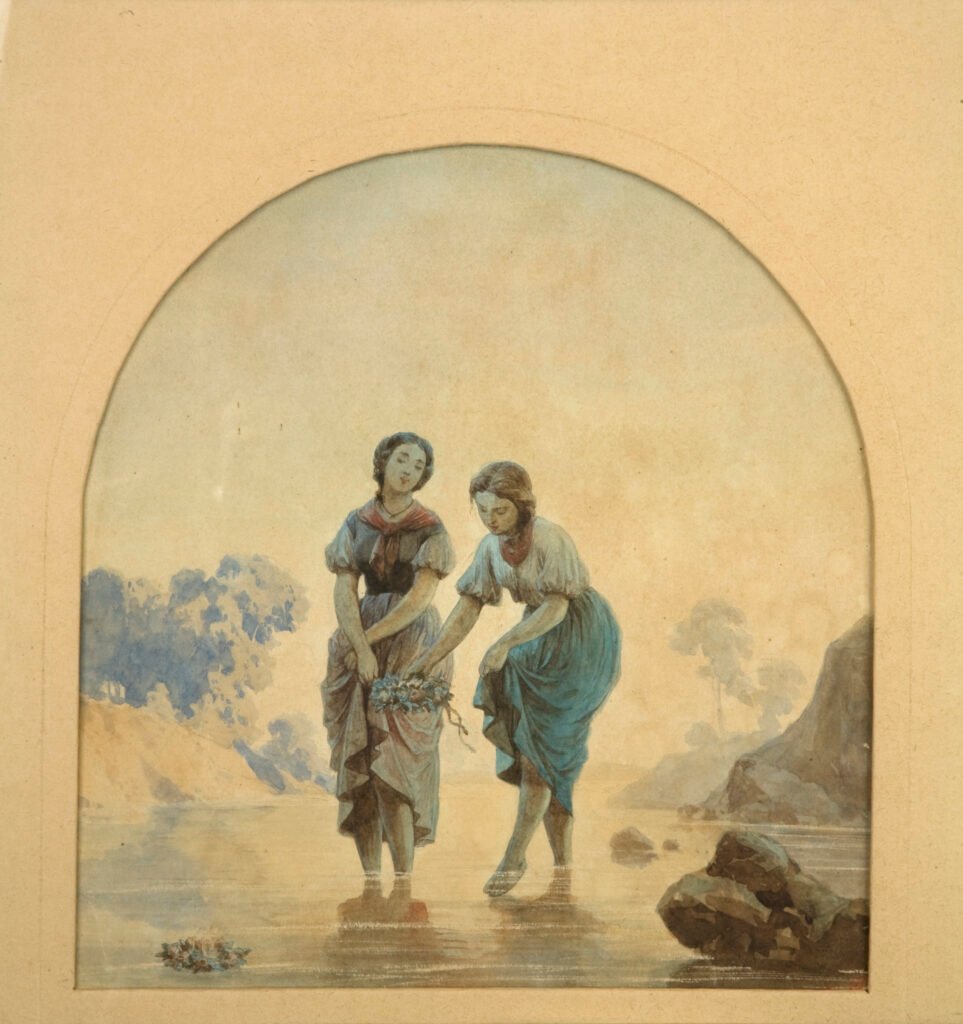
The rain along the Portlaoise roof arrives in slanting sheets, each drop a tiny percussion against the slate; through the blurred pane I see the lane as a pale river, a strip of pewter dragging fragments of sky toward the Barrow. At the table, lamp low, tea cooling, I set the reproduction of Artur Grottger’s Wianki beside my elbow. Two girls stand ankle-deep in a river that reaches across paper and century: one upright, one bent forward, both absorbed in their wreaths. The arch of the sheet encloses them like a chapel apse. Outside my window, Irish rain; inside that curve, Polish summer. The same water migrates between both, changing flavour, never character.
Grottger enters this quiet scene with a biography steeped in unrest. The boy from Ottyniowice in Podolia, born under an absent crown in 1837, grew up among tales of the November Uprising told by his father Jan Józef, a veteran who wore defeat as others wear medals.¹ The child learned pigment and patriotism at the same bench. Later came Lwów, then Kraków, then the academies and salons of Vienna, the imperial city where he handled orders from Habsburg patrons while his heart tuned itself to a different anthem. Wianki, around 1859, belongs to that young Viennese period: a watercolour on paper, modest in scale, with the air of a genre piece suited to a parlour wall, yet the hand that lays down those transparent washes already carries the fever that will drive the cycles Polonia and Lituania.
The age presses in upon the paper. Across the partitioned lands, talk gathers like thunder: rumours of conscription, whispers of plots, priests smuggling pamphlets inside missals. The famous national mourning, the black crinolines and iron jewellery of Warsaw, lies only a few years ahead, already fermenting in hearts. Against this background the ancient midsummer rite of Noc Kupały acquires dangerous energy. On that shortest night maidens weave wreaths from meadow flowers and herbs, then launch them upon the river’s skin to seek omens of love or doom. A wreath that drifts away with steady flame promises union; one that spins in place suggests delay; one that sinks suggests early sorrow, perhaps a lover taken by war or exile. The custom belongs to pagan centuries, yet every partitioned generation loads it with fresh anxiety.²
Grottger chooses a moment before the crowd and before the night. Wianki shows broad daylight, air bleached by early sun, the river a slow mirror that reflects neither torches nor bonfires but the tender pollution of sky. Two girls wade near the bank; the water grazes their calves. Hills rise to right and left, their ochres and blues softened by distance; trees dissolve into light, less individual plants than breath of foliage. The paper itself, warm cream, shines through the washes, lending the whole scene the quality of memory retrieved from a box of letters. Compositionally, the girls form a loose V, their torsos leaning toward the invisible point where their gazes meet, though their eyes direct downward, toward the wreaths. The arched top encloses this V like a vault, so that water, hills, and air feel gathered under an invisible cupola.
Look down to the bottom left of the sheet. There, almost discarded, lies a third wreath—or a cluster of flowers loosened from one. It drifts toward the edge, already half outside the world of the picture. This fragment, small and easily dismissed, acts as the hinge of the entire scene. The girls cradle their own wreaths with care; they stand mid-gesture, the right-hand figure lowering hers toward the surface while the left holds hers close to the apron. The stray bundle of petals near their bare feet explains the tensing of their hands and shoulders. One wreath has already left the fingers; the river has accepted its first question. Whatever answer it carries, the painter keeps from us. Only this tiny patch of colour remains, stranded on the picture plane like a word the tongue cannot quite form aloud.
The figures themselves belong both to village and salon. Their blouses and skirts echo peasant costume, yet their profiles, their narrow wrists, their neat coiffures reveal the draughtsman of courts and drawing rooms. Grottger understands that nineteenth-century Polish Romanticism delights in such disguises: noble daughters adopt rustic garb during patriotic tableaux, while actual peasant girls slip through the background as scenery. Here, however, the masquerade gains a sharper edge. These two stand barefoot in river mud. Skirts rise above the knee; one girl’s lifted hem exposes a shin with the whiteness of someone who spends more time indoors than in fields. Such exposure would cause comment in any kresy manor. In standing them here, half decorous, half vulnerable, Grottger stages a subtle collision between class and nature. The szlachta’s daughters seek regeneration through contact with folk ritual, yet they fear the chill of that water and the unpredictability of fate it carries.
Grottger’s handling of watercolour mirrors this tension. The sky and distant hills appear through soft, even washes, almost breath on glass. The trees to the left dissolve into blue blotches that suggest foliage without insisting upon each leaf. Over this atmosphere he lays more decisive strokes: the sharp contour of the right-hand girl’s bent leg, the darker plane of her skirt, the narrow vertical of the rock at lower right. The river’s surface carries only a few horizontal flicks of pigment to indicate ripples, yet those few suffice to set the figures trembling inside their reflections. The medium, ostensibly light and delicate, becomes a field where every decision arrives loaded: one misplaced stroke would tear the calm. Instead, the calm quivers.
Consider the posture of each girl. The one on the left stands almost straight, weight on the rear foot, wreath gathered against her, head tilted slightly back as if listening to a song born inside her throat. Her face turns away from the viewer toward some inward horizon. Her companion bends forward, one foot already stepping into deeper water, shoulders set in the concentration of physical action. Between them, Grottger stages a dialogue between contemplation and decision. The upright girl delays, clinging to the wreath a heartbeat longer; the bending girl consents to risk, to surrender the flowers and so invite the omen. A generation stands precisely there in 1859: one part of the youth of the land stays in libraries and salons, wedded to talk; another walks toward sabres, rifles, Siberian snow.
The landscape supports this drama without theatrics. To the right, a dark rock mass juts from the river like a prow, its weight anchoring the edge of the sheet. Behind it rises a low bluff, then paler slopes, each successive hill more reduced in tone, until land fades into the sky. That recession of value opens the distance both physically and spiritually; space appears generous, yet the arched format seals it at the top, as a church seal holds wax. The girls stand between bank and bank, between rock and open water, between childhood and knowledge. Grottger avoids clouds that might carry explicit omen; instead, the sky remains a haze through which light seeps evenly, like the milky air before a storm that arrives tonight or in a decade.
Return to that little wreath near their feet. Its petals share the same blue and red as the main bouquets, yet their arrangement loosens. It resembles a ring already broken. Folklore speaks about wreaths as symbols of maiden honour and future union. Once cast away, they join the realm of spirits, currents, and submerged branches. Grottger places this broken circle exactly where the reflections of the girls begin: a frontier where identity meets water. The wreath marks the spot where the future ceases to belong entirely to the will of the maidens and passes into hands they cannot see. Here the painting states its hard theology: desire carries force, yet river and history carry greater.
Grottger himself knew that current intimately. While he painted such lyrical scenes, letters from friends and cousins carried news of arrests, censorship, estates under surveillance. His own lungs already betrayed him; tuberculosis dug into his chest with the same patience as frost into steppe soil.³ The translucence of this watercolour therefore acquires an additional layer. The delicate paper hosts a man who senses the shortness of his span and the long reach of his nation’s grief. He handles youth and sunlight with a care close to reverence, as though each wash of blue over the river preserves a breath he longs to extend. Later, in the monochrome drama of Polonia and Lithuania, corpses, widows, and exiles crowd the frame. Wianki stands as their prelude, a river before blood.
The Irish mind knows rivers of that sort. I remember a dawn along the Barrow near Carlow, mist standing knee-high over the meadows, the water so calm that every rush and cow-print doubled exactly. A child in a red jumper threw in a daisy chain; it drifted toward the bridge, its reflection brighter than the flowers themselves. Behind us, traffic already groaned; ahead, the river glided toward the sea as if centuries counted less than inches. That daisy chain returns as I trace Grottger’s tiny wreath. Borderlands differ in tongue and empire, yet they share that sense of offering small, beautiful objects to currents far larger than any one life: garlands, sons, songs, rebellious pamphlets.
Art historians of a later Positivist generation preferred Grottger the chronicler of martyrdom: they praised his cycles as patriotic sermons and treated works like Wianki as charming sidelines, trifles for provincial drawing rooms.⁴ Such reading flattens him. The same rigour governs both the drama of insurgents and the hush of these two girls in a river. The geometry of the composition—arched top, river horizontal, V-shaped pair of bodies, triangular rock—belongs to a mind trained to think in structures suited to altarpieces and history painting. Yet he applies this architecture to a subject of peasant ritual and private anxiety. In doing so he grants folk custom a dignity normally reserved for kings and saints.
Colour plays its part in that elevation. The skirts, one russet, one teal, occupy the richest range of chroma, anchoring the eye. The blouses remain pale, tinged with blue shadows, so that the torsos appear almost carved from mist. The riverbed below their feet shows through in warm browns; reflections of garments stretch downward in rippled echoes. That limited palette—earths, a few blues, a touch of rose in cheeks and petals—creates unity of mood. Everything here shares a single air, as though the day itself fitted them with one common garment. Light behaves with fairness: it touches rock and skin, distant hill and near water with equal sincerity, an early sign of the discipline that will mark Grottger’s larger visions.⁵
Yet the painting refuses resolution. The right-hand girl’s wreath hangs a finger-width above the surface. Another moment and it will float, spin, or slip under. The left-hand girl’s wreath remains undecided, close to her waist; she may keep it as talisman, she may follow her companion’s gesture. The third wreath, already drifting away, hints at an outcome we never witness. Grottger suspends time at this point of trembling. He avoids the easy consolation of showing wreaths gliding serenely downstream, candles gleaming like stars; he equally avoids the blunt melodrama of sunk flowers and sobbing faces. Instead he paints the interval itself—the breath held before the omen.
In that decision lies the courage of Wianki. Faith, whether religious or patriotic, often seeks narrative closure: victory, martyrdom, resurrection, some clear sign that sacrifice secures reward. Grottger grants his viewers something severer: the discipline of standing in the water while the heart questions. Fate may answer through wreaths, conscription offices, diplomatic treaties, or the cough of a young artist in a cheap Montmartre pension. None of that appears on the paper. Only two girls, three wreaths, a river, and a sky wide as possibility.
So I sit at the Portlaoise table while rain carves its silver script down the glass, and I follow those slight figures in their shallow stream. Their world, bound between borders imposed by Petersburg, Vienna, and Berlin, speaks quietly to this island, which knows its own history of lost uprisings and long negotiations. The wreath that drifts near the lower edge of the sheet feels close to the edge of my own time. Each generation assembles its garlands—of words, marches, minor acts of fidelity—and entrusts them to the dark, slow water of history. Grottger, sick and brilliant, stands beside us on the bank. With a watercolour brush he records the angle of two young shoulders as they lean westward, the tautness in fingers that release flowers into current. Through that small, exact gesture he whispers that every river remembers each offering, and that light on water, though fragile as breath, endures longer than the empires along its banks.
Notes:
1. Antoni Potocki, Grottger, Księgarnia H. Altenberga, Lwów, 1907, pp. 12–15. Potocki sketches the basic co-ordinates of Artur Grottger’s life that later writers develop in greater detail: birth in 1837 on the leased estate of Ottyniowice in Eastern Galicia; a childhood shaped by his father Jan Józef, an officer from the November Uprising and an amateur painter; early lessons in drawing given at the same table where patriotic stories circulated. Potocki emphasises the atmosphere of provincial noble houses in the borderlands, where memories of lost independence formed part of everyday conversation. From this environment Grottger moved to Lwów and Kraków for more systematic training, and then to Vienna, where he studied under Karl von Blaas and Christian Ruben at the Academy of Fine Arts. That mixture of Podolian melancholy and Viennese academic discipline stands behind the delicate yet controlled structure of Wianki: a small genre scene framed with the seriousness of history painting.
2. On the midsummer rite, see Henryk Biegeleisen, Kupała. Studium etnograficzne, Gebethner i Wolff, Warszawa, 1929. Biegeleisen gathers songs, descriptions, and regional variants of Noc Kupały (Kupala Night), the ancient Slavic celebration of the summer solstice. Young women weave wreaths from meadow flowers, sometimes with particular herbs chosen for protective or erotic power, set candles within them, and cast them onto rivers or ponds. The path of the wreath foretells the future: a wreath that drifts freely promises a good match; one that circles in place suggests obstacles; one that sinks may hint at early widowhood or a life outside marriage. Fire, water, and vegetation work as a single symbolic ensemble: burning wax, flowing current, living plants. In the nineteenth century, especially under the partitions, such folklore scenes gained a second meaning. Public insistence on “old Polish” customs in an era of Russification and Germanisation functioned as quiet resistance, so that the fate looked for in the wreath belonged both to a specific girl and to a nation longing for return.
3. Wiesław Juszczak, Artur Grottger. Pięć cyklów, Arkady, Warszawa, 1958, pp. 5–18; and the biographical entry in Polski Słownik Biograficzny, vol. XX, 1975. Juszczak reads Grottger’s later crayon cycles—especially Polonia (1863) and Lituania (1864–66)—as a single sequence tracing the sufferings of the January Uprising and its aftermath: arrests, executions, deportations, ruined manors, wandering orphans. These cycles emerge from the final years of Grottger’s life, when tuberculosis had already seized his lungs. He met his fiancée Wanda Monné in Lwów in 1866, travelled with hopes of recovery to Paris and then to the spa of Amélie-les-Bains, and died there in December 1867, aged thirty. Against that timeline, Wianki from 1859 stands at an earlier, sunlit threshold. The bodies of the girls appear healthy, the atmosphere clear, yet the subject already centres on a choice offered to youth by an uncertain river. The later cycles turn this lyric hesitation into explicit tragedy; the water in Wianki becomes, in retrospect, the rehearsal space for that later martyrology.
4. For the later critical response, see Ludomir Benedyktowicz, Stanisław Witkiewicz jako krytyk. Jego pojęcia, zasady i teorye w malarstwie, Towarzystwo im. M. Reja, Warszawa, 1902. Witkiewicz, painter, architect, and influential critic of the Positivist generation, admired sincerity and close observation in art and grew impatient with what he perceived as overwrought Romantic allegory. He argued that the country required clear-eyed images of peasant work, modern life, and social problems more than another series of symbolic martyrs. Within that programme, Grottger’s women in mourning and spectral riders seemed to belong to an exhausted style. Yet popular memory moved in a different direction. Reproductive prints of Grottger’s cycles hung in homes across the partitions, and his name entered patriotic legend beside poets like Słowacki. Seen from this angle, his “theatricality” acquires a liturgical function: paintings and drawings provide a shared set of images through which a stateless community imagines its history and grief. Wianki, though gentle, already participates in this function by turning a village game into a solemnised act.
5. On Grottger’s method as a draughtsman who paints, Juszczak places strong emphasis on line as the skeleton of his images. Even in oils and watercolours, Grottger begins with a precise drawing, then lays washes of colour over it in thin, transparent layers. This approach shows clearly in Wianki: contours of legs, arms, and rock remain clean and economical, while the sky and distant hills dissolve into soft zones of diluted pigment. The arched sheet encourages him to think of the whole upper area as one continuous dome of wash. Within that dome he models light gently, reserving more saturated colour for key accents—the teal and russet skirts, the wreaths, the dark rock—so that the eye gravitates toward the figures while still sensing the breadth of the landscape. The result can be described as a “drawn painting”: firm structure and atmosphere cooperate rather than contend, which suits an image where firm decisions (the casting of the wreath) meet the enveloping uncertainty of fate.