
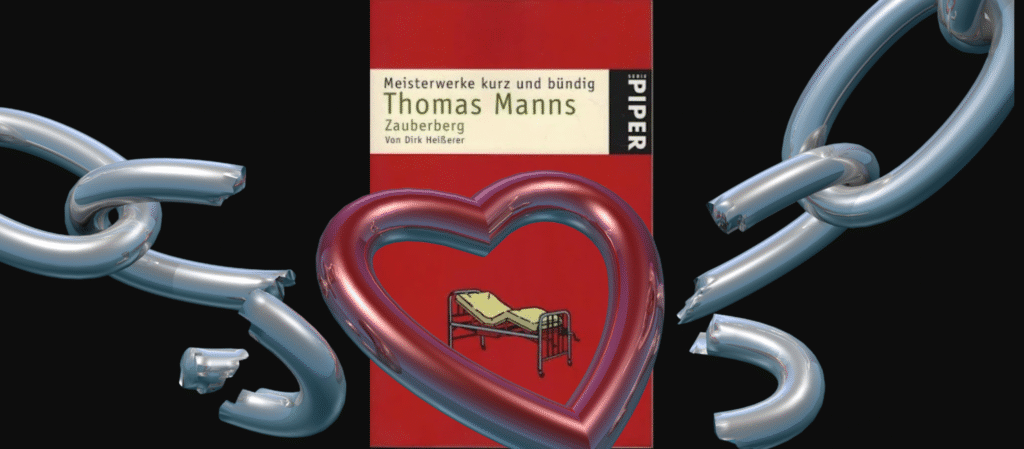
My mother, God praise her soul, taught Polish in Warsaw, in a city where every façade carries bullet scars and every tramline remembers some upheaval. Her favourite book, through all those decades among exercise-books and staff meetings and parent complaints, remained Thomas Mann’s Magic Mountain.¹ She valued many writers, yet that one novel occupied a private altar on her shelf, dog-eared and bristling with slips of paper. From her came a sentence that entered me long before I heard of Davos or Hans Castorp:
The first step towards enslaving the mind is to narrow one’s perspective. Closed borders are like a muzzle and a collar for a rebelling dog. Unfortunately, today Europe is full of places that resemble Dog Pounds for willful mongrels rather than civilised countries.
She delivered those words in a teacher’s voice, the tone that had disciplined generations of Warsaw pupils, yet a certain feral laughter flickered at the edges. The city around her knew sieges, checkpoints, occupations, treaties, reopenings; my mother carried that memory as a lived grammar. When she pressed Mann’s novel into my hands, she offered more than a text from the canon. She offered a counter-spell against the kennel-instinct of power: the drive to fence in bodies and shrink horizons. In her classroom, walls framed by maps and portraits, The Magic Mountain answered the bell like an accomplice. The book withdrew to an Alpine sanatorium, yet it smuggled through that retreat a ferocious inquiry into the European hunger for muzzles.²
From the first pages, Hans Castorp’s ascent to the Berghof enacts a seduction by altitude that reveals both the sweetness and the danger of retreat.³ A young engineer sets out for a short visit; the thin air, the measured fevers, the elongated meals, and the languorous conversations enfold him in a time apart. The mountain appears to lift him above Hamburg’s shipyards and everyday obligations, as though the world below simply recedes into cloud. Mann fashioned this ascent as more than a holiday. The sanatorium receives a representative Europe: Italian humanist, Jesuit dialectician, Dutch sensualist, Russian femme fatale, German officer. A closed institution emerges, perched above the flatland, where time dilates and talk thickens. In that setting, my mother’s warning about muzzles acquires a subtler shape. The collar no longer takes the form of barbed wire; it arrives as a comforting regimen of rest cures, temperature charts, and philosophical disputations that extend the postponement of any decisive act.
For Mann himself, the Berghof condensed a personal transformation. Before the Great War, he spoke for a conservative cultural nationalism that idealised apolitical inwardness and German Kultur.⁴ During the war, his brother Heinrich and the wider catastrophe unsettled that assurance. After 1918, while Weimar flickered between democratic promise and street violence, Mann revised his stance and composed the later chapters of The Magic Mountain with a sharpened sense of responsibility.⁵ The publication year, 1924, already carried inflation, political assassinations, and the memory of trenches. Entire classes across Europe struggled to understand their role in the disaster. In that climate, the sanatorium became a microcosm of the continent’s educated middle stratum. Settembrini’s liberal rhetoric, Naphta’s theological-radical ferocity, Peeperkorn’s intoxicating life-philosophy, Clawdia’s erotic gravity—each figure enacts an idea that attracts and tests Hans’s soul. The novel advances a manifesto through this theatre: a declaration that the educated European conscience cannot evade history through culture alone, yet still retains the capacity to reform itself through conversation, irony, and purpose.⁶
Time inside the Berghof does more than pass slowly; it thickens, folds, and returns upon itself, as though every season brushes the same faces at the dining-room tables while the world below accelerates toward catastrophe. Mann treats illness as a heightened form of experience; the body’s weakness creates a permanent twilight in which ideas gleam more sharply and death hovers with ceremonial intimacy. In the “Schnee” episode, Hans loses his way in a snowstorm and, while exhaustion presses him toward a white oblivion, he receives a vision of a Mediterranean humanity: warm plazas, naked children, communal joy.⁷ The dream interweaves Eros and ethics, as if the possibility of a truly humane civilisation appears precisely when he hovers near self-erasure. From that point, the novel steers his education toward a choice between sterile necrophilia and a renewed allegiance to life. For Mann’s contemporaries, this carried a distinct message. Retreat into an intellectual or aesthetic enclave might prepare a richer return to civic engagement, yet any elevation that refuses descent courts madness and war.⁷
A century later, another type of elevation spreads across Europe and far beyond, although it unfolds through airport lounges, budget airlines, and broadband signals in place of mountain railways.
Digital nomads set up their laptops in Lisbon cafés, Georgian guesthouses, Mexican rooftops, Thai islands. They work for companies headquartered in distant capitals or freelance for clients who remain abstract names in an inbox. Social media feeds display hammocks, coworking spaces, shell-pink sunsets over rented balconies. Official narratives around this lifestyle praise freedom, self-realisation, frictionless mobility.⁸ These travellers carry their own sort of sanatorium with them: an envelope of Wi-Fi, cloud storage, messaging apps, and booking platforms that shelters them from the deep entanglements of any particular place.⁹ My mother’s warning about muzzles acquires a new inflection here. The collar no longer clamps around the neck through border guards alone; it nestles in the phone’s glow, narrowing attention to screens through which only certain realities gain entrance.
Mann’s vision of the author belongs to a world where such weightless mobility remained unimaginable. His writer inhabits a specific language, wrestling with shared myths, idioms, and neuroses, and speaks to a community with common references and a common stake in political decisions. Even when exile later forced him toward America, he carried Lübeck and Munich and the German tongue as inner homelands. In The Magic Mountain, Settembrini stands as one version of that figure: a “man of letters” who treats literature as an instrument for enlightenment, progress, and dignified civic life. Naphta mocks him as a shallow representative of empty civilisation, yet the narrative grants his humanist insistence increasing weight. Authorship here aligns with pedagogy; the writer assumes a guiding role inside a historical crisis, shaping a readerly public prepared to choose life over annihilation. Creation emerges as responsibility to a specific polis, a pledge that thought and language will answer to the fate of flesh-and-blood neighbours.
Contemporary digital nomad culture produces a different sort of creator. The influencer, the remote-working novelist, the content strategist, the code-writer, the YouTuber teaching productivity hacks in yet another short-term apartment—each communicates with a dispersed audience scattered across continents. Language shifts toward global English. Local references grow lighter, as a post, a newsletter, or a video aims at legibility from São Paulo to Stockholm. The creator’s income may depend less on one nation’s public discourse and more on platform algorithms, advertiser demand, or subscription metrics. In such a regime, borders feel permeable for those with the right passports and digital skills, while others confront detention centres, deserts, and seas. Mann’s mountain divided flatland and sanatorium through a railway and a change in air pressure; the twenty-first century divides anchored lives and cloud-bound lives through cables, databases, and biometric gates. The digital nomad who glides from Schengen zone to tropical coasts experiences freedom of movement, yet often in a gated version that excludes the majority of migrants.
This distance alters the meaning of The Magic Mountain for present readers. For Mann’s first audience, the novel staged a possibility: a Europe that revises its conscience through a period of intense reflection, then returns to history with a commitment to human dignity. Hans’s eventual descent from the mountain onto the First World War battlefield carried tragic grandeur precisely because readers sensed a collective responsibility for the course that had led there. The book’s manifesto aspect drew its force from a still-lingering trust in Bildung, in dialogue, in the power of long novels to orient a class toward humane choices. For a reader schooled by remote work, social media, and perpetual travel offers, the same narrative may appear less as warning against retreat and more as an almost luxurious fantasy of extended withdrawal. Seven years in a sanatorium among articulate interlocutors, funded by inherited wealth, can resemble a historical equivalent of the subsidised co-living programme or the remote-work visa in a picturesque small city.
Borders themselves now stage an even harsher contrast. Warsaw once saw foreign armies march through its streets; my mother’s Europe remembered that every line on a map could harden into a wall at any moment. Today, within the Schengen core, citizens experience a wide-open field for tourism and work, while refugees in camps across the Mediterranean fringe, Ukraine’s displaced families, and African or Middle Eastern migrants on perilous routes encounter fences, quotas, and hostile rhetoric. At the same time, governments court high-spending digital nomads with special visas and tax arrangements, transforming certain cities into playgrounds for laptop workers while neighbouring regions absorb economic and ecological strain. In such a setting, Mann’s sanatorium appears as a parable for a privileged archipelago drifting above a suffering sea. The mountain no longer represents Europe as a whole; it mirrors a stratum that floats free from ordinary hazards. My mother’s phrase about shelters for disobedient dogs thus circles back with bitter irony, as secure compounds proliferate for every social category: asylum-seekers, gated elites, global freelancers.
Attention, too, obeys altered laws. Inside the Berghof, conversations unfold through long afternoons, recurring walks, measured visits to the X-ray room; the novel’s very sentences extend in elaborate constructions that demand focus. Readers follow the texture of Hans’s fascination with Clawdia Chauchat, the slow evolution of his friendship with Joachim, the duel that resolves Settembrini and Naphta’s ideological combat. Such slowness trains an ethical capacity: the patience to hear contrary arguments and inhabit discomfort. Digital life, on the other hand, inclines toward fragments—tweets, reels, posts, stories, status updates. Digital nomads in coworking spaces work amid constant notifications, attempting deep concentration while devices beckon toward fresh stimuli. Their accounts online foreground beaches, skylines, latte art. Illness, boredom, ambiguity, and political conflict seldom enter those frames. In that sense, contemporary attention economies shorten perspective even as physical mobility expands; the muzzle moves from border to feed, from checkpoint to interface.¹⁰
Yet an unexpected affinity emerges when one listens closely to the more candid voices among digital wanderers. Many describe a certain fatigue that rises through endless transition: the suitcase that never fully empties, the friend circles that dissolve every few months, the bittersweet glow of new landscapes that lack shared history. Some confess a longing for a library card, a regular café table, a window that always frames the same tree. Online forums fill with discussions about “settling down” after years of movement, choosing a city, accepting taxes and communal obligations. In those testimonies, Joachim Ziemßen’s yearning for military service in the flatland suddenly appears contemporary. He feels drawn toward a life in which duty comes with clear contours and sacrifice gains recognizable meaning. Hans’s path, too, culminates in immersion within the mud and terror of war, where all his airy speculations encounter bullets and shellfire. A similar dynamic surfaces when digital nomads finally choose one community, one school system for their children, one local election where their vote counts.
Within that parallel, The Magic Mountain regains its manifesto energy for the present. The novel challenges a culture that prizes perpetual openness to every option yet shrinks from binding commitments. Mann invites the reader to imagine an ascent for the sake of deeper understanding, followed by a descent in which that understanding confronts concrete history. Digital nomadism, in its most thoughtful form, might accept a comparable structure: a phase of roaming for insight and comparison, followed by embedding within a particular place’s struggles. The friction arises when movement hardens into lifestyle ideology, when altitude becomes permanent and flatland turns into mere content. In that case, the novel’s world and ours drift from each other: his faith in educative retreat and responsible return clashes with a contemporary ethos that sanctifies personal freedom even at the cost of solidarity.
I picture my mother again, in a Warsaw classroom filled with the smell of chalk and damp coats, as she lifts The Magic Mountain and addresses a roomful of teenagers already half-seduced by digital life. She speaks about Hans, about Clawdia’s slamming door, about Settembrini’s theatrical speeches, about the snow vision and the final march into war, yet every sentence carries the shadow of current Europe: refugee tents at the edges of cities, biometric gates at airports, coworking hubs rising in former industrial quarters along the Vistula. Her old maxim about muzzles falls into the silence after the bell. She understands enslavement of the mind as a process that begins in narrowed perspective, whether through censorship, propaganda, or the more seductive narrowing that arises from endless self-curated comfort. Mann’s mountain, in her reading, offers both a diagnosis and an antidote. It reveals how privilege can wrap itself in illness and contemplation, and it hints that any honourable life eventually chooses a valley, a side, a set of neighbours.
In that sense, the novel and the digital present stage a demanding dialogue. Mann’s author-figure speaks from rootedness, from a history that scarred cities like Warsaw, and from a belief that language can enlarge the field of vision. The digital nomad speaks from flux, from mid-air routes and cloud accounts, and from a belief that freedom lies in multiplication of options. Between them stretches a question that my mother bequeathed along with her underlined copy of Mann’s book: how wide will a mind allow its perspective to grow, and which borders—geographical, digital, ideological—will it accept as collars? Every reader who climbs Mann’s mountain today, then returns to a laptop in a rented room, carries the chance to answer with action. Time still grants a choice between altitude as refuge and altitude as preparation. Somewhere beyond the screen, beyond the airport queue, beyond the temporary visa, a particular street awaits that will demand more than a passing glance, and along that street a voice—sharp, loving, utterly unafraid—will ask whether the leash finally lies on the ground.¹¹
Notes:
1 The Magic Mountain, Thomas Mann, trans. John E. Woods, Vintage, New York, 1996, pp. 1–706. I anchor every later allusion to the novel in Woods’s cadence here, even though my first experience came through a Polish edition.
2 Thomas Mann’s Novel Der Zauberberg: A Study, Hermann J. Weigand, AMS Press, New York, 1971, pp. 84–85, where the Berghof appears as a European microcosm suspended above history.
3 Thomas Mann: The Uses of Tradition, T. J. Reed, Oxford University Press, Oxford, 1974, pp. 226–227, on the ascent to the mountain and the way Mann turns spatial withdrawal into moral experiment.
4 Reflections of a Nonpolitical Man, Thomas Mann, trans. Walter D. Morris, New York Review Books, New York, 2021, pp. 1–40, where Mann defends German Kultur against Western Zivilisation and still allies himself with wartime conservatism.
5 Essays, Band 2: Für das neue Deutschland 1919–1925, Thomas Mann, ed. Hermann Kurzke and Stephan Stachorski, Fischer Taschenbuch, Frankfurt am Main, 1993, pp. 132–133, which print Von deutscher Republik and reveal Mann’s turn toward republican responsibility.
6 The Cambridge Companion to Thomas Mann, ed. Ritchie Robertson, Cambridge University Press, Cambridge, 2002, p. 95, and T. J. Reed, Thomas Mann: The Uses of Tradition, Oxford University Press, Oxford, 1974, p. 230, both reading the novel as a stage where European ideologies test a representative bourgeois conscience.
7 The Magic Mountain, Thomas Mann, trans. John E. Woods, Vintage, New York, 1996, p. 541, where Hans’s snow vision culminates in the italic sentence about charity, love, and resistance to death’s rule.
8 Digital Nomads: In Search of Freedom, Community, and Meaningful Work in the New Economy, Rachael A. Woldoff and Robert C. Litchfield, Oxford University Press, New York, 2021, pp. 1–20, which sketch the Bali community and its self-understanding in terms of freedom and lifestyle mobility.
9 Digital Nomads Living on the Margins: Remote-Working Laptop Entrepreneurs in the Gig Economy, Beverly Yuen Thompson, Emerald Publishing, Bingley, 2021, pp. 1–11 and 18, where coworking hubs, visas, and the gig economy appear as the structural envelope for laptop lives.
10 Social Acceleration: A New Theory of Modernity, Hartmut Rosa, trans. Jonathan Trejo-Mathys, Columbia University Press, New York, 2013, pp. 160–185, on the self-propelling circle of acceleration that compresses attention even as mobility expands.
11 Liquid Modernity, Zygmunt Bauman, Polity Press, Cambridge, 2000, pp. 1–20, where mobility enters as a central instrument of power and identity in late modern life, a lens that sharpens the final image of leash and street.