
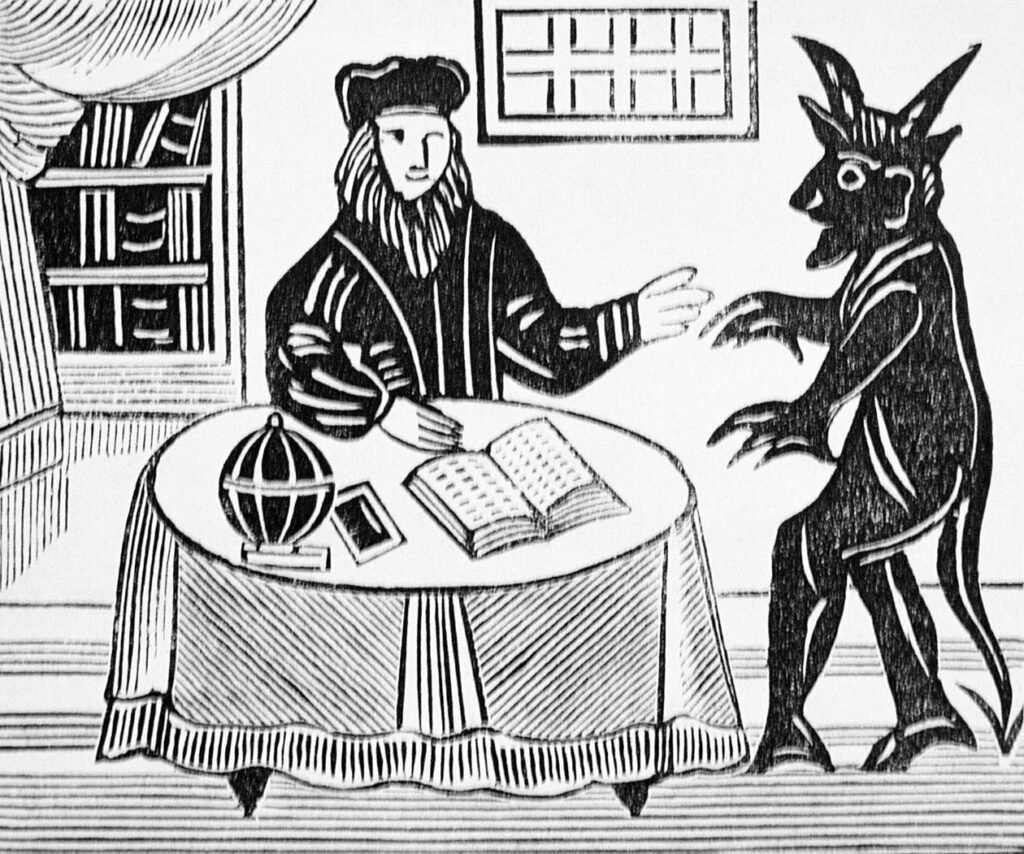
Lecture on Christopher Marlowe Doctor Faustus and Time’s Creditor
You sat under a roof of tar and rain-dark timber, while breath from the pit thickened the air with ale-sour warmth, and while the boards above you carried the tremor of feet that belonged to men who wore velvet on hire and fear by birth. A boy in a patched doublet—who had learned his letters from chalk that dusted his sleeve like flour—slipped between legs with a basket of apples, and when his heel struck a puddle that the floor kept in its own memory, your calf received a cold fleck through wool. You looked up, as a candle guttered near a painted post, and you saw the object that keeps calling us back, since it sat on a nail above the stage-gallows with the casual authority of a tool left in reach: a small tambourine, its skin rubbed thin, its rim splintered, its little brass jingles browned by sweat and breath. You heard it before you studied it, since one careless touch made it answer in coin-sounds that mocked both prayer and arithmetic.
A scholar’s gown entered the light, and the cloth behaved like an argument, since it swung with learned confidence while it also showed its frayed hem, which had kissed London mud more than once. When Faustus spoke of “lines, circles, scenes, letters,”¹ his mouth shaped study into display, and you felt the audience lean, because a spell in a public place carries the same heat as a confession, while it also carries the showman’s need to keep the crowd from wandering toward the door. That tambourine hung there like a witness sworn at a parish inquest, since it had seen men clap for jests and then fall silent for screams, while it had also absorbed the damp of winter evenings and the smoke of cheap candles until its wood smelled faintly of singed resin.
A ledger begins, as a bargain begins, with a clean page that begs for ink.
You may tell yourself that Marlowe staged theology as entertainment, while the word “theology” can arrive in your mouth like a stiff collar, yet the play forces it into the hands and lungs. When Mephistophilis entered, the entrance behaved like a lesson in appetite, since the spirit’s promise arose from a refusal to stay abstract, and since the devil spoke as one who has listened to scholars brag in Latin until the brags began to taste of stale bread. The scholar asked for “a world of profit and delight,”² while profit carried the sound of a purse and delight carried the sound of a tavern door, and both sounds belonged to the same hinge. Your eye returned to the tambourine, because its little brass tongues shook whenever laughter broke, while laughter itself worked as a solvent that ate reverence and left hunger.
You watched the clown scenes with the shame that laughter often brings, since a man who laughs at a fool laughs at his own weak ankles, and since the play keeps placing the audience under judgment by making them complicit in the jest. Wagner’s pedantry, which arrived dressed as learning, moved through the air like a cheap perfume, because it promised authority and delivered mimicry. Robin and Rafe, who spoke with the bluntness of hunger, turned conjuring into a pub trick, while their mouths reached for Latin that their bodies had never owned, and the result carried comic terror, because the world they toyed with possessed teeth. When a devil appeared for them, the scene gave you an unclean delight, since you sensed the price behind the prank, and since the tambourine’s jingle sounded like a creditor’s smile.
Marlowe wrote at a time when pamphlets about conjurers, witches, and false wonders moved through England as quickly as gossip after Mass, while preachers fought for the ear with images drawn from hell’s inventory. Reginald Scot had already mocked much witch-lore as trickery,³ while King James had already treated spirits as agents in a war for souls,⁴ and the stage stood between those positions, since it held scepticism in one hand and dread in the other. That tension lives inside Faustus’s desire for knowledge, because he sought to convert learning into power that could be displayed, and because the public display required bodies as witnesses, whether those bodies belonged to students in Wittenberg or apprentices in London. The play turns scholarship into a lived argument, since every claim of mastery drags a consequence onto the boards.
Rain can polish a gallows beam until it shines like old bone.
Consider how the bargain functions when the doctrine stays in motion. Faustus, who begins as a man turning over books with fingers stained by ink and candle soot, speaks as if salvation were a question of logic, since he weighs texts as though God’s mercy followed syllogism. The scene persuades you through texture: parchment rasping under a thumb, a candle’s grease pooling beside a margin, a scholar’s breath tightening when a passage fails to grant comfort. When he declares “Divinity, adieu,”² the line lands as a gesture, since he pushes away a discipline that had promised order, and since he adopts necromancy as a style of command. The tambourine above the gallows keeps its place, and its mute presence teaches a harsh lesson about time, because instruments keep counting even when the player refuses to hear.
In the older Faust book, translated into English in the early 1590s, the magician’s bargain carries a deliberate chill, since the prose insists upon the legal shape of damnation, and since it depicts the devil as a kind of notary who loves signatures.⁵ Marlowe takes that chill and warms it with theatre, while the warming makes the chill more intimate, because laughter melts distance, and because proximity makes fear enter the ribs. When Faustus demands pleasures and crowns, the demand arrives with a boy’s impatience, yet the play keeps showing that impatience as self-destruction that seeks escape through purchase. Time behaves as creditor here, since the twenty-four years become a loan, and since each feast and prank spends the principal.
A man can spend his soul with the ease of buying another drink.
You, listening in the room where we sit now, may feel the old Protestant language press against your modern ear, yet the play keeps it bodily. A debtor knows time through muscle: through knees that weaken as the hour advances, through a stomach that turns when a knock comes at the door, through the sweat that rises when a ledger opens. Marlowe gives Faustus that debtor’s body, even when he dresses him in a doctor’s gown, because the scholar’s pride cannot cancel the pulse. The scenes of display, which include papal mockery and conjured shows, turn into evidence in a moral court, since each spectacle proves that Faustus seeks distraction from his own sentence.
The Rome episode, which often tempts a reader into political commentary, presses beyond satire when you attend to material detail. A friar’s robe brushes stone, incense hangs in air that also holds garlic from a kitchen, and the Holy Father’s table supports plates that gleam under candlelight. When Faustus and Mephistophilis play tricks in that sacred space, the tricks carry childish glee, yet the audience senses the deeper wound, since the man who can strike at a ritual keeps revealing his hunger for a ritual that could strike back. The tambourine above the gallows stays ready, as though the stage itself anticipated the moment when comedy would fail to shelter anyone.
Mirth can open a trapdoor as easily as grief can.
The play’s genius, which I speak of as a parish matter and as a scholarly matter, lies in how it refuses to treat knowledge as a clean ascent. In Marlowe’s hands, learning becomes theatre of the self, because the scholar’s boasting requires ears, and because the boasting becomes addictive. Faustus speaks to himself as though he were his own audience, and that self-address resembles prayer twisted into vanity. When he performs for emperors, he seeks the shine of courtly approval, yet the play shows the approval as thin, since emperors carry boredom like a crown, and since boredom demands fresh spectacles. In that demand, time tightens its grip, because each new show consumes what remains of the term.
The A-text gives you a Faustus who seems to rush, while the B-text gives you a Faustus who lingers,⁶ and both versions teach that the debt grows heavier as the debtor keeps delaying an honest reckoning. A clock in a scholar’s room carries a different sound from a clock in a merchant’s shop, yet each sound becomes the same accusation when the end nears. Marlowe makes time audible through interruptions: through devils that enter when a man tries to think, through clowns that burst in when dread tries to speak, through jingles from that tambourine that keep turning laughter into a counting-house noise.
The creditor’s art depends upon waiting.
When the Old Man appears, the stage offers a figure who smells of parish earth, since his speech carries the cadence of sermons heard in cold naves, and since his body carries the steadiness of one who has buried neighbours. His counsel enters Faustus’s ear as a tenderness that seeks rescue, and the play lets you feel the rescue as possible, because the Old Man refuses theatrical glamour and speaks from lived weather. Yet Faustus, whose pride has trained itself to distrust ordinary grace, answers with wavering, and wavering functions as the tragedy’s hinge, since wavering consumes time while it also deepens guilt. The tambourine, which had served comic scenes, begins to feel like a mockery, because a jester’s instrument hanging above a gallows implies that execution and entertainment share a beam.
Here we reach bargain theology’s core: salvation becomes a question of appetite, since the sinner wants the comfort of release while he also wants to keep the pleasures that built the prison. Augustine’s divided will, which had already spoken in Latin long before Marlowe’s London, fits Faustus like a second skin, because the mind can command and resist within the same breath.⁷ Marlowe dramatizes that division by turning it into stage action: angels that tug at shoulders, devils that press into the ear, pages of books that lie open as though they were mouths waiting to be fed. Such staging forces a listener into the event, because you feel your own delays and evasions mirrored under candlelight.
A man can stand beside a gallows and still speak of freedom.
I ask you to keep your gaze on the tambourine again, since its skin, stretched tight across its rim, resembles a membrane between worlds, and since its jingles, which hang like tiny tongues, speak when touched by accident. When Faustus calls for Helen, he calls for beauty as narcotic, because the kiss he receives feels like a potion that can quiet dread, and because beauty offers a dream of escape from self-made complexity. Yet the play keeps placing ugliness close by, since the devils remain near, and since the air of the stage holds sweat, wax, and old straw. The contrast arrives through the body, as the audience’s stomach turns from desire to fear within minutes.
The “comic terror” you were asked to feel arises from that bodily switching, since laughter loosens a person, and since loosened attention lets dread slip through. A tambourine, used for a jig, can also serve a march, while the same jingles can sound like festive coins and like chains. When Faustus conjures grapes for the Duchess of Vanholt, he behaves like a servant who wants applause, yet the gift also resembles a theft from nature, and theft always invites pursuit. The play keeps that pursuit present by giving you reminders of the term, because Mephistophilis repeats the contract’s limit until the repetition begins to bruise.
In the playhouse, a man near you crossed himself, although his neighbours mocked him, and you saw his hand shake.
The last act carries a different weather, because the air thickens with the sense of a door that will open whether anyone desires it. Faustus’s speech begins to fracture into pleas, yet the pleas remain tangled, since he seeks both escape and postponement. When he cries “Ugly hell, gape not,”² the line carries a child’s panic, yet the panic also carries the adult’s knowledge that his own choices built the pit. The audience feels time as creditor here, because every plea resembles a debtor’s last attempt to renegotiate, and because the creditor’s power lies in indifference to pleading.
Think of the material world Marlowe gives you at this point: a table where scholars sit, a candle throwing a long shadow, a window that frames night, a bed that will hold a body that cannot sleep. The scholar’s gown, which had signified authority, now behaves like a shroud rehearsed, since cloth begins to cling and weigh. The tambourine above the gallows, which had glittered with small brasses, now appears dull, because the stage’s light has shifted, and because dread steals shine from objects. When the clock strikes, the sound becomes a hammer on a coffin lid, and the audience receives it through bone.
Here the lecture becomes a shared ethical event, since each listener knows a private ledger.
You may have come to Marlowe seeking ideas about Renaissance curiosity, while your education may have taught you to speak of “humanism” as a banner, yet the play tears banners into rags and makes you wear the rag. Knowledge as display becomes lived argument because the display demands a life to carry it, and the life always carries a cost that abstraction tries to hide. When Faustus parades his learning, he behaves like a man who wants to silence his own fear by making the world clap, yet the clapping fades, and the fear remains, and the term keeps advancing. A tambourine can keep time for dancers, and in this play it keeps time for a condemned man.
Contemporary London knew public punishment with an intimacy that modern readers often meet through ink alone. A rope’s hemp carried a smell, a cartwheel creaked, a crowd pressed close enough to share breath, and ballads turned death into a tune that could be sold.⁸ When Marlowe places a tambourine above a stage-gallows, he draws on that city’s knowledge, since the audience had seen execution beams, and since the theatre could borrow their shape without borrowing their blood. Yet the emotional effect could rival the scaffold, because imagination can cut as sharply as iron, and because you attend with your own conscience as witness.
The play’s comedy participates in that punishment culture, because laughter can serve as a communal sentence, and because ridicule can function as a rope around dignity. When Faustus mocks the Pope, he shares in a Protestant theatre of contempt, yet the contempt teaches a darker lesson, since the man who mocks another man’s faith has already declared himself judge, and judgment breeds isolation. That isolation grows until the last hour, when Faustus discovers that he has stood alone in a crowded room for twenty-four years.
A human being can build a maze and then beg the walls for mercy.
The destruction in Faustus’s life carries a special cruelty, since it wears the mask of sophistication. He builds complexity by turning every domain into an instrument: theology becomes a set of proofs, medicine becomes a set of tricks, astronomy becomes a set of boasts. Each conversion promises mastery, yet mastery remains a mirage, because the human soul refuses to behave like a device with a simple lever. Even Mephistophilis, who appears as a servant, speaks with wounds, since he admits that hell follows him as condition, and since his speech suggests that distance from God feels like famine.⁹ Faustus hears the admission, yet he keeps pressing toward distraction, and the audience feels the tragedy sharpen, because counsel arrives, and the man refuses to receive it.
When the last hour comes, Marlowe refuses to grant release through theory. He grants an end through sound: through the clock’s strike, through the door’s imagined opening, through the devils’ rush, through the audience’s breath held tight. The tambourine, which has hung above the gallows through comedy and blasphemy and spectacle, finally receives a touch—perhaps a careless hand from a devil, perhaps a tremor from the beam itself—and its jingles answer with a bright, petty music that feels obscene. The creditor collects, and the instrument keeps time.
I have carried the image of that tambourine into older age, since it resembles every object we keep near while we bargain with ourselves: a pen that signs too quickly, a glass that refills too easily, a screen that glows while prayer waits.
So we reach the end that refuses to count, since the end behaves like a shape that keeps changing as you stare at it. You want a moral that could be taught cleanly, while the play offers mud. Faustus’s destructive action concludes with a desire for escape from the complexity he forged, yet the escape fails to arrive as a door he can open, because he built complexity as shelter and as weapon, and shelters and weapons share a structure. When he begs to become “a beast,”² he begs for simplification, since a beast lives by appetite and season, and since a beast avoids the torment of self-splitting reflection. The plea arrives too late, and lateness stands as the play’s final doctrine, because time, once borrowed, returns as claim.
Picture the stage after the devils have dragged him away, while the scholars stand with faces grey under candle smoke, and while the audience begins to shuffle toward the exit. The gallows beam remains, and the tambourine remains, and the nail remains. A thin thread of fog from the river creeps under the playhouse door, and it wets the boards where boots have ground in dirt from every lane of London. A boy, sent up to tidy, reaches toward the tambourine, since children touch what adults fear, and his finger presses the worn skin until a small sound answers, which resembles coins poured onto a table, while it also resembles tiny bones shaken in a cup. He lowers his hand, since he senses a boundary, and he looks upward at the beam as though he could read a sentence written in wood grain. Outside, the city holds real scaffolds, real ropes, real debts, and the wind moves through them with the same patient authority that moved through Faustus’s hours. In that wind, the tambourine keeps hanging, and its muted brasses keep waiting for the next touch, and you, who carry your own ledgers, leave with the sense that the creditor has already learned your name.
Scholia:
- Christopher Marlowe, Doctor Faustus: A-Text (1604), ed. David Bevington and Eric Rasmussen, Manchester University Press, Manchester, 1993, pp. 33–41. A reader who treats the opening soliloquy as a catalogue of disciplines misses the scene’s pressure, since Faustus stands before books as a man stands before tools, and since he tests each book for what it can do to his body and reputation. “Lines, circles, scenes, letters” carries the sound of workshop language, because geometry here behaves like carpentry of the unseen, and because the terms suggest a hand drawing figures on a floor that could be chalked in a tavern just as easily as in a study. The A-text tends toward speed and jaggedness, and that speed alters ethical perception, since haste compresses reflection and makes each renunciation resemble a reflex. When I anchor the lecture in a tambourine hung above a stage-gallows, I mean to preserve the play’s commitment to objects that count, because Marlowe continually ties his metaphysics to tangible things: books, blood, parchment, candles, cords. Those objects refuse to stay neutral, since they absorb desire and dread the way cloth absorbs sweat. The tambourine, although it appears as a stage property in my reading as witness, functions as a proxy for Marlowe’s technique, because it transforms sound into judgment: laughter sounds, the brass answers, time counts. Such counting turns knowledge into lived argument, since the audience feels the moral arithmetic through their ears and calves, and since a theatre seat can behave like a pew when the body receives doctrine through vibration.
- Christopher Marlowe, Doctor Faustus: B-Text (1616), ed. John D. Jump, Methuen, London, 1962, pp. 9–23. The B-text, whatever its compositional history and whatever its relation to theatrical revision, possesses a texture that thickens the play’s bargains, since it amplifies spectacle and expands comic business, and since expansion itself changes how a listener feels debt. A longer sequence of entertainments can resemble a longer walk taken to avoid a home where judgment waits. When Faustus speaks “Divinity, adieu,” the B-text context can lend the line a different weight, because a reader has lingered longer with his rationalisations, and because that lingering generates a form of complicity. The last act, likewise, can feel like a larger chamber in which terror echoes for extra beats. My lecture treats these textual differences as ethical phenomenology, since time in the play always arrives through duration, and since a line’s placement alters the audience’s bodily response. The tambourine’s continuing presence above the gallows works as a constant, because it suggests that the creditor’s counting persists through both versions, and because it implies that comedic dilation fails to cancel the term. When Faustus cries against hell’s opening, the phrase functions as a man’s attempt to command the mouth of consequence, yet the command fails, because the play insists that consequence owns its own agency. That insistence, shaped through theatre time, makes Marlowe’s theology feel less like doctrine recited and more like weather endured.
- Reginald Scot, The Discoverie of Witchcraft, Dover Publications, New York, 1972, pp. 1–18. Scot’s polemical scepticism matters for reading Doctor Faustus in a culture where wonder could be sold and where fear could be preached, since his book undermined the credibility of many accusations that had sent bodies toward rope and fire. Yet Scot’s scepticism failed to erase dread, because dread survives even when a mind doubts the mechanism. Marlowe exploits that survival: he places conjuring on stage as a performance that can resemble a juggler’s trick, and he keeps the consequences anchored in spiritual terror that refuses dismissal. The clown scenes, when read through Scot, carry an extra edge, since the audience sees the mechanics of summoning as buffoonery while they also sense a background insistence that buffoonery can open doors that logic cannot close. That double vision becomes the play’s ethical engine, because the audience laughs with the sceptic’s superiority while their flesh remembers sermons about devils. The tambourine symbolizes that engine: an instrument of dance and mockery that also resembles a ritual object, because it can summon bodies into rhythm while it can also mark a march. A creditor’s counting works the same way: it can look like neutral arithmetic while it can also become a tool of domination. Marlowe’s deployment of comic terror depends upon that ambiguity, since a line that sounds like a joke can become a blade when time brings the payment due.
- James VI and I, Daemonologie, ed. G. B. Harrison, Bodley Head, London, 1924, pp. 1–20. James’s treatise, written before his accession to the English throne, offers a cultural temperature for audiences who watched devils enter the stage, since it framed witchcraft and spirit traffic as matters of royal and divine concern. Even when playgoers held private doubts, they lived under a sovereign discourse that treated diabolic agency as a real political threat, because sedition against God could fold into sedition against king. Marlowe, whose own position within ecclesiastical and state structures remains a matter of scholarly dispute, wrote a drama that stages a rebellion of mind as a rebellion of soul, and that staging would have struck nerves conditioned by texts like James’s. The pact in Doctor Faustus resembles a treasonous document, since it bears a signature in blood, and since it enacts allegiance to an opposing sovereignty. By choosing a tambourine above a gallows as my lecture’s witness, I link the spiritual with the juridical, because gallows represent the state’s final claim upon a body, and because a tambourine’s jingle can mimic the sound of coin that funds both theatres and courts. The play’s theology of bargain thus becomes civic: a life of destructive action ends with collection, and collection resembles judgment passed in both heaven’s imagined court and London’s real yards.
- P. F. (attrib.), The Historie of the Damnable Life, and Deserved Death of Doctor Iohn Faustus, ed. John Henry Jones, Cambridge University Press, Cambridge, 1994, pp. 3–27. The English Faust book carries a legal chill that Marlowe transforms into stage heat. In the prose narrative, the devil’s contract often reads like a deed, since the language insists upon conditions and term, and since moral instruction frames the entire tale as a caution meant to preserve communal order. Marlowe keeps the contract’s skeleton, yet he changes how it enters a human being, because theatre can show the body’s wavering in real time, and because a trembling hand can tell more truth than a paragraph. The prose Faust tends to present a man whose conscience becomes a case study, while Marlowe gives a man whose conscience becomes an event, since the audience’s laughter and fear participate in the conscience’s movement. That participation builds what the prompt calls “lived argument,” because the play refuses to let knowledge remain a topic; it turns knowledge into a behaviour. The tambourine serves as a concrete emblem of that behaviour: it remains above the gallows as a prop of entertainment while it also becomes a tool of counting, since every jingle resembles a coin dropped into the devil’s purse. The Faust book’s end, with its horrific aftermath, haunts the play’s final moments, because the audience remembers that even the room’s exit cannot end the story, and because destruction continues beyond the stage in the form of memory and moral consequence.
- Leah S. Marcus, Unediting the Renaissance: Shakespeare, Marlowe, Milton, Routledge, London, 1996, pp. 135–168.
- Augustine of Hippo, Confessions, trans. Henry Chadwick, Oxford University Press, Oxford, 1991, pp. 150–156. Augustine’s account of a divided will, although written in a far earlier world, fits Faustus with uncanny intimacy, since Marlowe dramatizes the split between desire and fear as a struggle that happens within one body. Augustine describes a mind that commands itself and resists itself, and that description can feel like a microscope held over the scholar’s final hour. Yet Marlowe refuses to let the struggle remain inward, because theatre externalizes interior division through angels, devils, and interruptions, and because the audience receives that division as a pressure in the chest. When I speak of the lecture as a shared ethical event, I align it with Augustine’s insistence that confession involves witness, since confession requires a listener whether that listener sits as God or as community. The playhouse becomes a confessional space in a distorted form: a man exposes his self-bargaining under public gaze, and the public cannot pretend innocence, since their applause has fed the very vanity that destroys him. The tambourine above the gallows, which counts time through jingle and tremor, becomes an emblem of Augustine’s temporality, because memory and anticipation stretch the present into torment. Faustus suffers in that stretched present, since he imagines hell’s coming while he also clings to the sensual present that has become his drug. Augustine’s remedy depends upon surrender to grace, while Faustus keeps seeking purchase; the divergence clarifies the play’s moral claim, because the difference between release and bondage emerges through lived bodily rhythm instead of abstract proposition.
- John Stow, A Survey of London, ed. C. L. Kingsford, Clarendon Press, Oxford, 1908, pp. 56–62.
- Johann Weyer, Witchcraft and Sorcery: De Praestigiis Daemonum, trans. John Shea, Pegasus Press, New York, 1991, pp. 101–110.
- William Perkins, A Discourse of the Damned Art of Witchcraft, John Legat, Cambridge, 1608, pp. 1–12.
- Stephen Greenblatt, Renaissance Self-Fashioning: From More to Shakespeare, University of Chicago Press, Chicago, 1980, pp. 193–221.