
Birch trunks rose from the steppe like stripped ribs, each one thin as a whip under the winter sky, while the Volga lay somewhere east in the dark, its distant ice breathing a slow, unseen mist across the plain. Snow pressed against the dugout roof until the logs sagged with the weight, and the entrance stood framed by drifts that had hardened along their edges into a stony lace of wind-cut crystals. Air inside the shelter carried three smells in stubborn layers: lamp oil, men who had worn the same uniforms for weeks, and the dry, metal scent of weapons that had shed oil to the cold and stiffened in protest. A single kerosene lamp, its glass chimney crusted along the rim with brown soot, swung on a nail hammered into the beam and pushed a flattened circle of light across faces that already resembled masks from some underground shrine. By that winter the soil west of the Volga carried the scars of entire armies that had surged and buckled, and frost had arrived early along the middle reaches of the Don, turning rutted tracks into iron and folding temperatures far below freezing through December and January.
Lieutenant Sergei Remezov studied the map nailed to the plank wall—brown paper smudged with a sprawl of pencil arrows, red grease-pencil circles around fuel symbols, a line of blue for the river—while the colonel’s finger tapped once beside a mark labelled only “Depot, est. two companies security, fuel for one Panzer division.” Panzer, the German word rolled back across the table like a curse from someone else’s alphabet, and the men around the crate that served as desk shifted almost imperceptibly, boots scraping the frozen floor, greatcoats whispering. Remezov’s engineer’s mind measured distances out of habit: three kilometres across open ground, a depression with an iced-over stream, a sparse line of birches that offered more ghostly perfume from their peeling bark than genuine cover. Fuel drums lay somewhere out there, stacked in rows tall as a man, feeding engines that had already rolled over countless villages. Orders pinned the sight in place: nine men forward, reconnaissance-sabotage, approach under darkness and snow, infiltrate, ignite, then fade back into the white.
— Somewhere west of the Volga, — the colonel said, voice rough from cigarettes and trench air, — a Panzer division of Army Group Don sits hungry. Its fuel comes through that point.
His gloved knuckle tapped the circle again.
— You belong to divisional reconnaissance company. Nine men, one light machine gun, automatic weapons, grenades. You cross the line in snow and darkness. You reach this depot. You turn drums and tank trucks into a sheet of fire.
He raised his head.
— Lieutenant, name your men.
Sergei straightened, shoulders brushing the rough log behind him.
— Reconnaissance group, nine bayonets, — he said. — Lieutenant Sergei Pavlovich Remezov, Leningrad, engineer.
He jerked his chin toward the nearest figure, a lean man with a scar that ran from the corner of his mouth toward his ear, as if someone had once tried to unzip his cheek.
— Sergeant Mikhail Koltsov, Odessa.
Misha gave a shallow bow, his grin quick and insolent.
— Former locksmith, — he said. — City taught me to move through shadows and find weak hinges, comrade colonel.
— Thief, — the colonel replied without heat. — Now soldier.
Sergei continued.
— Yusuf Khadisovich Akhmetov, Tatar, shepherd, guide.
Yusuf’s dark eyes flicked up, nostrils flaring slightly as if even here he scented wind.
— I walked sheep along Volga uplands before war, — he said. — Snow and smell of wolves taught me their language.
— Grigori Petrovich Platonov, student of literature, grenadier.
Grigori gave a small shrug, hands resting on the belt where two F-1 grenades already hung.
— Once I recited Pushkin to girls in Moscow, — he said. — Now I recite grid squares. Life edits itself.
— Luka Antonovich Yegorov, Siberian hunter, marksman.
Luka shifted his weight, the long Mosin–Nagant and an ancient Nagant revolver hanging easily along his frame.
— My father carried this revolver in the Civil War, — he said, patting the holster. — Steel remembers how to speak.
— Viktor Chernenko, DP-27 gunner. Anatoly Sidorov, radio operator. Lev Abramovich, feldsher. Pavel Bezrukov, rifleman.
Pavlik looked up, youngest by several years, eyes too bright under the edge of his pilotka cap. His PPSh-41 hung heavy from his shoulder, the drum magazine pressed close to his chest like some metal drum waiting for its beat.
The colonel nodded once.
— Good. Weapons: four PPSh-41, two Mosin–Nagant rifles, one SVT-40, one DP-27. One old revolver, if hunter trusts family ghosts. Enough grenades to wake up half of Army Group Don.
He tapped the map again.
— Opposite you: German depot guard company. Sentries with Mauser 98k rifles, machine-gunners with MG 34, junior NCOs with MP40. A Feldwebel in command, a cook stirring soup, a driver humming some song while he checks fuel hoses at his Panzer. All teeth around same throat.
He drew himself up.
— Cross the line. Crawl under wire. Cut a path. Grenades into first line of drums. Machine-gun bursts. Tracer fire clawing sky. Then away before mortars harvest snow.
He looked each of them in the eye.
— Anything unclear?
Misha’s shoulders rolled.
— Clear as frozen glass, comrade colonel, — he said. — Only question: how many dogs around their fence? Four legs smell more sharply than eyes see.
— Two, maybe three, — the colonel replied. — Shepherd dogs. Handler from some supply battalion.
— Good, — Yusuf murmured. — Dogs tell truth about who lives inside wire.
Lev shifted his medic’s satchel.
— Casualty collection point? — he asked.
— Here, behind our forward trench, — the colonel answered. — If you reach this trench again, Abramovich, you can practise your art.
His mouth tightened.
— Many of our boys on the Volga will never reach any trench again. Their fate already sealed inside Stalingrad. You still stand on open earth with snow under boots. Use that privilege.
He closed his fist around the air.
— Go.
They climbed out of the dugout one by one, night air biting at their faces like teeth. Above the trench, sky stretched low and grey with blown snow, the stars thin, brittle sparks. The parapet rose ahead, bristling with bayonets and the humped silhouettes of men hunched against cold.
Captain Djubin waited near the fire-step, scarf up over his nose.
— Razvedchiki, — he said in greeting. — I envy you.
— Envy? — Luka echoed. — You sit here with boards under boots and tea in mug.
— I sit here and wait, — Djubin replied. — You at least carry movement in your bones. Out there, each metre carries meaning.
He offered a dented flask.
— For warmth, and for those who already lie under this snow.
They drank in turn. The liquid burned bitter lines down their throats.
— To the ones in the city, — Misha said softly, wiping his mouth. — May our little bonfire help them somehow.
They climbed onto the fire-step, then over the parapet into no-man’s-land. Snow deepened at once, swallowing their shins, clinging to the fringes of their white camouflage smocks. The trench behind them dropped out of sight like the lip of a harbour. Ahead, the steppe opened, flat and pale, the faint line of birches like a stitched scar on the horizon.
For a time they moved without words. Breath steamed, weapons creaked softly. Somewhere far to the east, artillery flashed, low glows under the clouds where the Volga front rumbled.
Yusuf halted first, raising one gloved hand.
— Gully, — he whispered. — Ice below, perhaps wire ahead. Mines like the company of such things.
— You smell mines now? — Misha murmured, crouching.
— I smell damp earth through snow, — Yusuf said. — Place where men dug and filled again. Metal under mud has its own weight in air.
They slid into the shallow depression. Under the snow, ice gleamed along a frozen trickle. Sergei stepped exactly where Yusuf placed his feet, boot soles landing in the same hollows. Behind them, Luka’s long silhouette moved with the heavy grace of a man who had walked forest trails all his life.
— In taiga, — Luka said quietly, — wolves know which traps smell of man. We learn from them.
— Here, man litters entire forest with traps, — Lev replied. — Hard work for wolves.
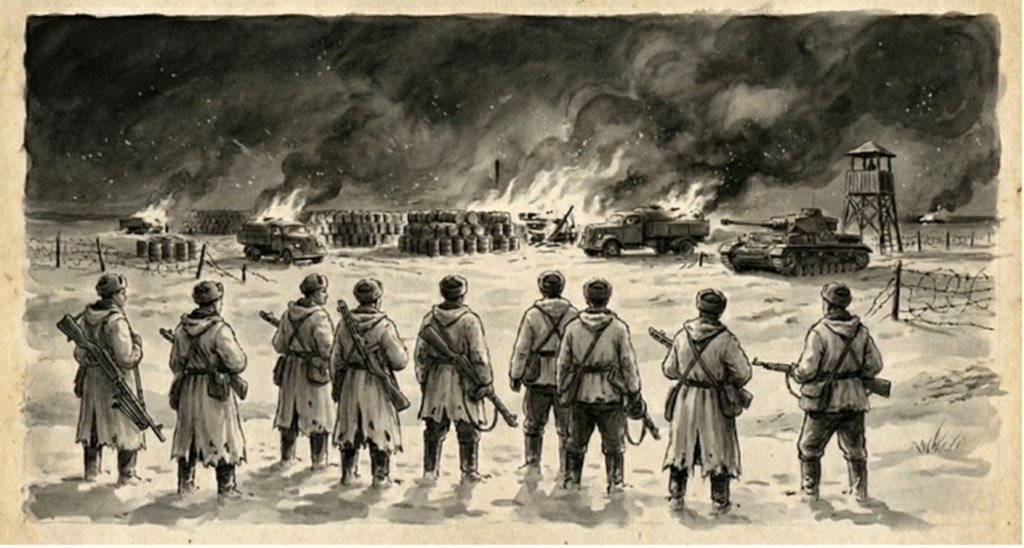
They climbed the far slope and spread out on their bellies. Ahead, light began to show: first a faint glow, then distinct points. Lamps on poles around the German fuel depot cast halos onto the white, turning stacked drums into lumps of shadow and metal.
Sergei raised his field glasses.
He saw rows of two-hundred-litre drums, four-high stacks that stood like dull black towers. He saw Opel Blitz tank-lorries, cylindrical tanks mounted on truck chassis, hoses coiled neatly. A Panzer IV crouched near the far edge, long 7.5cm gun pointing east, armour plates rimed with frost. A wooden watchtower rose beside the wire, a figure pacing inside, rifle slung. Barbed wire stretched in double belts, low and mean, frost blooming along every strand.
Inside the ring of light, German sentries walked their routes, breath smoking. One of them, a Feldwebel with a square jaw and a fur-collared greatcoat, stood near a small office wagon, a Schmeisser slung loose, face turned up to inspect the clouds as if searching for aircraft that would never come through that storm.
In the mess tent a cook stirred a vat of watery soup, head bowed, stirring rhythm as automatic as the drip of meltwater. In a corner of that tent, inside his tunic, a folded photograph pressed against his ribs: a cousin with round spectacles and a hesitant smile, face already illegal under Reich law, tucked away where it could touch the skin unpunished.
By one of the tank-lorries, a driver ran gloved hands along a hose connection and hummed something under his breath, a phrase from Schubert’s Winterreise that rose and fell like breath in cold. His fingers lingered on a valve handle with an intimacy that belonged more to a musician with an instrument than a soldier with equipment.
— There, — Sergei murmured. — Drums in blocks, trucks along edge, Panzer near tower.
— Sentries with Mauser, one or two with MP40, — Misha observed. — Dog kennel there, behind hut. I hear the chain.
A low bark floated out, followed by a handler’s curse.
— We go to work, — Sergei said. — Same drill. Misha cuts wire by third post, where snow drifts higher. Luka covers tower. Viktor prepares DP.
He looked at Yusuf.
— Keep nose open for mines.
— Whole field smells of metal and fumes already, — Yusuf answered. — Yet sharp teeth stand out even in crowded mouth.
They crawled forward again. Snow crept into sleeves, trousers, under collars. Fingers numbed inside wool. The sentry in the tower turned, rifle slung loosely as he peered into dark.
Misha reached the first belt of wire and flattened himself against the frozen earth. Frost crystals along the strands glimmered. He slipped his cutters from inside his coat, palms closing around the metal with careful pressure.
Each cut offered a small crunch. He held both ends of each strand, lowering them so they kissed snow without a sound. Time thinned. Breath rasped in his chest. Above, the sentry yawned and stamped his feet.
— He thinks about his stove, — Misha whispered. — Perhaps a girl somewhere too.
— Think about your cutter instead, — Sergei hissed.
Soon a low opening appeared, barely high enough for a man to wriggle through.
Sergei went first. Wire rasped softly along his smock as he pushed under, PPSh cradled against his chest. Yusuf followed, then Grigori with two grenades tucked close, then Viktor dragging the DP low.
Inside, drums rose beside them, cold giant coins stacked in the dark. The smell of fuel thickened, oily and invisible.
— Central stacks, — Sergei breathed. — We throw grenades there. Fire runs along the row. Then we go.
Grigori nodded, fingers resting lightly on cast iron.
— Count, — he whispered.
From inside the depot came the familiar small sounds of men at rest: a cough, the scrape of boots, the distant splash of someone using a latrine.
Sergei lifted his hand.
— One… two…
Grigori yanked both pins and arced the grenades. Black shapes flickered through the lamplight, vanished between drums.
— Three.
Misha’s PPSh roared a heartbeat later, stitching bullets along the base of the watchtower. Wood splintered. Above, the sentry stumbled, rifle clattering; his cry dissolved into the rattle of Viktor’s DP as the pan magazine turned. Luka’s Mosin cracked, its single report sharp as breaking ice.
Then the grenades went off.
Heavy, flat impacts. Drum walls blew out, and fuel geysered into air, a shimmering sheet that hung for an instant over snow before some fragment found spark.
Flame jumped. It seemed to leap even before sound reached them, tongues licking outward, then upward, turning the neat rows of drums into pillars of fire.
Shouts erupted.
— Alarm! Russians!
— Fire! Fire, for God’s sake!
Men blew from barrack-doors like beads shaken from a string. Helmets barely buckled, rifles clutched, boots slapping boards. The cook stumbled out of his tent with ladle still in hand, soup spattering across snow as a wave of heat hit him. The driver at his hoses flinched back as the tank-lorry beside him burst like a tin held to a forge.
The Panzer IV’s hatch swung open.
— Engine on! — the tank commander shouted down. — Move her out of the fire line!
Inside, the driver kicked the starter. The Maybach shuddered, coughed, then caught, exhaust pluming grey in the sudden furnace light.
Machine-gun fire lashed out from the far side of the yard, an MG 34 on tripod pouring tracers into the gully. Mortar crews sprang to their tubes, swinging them toward the flicker of muzzle-flashes in the snow.
— Back! — Sergei bellowed over the roar. — Same way! Go!
They ran inside the yard’s outer shadow, using burning drums for cover as best they could. Flame pushed their smocks against their backs; hair singed at edges.
A flare hissed upward from someone’s hand, spinning. It popped overhead, pouring magnesium-white across the field, flattening shadows.
For a heartbeat, the world froze: fire frozen in its leap, bullets frozen in their paths, human bodies pinned in sharp relief.
In that hard light, the sniper in the watchtower saw Sergei clearly: the angle of his jaw, the line of his shoulders, the dark of his eyes.
The Mauser barked once.
A round slammed into Sergei’s neck, just under the jaw, where artery and bone met. He felt the impact mostly as a firm, irresistible shove. The ground jumped sideways. The sky dropped.
He landed on his back, blinking through the dazzle. Cold snow cupped his head. His hands twitched, still trying to pull at his weapon. Warmth poured down into his collar, then steamed away.
— Lieutenant! — Pavlik screamed, stumbling toward him.
Lev tackled him, dragging him down as a burst from the MG dimpled snow where his legs had been.
— Move, Pavlik! — Lev rasped. — He spends his life already. You do not throw yours into same hole.
Mortar rounds began to walk across the field, each impact lifting snow and scrap metal into ragged fountains. One burst flung Viktor forward, DP flying from his grip as fragments shredded his thighs. Another landed close to Yusuf. Shards clipped his leg, his belly.
He slid, half-rolling, until his shoulder pressed against the Panzer’s track. The metal felt almost warm through his jacket. Smoke rolled over him like a slow, heavy tide.
— Iron sheep, — he whispered, lips finding a crooked smile. — I herded wool, and now I lie beside you.
Fuel dripping from a ruptured hose burst into flame beside his face. Light swallowed everything.
The others fell in their own ways: Misha spun by a burst that took him through lungs; Luka crushed when a burning drum toppled from its stack; Grigori torn by shrapnel; Anatoly and Lev caught in a mortar cone; Pavlik jolted backward as a bullet punched through his forehead.
For a few breaths, snow and fire mingled: white, red, black, orange, swirling together under the hammer of explosions. Drums popped open like seeds. Trucks sagged and melted.
Then sound went thin. Light shrank to a trembling core. Darkness stretched around it, patient, and folded over everything.
The lamp swung over the map again.
The soot on its glass drew a ring like a faint halo. The colonel’s finger rested beside the circle marked “Depot, est. two companies security, fuel for one Panzer division.”
Breath steamed in the dugout, nine plumes rising.
— Somewhere west of the Volga, — the colonel said, as if the earlier words had only paused mid-breath, — winter swallows the steppe, and our enemies feed their tanks from this point.
Sergei stared at his hand. It lay on his thigh, glove intact, veins beating faintly in his wrist. His throat felt whole. He touched his neck with careful fingers and found skin, scarf, the edge of a collar.
— You look like man who woke from very bad dream, Lieutenant, — the colonel observed. — Do you require feldsher before we begin?
Sergei raised his eyes.
— Comrade colonel, — he said slowly, — we already began.
Misha shifted, eyes scanning the familiar space: the lamp, the soot-ring, the map with its smudges.
— I remember your exact words, — he said. — Every scrape of your finger on that paper.
He pointed.
— You will say “fuel for one Panzer division.” You will tap exactly there.
The colonel’s hand paused, then reluctantly moved, almost because it had begun the gesture already. The finger landed on the circle.
— Fuel for one Panzer division, — he repeated, breath catching for a fraction of a second on the phrase.
Pavlik raised shaking hands to his forehead.
— I saw you die, — he whispered to Sergei. — In flare light. Your throat opened like…
Words failed him.
Lev touched his own neck.
— I lay behind you, — Lev said. — Mortar fragment through my chest. I choked on my own blood.
Yusuf’s nostrils flared.
— Fuel smoke, rubber, burnt paint, — he murmured. — Same smell as near that Panzer. Yet we stand far from it.
Grigori pressed fingertips to his temples.
— Shell-shock, — he offered weakly. — The mind sometimes plays entire theatres inside skull when body endures blast.
— Except we remember together, — Misha said. — Same scenes, same fire.
The colonel looked from one face to the next. His own jaw had stiffened, a pulse ticking near his temple.
— Men at front dream whole lives in one hour, — he said, voice hardening as if he shaped it against something inside himself. — You smell fire because fire waits ahead. You taste blood because war surrounds us. Reality remains simple: you breathe; enemy depot burns fuel for tanks that slaughter your comrades; Stavka orders destruction.
He slammed his palm on the crate.
— You depart at twenty-two hundred.
They filed out again.
In the trench, the boards gave the same creak under boots. Captain Djubin stood at almost the same spot, though now he smoked with more urgency, fingers cupped around the cigarette.
— You look as if you wrestled ghosts, — he said, eyes narrowing.
— Something like that, — Misha replied.
He glanced toward the open field.
— Again the snow.
Sergei pulled them into a small alcove where a collapsed dugout had left a sheltered corner.
— We treat this as real, — he said quietly. — We treat our memories as data. First assault: direct crawl under wire, grenades into central drums, full detonation, all killed by fire and fragments.
— Feels unpleasant to hear life summarized like after-action report, — Lev muttered.
— Truth carries its own tone, — Sergei answered. — This time we adjust.
He knelt, using a splinter of wood to trace lines in the packed snow.
— Depot lies here. Birches to the right, riverbank to left, gully straight ahead. We split into three trios, approach from three directions. When one group draws their fire, others move.
— Diversion from trees, — Luka said at once. — Forest gives cover.
— You, Lev, Pavlik with him, — Sergei agreed. — Fire from birches, throw grenades short to mimic platoon attack.
He pointed left.
— River approach: Misha, Yusuf, Viktor. Look for drainage culvert under wire. Once inside, you neutralise machine-gun nest and cover field with DP.
He tapped the central line.
— Gully again: myself, Grigori, Anatoly. We go for secondary fuel: trucks and outer drum rows, away from main cluster that blew us to pieces.
— Secondary tanks only, — Grigori echoed. — Less spectacular fireworks, more survivable blast.
Misha scratched his jaw.
— You reassured by word “survivable”?
— More survivable than last time, — Sergei said. — Which offered zero.
Yusuf watched snow drifting over the parapet, flakes swirling in the lamp-glow.
— Shepherd sometimes walks flock around wolf den from other side, — he said. — Still the same hill, same wolves, however.
— We give new hill a chance, — Misha replied.
They stepped off once more.
Across the snow, in the German depot, life unfurled along its own habitual grooves.
Feldwebel Otto Krämer finished writing in a notebook: fuel figures, consumption by company, arrivals from railhead. He capped his pen and rubbed at the ache between his brows. In his breast pocket lay a letter from Hamburg, paper already soft along the folds from repeated readings. His wife wrote of coal shortages, of their boy’s cough, of sirens that now howled above the Elbe.
In the kitchen tent, Gefreiter Ernst Vogel stirred the soup, thin broth with a float of cabbage and scraps of horse meat. Steam collected on the tent canvas and dripped down. Vogel slipped one hand inside his tunic and brushed his fingers along the hidden photograph: his cousin David in spectacles, smiling awkwardly in a garden. He touched the paper as if that contact might shield it from flames or discovery.
By a tank-lorry, Gefreiter Hans Becker ran his bare fingers briefly along the cold metal of a valve, then blew on them. His lips moved with a tune, the melody of a winter song from years before. Each time he reached a certain bar, words from a poetry professor in Leipzig flickered through his memory, some lecture about cycles of history, about time looping through the same wars in different uniforms.
On the watchtower, Obergefreiter Karl Fuchs yawned, rifle resting against the rail. He rubbed his eyes and blinked at the snowfield, the patterns of dark and light that shifted under the low clouds.
— Same darkness, — he muttered. — Same ghosts on that snow.
He shook his head, as if to dislodge a lurking image. For a heartbeat he saw shapes crawling there, heard distant shouts, smelled fire. Then the lamps below and the familiar layout anchored him again.
— Too many patrols, — he told himself. — Brain invents things when eyes have little to do.
From three directions, nine white-clad figures advanced.
Left, along the riverbank, Misha led, belly close to the crust.
— There, — Yusuf breathed, pointing at a dark circle half-buried in snow. — Drainage pipe.
— German engineer gave us mouse-hole, — Misha said. — We become mice.
He slid into the culvert feet-first, rifle balanced across his chest. Concrete scraped smock and wool. Ice brushed his spine. On the far side, he wriggled out into a shallow drainage ditch, heart thudding.
— Clear, — he whispered back.
Yusuf and Viktor followed. Once inside, they crept along the ditch toward the nearest MG-34 position, where two Landser hunched under a tarpaulin, gun resting across sandbags.
— Hands freezing, — one complained. — I feel every round through the metal.
— At least gun works, — the other answered. — Try standing in that wind without it.
Misha sighted along his PPSh.
— Quick, — he murmured. — Before one of them looks down.
His burst tore through canvas and bodies. The MG crew collapsed. Yusuf rushed forward, finishing the work with a short, brutal swing of his stock.
— Machine-gun silent, — Viktor said. — Good start.
Right, among the birches, Luka took up position behind a trunk, Pavlik and Lev flanking him.
— Remember, we aim for noise, — he said. — Sound of bigger unit. Fire from different spots, yell like entire battalion.
He breathed out, then squeezed the Mosin’s trigger. The shot cracked. Pavlik responded with a salvo from his PPSh, rounds hissing through branches.
— Uraaa! — he roared at the top of his lungs.
Lev hurled a grenade into empty snow between trees and depot, the explosion sending a towering plume of white upward.
Inside the wire, panic flared.
— Attack from the woods!
— Russians in the birches!
Machine-guns pivoted. Mortar crews re-aimed. Shell after shell began to fall along the tree line, shredding bark, sending splinters and snow in all directions.
Under that cover, Sergei’s group slipped through a freshly cut gap in the wire at the centre, lying flat between drum rows and the parked tank-lorries.
— Trucks, — Sergei whispered. — Secondary tanks. We place charges there. Less fire in our faces.
He crawled under the nearest tanker, the cold metal pressing against his back. He lashed a satchel charge to a crossbeam, fingers stiff.
— Fuse length? — Anatoly murmured beside him.
— Ten minutes, — Sergei answered. — Enough to run, if legs listen.
They moved along the line of trucks, placing charges, threading fuses.
In the mess tent, Vogel froze with ladle in hand as the first explosions from the birches rolled in.
— Artillery? — he asked, voice tight.
— Mortars, — a passing Unteroffizier barked. — Get outside if you care about your roof.
Vogel ducked his head through the tent flap. Out in the yard, flames had not yet risen, yet something inside him tensed, a premonition born from nothing he could name. He saw white shapes flicker near the fence, heard the flat crack of a Russian rifle that felt almost familiar.
— Again, — he whispered to himself, though he could not have explained that word.
At the tank-lorries, Sergei checked his watch.
— Seven minutes, — he said. — Time for us to vanish.
As they turned away, a young German sentry trotted past the trucks, heading for the latrine, Mauser slung. He saw movement at the edge of his vision: white shapes near drums, glints of metal. Startled, he swung his rifle up.
— Russians!
His shout cut across the yard.
The nearest machine-gun that still covered the gully spat, sweeping the area with rounds. Snow jumped around Sergei’s trio. Grigori dropped, a bullet through his shoulder. Anatoly’s radio set exploded in a shower of Bakelite shards.
— Leave it! — Sergei shouted. — Run!
They sprinted for the gap, grenades now useless weight. Behind them, the first satchel charge blew, turning one tanker into a fireball. The shockwave tossed them forward. Another truck went, then a third. Flames clawed upward, joining the glow from burning birches where fragments and shells had set tree-tops alight.
On the river flank, Misha and Viktor hosed the yard with fire, keeping heads down while they fell back toward the culvert.
— Move! — Viktor growled. — Before heat bakes us.
A mortar shell, mis-aimed in panic, landed almost at the mouth of the drainage pipe. The blast flung earth and rock. One splinter sliced across Yusuf’s thigh, another smashed into Viktor’s ankle.
— Keep crawling, — Yusuf gasped. — Fire waits behind.
They wriggled into the pipe as flames rushed above, sucking oxygen.
Right, among the birches, Luka’s trio withdrew by leaps, Pavlik limping from a grazing fragment.
— Every tree feels hungry for steel, — Pavlik panted. — We move before they feed.
They reached their own line in tatters, singed, but breathing.
Behind them, the depot burned again. This time, flames climbed from the tank-lorries first, then reached drums, spreading in a slower, staggered pattern. The Panzer, half-driven out of danger, caught fire along its engine deck when a flying fragment tore through its rear armour.
In the trench, Captain Djubin stared at the glow.
— You did something large, — he said as Sergei’s survivors tumbled back over the parapet. — Whole horizon glows.
Lev sagged onto a crate, hands shaking.
— We hit secondary tanks, — he managed. — Trucks for Panzer units.
— Some of us reached home, — Misha added, voice thin. — Unlike last time.
Djubin frowned.
— Last time?
Misha stared at him, then at Sergei.
— You explained first version already, lieutenant, — he said.
Sergei opened his mouth. Lamp light cut sideways across his vision.
The dugout walls pressed close again. The lamp swung softly. The map waited, red circles bright. The colonel’s finger hovered above the depot symbol.
Nine breaths steamed in the cold air.
— Somewhere west of the Volga…
This time the words came like the echo of a shout inside a canyon.
Yusuf closed his eyes for a heartbeat.
— Again, — he said quietly.
The colonel faltered.
— What?
— We already crossed that snow three times, — Yusuf replied. — Once we all died among drums. Once some of us did. Once again just now. Yet here we stand.
Grigori tilted his head.
— I can quote lines I never read, — he said slowly. — Whole passages.
He drew a breath, and words spilled out, some German, some Russian, images of winter roads and wasted men, phrases arranged in metrical patterns that belonged to poems he had never held in his hands.
— My mind receives fragments from other lives, — he concluded. — As if I read from a shelf that stands beyond this dugout.
Misha stared at the lamp.
— That soot mark, — he said. — There, like a bird on the glass. I watched it earlier, right before you told us about dogs.
— I told you about dogs once, — the colonel snapped. — You raise your voices because nerves fray.
Sergei listened to his own pulse beating at his temples.
— Comrade colonel, — he said, — treat our memories as real for a moment. First assault: direct approach, all killed. Second: three trios, hit secondary tanks, some survived until glow faded. Each time, we returned to this moment.
He lifted his hands slightly.
— That suggests some loop. Closed ring. We move along path, die, then find ourselves back at start.
— Save philosophy for after victory, — the colonel replied sharply, yet something in his eyes had shifted. — Until Front Commander tells me time abandons straight lines, I obey the simple ones.
He jabbed a finger at the depot symbol.
— Mission remains. You adjust tactics as you see fit. Just make sure their tanks stand dry when dawn comes.
They left him again.
Out in the trench, snow still fell, wind still carried fine grains that hissed along boards.
— At least we succeed in burning fuel each time, — Lev said quietly. — For someone out there, those Panzer crews curse our brave little deaths.
— I wonder if they remember, — Grigori murmured. — On the other side.
Across the snow, in the depot, Feldwebel Krämer leaned over his logbook and paused, pen hovering above the page. His hand trembled. Drops of ink gathered at the nib.
— You ever feel, — he said to Becker, who had ducked into the office wagon to escape the wind, — that you already lived through something?
— Every guard shift feels like that, Herr Feldwebel, — Becker replied. — Same snow, same wind, same soup.
— I mean something stronger, — Krämer insisted. — Flames, for example.
He rubbed his eyelids with thumb and forefinger.
— I see our fuel yard on fire in my sleep. Drums exploding, trucks turned over, men screaming. Then I wake, and everything stands as usual.
Becker hesitated.
— I see that too, — he admitted. — A Russian officer running with a submachine gun, flare light on his face. Every time I blink during guard, that picture lurks.
In the kitchen tent, Vogel paused mid-stir. The soup circle stilled.
— Ernst? — a comrade asked. — You daydream?
— I smell burnt rubber, — Vogel said. — As if tyres smoked right outside canvas.
He pushed the ladle through the liquid again.
— I dreamed it during my last nap. Whole sky red. Then I woke with taste of ash.
By the watchtower, Fuchs leaned on the rail, the MG-34 resting ready beside him. Under his breath, he muttered a snatch of the Lord’s Prayer, syllables shortened by habit.
— Deliver us from evil, — he whispered, — and from snow that brings white ghosts.
He squinted into the dark.
— Those ghosts keep coming.
The next assault brought prisoners into the pattern.
This time, Sergei sent Misha’s trio deliberately toward a young sentry whose route he now predicted from prior deaths.
— He walks eight paces, stops, looks toward birches, — Misha said during planning, voice flat. — Then turns back and glances toward river. Rifle moves exactly so. In one run I watched him fall. In another, he stumbled, shot Yusuf. I remember his face. He cannot be more than nineteen.
— We try to take him alive, — Sergei decided. — A prisoner might carry information we can use, or at least a voice that proves we share this curse.
— You trusting a German boy to help us break time? — Luka asked.
— I trust additional variables, — Sergei replied. — Our loop hates change less than it hates us.
Under the snow that night, everything unfolded with a familiarity that now scratched at their nerves: the gully, the reek of fuel, the wire glimmering like hoarfrost snares.
Misha slid close to the sentry’s path, lying almost invisible in the drift. He heard boots crunch, the rhythm he already knew.
As the boy passed, Misha exploded upward, driving a shoulder into his thighs. The Mauser flew from the sentry’s hands. Both men tumbled into snow.
— Quiet, little brother, — Misha hissed in his ear, wrestling his arms behind his back. — Shout and we all wake up in the same nightmare again.
The boy thrashed once, then froze as cold metal pressed against his neck. His breath came in ragged bursts.
— Do you understand me? — Misha asked in German. — Do you want to live?
— Yes, — the boy gasped. — Yes.
— Then stay still.
Yusuf snapped a length of German signal wire around the boy’s wrists, pulling it tight. Viktor gagged him with a strip torn from his scarf.
— One Hans in our pocket, — Misha murmured. — Maybe he speaks sense later.
Back at the trucks, charges went in again. In the birches, Luka’s trio shouted and fired. The main pattern held, yet new branches sprouted.
During withdrawal, a confusion of shapes near the fence led to catastrophe.
Luka’s group, pressed hard by mortar fire, veered too far toward centre. In the dark and snow, Soviet sentry posts along their own line saw shapes approaching the parapet. A nervous private, half-frozen and half-blind, raised his rifle.
— Germans! — he shouted. — In our wire!
Without waiting for an answer, he fired. Others fired with him, bullets lashing the snowfield.
— Friendly line, you idiots! — Luka bellowed, but his words vanished under the crackle.
A round struck Pavlik in the shoulder, spinning him. Another took Lev low in the side.
— Our own boys welcome us home with lead, — Lev gasped as Luka dragged him. — At least they aim in the right direction for once.
On the river flank, Misha’s trio and their bound prisoner stumbled toward the culvert. A shell landed too close; the blast hurled them into the pipe. Inside the concrete throat, bodies piled, legs tangled. The young sentry’s head struck the wall. He sagged, eyes rolling.
— Stay with us, boy, — Yusuf urged, shaking him.
Only a wet groan answered.
Above, the depot burned again, this time with a slightly different pattern of explosions and screams.
Later, back in the trench—then, an instant later, back in the dugout—the memory of the bound boy’s limp form lay between them like another corpse.
— He still dies, — Misha said dully. — Even when we spare him.
— Perhaps in some other run he lives, — Grigori murmured. — We catch him in different way.
— You speak as if we swim in a river full of branches, — Yusuf said. — Each time we choose one, the others still flow somewhere.
After that, both sides began to speak more plainly about the loop, although neither could explain its mechanics.
Between assaults, in one of their strange in-between evenings, Sergei found himself sharing the dugout with the colonel and a bottle of vodka cracked from some hidden box.
— In Leningrad, my family vanished during siege, — he said quietly. — Shell, hunger, disease, I never learned which. I marched south with 62nd Army and thought that gave their deaths shape. Now I die and rise and die again on this patch of snow. My engineering teacher admired elegant solutions. This carries anything but elegance.
— My brother lies somewhere near Smolensk, — the colonel replied. — One bullet, one fall, and then earth. That seems cleaner than this ghost work.
He took a swallow, grimaced.
— Do you still feel duty, lieutenant? After third life? Fourth?
— Duty feels stronger, — Sergei said after a moment. — If flesh returns each time, something else must carry meaning. Fuel for our enemy still burns. That fact does not loop. We cut it again and again, perhaps we carve some deeper wound in their war.
Across the wire, Feldwebel Krämer confessed his nightmares to Oberleutnant Weiss in the lit interior of the office wagon.
— I see the same faces, — he said. — Same Russian officer, same Tatar with dark eyes. They appear in different corners of the yard. Sometimes they crawl under the wire, sometimes they walk toward us with hands raised. Always flame afterwards.
— I see them too, — Weiss answered, fingers tracing the spine of a book that lived in his memory more than his pocket: a volume of Nietzsche that had talked of eternal recurrence. — Perhaps we stand inside a circle only philosophers admired in lecture halls.
— Philosophers sit in warm rooms, — Krämer growled. — They talk about eternal return and refill coffee. We smell petrol and singed hair.
— Does duty change inside such a circle? — Weiss asked. — If we stand fated to fight the same night endlessly, does obedience gain more weight or less?
Vogel, the cook, lay awake on his bunk with the photograph of his cousin hidden under his shirt and wondered whether David dreamed him in some mirror-city, both of them trapped in different loops of fear. His fingers moved over the outlines of David’s face, memorising every curve as if repetition might save it.
Fuchs, the machine-gunner, whittled a small cross from a scrap of wood between alerts, lips shaping murmured prayers. The next time Russians came across the field, he promised himself, he would wait for a clear weapon in their hands, clear threat, before he fired. He rehearsed restraint as carefully as he had once practised trigger control.
The final cycle arrived with a strange calm.
By then, death had come from every angle:
A bounding mine that leapt waist-high and shredded their trio in a shower of ball bearings.
A Nebelwerfer salvo that draped shrieking fire across the gully, leaving limbs and boots scattered among charred snow.
A misdirected signal flare that lit them perfectly for every German rifle along the fence.
A panicked burst from their own Maxim that saw white smocks and assumed German winter camouflage, cutting them down before shouts reached the post.
Each time, the dugout returned, the lamp swung, the map waited. Memory layered atop memory until each man’s mind felt crowded, full of overlapping paths, failed approaches, last words.
At some point they abandoned counting.
They also stopped arguing about the loop’s existence. Even the colonel accepted it with the fatalism of a man who had seen too much.
— Orders still arrive from Front, — he said. — My telephone still crackles with Stavka’s voice. Time plays tricks on us, yet fuel still flows toward their tanks. Until something higher than this rank relieves me, I send you.
The nine met one last time at the trench edge before an assault that felt different because they named it so.
— We walked every trail, — Misha said. — Gully, river, birch, minefield, culvert. We crawled, we ran, we dug, we set charges.
— We took prisoners, — Luka added. — We spared that boy once, held our fire another time.
— We burned main tanks, secondary tanks, even drums near the office, — Lev said. — Those Panzers must feel thirsty in every possible version of this night.
— Still the lamp, — Grigori murmured.
They fell silent. Snowflakes drifted lazily past the trench lip, catching in their eyelashes. The sky above had cleared enough to show pinpricks of stars, cold and bright.
— So we test refusal, — Sergei said at last. — We walk straight at their wire with hands raised, weapons slung, bolts open. We speak. We ask to surrender if they wish. We ask them if they share this circle.
— You believe speech can crack a ring that bullets and fire leave untouched? — Luka asked.
— I believe we have no other experiment left, — Sergei answered.
Yusuf nodded.
— When shepherd grows tired of running from wolves, he stands up, opens arms, and shouts. Sometimes pack flees from strange shape. Sometimes they bite his throat. Yet at least he stops running.
They checked weapons one last time, more out of habit than necessity. PPPSh drums seated, Mosin bolts smooth, DP’s pan heavy. Then they cleared chambers, slung rifles across their backs, and climbed over the parapet without attempt at stealth.
Nine men in white smocks walked into the open, line broken only slightly by gullies and hummocks. Their hands rose slowly to shoulder height, palms outward.
From the depot, sentries spotted them at once.
— Movement on the field!
Binoculars they had already raised a hundred times came up again. Glass reflected starlight.
— Weapons down, hands up, — one said. — They walk like men headed for chapel, not raid.
— Helmet straps unfastened, — another observed. — Strange.
Feldwebel Krämer strode to the wire.
— Halt! — he shouted across the snow, voice carrying. — Stop where you stand!
The nine halted.
Sergei lifted his voice, calling in German that turned the air between them into a fragile bridge.
— We come without intent to fire! We want to speak!
Weiss joined Krämer at the wire, coat open, breath smoking.
— Speak, then, — he called back. — Say something that justifies this parade.
— We die here again and again, — Sergei shouted. — We burn your fuel, you shoot us, your depot explodes, our bodies freeze. Then we wake in a dugout and you wake in your barracks, and the night begins again.
He spread his arms wide.
— We come without weapons in our hands. Take us prisoner if you wish. Or say you share this circle, and we find some other way together.
Misha muttered out of the corner of his mouth.
— Philosophy on the steppe. Professors would clap.
Yusuf watched the faces beyond the wire.
— They heard that speech in another run, — he said softly. — Look at their eyes.
Weiss’s jaw clenched. Images crashed through his mind: flames, Russians in white crawling among drums, the vineyard smell of fuel, Fuchs firing, bodies falling. The words “again and again” struck something already cracked inside him.
— Perhaps he speaks truth, — he said under his breath to Krämer. — At least inside our skulls.
— Truth in war lives in orders, — Krämer replied, though his voice lacked old certainty. — Orders say: hold fuel depot, engage enemy.
He raised his voice.
— Throw down your weapons and move forward slowly.
— Our weapons already hang useless, — Sergei answered. — We come as men only.
They took a few more steps.
Up in the watchtower, Fuchs stared through the sight of his MG-34. His breath came shallow. Lines on the snow blurred into shapes he had seen in every dream for what felt like months.
White figures advancing. Hands raised. Words carried on wind that his mind insisted had been shouted countless times.
His memory jumped: partisans in forests, white cloths turning into grenade flashes, comrades torn.
— They trick again, — a voice inside him insisted. — They approach and then pull out fire from under coats.
Another voice, quieter, murmured the Lutheran prayer he had repeated since childhood.
— Deliver us from evil.
To his right, Becker said something about holding fire, about surrender. To his left, someone else called that this did not look like an attack.
The words slid over Fuchs’s ears without anchoring. Fear had built its own groove in his nerves, a channel deeper than reason. His finger curled around the trigger.
— Wait, Karl, — Weiss shouted from below, hearing a change in the gunner’s posture. — Hold your fire!
The order reached too late.
The MG-34 thundered. Tracer lines stitched the snow, a glowing arc that intersected the Russians’ line.
Misha jerked first, chest punched open, the old scar on his cheek briefly lit by muzzle-flare before his body folded. Luka staggered as rounds plucked at his shoulders and throat. Lev took a burst through the hips and went down in a spray of red on white. Pavlik crumpled as a round found his head. Viktor twisted, hands clutching his stomach in reflex. Anatoly and Grigori toppled together, one hand still reaching outward as if to grab the air.
Yusuf’s legs buckled under him, bullets scything through his thighs. He sank to his knees, then to his side.
For an instant, Sergei remained untouched at the centre of the storm. He saw Weiss tackle Fuchs from behind, wrestling the gun aside.
— Stop, damn you!
He saw Krämer’s face, strangled between fury and horror. He saw Becker frozen, fingers rigid around a useless rifle. He saw Vogel in the doorway of the mess tent, ladle in hand, mouth open.
Then a final, ragged burst spat from the MG as Fuchs’ hand spasmed under impact. Rounds caught Sergei across the chest. The world jumped sideways.
He fell backwards, sky swinging into view, stars like ice shards overhead. Snow cushioned him. His lungs refused to draw air. Warmth spread under his back.
— It never changes, — he whispered, though whether the words left his mouth or stayed inside skull no longer mattered.
His vision narrowed to a tunnel: nine forms sprawled in scarred snow, Germans running, shouting, some already dropping to their knees beside the fallen, others staring in mute shock, the MG barrel smoking like a guilty limb.
Darkness rose one more time.
When light returned, it came through the same lamp-glass, around the same soot-ring. The same map hung on the same wall. The same colonel’s hand hovered above the same circle.
Around the crate, nine men gathered. Their faces carried all the layers now: the original youth, the fatigue of dozens of deaths, a strange clarity that grew only in those who had passed the same threshold too often.
The colonel’s voice began its familiar pattern, then faltered.
— Depot, west of the Volga, — he said softly. — Fuel for one Panzer division.
His hand dropped.
— You know the rest.
Sergei met Misha’s gaze, then Luka’s, then each of the others’. No one spoke for a time. Words felt small.
Outside, beyond the dugout roof, birch-skeletons still scratched at the sky. Frozen rivers still carried ice westward. Fuel drums still stood in the snow, half-buried, inside wire where German sentries paced with rifles and submachine guns. In the yard, a Feldwebel who once studied philosophy in Leipzig still missed his wife, a cook still hid his cousin’s picture, a driver still hummed Schubert, and a machine-gunner still muttered prayers between bursts.
All of them lived inside the same ring, duty coiled around their lives like wire.
Later that night, along a blackened treeline under star-pricked frost, nine silhouettes moved again. White smocks blurred into snow. Weapons hung at their shoulders, heavy as verdicts. Breath steamed from their mouths, each cloud vanishing almost at once into the greater cold.
They walked with the steady pace of men who had already died in every imaginable fashion and still stepped forward. Plank-dugouts, lamps, maps, orders: those waited behind. Ahead lay wire, drums, engines, other men with their own maps and lamps.
Somewhere between, in the deep, unmarked snow, the circle closed and opened, closed and opened, as winter swallowed the steppe again and again, and duty, stripped of all illusions, persisted inside nine skulls long after any single heartbeat yielded to the frost.