
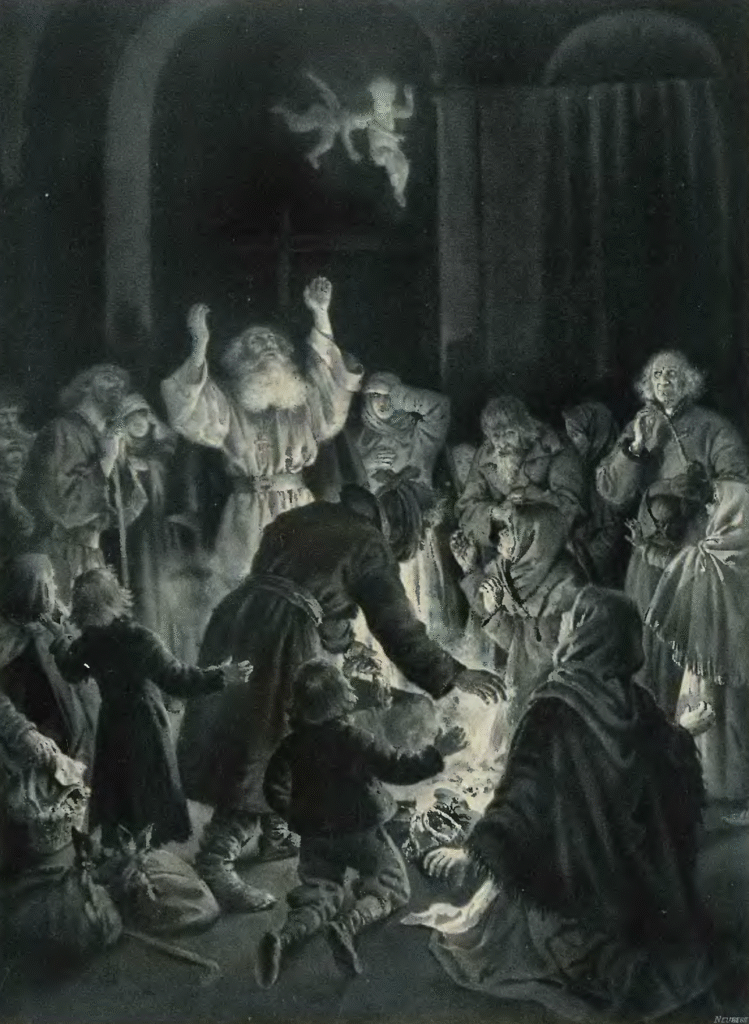
Before you enter the poem—whichever tongue you choose, or each in turn—I offer a brief confession. After two years and seven months I have written again in Polish, and I feared the path to my own speech had grown over; the thought weighed heavily. I wished to speak of a Polish observance that runs against the flashy, pop-cultural carnival of All Hallows’ Eve embraced by children today. I quarrel with no revel, yet I would raise into view another rite—equally old, equally lovely. Each language here keeps a chamber in me: Polish, the cradle that formed me and still houses my thinking; English—stubborn, brave Hiberno-English—the foster home that received me and grants me ease; Ukrainian, the speech of my father and grandparents, carried into the Małek family by my grandmother, who taught it to my father early and carefully; and Russian, learned under threat, which yet carries a peculiar charm—a power that seems to turn victims into lovers—once driven from my mouth by grief when the invasion began and Bucha and Irpin entered our sleep, yet later returning as I recalled Berdyaev and Shestov, Pushkin, Count Tolstoy, Gogol, Dostoevsky, Lermontov, and the Cossack lullaby my father sang. From single words to whole sentences, the voice returned, and from that wrestle with language and self came this poem—a small prayer in four tongues of one soul. And as a bonus, in an act of my own defiance, I set it as well in medieval Latin—a deliberate choice of a “dead” language over the living—because its sound carries something almost magical, even eschatological, in the ear. The task proved stern: every version holds to iambic pentameter and a strict rhyme design—a discipline demanding in one language and fiercer still when carried, step for step, across five.
Pierwsze Precatio
To z wami — z wami — kroczyłem w niebiesiech blasku,
Z wami, gdzie modrzew szepce nad strumieniem
A wiatr, kochanek, w nocy jak w potrzasku
Łez nici naniza na szyby — niby dzień promienie
Więc cisza — Cisza — znajoma jak po upadku gromu
Patrzymy na świat w oddali karminowy;
Z mgieł dźwięk się budzi, podnosząc łoskot dzwonu
gdy trwoga ciska ludzi niczym kamienie wskroś przestwór pirynowy
Życie w swej pełnej fanaberii… Zaledwie krótki akord,
Maleńka nuta z symfonii wyroków śmiertelnego losu
Gdyśmy jak chłopcy w euforii ruszyli na jego krwawy zaciąg
I żywi nam śpiewali smutne precatio na wiele głosów
Bo tu nad grobem, gdzie dzień do snu układa głowę
W upartej Polsce — po polsku kołaczące serce
W noc Dziadów oświetla duchom drogę
a rankiem więdnie… Jak zapomniany kwiatek w butonierce
First Precatio
With ye — ye all — I walk’d in heav’n’s light,
With ye where larches whisper o’er the streams;
And wind, a lover, rock’d in arms of Night,
Casting his tears to smoke-dimm’d, window’d gleams.
So hush abides—well-known when thunders roll—
We mark the world afar with carmine gaze;
From mist a bell climbs up to sound its toll,
Athwart sweet pyridine in crimson blaze.
Life, wayward, strikes a chord—a fleeting word—
Begot of reckonings of mortal fate;
We lads, exultant, muster’d to the horde,
The living raise first precatio’s weight.
Here, by the graves—where Poland breatheth most,
Among her realms and through enduring verse,
At Dziady’s Night her beacon flames for ghosts,
Then crackles low as dawnward beams disperse.
Первое Precatio
С вами — да с вами — ходил я в вы́шний свет,
С вами, где ли́ствен шепчет над ручьём;
И ветр-люб в объя́тьях Ночи шлёт ответ,
Роня́я слёзы на закопте́лый дом.
Так тишь стоит — знакомая по грому;
Мы зрим далёкий мир в отливе — багрец;
Из мглы восходит звон, подвластный грому,
Сквозь пири́новый катится огня венец.
Жизнь своево́льна — бьёт лету́чий запев,
Взращён счисле́ньем мра́чной его судьбы;
Мы, о́троки, в востóрге вста́ли — напев,
Живы́е ны́не возно́сят чин мольбы.
Здесь, у гробо́в, где По́льша ды́шит всей,
Среди её держав и древних слов,
В Ночь Дзя́дов свет её гори́т для тене́й,
А к у́тру тре́ск смолка́ет — та́ет сно́в.
Перше Precatio
З ва́ми — та з ва́ми — йшов у ви́шній світ,
З ва́ми, де мо́дрини шепчу́ть над струмко́м;
І ві́тер-лю́б у ло́ні Но́чі шле заві́т,
Сльо́зи ллє по закіптю́женим скло́м.
Тож ти́ша держить — знáна по грома́х,
Ми світ здаля́ споглядає́м в кармі́ні;
З імли́ встає́ набáт у ва́жких уда́рах,
Крізь пірі́новий коти́ться вогонь — в рубі́ні.
Життя́ сваво́льне б’є летю́чий ла́д,
Поро́джене числе́нням фата́льної долі́;
Ми, юнаки́, у за́хват ста́ли в ряд,
Живі́ тепе́р підно́сять пе́рше precatio пово́лі.
Тут, край моги́л, де По́льща ди́ше поміж тіне́й,
Помі́ж краї́в і в ві́ршах — на́че вівта́р;
В Ніч Діди́в її мая́к пала́є для тіне́й,
А з ра́ннім про́менем тріщи́ть — згаса́є жар.
Prima Precatio
Vobíscum — vōs omnēs — per caelī lūmen portābar,
Vobíscum, ubi laríces super undās susúrrant;
Et ventus amāns in ulnīs Nóctis gestābar,
Lacrīmae in ātrās fenéstrās tarde stíllant.
Quiēs resídet — nōta post tonítrūs fragórem,
Longínquum órbem spectámus in rubóre;
Dē nēbulā campāna surgit ad sonórem,
Per Pyridīnam dulcem fulget Tyriō colóre.
Vīta vagánsa percutit brévium carmén,
Ex ratiōníbus fatī mortālia facta;
Nōs puerī laetī conscrīptī ad ágmen,
Viventēs tollunt prīmae precatiōnis pácta.
Hīc iuxtā túmulōs Polōnia spīrat audax,
Per rēgna multa atque per sānctam memóriam;
In Nocte Dziadórum lucet antīqua fax,
Et prīmā lūce crepitus silet históriam.