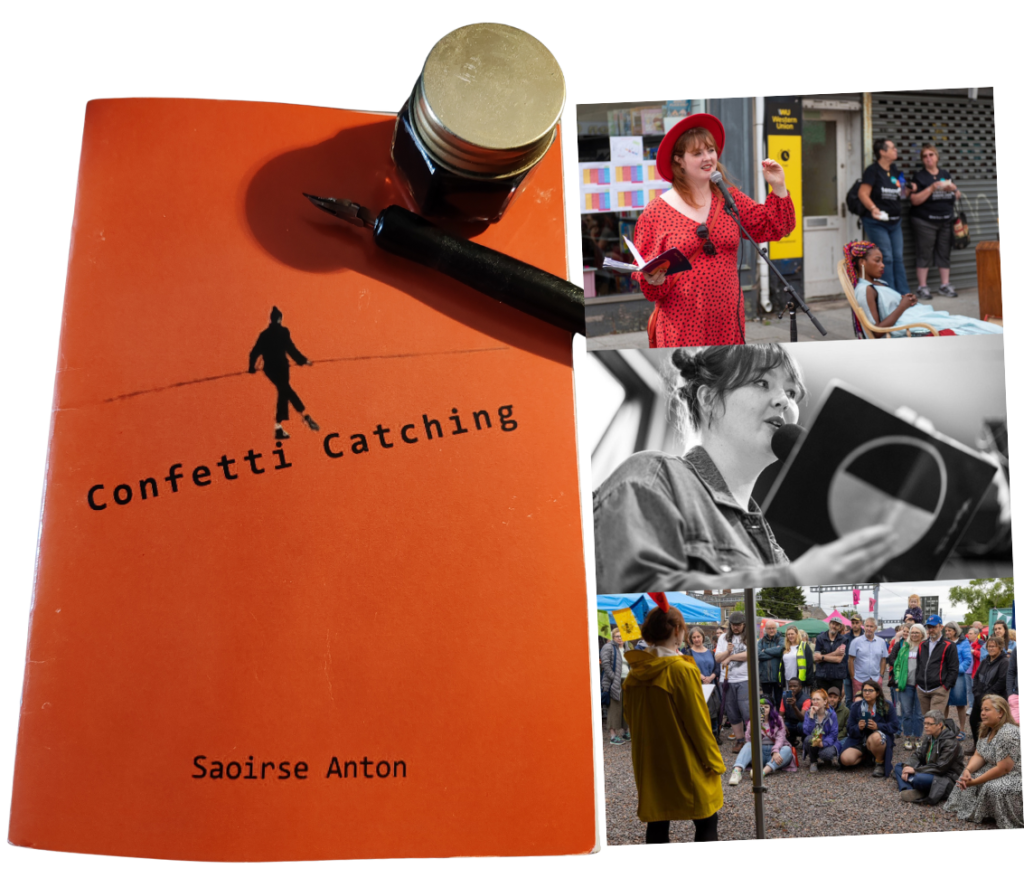
Which creature returned from every road with its own tail between its teeth, and by chewing that circle kept a travelling village fed, warm, and awake? Rain had crept along the Welsh canvas in a thin, patient way, and the tent—one of those temporary heavens whose ribs live on borrowed metal—had answered with a soft drumming that sounded like hands practising applause in secret. I held Confetti Catching with that same sense of borrowed shelter. The pamphlet carried the air of the Circus Village at Swansea—rope-sweat, tea-steam, damp grass, a hint of mascara near a mirror, the dry tang of sawdust that clings to socks after the show has already fled into night. Saoirse Anton wrote these poems in Spring 2023 while living in her “little tent” during her month as Production Poet in Residence with NoFit State Circus on Sabotage, and she placed that provenance plainly, without ornament, as though honesty belonged among the first virtues of the page.¹ A reader could treat such a scene as charming, though charm alone would fail the book. Anton’s lyric mind turned the circus into a method for knowing the present. The big top functioned as a lens that magnified our era’s core arrangement: human beings gathered under pressure, sustaining wonder through shared competence, with risk hovering near every kindness. Instead of offering a touristic gaze upon “circus life,” she treated the apparatus as moral grammar. Flight depended upon trust held in small, repeatable acts; care entered through those acts and thickened into labour; the labour, performed with loyalty to what the audience never sees, kept the whole bright risk from collapsing. The book’s originality grew from that insistence that poetry approach spectacle through its infrastructure, so that the reader began to sense how modern life itself hangs on the unglamorous fastening of things. I remembered a winter evening at the turn of 2017, moving into 2018, when I met her—very young, a girl whose openness carried the confidence of someone who had already made peace with curiosity. Conversation moved with ease, yet her phrases arrived with a precision that many seasoned writers chase across decades. Her speech held lyric charge without any fog of vagueness; each sentence carried its own clean edge, as though she had learned early that beauty thrives when it serves accuracy. I listened with the particular attention of a man who has lived in poetry for over three decades, and who has edited and redacted more pages than he cares to confess, yet her casual talk offered no loose thread asking for repair. The thought came then, uninvited, that her light would soon outshine many who wore the titles of writer or scholar with proud stiffness, and years have rewarded that first apprehension with a kind of stern delight.² The public record, checked with care, confirms the shape of her practice without exhausting it. Anton describes herself as writer, performer, producer, and she has carried her work across festivals, readings, commissions, and performance settings. Her debut pamphlet Confetti Catching appeared in February 2024, and her poems have also appeared in Rise Up and Repeal from Sad Press Poetry and in Cardiff 75: Writings from the City from Parthian Books, while commission work has linked her to NoFit State Circus projects such as a Clifton Street Festival poem.³ Her profile also notes writing for children’s poetry films commissioned by Studio 9 and RTÉ, including An Oíche is Speisíalta (2020) and Navigating the Rough Seas (2022).⁴ Such facts place her within a contemporary ecology where poetry travels through stage, screen, anthology, and community, and where the poet often functions as cultural worker as much as solitary page-maker.
Yet scholarship loses courage when biography becomes a substitute for reading. Anton’s value emerges in the poems’ thinking, and that thinking arrives through materials: rigging, kitchens, trapdoors, call-times, crossed wires, mud, weather, bread, the long chain of minor tasks that keep a show alive. Her diction keeps its plainness like a virtue, though that plainness carries a disciplined music. White space behaves as breath. The line breaks resemble the pauses of backstage coordination, where speech stays lean because time stays scarce. Even humour carries a practical weight. Through these means she builds a philosophical stance: contemporary existence resembles a touring camp—temporary structures raised fast, exposed to storm, held together through trust and competence, visited by audiences hungry for meaning while barely noticing the labour that enables their brief enchantment. Hannah Arendt’s triad—labour, work, action—offers a sturdy frame for Anton’s circus-world, though the poems themselves supply the evidence without requiring theory to flatter them.⁵ Labour returns in the kitchen, in washing-up, in the daily repeats that keep bodies fed. Work appears in the routines, the apparatus, the practiced craft that turns risk into form. Action arrives under lights, where plurality and appearance meet and a human being reveals herself through deed. Anton refuses to sever these modes. Many writers praise performance while letting labour vanish behind velvet. Anton keeps the kettle and the bread beside the trapeze. The backstage becomes a public realm of its own, and the poem becomes a civic document for the unseen. Simone Weil sharpens that perception. Her ethic of attention treats the act of sustained looking as a moral discipline, and she never permits attention to slip into sentiment.⁶ Anton’s poems practice such attention with a rigger’s vigilance. She honours “carabiners,” “links,” “pulleys,” “king poles,” and “ropes,” which appear as more than objects: they function as the poem’s theology of fastening. A reader trained by modern spectacle tends to look upward toward flight; Anton trains the gaze toward what holds flight from collapse. The moral claim follows quietly: societies endure through their carabiners, their unnoticed links, their kitchen hands, their stage managers, their careful minds who foresee the fall. A further kinship surfaces with Iris Murdoch, whose moral psychology prizes the long correction of vision, a turning from ego toward reality through “unselfing.”⁷ Anton’s voice asks for that turning without sermonising. She invites the reader to accept failure as ingredient, to loosen vanity, to remain playful under pressure. Her counsel carries an odd tenderness: error stays human, and a human show requires room for the imperfect. The poems share the hard truth that perfection belongs to machines and to propaganda; art that breathes belongs to a community of fallible bodies who keep choosing care. Simone de Beauvoir’s sense of situated freedom also fits Anton’s practice, though again the poems supply their own proof.⁸ The circus offers conditions: weather, schedule, fatigue, hierarchy, limited resources, transient ground. Within such constraints Anton’s speaker still exercises agency through craft and attention. Her imperatives feel earned, because they come from inside the camp, not from above it. She speaks as one who has carried gear and watched the skies, who knows that courage often appears as small competence repeated faithfully. Luce Irigaray helps name another dimension: the formation of alternative symbolic orders rooted in relation, breath, and embodied difference.⁹ Anton’s poems return obsessively to circles—circles of sawdust, circles of seats, circles of routine, circles of shared meals, circles of repeated nights. The circle becomes a feminine metaphysics of holding: not an enclosure of captivity, though a shelter of relation. In a culture that prizes linear conquest and solitary heroics, Anton writes a circular ethics that favours maintenance, return, and shared rhythm.
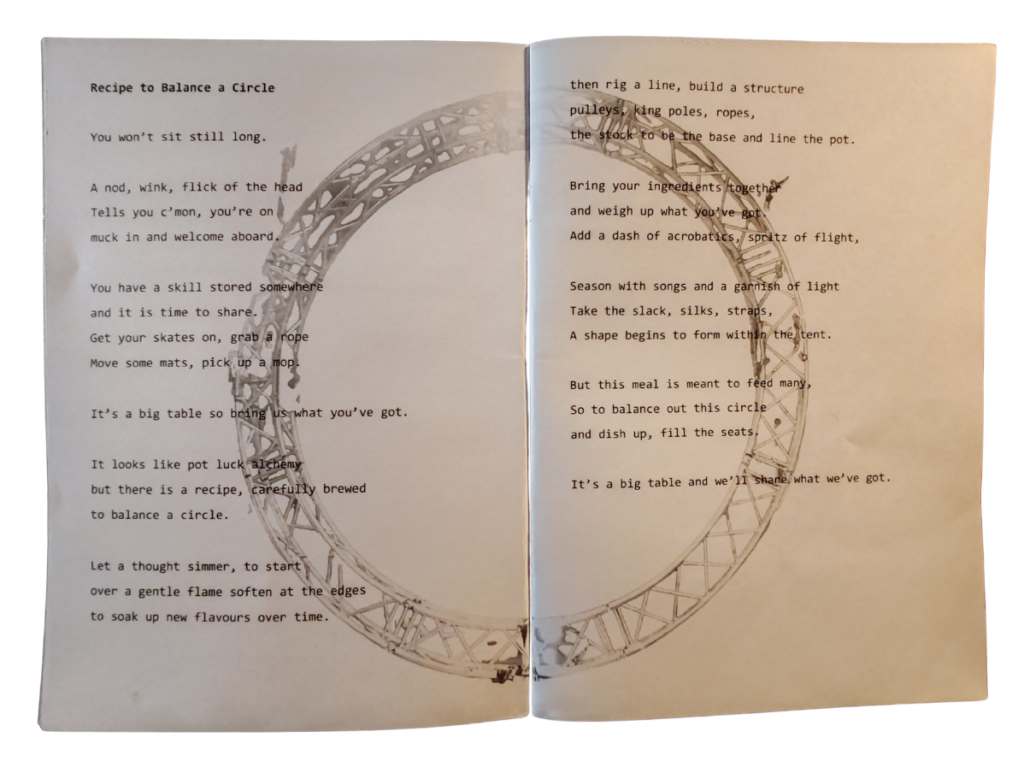
Two poems form the book’s philosophical spine, and they deserve slow, almost bodily reading: “Recipe to Balance a Circle” and “Mud.” Each offers a distinct account of the modern world, though both converge upon the same ethical lesson: wonder survives through the labour of care, and care lives close to dirt. “Recipe to Balance a Circle” begins with impatience recognised as common human posture: —You won’t sit still long. The line lands with a grin and a warning. Restlessness belongs to contemporary consciousness; attention has become a muscle starved by constant twitching. Anton refuses to scold. She offers initiation through gesture: —A nod, wink, flick of the head. The phrase carries the authority of a backstage cue; it also carries an intimacy, as if a friend had guided you through a crowded doorway into warmth. When she says —Tells you c’mon, you’re on, she invites complicity. The reader enters the tent as participant, and that shift matters, because the poem’s ethics depend upon shared risk. The recipe conceit could have drifted toward whimsy, yet Anton keeps it anchored in physical systems. Her ingredients include —pulleys, king poles, ropes—then —the stock to be the base and line the pot. The culinary language has teeth because it remains literal: structures require base; base requires preparation. In a time when language often floats free of the world, her metaphors behave like tools. Sara Ahmed’s work on affective economies illuminates the recipe’s deeper mechanism: feelings circulate socially, and they stick to bodies, objects, and institutions, forming a shared atmosphere that shapes perception and action.¹⁰ Anton treats light, music, tension, and laughter as ingredients that “season” a collective. A “thought” that “simmers” becomes an ethic of attention enacted as cooking: heat shared, time granted, flavour earned. The table returns as a moral image, and Anton handles it with unusual care. —It’s a big table so bring us what you’ve got. The line avoids romantic collectivism. Contribution stays required; the show survives through shared offerings. Her voice sounds like a stage manager, yet the cadence carries something older: the village feast, the communal pot, the rural commons. The modern world, which often fragments into isolated consumption, receives a different model here: communal production of wonder through shared labour, where each person’s “ingredients” find place. The poem’s sharpest insight lies in its handling of error. —It looks like pot luck alchemy but there is a recipe, carefully brewed to balance a circle. Pot luck implies chance; recipe implies craft. Anton refuses either extreme. She grants accident its dignity, though she honours preparation. The modern fantasy of total control collapses under canvas, and the modern fantasy of pure spontaneity collapses alongside it. A circle balances through a tension between discipline and openness, and this tension resembles the ethical life: a person prepares, errs, adjusts, continues. Murdoch’s moral philosophy often turns on that quiet continuing—vision corrected through repeated attention—though Anton offers it with humour and grease on the hands.¹¹
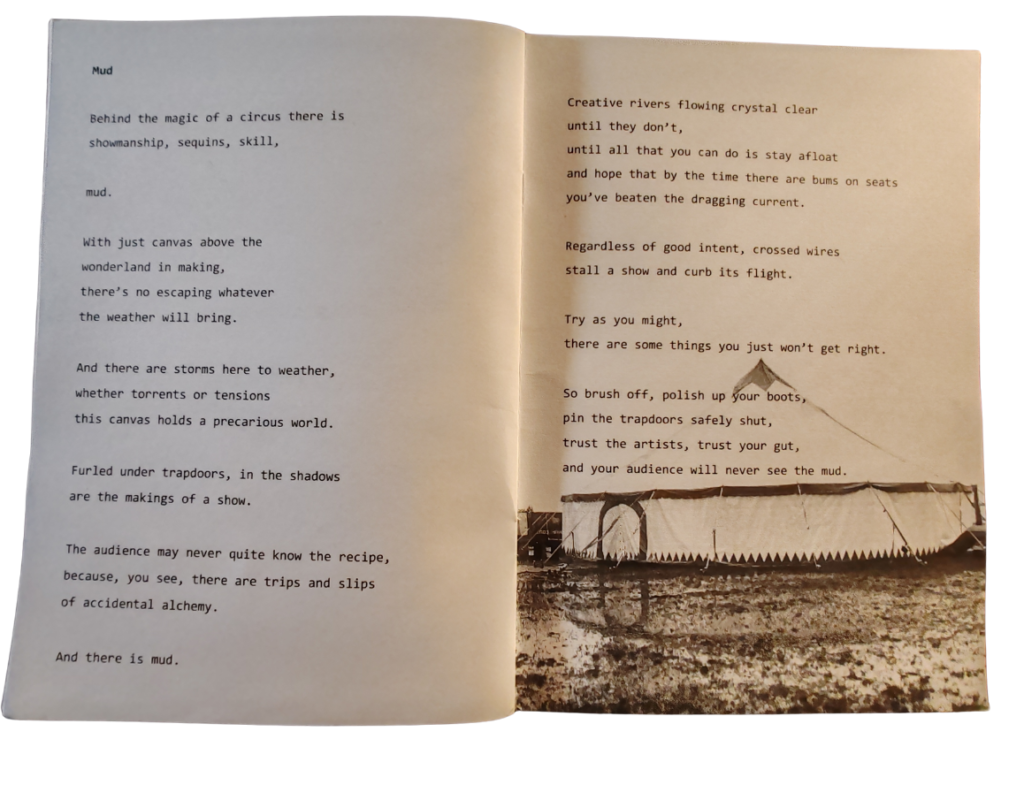
“Mud” carries the book’s counter-prayer. Where “Recipe” celebrates communal making, “Mud” names the cost that making demands. —Behind the magic of a circus there is showmanship, sequins, skill, mud. The final word falls like a boot into wet ground. Mud functions as antagonist and as truth-teller. It clings to cuffs and hems; it refuses invisibility. It arrives with storms, and storms, in Anton’s hands, become both weather and social pressure. —And there are storms here to weather, whether torrents or tensions this canvas holds a precarious world. The sentence binds climate to politics through lived experience: precariousness has texture; it soaks into cloth; it creeps into joints; it forces communities to invent safety daily. Anton’s most piercing social critique comes through her account of audience ignorance. —The audience may never quite know the recipe, because, you see, there are trips and slips of accidental alchemy. That “you see” carries an intimacy that feels like whispered confession. A modern audience often consumes surfaces while remaining oblivious to the labour beneath them—products without supply chains, comfort without cost, art without maintenance. Mud contradicts that cultural amnesia. Mud exposes what gets hidden. Mud teaches that wonder depends upon bodies who fall, laugh, bruise, stand again, and wipe their hands. Here the book’s originality becomes most apparent for literary studies: Anton crafts a poetics of backstage justice. Community appears through maintenance, and maintenance appears through dirt. Maintenance has long carried feminine coding in many cultures—cleaning, feeding, tending, repairing—work treated as natural duty instead of skilled labour. Anton restores maintenance to the status of craft. The circus, often idealised as pure glamour, becomes in her work a school of care. Care becomes engineering: the discipline that permits flight.
At this point, a Polish voice enters as Anton’s spiritual counterpart, though the resonance carries paradox. Bronisława Wajs, known as Papusza, wrote in Romani, and her poetry reached wider publics through translations into Polish by Jerzy Ficowski, a process that brought both recognition and grievous consequence within her community.¹² Papusza’s poems carry forest, hunger, road, song, exile, and a fierce tenderness toward the vulnerable; her language often treats nature as co-protagonist, bearing witness to human cruelty while offering shelter. Anton writes under canvas; Papusza writes under trees. Anton’s mud clings; Papusza’s forest absorbs. Both poets craft a lyric of survival that refuses sentimental spectacle. A translation excerpt associated with Papusza’s wartime witness offers a haunting echo of Anton’s ethic of care under pressure: —Don’t tell anybody. I too am a dark Gypsy, of your blood… God help you in the black forest… For two three days no food… God, how beautiful it is to live… Blind the Germans! Confuse them, lead them astray, so the Jewish and Gypsy child can live!¹³ In Papusza the forest becomes both refuge and witness; hunger becomes the ground of metaphysical clarity; beauty persists inside terror as stubborn flame. That flame resembles Anton’s refusal to let mud cancel wonder. Each poet writes from a place where survival requires community, and community requires shared labour. Another Papusza fragment, preserved in a critical discussion, speaks of growing in the forest “like a shrub of gold,” born in a tent, cradled by winds, carried into the world.¹⁴ The image bridges Anton and Papusza with uncanny ease: both treat the mobile shelter—tent or canvas—as birthplace of voice, and both treat nature as a force that shapes the lyric self. Papusza’s tent belongs to Roma life on the road; Anton’s tent belongs to circus life on tour; each becomes a school of attention where language learns its sharpness under weather. The comparison gains precision when set beside Anton’s two central poems. “Recipe to Balance a Circle” builds communal wonder through ingredients of rigging, song, light, and shared table. Papusza’s forest poems, in contrast, build communal survival through fire, song, and careful concealment. Anton’s recipe welcomes a reader into muck; Papusza’s address often warns, prays, pleads, shields. Each voice speaks from within precarious community, though each faces a different antagonist: Anton’s antagonist often arrives as weather, fatigue, cultural inattentiveness; Papusza’s arrives as persecution, hunger, the violence of history. The shared core remains: attention to what holds life together. Mud itself becomes a bridge. Papusza’s wartime account evokes bodies in forests, hunger gnawing, eyes on stars, winter approaching. Anton’s mud evokes storms, slips, trapdoors, precarious ground. Both treat the earth as moral witness. A reader could say: Anton writes the mud of contemporary cultural labour; Papusza writes the mud of history’s cruelty. Both insist that the ground carries truth more reliably than spectacle. Papusza offers a warning that deepens Anton’s audience motif with a darker grain. A poem carried into public through translation and authorised print can turn, for the originating community, into a wound that keeps reopening: exposure begins to resemble betrayal, and “being heard” begins to resemble harm.¹⁵ That knot—recorded in biographies and scholarship—makes the reader feel how the public gaze can sharpen into appetite, then into extraction. Anton’s critique arrives gentler, though it still carries a blade: her poems ask what an audience deserves when it wants enchantment while refusing the labour that keeps enchantment upright. Papusza shows the end of that refusal when the gaze grows predatory. Anton keeps the ethical pressure without the same historical violence; she understands that an audience remains a power, and power calls for scrutiny. Her circus served as epistemology because it placed human beings inside a structure where risk shaped choice, appetite pulled bodies toward gathering, and trust—kept alive through small repeatable acts—held precarious beauty away from injury. An audience entered with a sincere hunger for spellwork, while impatience tugged at attention like a child at a sleeve. The poems responded by training vision toward what spectators seldom bless: the fastening, the washing-up, the mud, the crew’s quiet competence, the shared table that makes a village out of strangers. Murdoch would have recognised a moral schooling here, because Anton’s discipline of attention draws the mind away from self-display and into the shared world, and that turning brings a justice that lives in readiness for correction. Under the canvas, virtue behaves like craft: it depends upon practice, humility, and the willingness to be adjusted by reality. The circus also behaves like a contemporary cosmology. The tent above holds a temporary firmament; rigging writes fate through tension and release; the kitchen below keeps the village-fire alive in a form suited to the road; the audience, seated in dark, participates in a faith sustained by labour that stays invisible to their eyes. Mud binds the whole arrangement to the earth, reminding every body—performer and spectator alike—that wonder begins in the ground and ends there. At the tent-flap of the argument, the creature with its own tail between its teeth belonged to the ouroboros: a serpent of recurrence, self-consuming and self-renewing, with time chewing its past to keep a future possible. Anton’s circus enacted that figure as daily ritual. Night returned as bodies repeated, and a familiar show arrived newly alive. Confetti fell and work gathered it. Mud returned with weight that taught the boot the ground again; a hand opened for bread, and its breath carried the story onward. By chewing the circle, the troupe kept its travelling village alive, sustaining bodies and imagination while answering a hunger for community that the wider world has learned to starve with quiet efficiency. The serpent ate its tail, and the village ate together.
Scholia:
- Saoirse Anton, “About,” Saoirse Anton Writes (https://saoirseantonwrites.com/), accessed 2026; confirmation of Production Poet in Residence role, Swansea Circus Village, Spring 2023; Confetti, Catching, Saoirse Anton, Poetry, 9781805172253
A residency inside a touring arts ecology generates a particular lyric authority: the poet’s witness arises from proximity to labour. The archive becomes call-sheets, risk assessments, kettle steam, bruises, and the minute choreography of cooperation. Scholarship often treats “poetry of work” as a theme within texts; Anton offers a case where work shapes the very grammar of perception. Her poems behave like safety checks that also carry metaphysics, since rigging and trust share a logic: each depends upon invisible integrity. - Here the pattern involved unusual precision in casual speech, a lyric discipline that resisted drift, and a natural sense of cadence that required no editorial tightening. Such traits often emerge in mature writers after years of apprenticeship; Anton carried them in youth, which suggests a temperament already aligned with exactness, a virtue that later underwrites the ethical attention visible across Confetti Catching.
- Saoirse Anton, “Read,” Saoirse Anton Writes (op.cit), accessed 2026; Sad Press Poetry, “Rise Up & Repeal,” publisher page (2019); Llenyddiaeth Cymru author profile entry for Saoirse Anton, accessed 2026.
- Llenyddiaeth Cymru, “Proffil” entry for Saoirse Anton, accessed 2026; Etsy shop description “SaoirseAntonWrites,” accessed 2026, noting RTÉ and Studio 9 commissions and children’s poetry film titles.
- Hannah Arendt, The Human Condition (University of Chicago Press, Chicago, 1958), pp. 7–21, 175–188.
Arendt’s triad—labour, work, action—often enters criticism as tidy typology. Anton’s circus poems allow the triad to be felt in the body. Labour appears as washing-up and bread; work appears as rehearsed apparatus; action appears as performance under lights, where plurality and appearance converge. Anton’s refusal to romanticise action while ignoring labour carries political weight, because modern public culture often devours the visible and forgets the sustaining hidden. - Simone Weil, Gravity and Grace, trans. Emma Craufurd (Routledge & Kegan Paul, London, 1952), pp. 105–123; Simone Weil, Waiting for God, trans. Emma Craufurd (Routledge, London, 1951), pp. 57–82.
Weil’s “attention” functions as severity masquerading as gentleness. It demands refusal of distraction, refusal of egoic fantasy, refusal of the comfort that arrives through looking away. Anton’s fixation on fastenings, crew, and “unseen” work mirrors that severity, though her tone remains hospitable. Mud, within that Weilian lens, functions as the residue of labour that spectacle-trained eyes wish to forget, and the poem’s insistence on mud becomes an ethics of refusing erasure. - Iris Murdoch, The Sovereignty of Good (Routledge, London, 1970), pp. 29–52.
Murdoch’s “unselfing” carries practical implications that criticism sometimes softens. The ego seeks control, applause, purity; the moral life demands a turning toward reality and toward others, which involves correction and humility. Anton’s counsel around error and shared making embodies that turning without philosophical jargon. Her backstage voice instructs the reader through craft: the show survives when vanity loosens its grip, and that survival becomes an emblem for ethical life. - Simone de Beauvoir, The Second Sex, trans. H. M. Parshley (Jonathan Cape, London, 1953), pp. 33–58.
- Luce Irigaray, This Sex Which Is Not One, trans. Catherine Porter and Carolyn Burke (Cornell University Press, Ithaca, 1985), pp. 23–48.
- Sara Ahmed, The Cultural Politics of Emotion (Edinburgh University Press, Edinburgh, 2004), pp. 11–36.
- Saoirse Anton, “Gigs,” Saoirse Anton Writes (op.cit), accessed 2026; evidence of performance contexts and hosted events, including Green Gathering listing and Poetry Competition note.
The gig-list operates as cultural archive, since it shows where poems live: tents, cabarets, festival stages, community rooms. A poem delivered in such contexts behaves differently from a poem read in solitary silence. Anton’s writing carries that performative awareness into the line itself: cues, timing, audience psychology, backstage pragmatics. Literary studies that track contemporary poetry’s institutional shifts can treat such evidence as part of the poem’s social life. - Culture.pl, “Papusza – Biography,” accessed 2026; Polish Institute New York, “Bronisława Wajs ‘Papusza’—the Queen of Roma Poetry,” 8 May 2025; In Her Wake (PDF), Metambesen, accessed 2026, on Papusza’s life and reception.
Papusza’s case reveals a harsh paradox: literary visibility can function as both recognition and wound. Translation and publication brought her voice into Polish literary culture, yet those same processes intersected with internal community judgments around cultural disclosure. Her biography therefore carries scholarly value for ethics of representation, authorship, and the politics of “being heard.” Bringing her into dialogue with Anton risks flattening historical difference, yet it also clarifies a shared devotion to communal survival as lyrical subject. - Bronisława Wajs (Papusza), poem excerpt in translation, as reproduced in Baltic Worlds PDF (papusza.pdf), accessed 2026, pp. 1–2.
This excerpt compresses an entire moral universe: hunger, fear, stars, beauty, prayer, and protective cunning directed toward the vulnerable. The lines speak to survival under persecution, yet they also offer a philosophy of stubborn life—beauty persists as refusal of annihilation. When set beside Anton’s “Mud,” the shared element involves earth as witness and the community as the unit of endurance, though the historical stakes diverge sharply. - Bronisława Wajs (Papusza), “Gypsy Song Taken From Papusza’s Head / Gili romani…” as reproduced in Hadji Bakara, “Transnationalism and the Poetry of Bronisława Wajs,” American Literature in the World (8 Nov 2014), accessed 2026; discussion includes English translation excerpt.
Even through the mediating layer of a secondary critical discussion, the imagery retains its force: growth “in the forest,” birth “in a Gypsy tent,” winds cradling and carrying. The poem treats nature as parent and conveyor, forming a lyric identity inseparable from motion. Anton’s circus tent functions similarly as formative shelter, though her world carries a different violence. The comparison therefore illuminates a shared poetics of itinerant life, where shelter becomes cosmology and travel becomes the condition for voice. - Scholarship on Papusza frequently grapples with the “myth” structure imposed upon Roma voice by majority cultures—an aestheticisation that risks turning lived history into consumable romance. That danger also haunts any audience-facing art form, including circus and spoken poetry. Anton’s work, with its insistence on mud and maintenance, offers an implicit critique of that myth-making impulse: glamour without labour becomes falsification. Papusza’s reception warns of another edge: glamour can become extraction. Reading the two together keeps criticism alert to the ethics of attention, publication, and the audience’s appetite for exoticised wonder.