
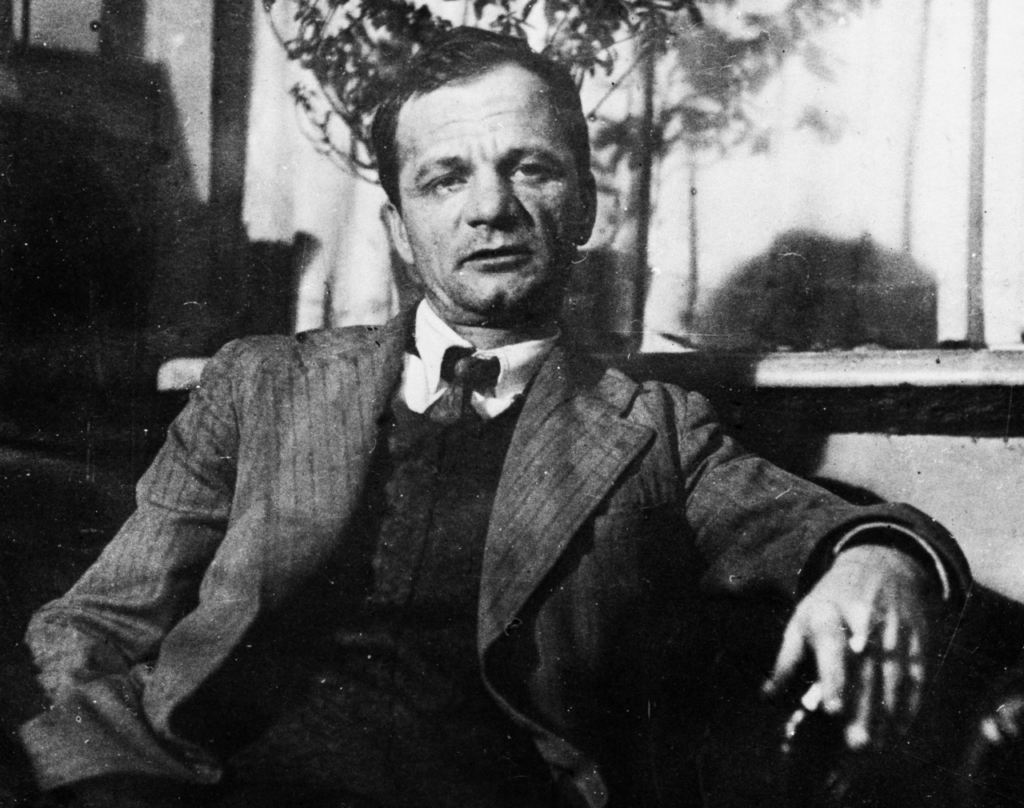
of The Foundation Pit.
Lecture on Andrei Platonov and The Foundation Pit.
I spoke of this book while standing where limestone holds its breath, beneath the Rock of Dunamase, with January wind shouldering the grass, and with the old wall’s broken teeth catching light in the fashion of a jaw that had learned patience through conquest. A rook, as if it carried a black seal of office, kept walking along the parapet, pausing whenever my voice rose, and since the whole place had belonged to too many hands for any single claim to sit easy, the stones pressed one question into my ribs with the weight of an oath: when a foundation gets dug, whose life gets lodged inside it.¹
Your mind, trained by civic stories that dress progress in clean geometry, tends to picture utopia as a skyline; and since skylines announce themselves as reassurance, you may arrive at Platonov with the expectation that tragedy will visit from outside, like a storm that interrupts an otherwise rational plan. Yet The Foundation Pit refused that comfort, for it shaped its catastrophe out of the very verbs by which a collective promised itself bread, warmth, and a shared roof, so that excavation served as a lived argument enacted in clay, muscle, frost, and fatigue, while hope, once spoken in the official tongue, hardened into an implement whose edge cut deepest in the hands that swung it. When the workers dig, they also reason; when their speech twists, their souls get twisted; when the pit widens, the horizon of mercy narrows through consequence.²
Consider the phrase that lures many readers into a false clarity: “a house for the proletariat,” since the slogan seems to belong to architecture, and architecture seems to belong to the practical domain, and the practical domain seems to promise shelter from metaphysics. Platonov would grant the phrase its full body, though he would also force you to feel the body’s fever. The pit begins as an argument that matter can be reorganized into justice, while it ends as an argument that matter, when treated as obedient, turns human beings into expendable material; and the transformation occurs through a chain of causes in which each step appears reasonable to the people inside it, since reason itself has been trained to answer only the future’s demand. When Voshchev gets expelled for “thinking,” the charge sounds absurd until you grasp that thought, in that epoch, had been conscripted into production, so that any reflection that failed to yield an immediate quota read as sabotage in the grammar of urgency.³
A man who carries a file of dismissed labour papers also carries a theology of waste, for the State’s refusal of his body implicates his soul, and since Platonov had learned his own world through machines and land work, he wrote with an engineer’s attention to stress, friction, and failure, while he also wrote with a believer’s terror before the idol that demands sacrifice while calling itself salvation. His lineage mattered here in a way that criticism often glances past, since he had been born Klimentov, the son of Platon Klimentov, and since he chose the pen name Platonov, he performed a subtle act of self-requisition: he surrendered the family surname, which carries private inheritance, while he elevated the patronymic into public identity, which carries a collective stamp, so that he entered literature by renaming himself as a son whose father became his banner. The shift appears mild until you feel how it rhymes with the novel’s logic, where individuals get asked to die into a structure that will carry their children’s names.⁴
Here, the Rock of Dunamase enters my lecture as more than a scenic intrusion, since that outcrop, long before any Soviet decree, had watched ownership become a ritual of force: Gaelic lordship, Norman title, plantation logic, and the later polite paperwork of modern tenure, each turn leaving its own scar in stone and in memory. When I pressed my palm to a cold block at Dunamase, I felt how a fortress gets called protection by the ones inside it, while it reads as threat to the ones outside, and since a foundation serves as a promise of permanence, the moral question hides beneath engineering: whose permanence. That question, carried across centuries, illuminates Platonov’s pit, for his workers dig a fortress for the future, while the living present gets treated as a trespasser upon its own earth.⁵
Platonov’s genius arrived through distortion, though distortion here carried an ethic, since his language warped the official lexicon until it revealed its violence with the clarity of a cracked mirror. Bureaucratic nouns walk around with human legs; sacred words get replaced by technical substitutes; and tenderness becomes a kind of error in the system’s paperwork, though the error persists like a weed in the clay. When Chiklin speaks, his sentences obey the hammer’s rhythm, yet the rhythm stumbles whenever a child enters his attention, as if the body’s instinct carried a counter-doctrine that the mind had learned to suppress. Nastya’s presence, which the workers treat as a living emblem of the promised epoch, turns the project into a sacrament that has lost its altar, since the child carries innocence as a warrant for any cruelty committed in her name.⁶
A pit, once conceived as a womb for a communal house, begins to resemble a grave, though the resemblance grows through accumulation rather than through any theatrical reversal. Since Platonov wrote in the years when the Five-Year Plan had become a moral calendar, with slogans that offered speed as virtue, you can hear the tempo in the workers’ speech, where time itself becomes an overseer, so that even compassion must justify itself as productive. A line from the era, repeated with pride, carried a whole cosmology: “We are fifty or a hundred years behind the advanced countries… we must make good this distance in ten years.”⁷ When such a sentence settles into the blood, the future gains the status of an emergency, and in an emergency, bodies become fuel. Platonov’s pit expands inside that emergency, while his prose makes you taste the grit of its logic.
A short paragraph must fall here, since breath gets required when the ground keeps opening.
The pit widens, and the sky feels farther. Frost makes a law of every morning. A shovel, when lifted again, turns into a prayer spoken by muscle, though the prayer bends toward a god made of targets.
When utopia gets treated as an excavation, the earth becomes an opponent, and since the earth cannot sign decrees, the fight turns one-sided, ending with men who resemble instruments more than neighbours. Platonov makes that transformation audible by letting slogans slide into private speech, so that the border between propaganda and confession dissolves; and he makes it visible by presenting the worksite as a civic liturgy in which each gesture carries the weight of a promised dawn. Yet dawn remains deferred, and deferral becomes the engine of obedience, since the future, always arriving later, can demand any price today. This mechanism, which political theory often describes as abstraction, becomes in Platonov an embodied sequence of hunger, fatigue, and grief. The reader’s hope gets weaponized through empathy: you want the house to rise, and since you want it, you become complicit in the pit’s widening.⁸
Language distortion meets collective tragedy most sharply when the novel treats death as administrative output, while it still allows the dead to feel present. The kulaks, marched toward removal, become in the workers’ accounts a category more than a community, and since category-thinking offers relief from guilt, it functions as a tranquilizer for the conscience. Platonov, though, keeps returning to the stubborn particular: a face, a gesture, a body that resists reduction. Even the bear, which appears as a grotesque worker, participates in this blurred domain where the line between human and tool collapses. The grotesque carries a severe seriousness here, since a society that claims universal brotherhood while turning persons into means must either embrace comedy or go mad; Platonov chooses both, though he binds them together with sorrow.
I spoke once with a man in Portlaoise who had spent his life laying blockwork, and who said, with a shrug that carried a catechism, that every wall remembered the hand that set it. The remark came back to me while reading The Foundation Pit, since Platonov writes as if the earth itself stores the imprint of labour, and since the novel’s tragedy depends upon the fact that human work, when offered as devotion to an idea, still remains carved into the worker’s spine. A future palace—imagine, for a moment, that metro palace of marble beneath Moscow, whose chandeliers turned the underground into a liturgical hall—gets its beauty from stone hauled, cut, and polished by bodies that had learned obedience under pressure. When splendour blooms below ground, the pit gains a sinister kinship with the cathedral crypt: glory placed beneath the living, with the dead serving as foundation.⁹
Platonov’s “previously unobserved detail,” as you demanded of me, lives in that renaming I mentioned earlier, though it requires a further turn: by choosing “Platonov,” he aligned his public self with a father whose given name echoes Plato, and since Plato’s philosophy had long treated the visible world as a shadow of a higher Form, Platonov entered Soviet modernity with a surname that already carried metaphysical irony. The Soviet project claimed that the ideal could be made immanent through planned labour; Plato had claimed that the ideal remains higher than matter’s reach; and Platonov, whose very name carried that classical ghost, wrote a novel where the ideal gets pursued through matter until matter becomes a devouring god. The detail shifts interpretation, since the book’s war between slogan and soul carries, beneath politics, a quarrel between metaphysics: the dream of Form brought down into clay, and the clay’s revenge upon the dream.¹⁰
The epoch’s chronicles, when read beside Platonov, feel like hymns sung in a key that cracks the voice. A pamphlet voice insists that “cadres decide everything,”¹¹ and the sentence, carried into the worksite, turns people into replaceable parts, while it also turns leadership into a priesthood of efficiency. Another public line, offered with festive confidence, declares that “life has become better, life has become more joyous,”¹² and since Platonov’s pages fill with hunger and funerary cold, the contrast exposes the mechanism by which public joy gets manufactured: the declaration precedes the experience, and the experience must reshape itself to justify the declaration. In that inversion, language ceases to describe, while it begins to command. Platonov’s distortions, then, do not function as style alone; they function as a counter-chronicle that records how words, once severed from lived truth, begin to chew through the mouths that speak them.
A lecture, to earn its salt, must accept the possibility of sin within scholarship, since one can take a book of suffering and turn it into a decorative argument, as if the dead existed to furnish our cleverness. I tried, while reading Platonov, to keep the pit’s cold in my own bones, since the novel’s ethics demand an embodied response: Voshchev’s wandering, which reads as philosophical vagrancy, carries the hunger of a man whose labour value has been denied; Chiklin’s brutality, which readers often judge as mere fanaticism, carries the desperation of someone who has been told that mercy endangers the whole edifice. The collective tragedy emerges because each person behaves as if trapped inside a single moral tunnel whose end has been named “future,” and since the tunnel has been declared sacred, dissent becomes blasphemy.
You may ask, with a reasonable impatience, why I kept bringing Dunamase into a Soviet text, while the two worlds share neither language nor flag. The answer lives in rock, since rock carries the record of claim-making, and since claim-making, whether in Leinster or in Voronezh, operates through the same sacramental gestures: naming, fencing, promising, punishing. The Rock of Dunamase, whose lordship changed hands through warfare that later got sanctified by paperwork, taught me how a “home” can serve as a banner for dispossession, and since Platonov’s communal home gets built through the displacement of bodies and the erasure of prior life, the Irish stone becomes a lens through which Soviet modernity appears less alien and more tragically human. The pit, then, belongs to a global history of foundations dug by those who believe that their children’s shelter grants permission for their neighbours’ ruin.¹³
Platonov’s Christianity, often treated as subterranean influence, rises here without piety, since the novel’s most biblical image remains the pit itself: a descent into earth that feels like a parody of burial and resurrection. “Out of the depths I cry to thee, O Lord,” the psalmist sings, and Platonov, though he rarely grants his characters a stable God, grants them depths in abundance, so that each shovel stroke becomes a cry that lacks an addressed ear. The workers’ faith, diverted from altar to plan, becomes a secular eschatology: salvation promised after sufficient labour, damnation threatened for insufficient zeal. When Nastya dies, the death reads as a sacrificial failure that exposes the cult, since the child had been treated as guarantee of meaning, and since her body collapses into earth, the earth begins to look like the only honest god remaining.¹⁴
A shorter span again, as the throat tightens.
The child’s coffin sits near the pit’s edge. Men keep working, since work has become their moral breath. A future house waits in imagination, while the present keeps burying its proof.
Where language distortion meets tragedy most intimately, Platonov achieves a rare cruelty: he makes the reader feel the seduction of official speech while he also reveals its cost. The characters speak in phrases half-made of slogans, half-made of private longing, and the hybrid tongue grants them a strange dignity, since it shows their effort to survive inside an imposed grammar. Yet that survival requires the mutilation of inner speech, and since inner speech serves as the last refuge of conscience, the mutilation spreads. You can watch it in the way Voshchev’s reflective sentences get interrupted by workplace imperatives, as if the soul’s syntax has been put under time pressure. A theory essay might name this “ideology,” though Platonov’s pages force a more bodily name: starvation of meaning.
Many critics discuss Platonov’s “estrangement” as technique, and the term carries a literary pedigree; yet the pit demands a harder recognition, since estrangement here resembles a symptom of social injury. When words cease to match things, and when things cease to match promises, the mind loses its anchors, and since human beings cannot live without some anchorage, they attach themselves to slogans with a hunger that resembles devotion. This hunger, which feels spiritual, gets exploited by power, while it also gets exploited by the victims themselves, since the slogan grants them a way to endure their own complicity. Hope becomes consequence, and consequence becomes the pit’s geometry.¹⁵
In the end, interpretation must face its own foundation: what permits a reader, safe behind time, to enter this work and leave with a clean conscience. Platonov does not grant that cleanliness, since the novel’s structure invites you into sympathy with the builders, while it also forces you to watch the builders erase lives. The reader’s desire for a house, which begins as humane, gets revealed as a form of appetite that can cooperate with cruelty when guided by a promised dawn. Such a revelation carries political weight, though it also carries personal weight, since each of us, when we accept a future in exchange for someone else’s present, digs a small pit under our own floorboards.
I returned, after finishing the last page, to Dunamase at dusk, when the stone turns purple-brown and the fields below carry a pale hush, and I found myself staring at the ruin’s emptiness as if it were an unfinished foundation. A fortress had stood there; then it had fallen; then sheep had grazed where banners had waved. Time, indifferent to slogans, kept chewing. The pit in Platonov, though, resists time’s comfort, since it does not become picturesque ruin; it becomes an open wound in the reader’s moral landscape, and since wounds tend to keep pulsing whenever the body walks, you carry it onward. A metro palace of marble, with chandeliers burning under ground, may glitter as a triumph of communal ambition; yet once Platonov has entered your bloodstream, that glitter throws a shadow shaped like a pit, and the shadow keeps asking, in the plain voice of stone: which bodies paid for the light.¹⁶
The lecture ends where the shovel keeps moving, since Platonov refuses finality; and as I stepped away from Dunamase, with dark falling into the hollows of the wall, I felt the unsettling kinship between ruins and utopias, since each begins with a claim upon earth, and since each demands belief in permanence while the human body remains temporary. The question, then, persists beyond the page, refusing closure while it also refusing comfort: when we dig foundations for our imagined palaces, what part of our own language gets buried alive, and what part returns later, speaking through stone, through children’s graves, through the quiet that follows slogans once the mouth grows tired.¹⁷
Scholia:
1 Andrei Platonov, The Foundation Pit, translated by Robert Chandler, Elizabeth Chandler, and Olga Meerson, New York Review Books, New York, 2009, pp. 1–12.
Translation matters here with a seriousness that touches ethics, since Platonov’s Russian bends Soviet idiom into a grammar that feels both official and wounded, and since English tends to smooth jagged phrases into idiomatic ease. Chandler, Chandler, and Meerson pursue a deliberate roughness that keeps the reader close to the strange pulse of the original, where abstract nouns behave as if they possessed hands, and where verbs slide between technical and spiritual registers. The “pit” itself arrives early as a physical site and as a conceptual device, since the work begins by grounding utopia in an excavation that can be measured, widened, and scheduled. Readers who meet the novel through softened paraphrase risk treating the book as satire alone, while readers who meet it through a translation willing to keep its angularity feel how satire and lament share the same throat. The early pages, in particular, establish the tone through their refusal of narrative reassurance, since even the opening expulsions and administrative decisions carry a ritual cadence, as if bureaucracy had learned the posture of liturgy.
2 Fredric Jameson, Archaeologies of the Future: The Desire Called Utopia and Other Science Fictions, Verso, London, 2005, pp. 1–38.
Jameson’s argument about utopia as a function of desire and as a diagnostic of historical limits offers a useful counterpoint, provided that one keeps Platonov’s mud and frost within reach. Jameson frames utopia as an act of imagination whose value often emerges through its failure, since the impossibility of a completed utopian picture exposes the constraints of the present. Platonov, though, turns that conceptual failure into bodily consequence, since his “utopia” takes the form of a construction project whose incompletion kills. Reading Jameson beside Platonov clarifies a key lecture claim: abstraction carries a material afterlife. The “archaeology” metaphor in Jameson also resonates with Platonov’s excavation, though the resonance becomes grim when one recalls that archaeology, as a discipline, often deals in ruins, whereas Platonov writes a ruin being manufactured in real time through labour and belief.
3 Sheila Fitzpatrick, Everyday Stalinism: Ordinary Life in Extraordinary Times: Soviet Russia in the 1930s, Oxford University Press, Oxford, 1999, pp. 1–31.
Fitzpatrick offers a grounded account of how policy language entered daily speech and behaviour, clarifying the social field in which Platonov’s characters speak.
4 Thomas Seifrid, Andrei Platonov: Uncertainties of Spirit, Cambridge University Press, Cambridge, 1992, pp. 15–46.
Seifrid’s attention to Platonov’s biography and to the spiritual tension within his prose supports the lecture’s emphasis on identity and naming. The surname shift from Klimentov to Platonov carries more than literary convenience, since it signals an author entering public space through a chosen patronymic-derived marker, while he also steps away from the private lineage embedded in a family surname. Soviet modernity, with its appetite for remade selves, encouraged such transformations, though Platonov’s version carries an added philosophical echo through the name “Platon,” which summons the classical tradition’s disputes about ideality and matter. Seifrid’s work also highlights the persistent uncertainty in Platonov’s stance toward the revolutionary project, where critique and longing intertwine instead of standing apart. That intertwining underwrites the lecture’s claim that hope becomes a weapon through the very tenderness it awakens.
5 Michael J. Enright, Lady of the Rock: The Story of the Rock of Dunamase, Irish Academic Press, Dublin, 1999, pp. 1–55.
Dunamase enters the lecture as a comparative instrument rather than as decorative local colour. Enright traces the site’s shifting claims, where fortification, lordship, and later romantic ruin each framed “ownership” as a story told to justify power. A fortress promises shelter to its holders, while it also projects domination outward; and the dual function clarifies how “home” functions as political theology. The Soviet communal house, though conceived as egalitarian shelter, still operates as a claim upon land, labour, and the moral imagination, while it demands that present lives accept sacrifice for a promised permanence. Dunamase teaches, through Irish history’s long memory of confiscation and tenure, that stone keeps a record of contested belonging, and that the language of protection can mask extraction. The lecture uses this to sharpen a reading of Platonov’s pit as a site where belonging gets promised through excavation, while the excavation itself consumes the community’s living tissue.
6 Andrei Platonov, The Foundation Pit, translated by Robert Chandler, Elizabeth Chandler, and Olga Meerson, New York Review Books, New York, 2009, pp. 55–90.
Platonov’s handling of Nastya and of the workers’ speech around her anchors the lecture’s claims about emblematic innocence and coercive futurity.
7 J. V. Stalin, Problems of Leninism, Foreign Languages Publishing House, Moscow, 1953, pp. 442–446.
The quoted line about historical lag appears in Stalin’s speeches and gets reproduced in later collections; its rhetorical force matters more than its exact venue for the lecture’s purpose, since it exemplifies a temporal emergency framed as national salvation. The sentence compresses history into a race, while it assigns moral weight to speed, so that delay begins to look like betrayal. Such rhetoric, when internalized, converts ordinary suffering into acceptable payment, since the future’s arrival gets treated as a matter of survival. Platonov’s novel, set within the Five-Year Plan atmosphere, shows how this temporal theology migrates from podium to worksite, where men who possess little beyond their bodies begin to interpret fatigue as proof of virtue. The line also illuminates the transformation of hope into instrument: when the future becomes emergency, hope ceases to comfort and begins to command.
8 Hannah Arendt, The Origins of Totalitarianism, Harcourt, Brace, New York, 1951, pp. 305–340.
Arendt’s analysis of ideology as a system that explains everything through a single “logic” assists a reading of Platonov’s pit as an enacted syllogism. In Arendt’s terms, ideology operates through inevitability: once the premise is accepted, every consequence follows with a grim purity that displaces ordinary moral hesitation. Platonov dramatizes such inevitability in bodily form, since the premise—collective salvation through planned construction—generates consequences that include dispossession, coercion, and death, while each consequence can be justified as a necessary step. The value of Arendt here lies in her attention to how language, once aligned with “law-like” historical necessity, can empty words of lived reference and refill them with command. Platonov’s distortions then appear as a counter-movement: he reattaches words to hunger, cold, grief, and fatigue, thereby breaking ideology’s spell through re-embodiment.
9 Stephen Kotkin, Magnetic Mountain: Stalinism as a Civilization, University of California Press, Berkeley, 1995, pp. 1–28.
Kotkin’s account of a “civilization” built through language, ritual, and industrial ambition clarifies the background against which subterranean splendour and surface deprivation could coexist.
10 Plato, Republic, translated by G. M. A. Grube, revised by C. D. C. Reeve, Hackett Publishing Company, Indianapolis, 1992, pp. 235–266.
The lecture’s biographical hinge—Platonov’s name—gains interpretive force when placed beside Plato’s dispute between the realm of Forms and the realm of material change. Plato’s ideality, pursued through philosophical ascent, stands in ironic tension with Soviet ideality, pursued through industrial descent into matter. Platonov’s pit becomes a site where “Form” seeks incarnation through labour, and where the labouring body pays for the incarnation. The name “Platonov,” which elevates “Platon” into public identity, therefore reads as a hidden signature of metaphysical tension: a writer whose very marker invokes idealism writes a book where idealism, turned into policy, consumes the human. The point functions less as biographical trivia and more as a key to the novel’s inner quarrel, where the future’s image gains the force of a Form demanding obedience, while the earth insists upon gravity, decay, and burial.
11 J. V. Stalin, Works, Volume 14, Foreign Languages Publishing House, Moscow, 1954, pp. 80–81.
The phrase “cadres decide everything,” circulated widely, exemplifies a managerial theology that reduces persons to functional units.
12 J. V. Stalin, Works, Volume 14, Foreign Languages Publishing House, Moscow, 1954, pp. 304–305.
The public declaration of improved life and joy, delivered with ceremonial confidence, illuminates a crucial feature of Stalinist speech acts: proclamation precedes verification, and verification becomes the population’s duty. Such declarations operate as performatives, shaping reality by commanding agreement and by punishing dissonant testimony. Platonov’s novel, saturated with hunger and grief, therefore reads as a quiet refutation grounded in sensory record: the cold bites, the stomach aches, the child dies. When propaganda declares joy, the burden shifts to the listener, who must either conform their inner perception to the public sentence or else accept the risk of being named an enemy of the future. Platonov’s language distortion mimics the public lexicon while it also fractures it, allowing the reader to perceive the gap between declared joy and lived suffering. The lecture’s claim about hope weaponized depends upon this mechanism, since hope, when turned into required optimism, becomes a tool for coercing silence.
13 Karl Polanyi, The Great Transformation: The Political and Economic Origins of Our Time, Beacon Press, Boston, 2001, pp. 35–58.
Polanyi’s account of disembedding and of social sacrifice under economic “necessity” offers a comparative frame for understanding coerced futures.
14 Rowan Williams, The Wound of Knowledge: Christian Spirituality from the New Testament to St. John of the Cross, Darton, Longman and Todd, London, 1990, pp. 1–20.
Williams assists the lecture’s theological undercurrent by treating spirituality as a discipline of truth-telling rooted in the body’s vulnerability. When a society redirects religious longing into secular salvation, it often preserves the forms of devotion—ritual, hymn, confession—while it changes the object. Platonov’s workers possess a longing that resembles religious hunger, though the plan absorbs it, and the future becomes an eschaton promised through labour. Williams’ emphasis on knowledge as wound fits Platonov’s ethic: truth arrives through pain and exposure, while false comfort arrives through polished speech. Nastya’s death then reads as a wound that knowledge forces open, since the child’s body refuses to validate the future’s rhetoric. The lecture borrows this frame to treat Platonov’s pit as a kind of anti-altar, where sacrifice occurs without redemption, and where the only “revelation” arrives through the refusal of matter to cooperate with slogans.
15 Mikhail Bakhtin, Rabelais and His World, translated by Hélène Iswolsky, Indiana University Press, Bloomington, 1984, pp. 1–58.
Bakhtin’s theory of the grotesque, developed through Renaissance carnival, illuminates Platonov’s strange humour, where bodies, tools, animals, and slogans mingle in forms that feel both comic and grievous. The grotesque body in Bakhtin resists closed perfection; it opens, consumes, excretes, and changes, thereby challenging official ideals of purity and completion. Platonov’s Soviet world, obsessed with completed plans and finished houses, meets grotesque resistance in the bear-worker, in the awkwardness of speech, in the constant intrusion of hunger and fatigue. The grotesque, then, becomes political without sermonizing, since it exposes the false sanctity of an idealized future by insisting upon the body’s messy persistence. The lecture uses Bakhtin to argue that Platonov’s laughter carries ethical force, since it prevents the reader from treating suffering as solemn pageant, while it also prevents ideology from appearing majestic. Grotesque comedy, bound to tragedy, keeps the pit from becoming a symbol alone; it remains a place where flesh labours and breaks.
16 Richard Stites, Revolutionary Dreams: Utopian Vision and Experimental Life in the Russian Revolution, Oxford University Press, New York, 1989, pp. 1–22.
Stites’ survey of utopian ambition and experimental living clarifies how dream and coercion could share a vocabulary during the revolutionary decades.
17 Simone Weil, Gravity and Grace, translated by Emma Craufurd, Routledge, London, 1952, pp. 1–18.
Weil’s pairing of “gravity” with “grace” offers a final pressure point for the lecture’s closing tension. Gravity, in her sense, describes the way force, necessity, and habit pull human beings toward predictable cruelty, while grace describes a counter-movement that arrives as gift and as attention. Platonov’s pit operates as gravity made architectural: it pulls bodies downward into labour, it pulls language downward into command, it pulls hope downward into obligation. Yet flashes of grace appear in small attentions—an awkward tenderness toward a child, a moment of reflective hesitation, a fleeting recognition of another’s suffering. The tragedy of the novel lies in how such attentions get absorbed into the project’s machinery, where even tenderness becomes a justification for further digging. Weil helps articulate the lecture’s unresolved ending: when humans build futures, gravity dominates, while grace persists as fragile possibility whose survival depends upon speech that remains faithful to lived truth.