
Listen to the lecture:
Lecture on how meter turns terror into political obedience.
The hymnbook lay on the piano’s closed lid as though the lacquered wood had agreed to become a cell’s plank bed for an hour, and while the radiator kept its thin hiss and the corridor carried the muffled discipline of students passing between rooms, I watched your hands—some ink-stained, some callused, some nervously clean—hover as if you expected the book to bite. Its cover had once been black. Years had turned it into a bruised brown. A cross, pressed into the leather, had lost its gilt the way a riverbank loses grass under repeated floodwater. When I opened it, the page edges revealed a tide-mark, uneven and tea-coloured, that ran through the first gatherings and then faded, as though the water had relented mid-sentence. I had found it in a second-hand shop whose owner spoke with that Donegal patience that makes every transaction sound like confession, and he had told me—softly, with a glance that asked my discretion—that the book had travelled out of Russia inside a suitcase whose owner preferred silence. I believed him, since the hymns carried pencilled dates in a hand that had learned its alphabet under pressure.¹
A conservatory breeds its own sort of piety: scales, arpeggios, the daily submission to metronome and muscle memory. Yet Pushkin’s The Bronze Horseman carries a stricter liturgy, since it asks the reader to hear how an empire sings itself into righteousness while a single man’s breath breaks in the choir stalls. Pushkin wrote the poem in 1833, and the text lived for years inside the anxiety of imperial eyes, since Nicholas I had appointed himself censor, and since Pushkin’s lines kept letting bronze speak too loudly.² The poem reached public life after Pushkin’s death in a compromised form, and editors—friends, mourners, loyalists—trimmed it so the sovereign’s shadow would pass.³ A reader enters, therefore, into a work already marked by authority’s hand, which means that the poem’s quarrel between state and individual begins before Евгений ever appears: the poem itself endured a state’s touch.
A hymnbook, when it sits inside a prison cell, performs a small miracle of orientation. Stone walls tell a person that time belongs to keys and guards. A hymnbook tells that same person that time belongs to God, since the psalms move in circles older than empires. I keep returning to this object because Pushkin kept returning to an object too, although his object stood outside in the square: Falconet’s equestrian statue of Peter the Great, commissioned by Catherine the second, raised on the Thunder Stone, inscribed in Latin and Russian with the phrase that binds legitimacy to bronze—Petro Primo Catharina Secunda.⁴ The statue’s unveiling in August 1782 carried ceremony, crowds, and the peculiar claim that metal can teach a people where to aim their gratitude.⁵ Pushkin turned that metal into a moral instrument, and he did so by setting it against water, against a man’s household dream, and against the theological instinct that hears judgment in flood.
Here comes the thesis that sits like a cold coin under the tongue. The Bronze Horseman functions as a sacramental engine in which the state borrows the grammar of divine judgment, and in which the reader’s aesthetic pleasure becomes a form of civic communion, so that Евгений’s madness serves as the necessary offering that keeps Petersburg’s hymn audible. The poem presents flood as judgment, and then it transfers the right to judge from God and nature into the monument’s pursuing hoofbeats, with the consequence that an individual’s interior collapse becomes the location where empire proves its metaphysical authority. You feel that process in the body, since Pushkin refuses an abstract debate; he stages argument as weather, stone, breath, panic.
When Pushkin begins, he sings in a voice trained for public odes. Peter stands by the Neva’s mouth, looking across reeds and swamp toward a future that exists as command before it exists as timber and granite. Pushkin gives the founding image with a bluntness that feels like prophecy and like military reconnaissance at once:
На берегу пустынных волн
Стоял он, дум великих полн,
И вдаль глядел. Пред ним широко
Река неслася; бедный чёлн
По ней стремился одиноко.
По мшистым, топким берегам
Чернели избы здесь и там,
Приют убогого чухонца;
И лес, неведомый лучам
В тумане спрятанного солнца,
Кругом шумел.⁶
The phrase пустынных волн carries a theological chill: a “desert” made of water, a wilderness that belongs to Exodus as much as to geography, and Peter stands as though he had chosen his Sinai. Then comes чухонца, the old imperial word for a Finnic local, a word that folds conquest into a single syllable; the founding hymn already includes the erased inhabitant, placed in the scene as “wretched shelter,” an object inside someone else’s grand sentence. The hymnbook on the piano suddenly felt heavier, since its humble psalms refuse that kind of reduction: a person remains a person in sacred address, even when an empire calls him a minor detail in the landscape.
The poem’s opening gives you the intoxication of order. That intoxication matters, since it makes later horror carry the taste of betrayal. Pushkin also smuggles in the delta’s ancient veto through sound: мшистым, топким—mossy, boggy—words that ooze in the mouth, as though the land itself had spoken a warning that an imperial hymn would rather drown out.
Listen for a shift that Pushkin performs with a musician’s cunning: after a brief leap across a century, the narrator moves from imperial grandeur into intimate address, praising Petersburg’s aspect, its granite embankments, its bridges, its disciplined water. In Dewey’s translation, the voice almost blushes with affection, and then it stiffens into a ceremonial petition—Petersburg must stand firm, unshakeable—before it drops again into a quieter register that acknowledges the river’s capacity for violence.² The poem therefore begins by demonstrating how a state’s hymn enters a person’s private mouth, since the narrator’s “I love you” crosses into the reader’s ear, and the reader begins to hum along.
A hymnbook in a cell teaches the opposite motion. It draws the voice inward. It trains a singer to offer weakness as truth. It asks for mercy in a tone that carries dust and hunger.
Евгений enters beneath that contrast. Pushkin gives him a name that feels ordinary enough to vanish inside a clerical list, and he gives him a life defined by rented space, modest wages, and the future that the poor build through imagination, since imagination costs less than bread. Евгений dreams of Parasha, and the dream possesses a tenderness that carries its own dignity: he wants marriage, a stove, children, a roof that holds. Pushkin does something morally dangerous here: he makes the domestic plan feel sacred, since it depends on fidelity and patience, and since it carries the sort of hope that even a psalm might bless. In Augustine’s language, Евгений’s desire belongs to the vulnerable love that marks the earthly city’s longing for peace, although the earthly city keeps seeking peace through domination.⁷ The tension between those two kinds of peace—peace as home, peace as empire—begins to tighten.
Then the weather changes, and the poem starts arguing through water.
On 7 November 1824, a storm surge driven from the Baltic pushed into the Gulf of Finland and up the Neva, and the river rose fast enough that the city’s geometry turned into a trap. Barabanova’s historical account preserves the blunt timeline: the surge began in the morning, the peak arrived in early afternoon, and the record height reached roughly 4.20 metres above sea level, leaving parts of the city drowned and leaving bodies in the streets when the water withdrew.⁸ Pushkin used contemporary journals for detail, and he set the flood inside the poem as though the river carried a will.² A reader may explain the mechanism in meteorological terms, yet the poem keeps making the event feel addressed, as though the city’s pride had invited a reply.
Pushkin’s Russian floods with a violence that feels like a liturgy gone feral, a psalm sung by an animal throat:
Нева вздувалась и ревела,
Котлом клокоча и клубясь,
И вдруг, как зверь остервенясь,
На город кинулась.
…
Осада! приступ! злые волны,
Как воры, лезут в окна.⁹
Осада! приступ!—siege, assault—military vocabulary pours into hydrology, and the city’s proud planning gets reclassified as a fortress under attack. Then Pushkin delivers that ugly, perfect simile: waves as thieves. Water enters as a moral agent, and the phrase carries a Gospel echo turned inside out, since “thief” belongs to judgment scenes, to sudden arrival, to the stripping of security. A hymnbook held by a prisoner knows that logic in the blood: night arrives, boots arrive, loss arrives, and explanations arrive too late.
Евгений, in the midst of that reply, becomes a creature of pure contingency. He moves through water and wind, he climbs to survive, he clings to a marble lion near Senate Square, and from that perch he sees the world that held his promise torn apart. Pushkin’s staging matters: Евгений perches near the monument, so that the symbol of imperial order stands beside a man whose private order collapses. The state and the individual share a single frame, and the river runs beneath them both like a verdict that refuses to discriminate.
At this point I tap the hymnbook’s tide-mark with a finger, and the paper yields with a small crackle. The stain resembles the flood’s watermark inside Евгений’s mind. A hymnal page carries song, and song carries stability, and stability breaks when water enters the fibres. The hymnal survives, although it carries damage as testimony. Евгений survives too, although his survival carries damage of another kind.
When the flood recedes enough that a man can walk, Евгений hurries toward Parasha’s district, and Pushkin’s lines accelerate with the breathless logic of someone whose hope persists under terror. He arrives at absence. The hut has vanished. The familiar lane has become a ruin. A future that had seemed almost attainable dissolves into driftwood. Pushkin forces a reader to endure a specific kind of grief: grief for a person, grief for a plan, grief for the sense that the world obeys moral proportions. The Genesis flood narrative carries a terrifying clarity—violence calls forth water, water wipes clean, a covenant follows—yet Pushkin’s flood offers less comfort, since the poor receive catastrophe without any promise that their suffering purchases renewal.¹⁰
Евгений returns to the city with a mind that has lost its domestic psalm. In a borderland village, when a river takes a cottage, neighbours speak about fate, about God’s will, about the old stories that make pain intelligible. Petersburg’s pain arrives inside an imperial city whose official hymn praises the founder, praises the granite, praises the bridges, and therefore leaves a grieving clerk with a problem: where can grief speak, when public speech belongs to monuments?
The hymnbook on the piano answers in its own way. A hymnbook gives grief a vocabulary that refuses to flatter power. The psalms address kings and beggars under one sky. The Gospels place the blessed among the poor. Yet Pushkin shows a man whose life sits too far from church language, whose poverty has trained him in practical counting, and whose city has trained him to accept the state’s hymn as the dominant melody. When his private world collapses, he lacks the interior instrument that could translate suffering into prayer. His mind seeks an addressee. The addressee stands in bronze.
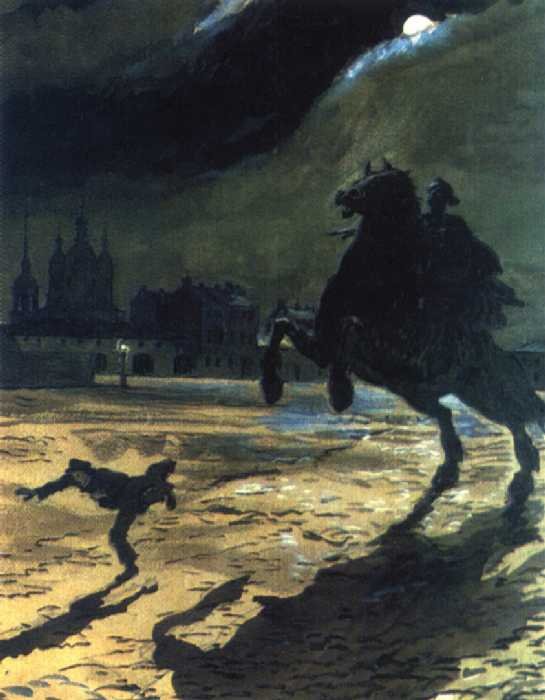
Евгений returns to Senate Square, and the poem’s moral machinery clicks into place. He sees Peter’s statue above him, arm extended, horse rearing, metal aimed toward the river. He speaks a threat—short, raw, almost childish—and the threat functions as blasphemy, since it addresses the founder with the tone a prophet might use toward an idol. Pushkin’s Russian chooses a word that carries an Old Testament sting, and the choice matters as much as the threat:
Кругом подножия кумира
Безумец бедный обошёл
И взоры дикие навёл
На лик державца полумира.
…
И, злобно задрожав, он кумиру
Ужо тебе!..¹¹
Кумир belongs to iconoclastic Scripture; it smells of smashed calves and prophets’ rage. Pushkin could have written “statue,” could have written “monument,” could have written “изваяние,” and he would still have delivered political protest. He chose кумир, and with that choice he dragged the whole theological quarrel into the square: worship offered to a carved thing, worship demanded by a civic cult, worship that requires punishment when an adherent’s tongue slips. The phrase безумец бедный appears before the chase, as though the poem stamps Евгений with a diagnosis early, and that stamp tempts a reader to treat the coming terror as private pathology. Yet the stamp also reads like a state’s label applied to dissent: “madman,” “pauper,” “unreliable voice.” The hymnbook’s margin notes suddenly looked like kin to that square: writing under pressure, words that survive by hiding.
Pushkin then unleashes the chase. The horseman pursues. Hooves strike stone. The sound follows Евгений through streets, across bridges, into spaces where a poor man’s lungs burn and his mind narrows to survival. A reader experiences the chase as consequence, since it grows from the curse, since it grows from the insult offered to the monument, since it grows from the city’s need to punish sacrilege against its founding myth. A reader also experiences a surge of aesthetic exhilaration, since Pushkin’s rhythm tightens and the narrative delivers speed, fear, and the sublime motion of an unstoppable force. That exhilaration forms the scandal at the heart of my thesis: the poem trains your senses to enjoy the mechanism that destroys its victim.
Pushkin’s stanza that seals the pursuit has entered Russian memory with the stubbornness of a refrain; it carries the beat of inevitability:
И во всю ночь безумец бедный,
Куда стопы ни обращал,
За ним повсюду всадник медный
С тяжёлым топотом скакал.¹²
Four lines, one moral trap. Во всю ночь stretches time, making terror a vigil. Куда стопы ни обращал turns every choice into futility, as though free will had been reduced to directionless running. Then the climax: повсюду—everywhere. The word denies hiding places, and the bronze rider becomes omnipresent inside the city’s stone veins. A hymnbook in a cell offers a different omnipresence, the presence of God in confinement, in whispered song, in the fact that a person remains more than an object of power. Pushkin’s omnipresence here belongs to civic idolatry, and the reader feels its seduction through sound.
Simone Weil, writing of the Iliad, describes force as a power that turns a person into a thing, and she insists that the poem’s grandeur arises from its unwavering gaze upon that transformation.¹³ Pushkin’s chase performs a related operation: Евгений becomes a thing hunted by the city’s idol, and the poem’s beauty intensifies while the human subject collapses. The reader, drawn by art, participates in the conversion of person into object. A sacrificial logic enters by stealth.
The monument, in that logic, behaves like a saint’s relic in a civic cathedral, since Petersburg’s public space functions as liturgical architecture. Granite embankments resemble aisles. Bridges resemble processional crossings. The Senate Square resembles a nave where power displays its holy image. Falconet himself described Peter’s raised hand as beneficent, and later interpreters argued over whether the statue represented blessing or menace.⁴ Yet Pushkin makes the argument corporeal by forcing a frightened clerk to supply the statue’s agency. Empire gains metaphysical authority through the psyche of a powerless man. The state achieves a miracle, and the miracle depends upon madness.
Lotman’s thought about cultural “explosion” helps here, since he treats catastrophe as a rupture that re-orders meaning inside a society.¹⁴ Lotman’s language can sound clinical, yet a flood makes it visceral. When water enters streets, the city’s signs fail: maps turn useless, addresses lose clarity, the ordinary logic of movement breaks. Pushkin intensifies that semiotic collapse by allowing the monument—an object meant to stabilize meaning—to enter motion inside a mind that has lost its private grammar. The poem therefore dramatizes how a state repairs the wound of chaos by turning its own symbol into pursuing judgment, while a human being becomes the site where repair takes place through breakdown.
A hymnbook in a cell resists that repair. It keeps insisting that judgment belongs to God, and that empires serve as dust beneath time’s feet. Yet Pushkin’s Petersburg has trained its inhabitants to hear the state’s hymn as ultimate. Евгений, when his home-psalm dissolves, turns toward the monument as a substitute altar. His curse resembles prayer. His flight resembles penance. His madness resembles possession.
Pushkin ends with a body found near the water on a small island, with the remnants of Parasha’s house nearby, and with a burial that passes quickly, as though the city has already resumed its song. Dewey’s notes mention Akhmatova’s suggestion that the island may connect Евгений’s end to Decembrist memory, given rumours of unmarked graves.² The poem, therefore, hints that Евгений’s private rebellion touches political rebellion, while the state’s hymn absorbs both into silence.
Bakhtin’s account of competing voices in Russian narrative offers another lens, since he treats literature as an arena where languages collide under pressure.¹⁵ Pushkin orchestrates competing voices with a musician’s ear: the ceremonial ode, the intimate address to friends, the clerk’s frightened interiority, the river’s roaring presence, the monument’s silent command that turns into pursuit. The poem refuses an official referee, and that refusal forces a reader into responsibility, since every interpretation places the reader in alliance with water, bronze, or the broken mind between them. Ethical reading becomes a lived act, akin to choosing which hymn one sings in a public square.
Now I return to the hymnbook and I ask you to imagine its cell. The cell holds light the way old churches hold light: a narrow window, a slice of sky, bars cutting the blue into segments like measures on a score. A prisoner opens the book. He finds Psalm words that promise rescue. He hears footsteps in the corridor. He hears the river outside, or he remembers it, since memory can make water audible even in dry stone. He sings softly, and the singing becomes a form of interior sovereignty, since it refuses to let the state own time.
Pushkin wrote a poem that both honours and threatens that sovereignty. He honours it by letting Евгений love. He threatens it by showing how easily a state’s myth can seize a man’s imagination and turn it into punishment. The poem’s metaphysical machinery feels uncomfortable because it implicates the reader: you experience pleasure from the chase, you admire the founding vision, you grieve for the drowned domestic hope, and your shifting sympathies resemble the shifting voices within the poem. The state’s hymn enters your ear through art, while the individual’s cry enters through pity, and the poem keeps you suspended between them in a condition that resembles moral dizziness.
Rosenshield’s work on Pushkin and madness insists on genre and form, and he shows how Pushkin manipulates uncertainty so that a supernatural reading and a rational reading can coexist.¹⁶ I treat that coexistence as an ethical trap. When a reader explains the chase as hallucination, the state escapes into innocence, since bronze remains bronze and the poor man’s collapse becomes private pathology. When a reader accepts the chase as supernatural, the state gains demonic grandeur that can feel thrilling. Pushkin compels you to hover, and the hovering keeps the civic hymn alive while it keeps the victim’s suffering available as spectacle. The poem therefore becomes a shared event of conscience: Pushkin sets the mechanism, Евгений pays in sanity and life, Peter’s image stands as the city’s altar, and the reader supplies the final consent through attention.
A concluding cadence in a lecture hall often aims for comfort, since comfort makes applause easier. A hymnbook in a cell refuses easy comfort. It teaches that consolation arrives through truth, and truth can cut. Pushkin’s poem offers a truth about empires that build on marshland—physical marshland, moral marshland—since such empires require victims to keep their songs coherent. Petersburg survives the flood, and Petersburg survives Евгений, and the monument remains, pointing and rising, while the river keeps its old power to rise again.
You, sitting here with your disciplined fingers and your bright fear of wrong notes, inherit the poem as an ethical event, since reading becomes participation. The question follows you beyond the room: when the public hymn demands your voice, and when a private life collapses beside you, which music claims your breath?
I close the hymnbook, and the leather meets itself with a soft thud that resembles a prayer ending in a whisper. The tide-mark remains inside, and the stain refuses cleansing, since it bears witness. Pushkin placed a monument in a square, and he let a flood speak, and he let a man go mad at the seam where state worship crushes household hope. The lecture ends, although the moral tension stays awake, since bronze and water continue their argument, and each reader’s conscience supplies the final acoustics.
Scholia:
1 Hymns Ancient and Modern, William Clowes and Sons, London, 1861, pp. 1–48.
2 Aleksandr S. Pushkin, The Bronze Horseman: A St Petersburg Story, trans., commentary, and notes John Dewey, Edinburgh University Press, Edinburgh, 1998, pp. 59–71.
3 A. Khan, Pushkin’s Bronze Horseman, Bristol Classical Press, London, 1998, pp. 1–58.
4 Alexander M. Schenker, The Bronze Horseman: Falconet’s Monument to Peter the Great, Yale University Press, New Haven, 2003, pp. 1–44.
5 Alexander M. Schenker, The Bronze Horseman: Falconet’s Monument to Peter the Great, Yale University Press, New Haven, 2003, pp. 171–200.
6 Aleksandr S. Pushkin, Polnoe sobranie sochinenii v desiati tomakh, vol. 5: Poemy, Akademiia Nauk SSSR, Leningrad, 1949, pp. 139–140. The founding stanza achieves its moral work through diction that looks like topography while acting like theology. Пустынных shifts water into wilderness, and wilderness in the Slavic Biblical ear carries testing, temptation, and the hunger for a promised city. The poem begins with an imperial Moses whose promised land arrives through coercion, and the word чухонца marks the human cost in a single ethnonym.
7 Augustine of Hippo, The City of God, trans. Henry Bettenson, Penguin Books, London, 1972, pp. 567–590.
8 Kseniya Barabanova, “The St. Petersburg Flood of 1824,” Arcadia: Explorations in Environmental History, Rachel Carson Center for Environment and Society, Munich, 2014, pp. 1–5.
9 Aleksandr S. Pushkin, Polnoe sobranie sochinenii v desiati tomakh, vol. 5: Poemy, Akademiia Nauk SSSR, Leningrad, 1949, pp. 147–148.
10 The Holy Bible, Douay-Rheims Version, trans. from the Latin Vulgate, Baronius Press, London, 2007, Genesis 6–9, pp. 10–14.
11 Aleksandr S. Pushkin, Polnoe sobranie sochinenii v desiati tomakh, vol. 5: Poemy, Akademiia Nauk SSSR, Leningrad, 1949, pp. 153–154. Pushkin’s кумир drags the monument into the Scriptural courtroom where idols demand worship and punish dissent. The term also exposes a civic sacrament: the state asks for reverence in the square, and the square supplies a theology of obedience. When the poor man names the idol as idol, the poem shows punishment rising as though the city had defended its god.
12 Aleksandr S. Pushkin, Polnoe sobranie sochinenii v desiati tomakh, vol. 5: Poemy, Akademiia Nauk SSSR, Leningrad, 1949, p. 155.
13 Simone Weil, “The Iliad, or the Poem of Force,” in Simone Weil: An Anthology, ed. and trans. Sian Miles, Penguin Books, London, 2002, pp. 161–182. Weil’s severity guards a reader from sentimental pity, since she insists that force enters posture and grammar, turning a person into matter. Pushkin’s chase operates under a similar physics, although force wears a civic costume. The poem’s beauty, which intensifies while Евгений’s humanity collapses, demands vigilance from a listener who wishes to remain human while receiving pleasure from form.
14 Yuri M. Lotman, Culture and Explosion, trans. Wilma Clark, Walter de Gruyter, Berlin, 2009, pp. 1–24.
15 Mikhail Bakhtin, Problems of Dostoevsky’s Poetics, ed. and trans. Caryl Emerson, University of Minnesota Press, Minneapolis, 1984, pp. 181–215.
16 Gary Rosenshield, Pushkin and the Genres of Madness: The Masterpieces of 1833, University of Wisconsin Press, Madison, 2003, pp. 117–168.