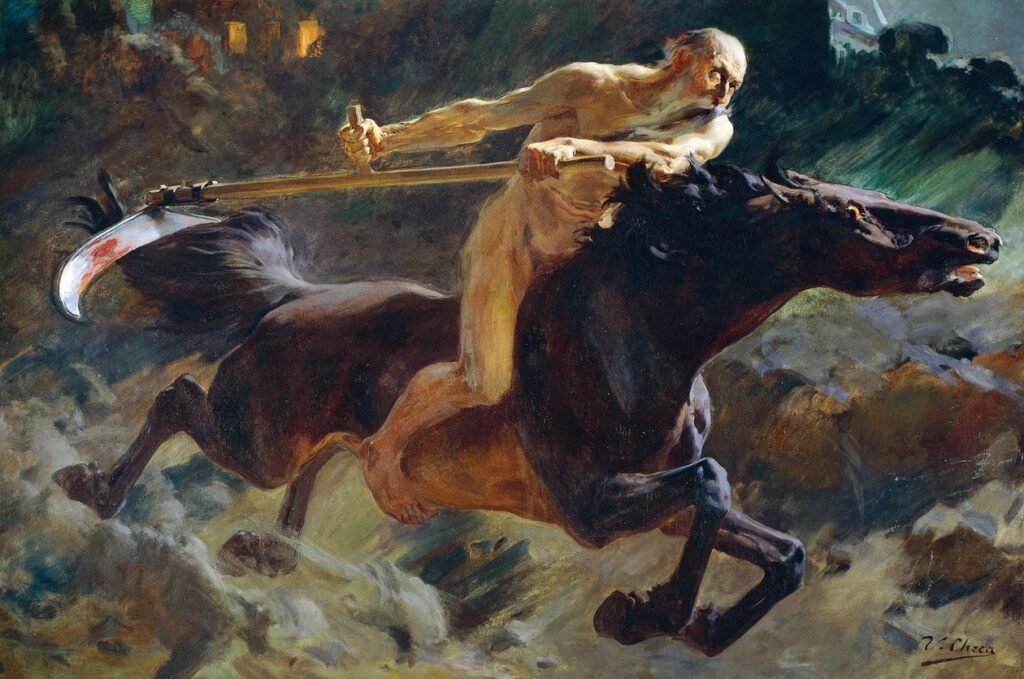
A streak of red rides the scythe’s crescent as though the metal had sliced through flesh, through banner cloth, through the thin membrane that separates a century from its own self-congratulation, and the stain holds its place at the far left edge where your eye expects mere highlight yet receives a wound, so that the whole image begins in blood before it reaches philosophy.¹ The old rider—bare as an unburied corpse, beard blown back like spent flax—leans forward with the grim competence of a farmhand who has harvested rye in a cold August and has learned, through seasons and funerals, how swiftly the field empties. The horse, black as a coal seam, surges through a vaporous ground that behaves like storm-cloud and battlefield smoke together, while ember-bright windows flicker in the distance with the domestic scale of catastrophe: a town, a parish, a row of rooms where bread once cooled and where, by 1916, Europe had trained itself to watch flame with administrative calm. In such a setting, allegory arrives with the speed of newsprint, and yet Checa’s figure bears an older weight, since the scythe belongs to Saturn as much as to the peasant, and the nakedness belongs to medieval danse macabre as much as to the academic studio, and the gallop belongs to apocalyptic riders as much as to the modern appetite for velocity.²
Checa’s lineage, which grew from a Spain that had made painting serve both altar and court before it learned, under nineteenth-century academies, to serve the salon and the illustrated magazine, forms a braided rope of influences whose fibres catch light in this canvas. Spanish art after Goya had moved with a nervous attention toward France, adopting classicizing severity, then romantic drama, then the polished historical spectacle that filled museums and state competitions, until a generation trained itself to paint incident with persuasive sheen and to sell narrative as a civic virtue.³ Within that climate, Fortuny’s brilliance in handling and his taste for costume, sunlight, and the glitter of surfaces had offered younger painters a model of theatrical exactitude, while Paris supplied a market and a grammar of finish, and Rome supplied antique authority, and the press supplied deadlines that demanded legibility at a glance.⁴ Checa, whose broader career belonged to this late-academic world of battle scenes, equestrian charge, and picturesque history, carried the Spanish fascination with spectacle into an epoch when spectacle had turned murderous by industrial means, and thus the old allegory of Time, which once functioned as moral instruction in chapels and palaces, re-enters as a commentary on mechanised slaughter, even when the painter keeps the iconography archaic. The canvas behaves like a bridge between Velázquez’s measured court time—candles, clocks, the pacing of audiences—and the trench time of the Great War, where hours congealed into mud and flares.⁵
The creative milieu of 1916 pressed upon painters with the force of rationing and censorship, while the public sphere—cafés, parish halls, railway platforms—absorbed war bulletins as daily liturgy, so that even artists distant from the front carried the front inside their sleep. In Madrid, in Paris, in any city where an academy had once promised that drawing could rescue the mind from chaos, the war taught the opposite lesson: geometry could guide artillery, chemistry could burn lungs, perspective could become reconnaissance. It matters that Checa sets Time upon a horse whose eye glows with a hard red point, since the animal reads as both mythic steed and modern engine, and the space beneath its hooves reads as both cloud and pulverised road, and the entire movement reads as a single command: forward, faster, through bodies. In that sense, the painting participates in the wider European meditation on speed, perception, and domination, where the visible world had become a target field and the human body had become a unit of expenditure, as though the century had chosen to measure itself by destruction in order to feel its own power.⁶
Checa’s composition holds a violent clarity. The scythe forms a long horizontal that counterbalances the horse’s diagonal rush, creating a cross-like structure whose arms stretch from the blooded blade to the rider’s clenched hand, so that the viewer’s gaze travels along a weapon that also functions as a measuring rod. The old man’s torso twists with controlled torque, and the sinews of his forearm tighten around the shaft, and the beard trails back in a white smear that echoes the smoke, and the horse’s neck thrusts forward in a muscular arc that carries the entire picture like a ship’s prow cutting black water. The palette, built from greens darkened toward pitch, greys thickened with brown, and sudden orange flares, suggests a world lit by fire through fog, which grants the surface a damp, funereal chill even where flame appears. The paint handling—smooth in the horse’s mass, softer in the vapor, sharpened at the blade—teaches the eye how to rank realities: muscle as fact, smoke as medium, fire as omen.⁷ Yet the painting’s true audacity lies in the way it makes allegory share the same air as reportage, since the distant lights resemble actual windows and actual burning dwellings, and the vapor resembles the chemical haze of modern war, so that the myth walks into history with unwashed feet.
A viewer trained by standard iconography might accept the rider as Time triumphant: Saturn’s harvest of lives, the relentless advance of years, the inevitable levelling of kings and beggars. Barnes, who distrusted the fog of literary chatter around pictures and demanded an encounter grounded in visible quality, would push the observer to test such an interpretation against the surface’s decisions—edges, weights, intervals, tonal relations—until symbol submits to sight.⁸ When that discipline governs the gaze, a small element begins to exert strange authority: on the rider’s left wrist, where one expects simple flesh, a pale band catches light with the insistence of metal or cloth, a narrow ring that interrupts the anatomy like a modern fastening.⁹ It may look, at first glance, like a studio accident of highlight, yet its placement, its contour, and its contrast against the browned skin make it read as a strap, a binding, a manacle, or even the ghost of a watchband, and once that association takes hold the allegory shifts from mastery to constraint, since Time, the supposed sovereign of all bodies, appears bound by an object that belongs to human manufacture and human scheduling.
That band changes the canvas’s theological temperature. Augustine, while wrestling with the mystery of time as distentio animi—stretching of the mind—found himself circling an enigma where measurement arises inside the soul even when the cosmos supplies day and night, and thus time becomes both real and dependent upon an inner faculty that counts.¹⁰ Checa’s wrist-band turns that inward problem outward and material, since the rider’s body—ancient, nude, supposedly elemental—carries an artefact of modern counting, as though the war had fastened chronometry onto the bones of myth. In 1916, clocks governed rail timetables, factory shifts, artillery schedules, and casualty lists, so that time, once felt as season and prayer, became a grid of obedience; and if Time itself carries a strap, then the painting stages a reversal: the cosmic reaper functions as conscript of the very systems that claim merely to measure him. Bergson’s distinction between lived duration and spatialized time—between inner flow and external quantification—sharpens this reversal, since the strap hints that duration has been forced into the form of number, and that life has been coerced into units fit for administration.¹¹
Such a reading presses back upon Checa’s milieu, since late academic painting had long served institutions that loved clear narratives and public legibility, and the war intensified that hunger for images that could organize fear. Macfall warned that criticism often collapses into jargon that appeals to reason while abandoning the senses, and yet he also insisted that words, when shaped as literary art, could carry the emotional truth of painting with direct force.¹² Here, words earn their right by returning to the band on the wrist and to the blood on the blade, since those two accents—one of binding, one of injury—turn the rider into a figure who suffers history as much as he enacts it. The red stain at the blade’s tip, viewed through this lens, ceases to signal timeless mortality and begins to suggest a fresh cut inside a specific year, a moment when Europe’s harvest had acquired a new technique.
Once the wrist-band becomes central, other relations rearrange themselves. The horse’s red eye, which could read as demonic, begins to resemble the glow of an engine sight or a signal light, a modern eye of apparatus, and the vapor around the hooves begins to resemble churned dust from roads and shellbursts, which implies that Time rides a machine-like beast that belongs to industrial momentum. The distant windows, which seem few and scattered, begin to resemble civilian dwellings caught in a theatre of total war, where the home loses sanctuary and becomes target. The rider’s nudity, which earlier could read as classical universality, begins to read as exposure, as vulnerability, as the stripping away of old protections. Even the scythe, an agrarian tool converted into a weapon, begins to look like an emblem of how peaceful labor had been drafted into killing, since the same curved blade that once cut grain now becomes a signature for mechanized death.
Checa’s training, grounded in drawing that respects anatomy and in compositional habits that value legibility, enables this allegory to remain convincing even as it enters modern dread. The body of the rider holds believable weight upon the horse’s back; the torso compresses; the thigh grips; the shoulders bear strain. The painter’s knowledge of equine motion—forelegs reaching, hindquarters driving, neck extended—anchors the supernatural in the measurable. Technique here functions as moral strategy, since the painting persuades the eye that myth lives inside physical law, and therefore that the terror depicted belongs to the same world as the viewer. Wallert, Hermens, and Peek emphasized that materials and methods, when studied across disciplines, reveal how painters build meaning through ground, film, and surface decisions; and in Checa’s case, the alternation between dense, dark passages and softer vapors supports an atmosphere where forms emerge like memory through smoke, suggesting that history itself has become a medium that blurs.¹³
The sociocultural ether of 1916 also includes the uneasy commerce of value and prestige, since war intensified the need for public symbols while the art world continued to trade in reputation, exhibition setting, and critical authority. Li’s study of valuation under shifting contexts demonstrates that even experts, who claim immunity, can be swayed by setting when assigning worth, which offers a parallel to how viewers read allegory under the pressure of wartime framing: the same image, hung in a museum, may appear timeless, yet seen beside casualty lists it acquires an immediate sting.¹⁴ Checa’s Time, conceived within a world saturated by propaganda and grief, may have been received as a grand emblem of inevitability, yet the wrist-band—quiet, almost hidden—suggests that the painter’s own eye had begun to see the modern binding of existence, the way schedules, mobilization orders, and bureaucratic measures could enslave even the most ancient categories.
The previously overlooked detail thus opens a different ethical horizon. If Time wears a strap, then Time has entered the regime of objects; if Time bears a binding, then Time participates in the same vulnerability as the conscript, the nurse, the widow, the clerk counting telegrams. The canvas ceases to flatter fatalism and begins to accuse an epoch that had reduced duration to quota and life to inventory. The rider’s forward lean, previously a sign of unstoppable force, becomes a posture of compelled acceleration, as though a whip beyond the frame drives both horse and reaper. The old beard, blown back, ceases to signify wisdom alone and begins to resemble the shredded remnants of an older Europe—Latin prayer, village proverb, guild routine—torn by a wind of modernity that demanded speed without mercy.
In the end, the painting offers a bleak tenderness, since it grants even the reaper a mark of bondage, and by granting that mark it suggests that human beings, through their inventions, have begun to govern the very conditions they once feared as divine. When you stand before the horse’s black mass and follow the scythe’s line to the blooded tip, the mind may seek consolation in the thought of inevitability, yet the wrist-band refuses consolation, since it implies responsibility, and therefore guilt, and therefore the possibility of change that history rarely grants in time. In that refusal, the canvas leaves a final motion: Time gallops through smoke with a strap upon his wrist, and the strap tightens as the century counts itself, and the counting continues beyond any final sentence, into an Uncountably Shaped End.
Scholia:
1 John C. Van Dyke, A Text-book of the History of Painting, Longmans, Green, and Co., New York, 1919, pp. 218–219. Van Dyke’s survey, composed while academic history painting still carried institutional authority, provides a period ear for how “modern Spaniards” were perceived in an Anglophone pedagogical frame, since he places post-Goya Spanish production within a field drawn toward France, toward salon display, and toward a taste for pageantry. His language, for all its early-twentieth-century temperament, captures an art public that judged pictures by immediate effect, finish, and anecdotal charge, which suits the reception environment from which Checa’s allegorical gallop emerged. Checa’s visual rhetoric belongs to an era when Spanish painters moved inside Franco-Spanish circuits of influence, where Meissonier-like precision, costume spectacle, and “historical works” occupied the same cultural shelf as national memory. Within that shelf, an allegory of Time could appear as moral emblem while also performing as marketable drama, and thus the painting’s interpretive field includes both metaphysical tradition and public appetite.
2 Aby Warburg, The Renewal of Pagan Antiquity: Contributions to the Cultural History of the European Renaissance, trans. David Britt, Getty Research Institute, Los Angeles, 1999, pp. 273–314. Warburg’s attention to the afterlife of antique formulae—gestures, postures, pathos-charged motifs—offers a method for reading Checa’s rider as a survival of Saturnian imagery that re-enters modern conditions with altered voltage. The “pagan” figure persists, yet the context changes the charge, so that a scythe and a gallop, once attached to cosmic cycles, can be reattached to mechanized catastrophe. Warburg’s broader claim, that inherited forms migrate across centuries while carrying memory within their bodies, permits a disciplined approach to allegory: one reads the horse, the beard, the weapon, and the storm as carriers of older energies, while asking which modern pressures have redirected those energies. Checa’s canvas, painted amid world war, behaves as a laboratory for such migration, since it dresses an ancient power in the air of smoke and burning dwellings.
3 John C. Van Dyke, A Text-book of the History of Painting, Longmans, Green, and Co., New York, 1919, pp. 218–219.
4 Haldane Macfall, A History of Painting: The Modern Genius, T. C. and E. C. Jack, London and Edinburgh, 1911, pp. vii–x. Macfall’s foreword, written with polemical heat against academic jargon, supplies an ethical standard for prose that seeks to remain answerable to sensation—colour, weight, edge—while still carrying historical meaning. His insistence that words must function as an art in order to convey art forms a useful constraint when approaching Checa’s painting, since allegory tempts the critic into abstract naming that can float free of the surface. By leaning on Macfall’s distinction between cold explanatory language and sensory speech, one keeps the reading attached to the scythe’s red stain, the horse’s muscular darkness, the smoky atmosphere, and the small wrist-band that alters the interpretive centre.
5 Martin Smallridge, Diego Rodríguez de Silva y Velázquez — A Sovereign Soul, Lyrics Editorial House, Portlaoise, 2025, pp. 90–91. These pages describe court time as a lived regimen—candles, pacing, rhythms of audience—thereby offering a foil for the war time that Checa’s painting invokes. The relevance arises through contrast: early modern sovereign life counted time through ritual and bodily sequence, while twentieth-century mass mobilisation counted time through schedules, shifts, and mechanised coordination. This contrast assists the argument that Checa’s wrist-band reads as a sign of chronometric binding, since the strap suggests the modern conversion of duration into administered units.
6 Paul Virilio, War and Cinema: The Logistics of Perception, trans. Patrick Camiller, Verso, London, 1989, pp. 1–35. Virilio’s thesis, that modern war reorganises seeing through speed, targeting, and technical apparatus, aids the reading of Checa’s red-eyed horse and the vaporous ground as a world where perception serves destruction. The horse begins to resemble an engine of acceleration, and the landscape begins to resemble a theatre where visibility has been weaponised. This does not require literal depiction of artillery; the atmosphere and the optical cues suffice. The wrist-band then functions as a further sign that the epoch has bound even the allegorical figure of Time to the logic of coordination.
7 Arie Wallert, Erma Hermens, Marja Peek, Historical Painting Techniques, Materials, and Studio Practice, Getty Conservation Institute, Los Angeles, 1995, pp. viii–ix. The editors’ preface frames technique as an interdisciplinary object of study, which supports the insistence that meaning in Checa’s canvas arises through surface decisions—density of darks, softness of vapors, sharpness of blade—rather than through iconographic naming alone. The wrist-band, in particular, becomes legible through attention to paint contrast and edge control, since its pale ring depends upon deliberate tonal separation from surrounding flesh.
8 Albert C. Barnes, How to Judge a Painting, Arts & Decoration, Adam Bude, New York, 1915, pp. 217–220, 246, 248–250. Barnes’s insistence upon judgment grounded in pictorial relations—colour, form, spacing—disciplines the temptation to treat Checa’s image as mere emblem. His distrust of explanatory verbosity pushes the observer toward the horse’s mass, the scythe’s line, the balance of diagonals, the handling of atmosphere, and the small anomaly at the wrist. In this sense, Barnes provides a methodological ally: the “previously unobserved detail” gains authority precisely when the eye accepts Barnes’s demand that meaning remains accountable to the visible.
9 Augustine, Confessions, trans. Henry Chadwick, Oxford University Press, Oxford, 1991, pp. 230–242. Augustine’s wrestling with time as a mental stretching supplies a philosophical ground for interpreting the wrist-band as a sign of externalised measurement. Checa’s Time, whose body suggests ancient universality, bears a mark that hints at counting by instrument, thereby staging a tension between inner duration and imposed metric. The canvas thus turns an interior theological inquiry into a historical symptom.
10 Henri Bergson, Time and Free Will: An Essay on the Immediate Data of Consciousness, trans. F. L. Pogson, George Allen and Unwin, London, 1910, pp. 98–120.
11 Elaine Scarry, The Body in Pain: The Making and Unmaking of the World, Oxford University Press, New York, 1985, pp. 3–27. Scarry’s analysis of how pain disrupts world-making assists the reading of Checa’s blooded scythe and exposed body as signs that the epoch’s violence has entered the allegorical register. The red stain, seen alongside the wrist-band, suggests injury and constraint, which together alter the tone from triumphant inevitability toward damaged agency. This supports the claim that the painting carries an ethical accusation aimed at a historical system that converts bodies into expendable units.
12 Qin Li, Looking Expensive: Experts’ Valuation of Paintings Influenced by Context, Journal of Expertise, Queensborough Community College, New York, 2024, pp. 1–20. Li’s findings about context effects on valuation offer an analogue for context effects on interpretation, since the same allegory can appear timeless in one setting and historically charged in another. This note supports the argument that Checa’s painting, when read within the sociocultural ether of 1916, yields a different centre of gravity, especially once the wrist-band is seen as a mark of modern chronometric binding.