“…the call for unlimited births is imperialism, retaliation, a future war. The day on which Polish women would agree with the German ones to ‘demobilise wombs’ would be an important day for peace among the humanity.”¹
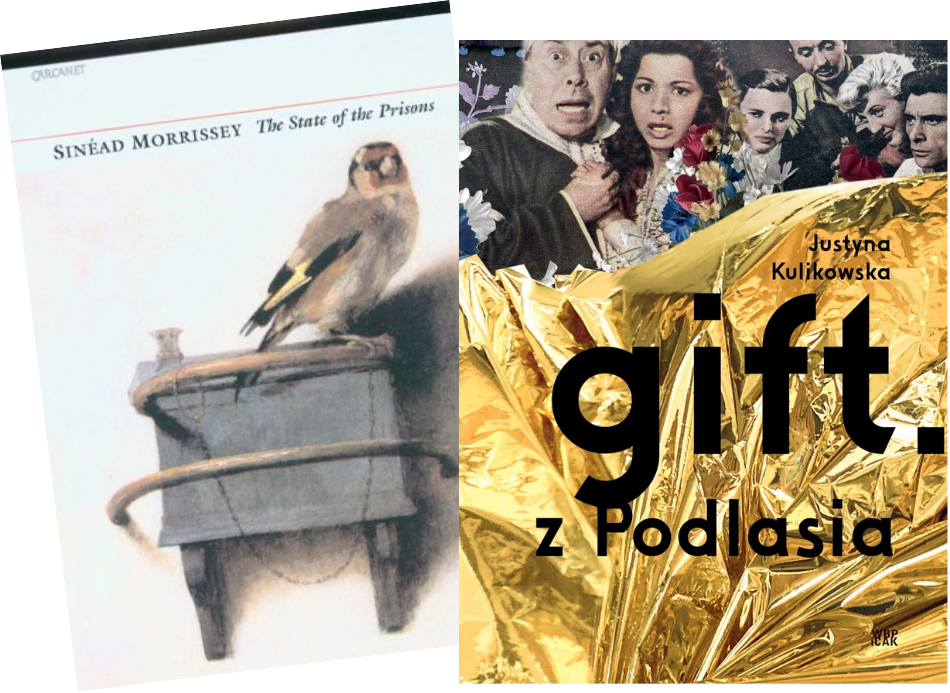
On a table, two thin volumes lie open beside each other while a pair of hands hovers above them, a small domestic constellation of paper, skin, and print; on the left, Sinéad Morrissey’s villanelle Genetics begins with its famous opening line about fingers and palms, on the right, Justyna Kulikowska’s ostatni gift. z Podlasia closes a fierce Podlasie sequence with a meditation on precision and harm, and between both poems Boy-Żeleński’s sentence about demobilised wombs drifts like an uninvited third speaker. Morrissey threads inheritance into anatomy through the image of hands that carry father and mother in separate zones of touch, while Kulikowska measures inherited damage through a voice obsessed with exact dosage, whether of pills, words, or aggression. Each poem listens to births, marriages, and families as political structures; each converts intimate gesture into a thesis about how one generation enters the next.
Morrissey’s first line already rehearses a kind of genetic chiasmus, since “My father’s in my fingers, but my mother’s in my palms” dissects the hand into two complementary fields, with consonance in “father’s / fingers” and “mother’s / palms” creating a soft drumbeat that steadies the ear before any narrative arises. The syntax moves through parallelism: possessive, prepositional phrase, possessive, prepositional phrase, and the repetition of structure yields a sense of law, as if heredity followed the rhythm of the sentence. Critics often emphasise that Genetics adopts the villanelle’s rigid pattern of five tercets and a closing quatrain with refrains in lines one and three, so that the poem spins around those hand-lines in gradually tightening circles, and the effect, once heard aloud, mimics a pulse that returns to the same pressure points again and again. The melodic line proceeds with a near-iambic sway, although Morrissey allows small syncopations, for instance in the lifted stress on “father’s” at the start, which gives the poem an embodied, heartbeat-like measure rather than a metronomic one.
Out of the villanelle’s turning pattern grows a tiny constellation of words that always arrive through skin. Fingers, palms, hands, touch, the faint sheen of flesh under light, the improvised chapel and steeple of a child’s game where interlaced fingers rise into a spire and an invisible congregation presses together inside: the poem keeps circling that sensory field as though every abstract thought about family needed a tactile counterpart. When the speaker confides, I lift them up and look at them with pleasure, the line carries a small, uncynical pride in one’s own body, a moment in which self-recognition comes through the gaze that lingers on one’s hands. Almost at once the poem admits another truth, since those same hands bear the entire memory of a union that survives in bone structure and in the shape of the palm, while the actual parents inhabit “separate lands” and “separate hemispheres,” each confined to a distinct latitude of bed and waking. Enjambment stretches that parting across white space; the eye jumps from “separate” to “lands,” from “hemispheres” to “sleep,” and the small leap over the gutter of the line recreates, at the level of the body reading, the gap between households and continents. Through all of this the villanelle advances with an almost ceremonious composure, since Morrissey keeps her lines in a narrow range of length and lets the rhymes reappear with unhurried regularity, so that the tempo itself suggests a speaker who has folded the shock of breakup into a cadence steady enough to inhabit.
A different current moves beneath that calm surface once Morrissey’s own history enters view. One can picture a Belfast kitchen in the nineteen-seventies, Portadown behind her as the town of birth and the city around her still tense from explosions and barricades, while a Catholic-born father and an English mother with Anglican roots return from a Communist Party meeting and place on the table leaflets filled with Marxist slogans and maps. Morrissey has spoken about those meetings, about Eastern European travel, about the dense, slightly foreign vocabulary of Marxism as part of her childhood weather, and about the decision her parents made to raise their children away from the usual Protestant–Catholic camps of Northern Ireland. A grandfather belonged to the same Communist milieu, so that family stories carried names of parties and movements along with the usual anecdotes about school or work. In light of such a background, the “separate lands” and “hemispheres” in Genetics point far beyond the confines of one divorce; they whisper of Ireland and England, of East and West, of Cold War borders and colonial sea-routes, all reduced to a diagram drawn in tendons and joints. The child of ideological internationalism discovers in her own hands a miniature treaty, since father and mother meet nowhere more fully than at the fold where “fingers link to palms,” and within that hinge the poem maintains a point of contact that outlives every institutional form of their marriage.
The poem’s ethical pressure arises inside its refrains. When the speaker declares, “I know my parents made me by my hands,” the verb “made” fuses physical procreation with deliberate creation, as if shaping clay or building an artefact, and the line returns later in slightly altered form, each time compressing a little more knowledge into itself. The friends who “quarry for their image by a river” suggest that other people search for resemblance in the speaker’s face, manner, or behaviour, yet the poem insists that true memory of the marriage takes place in the hands alone, through an internal, tactile awareness. The chapel-and-steeple game performs a brief, almost comic re-enactment of the wedding with these same hands, while the “demure priest reciting psalms” appears only as miniature, a puppet of finger-architecture, so that institutional religion shrinks beside the physical fact of inherited anatomy. For Morrissey, ethos emerges from that fact: a child bears the traces of parental vows permanently, in bone and skin, and must eventually decide how to pass those traces onward.
The closing quatrain lifts that responsibility into the future when the speaker turns away from her parents towards an unnamed beloved and promises, “I’ll bequeath my fingers, if you bequeath your palms.” Legal language enters here through “bequeath,” a verb from wills and probate; inheritance law steps into the intimacy of touch. The conditional structure—my fingers on the condition of your palms—frames love as a contract between equal partners rather than as a sacrament imposed by church or extended family, and the villanelle’s once-closed circle opens towards unborn children whose hands will carry an entirely new map of histories. For a poet raised in an atmosphere of Communist internationalism during the Troubles, such imagery carries an implicit challenge: every future pair of hands in Ireland, or anywhere else, embodies decisions about ideology, allegiance, and care. The poem, through its cool grace and melodic restraint, argues that conscious, mutual inheritance offers a way out of inherited violence.
Where Morrissey’s villanelle presents elegance and control, a poem that calibrates each repetition with almost architectural care, Kulikowska’s gift. z Podlasia sequence moves through a far more jagged soundscape, and the final poem ostatni gift. z Podlasia, printed in Gazeta Wyborcza and in Książki. Magazyn do Czytania, enters public space as a kind of lyrical dispatch from Poland’s eastern periphery. The very title “gift. z Podlasia” splices English loanword and regional designation, with the full stop after “gift” signalling a glitch in tone, somewhere between advertisement and warning. The book, published in 2021 by the regional cultural centre in Poznań, extends earlier work from Hejt i inne bangery and Tab_s, yet critics emphasise that in this volume Kulikowska’s poems appear especially “nervous, dirty and angry,” while at the same time they hinge on astonishing precision. The final text circles obsessively around a sentence that reviewers quote: “precyzja jest kwestią najistotniejszą” – “precision presents itself as the most essential matter” – and every stanza measures actions and phrases as if each gesture equalled a dose of medicine.
When her life steps out from bare dates and starts to move through particular corridors, kitchens, and bus shelters, the fury and care in her lines feel less like a literary pose and more like the set of a young jaw that has learned the weight of slammed doors, muttered threats, and a radio murmuring in the next room. In 1993 a girl drew her first breath in Szczuczyn in Podlasie, as fields pressed against council blocks and the road towards Białystok or Warsaw carried departures in both directions, so that the girl who grew from that scene, later signing herself Justyna Kulikowska, emerged as a daughter of the first generation shaped entirely by post-1989 Poland, where discount supermarkets throw acid light on puddles while concrete relics of state socialism stand only a few streets away. She remains oriented towards the east of the country, since even a later season in Lublin, with its other pavements, libraries, and voices, extends her range without severing that anchor in such a way that the poems that follow carry at once the chalk-dust of village roads and the quicker pulse of a provincial bus filled with commuters and students rehearsing routes out of town.
Her books trace a line of increasing visibility through that landscape of awards and juries: Hejt i inne bangery gathers the Kazimiera Iłłakowiczówna Prize together with an online readers’ distinction, Tab_s reaches the shortlists for the Nike and Gdynia prizes, gift. z Podlasia receives the Gdynia Poetry Award and the Kazanecki Prize in Białystok, while Obóz zabaw confirms that her voice has settled for good in the national conversation. Reviewers writing in Czas Kultury and in other venues speak of a diction soaked in long afternoons of provincial tedium, in slammed doors and emergency rooms, in psychiatric intake forms and the jittery patter of social media, and they stress how Podlasie enters those lines through grain of accent, through choice of slang and syntax, through stairwells, fields and bus stops, while folkloric patterning retreats to the margins.
In ostatni gift. z Podlasia, tempo runs fast and breathy; long lines carry clauses that coil through slang, clinical vocabulary, and abrupt images of bodies in pain or bodies sedated. The poem’s melodic line owes little to traditional metre and far more to spoken-word cadence, where abrupt enjambments mimic the jump-cut logic of a mind under pressure, and where fragments of online speech—hashtags, anglicisms, memes—slide beside intimate confessions. Reviewers remark that the poems appear “nervous, dirty and furious in a very precise way,” and that oxymoron captures the central stylistic paradox: Kulikowska sustains control through a simulation of breakdown, as if each jagged phrase had undergone tiny calibrations before release. Into this verbal storm she introduces the theme of precision: the exact flick of a mirabelle stone against a stranger’s back, the exact milligram of a drug, the exact grammatical choice that either humiliates or consoles. In such a framework, every word equals a potential instrument, with consequences measured in bloodstream and psyche.
That devotion to precision connects strongly with medical and pharmacological discourse, and through that with a long Polish debate about reproductive rights and bodily autonomy, the debate that Boy-Żeleński entered so fiercely in Piekło kobiet (Women’s Hell). Boy wrote as a physician and translator who campaigned against restrictive abortion laws during the interwar period; he framed birth control as a programme of pacifism aimed at peace between nations, while he saw pronatalist propaganda as an instrument of militarism, with women’s bodies drafted into demographic warfare. Kulikowska writes a century later in a country where abortion law again tightens and where conservative rhetoric glorifies large families and “traditional values,” and her poems register the fallout: domestic violence, unwanted pregnancies, chronic mental illness, and a sense of economic trap for young people outside major cities. Within that ethical landscape, the insistence that “precision” governs survival acquires a hard political edge. A young woman in Podlasie must choose words carefully with doctors, parents, partners, priests, employers; each misphrased sentence can carry costs, and each silence can reinforce someone else’s power.
When we set Genetics beside ostatni gift. z Podlasia, a shared philosophical framework begins to appear through the contrast in tone. Both poems imagine the body as archive and contract. Morrissey sketches the hand as a living document, where fingers bear paternal script and palms maternal, while the hinge between them records a marriage that ended in geographic and emotional separation. Kulikowska, in turn, treats the whole organism as a ledger of traumas and chemicals; pills alter perception, bruises record assaults, slang expresses class position and cultural capital. In both cases, the speaker asks how much freedom remains within a body pre-written by others, whether through DNA or through violence and neglect. Morrissey offers an answer grounded in a kind of Maussian gift-economy: the child can choose to “bequeath” her fingers knowingly, entering into a mutual exchange with a beloved, and thereby convert received inheritance into deliberate gift. Kulikowska approaches the same terrain through an economy of sale and purchase: she speaks of “selling trauma,” of transferring weight to the reader, which enacts a kind of counter-gift where the damaged subject hands over testimony and expects recognition as payment.
The deeper connection lies in tempo. Morrissey builds a villanelle that moves with dignified regularity; each return of the refrains arrives like a tide that repeats certain curves yet brings different sediment each time. Those refrains trace a calm spiral from observation (“My father’s in my fingers…”) through knowledge (“I know my parents made me by my hands”) towards pledge (“I’ll bequeath my fingers…”), so that the poem’s melody enacts a transition from passive reception to active gifting. Kulikowska, by contrast, sets up accelerations and stalls; long, rambling syntactic chains break suddenly into hard monosyllables or curses, and the very unevenness of rhythm reproduces anxiety and agitation. Yet inside that storm, the repeated notion of precision acts as a counter-melody, a quiet line that insists on control and discrimination. Her poem effectively says: chaos covers the surface, yet exact decisions in dosage and speech decide whether a body endures. When we listen to both voices together, Genetics supplies the steady heartbeat, and ostatni gift. z Podlasia supplies the arrhythmic panic that shares the same bloodstream.
Trivia about each poet’s family history enriches this dialogic reading. Morrissey writes as the daughter and granddaughter of Communists in a city defined through sectarian strife, and she has spoken openly about childhood evenings at Communist Party meetings, Soviet imagery in the home, and an upbringing that sidestepped Belfast’s binary of Catholic and Protestant affiliation. In Genetics, that choice materialises in the refusal to name any specific creed; the chapel-and-steeple remain finger-play, and the priest appears as miniature, while the genuine sacred object becomes the hand itself, bearer of an embodied internationalism. Kulikowska, born in provincial Szczuczyn “because there was no hospital in Żebra,” as she quips in one profile, inherits a different map: rural poverty, post-communist disillusion, and an intensely Catholic region where Church discourse permeates family life. Awards and acclaim arrive now, yet the poems remain rooted in that origin, in rooms filled with smoke, unfinished houses, cheap vodka, domestic quarrels, and psychiatric waiting rooms. Family life for her speakers appears as an engine that generates both affection and enduring harm, and precision of expression becomes the only available counter-technology.
Philosophically, both poems turn around a question that ancient thinkers would have phrased through physis and nomos: what rises from nature, and what arises from law or custom. Morrissey’s hands carry physis through genetic traits, while “marriage” and “bequeathal” belong to nomos, the realm of contracts and institutions. Her villanelle proposes that a subject can re-inscribe nomos upon physis by choosing how to interpret inherited features and by deciding which elements to pass further. Kulikowska’s Podlasie sequence, conversely, exhibits nomos as a sometimes violent script engraved upon the body: patriarchal family norms, Church teaching, neoliberal labour precarity, and psychiatric classification all write their signs upon the speaker’s flesh and language, yet inside that mesh she insists on phronesis, practical wisdom, in the sense of choosing dosage, vocabulary, and allegiance with surgeon-like care. Both voices therefore treat the person as a crossroads where nature, law, and ethical judgement intersect in every gesture.
In the final image, we return to the opening table. The reader’s own hands hover over two facing pages, one that speaks in measured villanelle turns and one that races through Podlasian slang, and the skin over the knuckles gleams under the lamp while Boy-Żeleński’s words about demobilised wombs echo at the edge of awareness. Morrissey’s child folds her fingers into a chapel and feels within that small architecture the impossible union of separated parents, whereas Kulikowska’s speaker calibrates the throw of a mirabelle stone, the swallow of a pill, the thrust of a sentence, each with the same ruthless attention to consequence. Both poems ask what kind of future emerges when births cease to follow blind obedience to nation and creed, and when children claim authority over the stories their bodies tell. Somewhere between Belfast and Podlasie, between villanelle and rant, between “bequeath my fingers” and “precision as the most essential matter,” an ethics of inheritance comes into view, one where each new pair of hands carries entire worlds and where peace, in Boy’s sense, begins when those hands learn to demobilise themselves from every imperial script and instead choose their own careful touch.
¹ Tadeusz Boy-Żeleński, Piekło kobiet (Women’s Hell), cited and translated in A. Budnik, “Women’s hell – the contemporary picture in the media space,” Acta Universitatis Lodziensis. Folia Sociologica 2016.