Literary sketches on “The mills kept grinding”
Our tempers under pressure tell all while keeping a portion veiled. For a maker—more precisely, an author—the character sketch exceeds a plan or chart of traits; during the work we cross a threshold and inhabit that invented skin, though the day-bright mind keeps its own address. So if you ask which figure in The Mills Kept Grinding walks closest beside me, I answer at once: Volker.
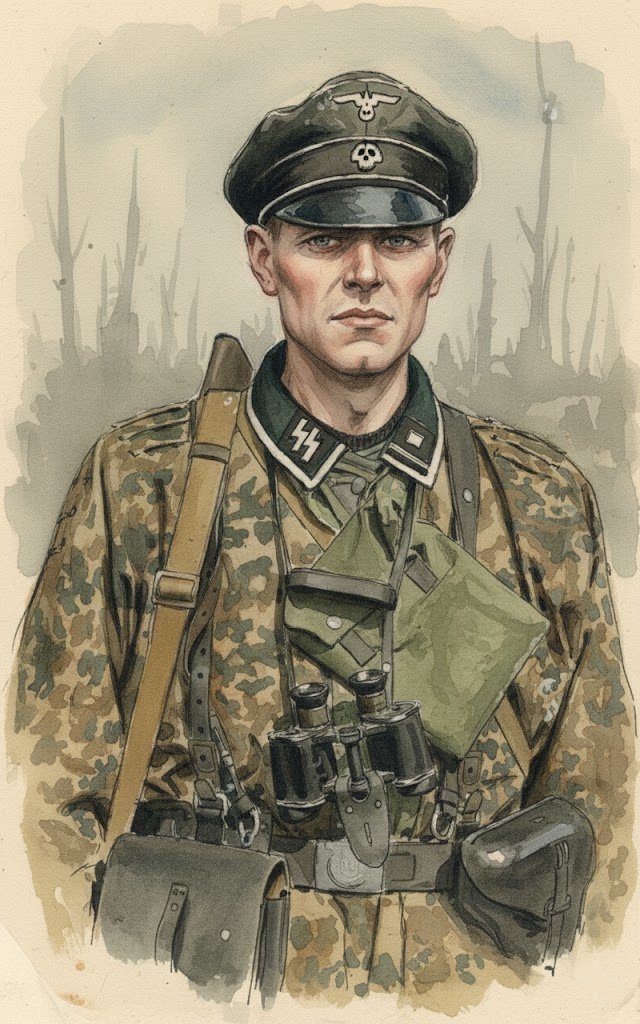
—a protagonist
in the German section
of The Mills Kept Grinding.
His economy tempts belief in predictability, the way a plain road tempts a tired walker. I shaped him from absence—nobody’s echo—unlike the others. Holger and Antoni, chiefly the latter, carry shards of people I have met; Antoni shadows my father’s fate through the book’s latter half. Wainwright tilts toward an alter ego. Lieutenant Adam, Captain Grzegorz, and Lieutenant Bugaj match dear friends so closely that I left their names untouched.
Imagination suffers the leash of lived hours and scenes, which feels unjust; yet a supple mind stretches and sets a stage beyond calendar and map, where a fresh order gathers at the lip of a beginning, rising from a spark that springs straight from those very limits.
Jörg Volker belongs to that borderland. He keeps step with his period and answers its grain, while he also exceeds it—an emblem with his own weather. Evil in historical fiction hugs reality’s edge and clings there like a parasite; I refused that grip while drawing Jörg. I see him as embodied malice yoked to a mind that nurses it. His show of dullness thins through his monologues and clears away, page by page. I aimed for a figure built in planes, onion-like, charred without, and within—layer under layer—a man who carries weaknesses in plenty and a meagre clutch of strengths that still grant him a tolerable weight.
A writer who faces evil carries a hard task: make the encounter bearable through a living bond between reader and the fate of those soaked in harm. We speak about a duel between light and darkness as if an old banner could answer every need—yet who swears that banner tells the whole?
That frame grows overused until anyone can spot it and summon it, like a pattern wired into bone. So I turned the wheel and chose another gauge—Goethe’s malice locked in a quarrel with itself, where a lesser force bites at a greater and wins a narrow ground. Injustice receives its own medicine. That line defines Volker, and Holger reads him there: “One thing stands sure: Gerver likely counts as the sole man on earth who met Volker’s knife and came away alive. Even a feigned trench collapse served him well, since Volker appeared to him as an unholy force fit to return at any hour. People abandoned that poor wretch in due course, and even Behrendt let the inquiry go. In the end Volker—while blind to his full part—grew into that ‘force which wills the evil and brings forth the good.’ Goethe guides the thought here, and perhaps Bulgakov glimmers; regardless, Volker served as judge, punishing the wrongs of a man who treated human and divine law as air.”
Can an author step aside from a figment and still grant the figment the texture of truth? Picture a father disowning a child, or a mother doubting the birth, claiming foreign blood where her own blood flows. While shaping Volker I feared that snare, and I confess that stretches arrived when I had to enter him whole—Being Volker. Horror mixed with a strange magnetism as I crossed barriers and moved as a will apart. At times the tale sounded through his throat, and my hand merely kept pace.
Evil lures us—reader and writer alike—through its foreign flavour, like fruit from the East that promises delight to the point of surfeit. Hard admission follows: particles of that malice lodge in each of us. Birth may bring it, or chance may seed it—family, kin, acquaintance. Some tend the seed more fervently than others; truth remains that it lives within and raises its voice when we grow certain of our wisdom. Well then… are we as wise as we claim?
Does a novelist choose evil as subject with full awareness, or does evil tempt the novelist with a changed register and lead the hand to a different music?
Call it innocence if you wish: I believe the subject selects its teller. While I wrote The Mills Kept Grinding, story after story pressed in as if carried by a current. Resistance felt wasteful, since I sensed them rising from my own experience or from the handed-down store of family speech. Those accounts leaned toward the subjective until they brightened into image and smudged the edge between here-and-now and there-and-then. Into that current flowed the remembered shock of North Korean fanaticism witnessed by my own eyes in the mid-1980s.
The combined experience of my parents and extended kin, joined with a child’s encounter with the predatory totalitarianism of the Kim Il-sung regime—heat I touched and that scorched—stirred an urge to mend the world by means of the page. The faces of friends stood with me against harm and gave armour—a suit of friendship—warding off the Volkers of any age or place.
So what counts as truth within a novel? In heaven’s name, a novelist differs from a reporter, so spare the demand for reportage. We feel and we write with the heart; the world strikes the soul and leaves a bruise because we stand over-responsive to its charm. A cold-blooded plan yields a pin of light that loses itself in a raging sea—an empty promise. I never sensed a clean rational choice. The reverse felt nearer the mark: events, people, memories, dreams, books, spoken tales, films—an entire procession, at once marvellous and surreal—surged forward for attention. Hence the persistence of ghosts and their province, which resists any tidy ledger of the real. The irrational springs ahead of the rational, born from it, then slipping past into something larger and, in its marrow, finer—a horizon each of us pursues. That same irrationality shares space within us with the dark element, yet a sun-ray enters as well—as when Jörg, unable to hold out, saved Frau Liselotte and her companions. A novel aims to bewitch, which never comes through a rigid vision where every cog sits in place.
Volker’s arrival served a plain end: shrink the gap between page and reader. Hatred and contempt quicken the blood when turned upon a figure we judge beneath us. Who falls beneath Volker? In that sense he became my victim more than I his. In another sense he stands as a victim of us all, though he barged through the door because we needed shade to measure the sun.
The book rests on Amazon and in other shops.
The book is available on Amazon and other retailers… By Martin Smallridge on May 23, 2022.Exported from Medium on October 24, 2025.