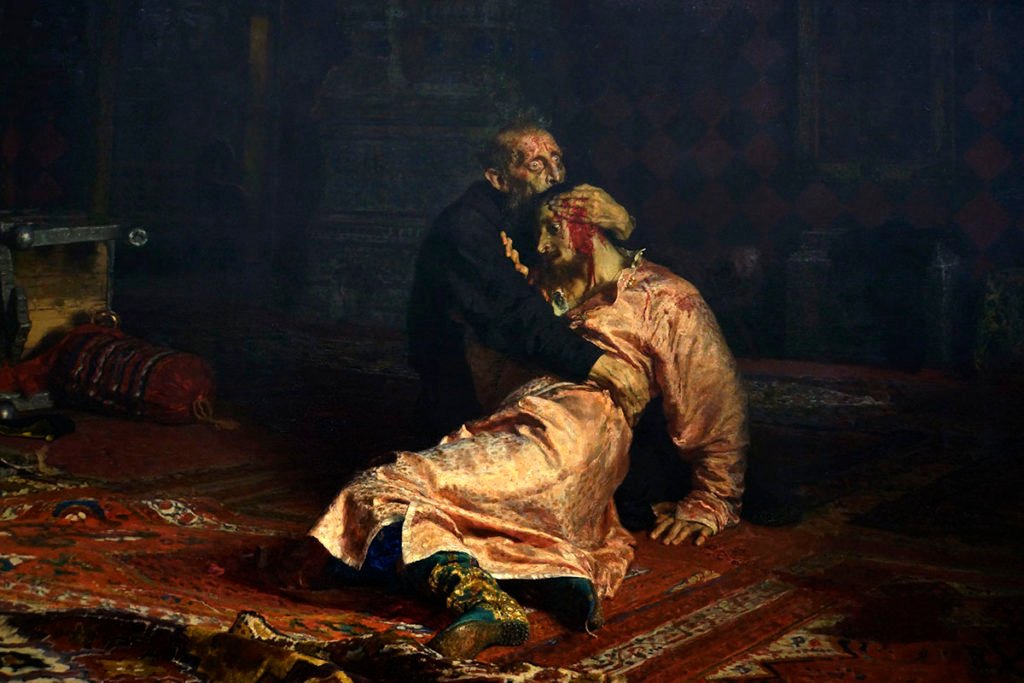
A fissure runs through the painting before any blade ever reached the canvas: a hair-thin seam of light that grazes the Tsarevich’s cheek, where a single tear catches the lamp-glow as if it belonged to a private sacrament, and where the red along his temple, carried by gravity toward the beard-line, reads with the slow insistence of a legal document that refuses to fold. The room that holds him—carpeted, stifled, velveted into twilight—serves less as interior than as throat, and the two bodies, knotted at the centre, gather the century into a single spasm of tenderness that has learned to carry violence as its twin. Repin sized the event to the scale of civic memory, since the canvas stands near two metres high and over two and a half metres wide, so that the viewer’s body approaches it as one approaches a tribunal, where even the hush along the wall feels complicit. The Tsar’s stare, widened into a feral wakefulness, holds you in the way a man holds a door when he has heard boots on stairs, while the son’s gaze, already glazing into distance, still grants a last human courtesy: he remains recognisable, he remains someone’s child.¹
Repin carried within his own bloodstream a geography of borders that Russian officialdom enjoyed describing as “province,” while the village knew it as krai (edge, marchland), and while the painter, when he crossed from Chuhuiv toward the academies of the capital, learned that every corridor of power demands a new accent.² The icon-painter’s apprenticeship, with its egg-tempera discipline and its theology of line, sat behind his later oil surfaces even when he devoted himself to realism, since he continued to think in terms of faces as moral weather and of hands as instruments of blessing or of theft. In Saint Petersburg, among the ritual humiliations of the Imperial Academy and the rival liturgies of the Peredvizhniki, he absorbed a lesson that an Orthodox parish child understands early: a crowd can pray and persecute within the same breath. When the Wanderers set their travelling exhibitions against courtly taste, their protest carried a civic intention, yet it also carried a hunger for the scene that would compel the public to look, even when looking turned painful. Repin, who could paint a river’s labour and a salon’s vanity with equal acuity, entered historical painting for this work as if he had entered a confessional that demanded a public penance, and he did so while the empire trembled after the assassination of Alexander II, whose death had rearranged Russian time into an era of tightened fists.³
The composition appears simple until the eye submits to its geometry, which works like a snare. The father’s black figure, pressed into the back wall’s murk, forms a vertical mass that anchors the scene as a pillar anchors a nave, while the son’s pale satin robe spills diagonally across the carpet, opening the picture toward the viewer as though the body were sliding from history into the present. The diagonal, which begins at the son’s boots and runs through his thigh and torso toward the bloody temple, meets the father’s arms in a knot that resembles a constricted heart, and the carpet’s patterning, with its repeated motifs and borders, repeats the idea of enclosure, as if the room itself had learned autocracy’s taste for containment. At the far left, the overturned throne or chair, together with the scattered objects that glimmer as broken order, suggests an argument whose sound has already died, leaving only aftermath, and the narrow casement at the upper left offers a sliver of exterior world that arrives too late to rescue anyone. Repin arranged light as an ethical pressure: it falls upon the son’s silk and face with an almost Rembrandtesque mercy, while it allows the father’s features to emerge as if from smoke, since guilt prefers a half-shadow that keeps its edges mobile.⁴
One learns the painting’s century through its textures, since each surface performs a social role. The son’s robe, whose sheen suggests privilege and vulnerability in a single stroke, carries folds that behave as water behaves, so that the fabric’s softness intensifies the brutality of the blow that preceded the embrace. The Tsar’s garment, darker and heavier, drinks light in a way that recalls a monk’s cassock, though the gold edging that catches the lamp gives away a worldly rank that refuses renunciation. The carpet, Persian in suggestion, declares imported luxury and the empire’s appetite for the “elsewhere” it conquers, and the patterned wall, which repeats red and black lozenges, hangs behind the scene like a banner of blood and ash. The son’s boots, greenish with a metallic glint, remain planted in the world of errands, councils, and rides; they carry the practicality of a life interrupted mid-step, and their presence keeps the drama from floating into allegory alone. Repin’s brushwork alternates between smooth modelling in flesh and quicker strokes in textile and background, so that the eye shifts continually between intimacy and theatre, between whispered confession and staged catastrophe.⁵
The subject itself arrives with historiographic weight, since the killing of Tsarevich Ivan Ivanovich by Ivan IV exists in sources that mingle chronicle, rumour, and political need, and since later national narratives have treated the event as a mirror for their own fears.⁶ Repin chose the moment after the strike, when the act has become irreversible and when the only available agency consists in response, in the frantic attempt to stop what has already begun. This choice aligns him with a moral psychology that the nineteenth century sharpened, when novels trained readers to inhabit the instant after transgression, and when the confessional, whether ecclesiastical or secular, became a stage for the self’s dissection. The painting refuses the satisfaction of action; it offers consequence, and consequence, in a society living under intensified surveillance and tightened censorship, could become the most subversive kind of speech. A viewer in 1885, walking from the street’s chatter into the exhibition’s hush, carried fresh knowledge of bombings and arrests and denunciations, and therefore could read the Tsar’s eyes as an image of state panic, since power, once it has struck its own future, begins to fear every knock.
When I stand close—close enough that the varnish’s sheen begins to behave like a thin skin—I find the detail that shifts the whole drama away from melodrama and into forensic prophecy. Beneath the Tsar’s left thumbnail, where the hand presses against the son’s hair and wound in an effort that looks like mercy, Repin placed a faint crescent of dark red, a half-moon lodged under the nail, which belongs neither to the carpet nor to shadow but to dried gore caught where a hand cannot cleanse itself without tools. I have watched many eyes travel from the son’s bleeding temple to the father’s stare, and then recoil, as if the painting demanded a strength they could not supply, yet that crescent remains overlooked, since it hides within the gesture that viewers prefer to call consoling. Here, however, the hand that “stanches” also carries evidence, and the father’s embrace becomes an exhibit: the state’s paternal arm contains the trace of the blow, trapped under keratin, surviving repentance, surviving prayer. The painting begins to speak in the language of modern investigation, which would later measure crime through residue and trace, and it does so within a sixteenth-century scene, as if to insist that autocracy has always left material proof on the body that serves it.⁷
From this point, every familiar reading—repentance, madness, paternal love—acquires a harsher edge, since the detail refuses the comfort of pure remorse. The Tsar’s eyes, which have so often been described as widened by horror at his own act, also resemble the eyes of a man who suddenly grasps that the world contains witnesses beyond his guards and beyond his priests, since a stain under a nail belongs to a realm of proof where rank loses privilege. The son’s face, pallid yet gentle, carries a tenderness that might be read as forgiveness, yet the father’s nail-stain insists upon the material continuity between violence and care, so that the embrace cannot dissolve the strike; the two belong to a single continuum of possession. In that sense, the painting stages a doctrine of power: the sovereign claims the right to wound, and then claims the right to comfort, and the subject—whether son, peasant, dissident—gets offered consolation as an extension of domination. Repin’s own milieu, steeped in debates about reform and reaction, understood such continuities with painful clarity, since the same state that promised “order” also filled prisons, and since the same paternal language of empire justified both protection and coercion.⁸
Repin’s lineage as a realist, shaped by the Wanderers’ civic ambition, appears here as a struggle between empathy and accusation. He had painted crowds with a moral camera’s patience, and he had learned, through portraiture, that a face can carry both public mask and private fracture, yet here he compresses social panorama into two figures, as though the entire empire had been reduced to a family scene that retains the logic of governance. In the academies, instructors taught history painting as a hierarchy’s summit, yet the Wanderers insisted that history exists in the present tense, in courtrooms, in villages, in hunger-lines; this canvas joins those positions by presenting a legendary autocrat as a living psychology, a man who sweats, panics, grips. The nail-stain seals this realism into a deeper register, because it behaves like the unplanned truth that escapes every official narrative, and because it converts the painting from moral theatre into material testimony. The nineteenth century loved grand explanations for national fate, yet this small crescent suggests that destiny often lives in residue, in what the body retains after ideology has finished speaking.⁹
The creative milieu that enabled the canvas also included the technical world of oil paint, studio labour, and the museum’s later interventions. Repin’s reds, which range from the son’s arterial flow to the carpet’s heated patterns, depend upon pigment traditions that nineteenth-century Russian artists inherited through European trade and local manufacture; the surface has since endured the vulnerability that accompanies cultural icons, including the knife attack of 1913 and the pole assault of 2018, after which conservators undertook extended technical study and restoration. Such damage history intensifies the reading of trace, since the painting’s own body has been wounded and healed, and since viewers now approach it with an awareness that images, like people, can be assaulted for what they “say.” When the Tretyakov Gallery returned the work to view after long conservation, public discussion again revealed that many prefer legends that flatter national pride, while an image that shows a ruler’s panic and a son’s bleeding face threatens the comfort of inherited myths. The nail-stain, in this context, begins to echo the canvas’s tears and repairs: proof persists, even when surfaces get mended.¹⁰
The social ether of Repin’s epoch carried a double pressure, since it demanded moral engagement while it punished overt political speech. Critics could praise realism as national truth, yet officials could recoil when truth approached power too closely; the Tsar on the canvas, though he belongs to the sixteenth century, inevitably conversed with the autocrat of the painter’s present, and viewers understood that conversation even when they pretended otherwise.¹¹ Repin’s friendships with writers and thinkers, his exposure to European art in Paris, and his dialogue with Russian critics such as Stasov shaped his capacity to fuse psychological intensity with social resonance, while his own borderland origin allowed him to sense that the empire’s centre often fears the provinces precisely because the edge carries alternative memories.¹² The painting’s interior, thick with objects, becomes a condensed Russia: imported rug, Orthodox atmosphere, courtly furniture, and an air that feels both intimate and carceral. The nail-stain, though minute, aligns with this ether, since it exposes how power leaves traces on its own hands, even when it claims purity. In a culture steeped in confession and in surveillance, the idea that guilt can be seen in the smallest physical remainder carries an almost apocalyptic charge, as if the last judgement has shifted from heaven to the forensic table.
A viewer who accepts the nail-stain’s insistence begins to reinterpret the son’s posture as well. His body leans away, yet it remains held; his eyes, softened by shock, gaze past the father, toward a point outside the room, as if he has already begun to inhabit a future that the father will never enter. The hand on the floor, splayed and tense, presses into the carpet as if seeking purchase in a world that is sliding away, and the son’s robe, though luminous, begins to read as a shroud in progress. When the father’s thumb presses near the wound, the gesture resembles a benediction, yet the stain under the nail undermines any easy sanctification, and therefore the painting enacts a paradox that Russian history repeats: salvation offered through the very apparatus that produced injury. Dostoevsky’s world, where murder and tenderness often intertwine, stands nearby in spirit, though the painting speaks through pigment instead of paragraphs.¹³ The room’s silence becomes a political silence, the kind enforced by fear, where people learn to whisper grief while the state speaks loudly of order.
One can push further, since the nail-stain also alters the painting’s relationship to time. Traditional readings tend to hold the scene in a single instant—strike, regret, embrace—yet this tiny residue implies duration: blood has had time to gather under the nail; the hand has touched, pressed, perhaps wiped, perhaps returned; the body has moved through stages of response. The painting therefore carries an implied sequence, and sequence invites responsibility, since responsibility belongs less to a lightning flash of rage than to the slower unfolding of possession and entitlement that made such rage possible. Here I allow myself a single blunt causal word, because the crescent under the nail compels it: the tragedy deepens because the hand retains what it did. The state, too, retains what it does, and the nineteenth century, though it cloaked itself in reforms and manifestos, carried under its nails the residue of serfdom’s afterlife and of punitive discipline.¹⁴ Repin, whose realism could render a peasant’s torn shoe with dignity, places the same ethical attention upon the autocrat’s hand, and thus refuses any hierarchy of moral scrutiny.
When the painting is approached as residue-driven testimony, the famous gaze of the father changes character: it becomes less a portrait of remorse alone and more a portrait of recognition that witness exists. The viewer functions as witness, the museum as archive, the canvas as document, and the nail-stain as a microscopic seal that binds the document to the act. In this reading, the picture forecasts the twentieth century’s obsession with evidence, with confession extracted under pressure, with files and fingerprints, with the state’s capacity to record and erase, and with the stubborn survival of trace. The borderlands I carry in my own memory—Warsaw conversations about history that feels unfinished, Vilnius streets where languages overlap, Kyiv churches where candles burn for the dead whose names remain disputed—teach that empires fear traces, since traces allow alternative narratives to survive. Repin painted a dynastic murder, yet he also painted a method: the smallest physical remainder can undo the most polished official speech.¹⁵
So the canvas ends where it began: at the tear and the stain, at the tenderness that remains entangled with violence, at the question of whether forgiveness can exist when proof clings to the body. Barnes, writing from another world and another decade, suggested that words rarely advance public taste in art, since paint itself carries meanings that language only shadows, and I feel the truth of that warning here, as I stand under the painting’s dark air and sense that each sentence risks performing the same evasions the Tsar performs. Yet the nail’s crescent insists upon speech of a different kind, one that serves witness, one that trains the eye toward what power prefers to hide in gesture and shadow. The father clutches the son, the son slips away, the room holds its breath, and under the thumbnail a half-moon of red persists, small as a seed, heavy as a dynasty, capable of germinating into every later scene where a ruler embraces what he has already broken.
Scholia:
- Elizabeth Kridl Valkenier, Ilya Repin and the World of Russian Art, Columbia University Press, New York, 1990, pp. 1–24, 145–168. Valkenier’s opening chapters anchor Repin within the social transformations of the later empire while keeping close to the painter’s practical education and professional networks. Her account gains force when read alongside exhibition catalogues, since she treats the Wanderers’ institutional strategies as lived realities: railway timetables, provincial audiences, and the uneasy truce between conscience and commerce that travelling shows required. The present essay’s emphasis upon scale and tribunal-like encounter depends upon her insistence that Repin sought public address even when he painted private emotion, since the painter’s realism carried a pedagogical ambition that approached moral instruction, though it remained suspicious of sermonising. The volume includes extended references and archival pointers (pp. 205–236), which allow cross-checking against letters and period criticism.
- Grigory Sternin and Elena Kirillina, Ilya Repin, Parkstone Press, New York, 2011, pp. 9–33. Sternin and Kirillina detail the painter’s early environment and the transitional character of his training, where ecclesiastical craft, artisan workshop discipline, and academic aspiration coexisted in tension. Their narrative clarifies how a borderland upbringing could generate an instinct for social observation, since the painter learned to read status through clothing, gesture, and the micro-rituals of deference. The term krai (edge, marchland) belongs to the cultural vocabulary of Russian imperial geography, carrying both administrative meaning and a quieter sense of peripheral identity.
- Nikolai Mikhailovich Karamzin, History of the Russian State, trans. in selected volumes by various hands, London and St. Petersburg editions across the nineteenth century; consult especially the sections on Ivan IV and court conflict, Vol. IX–X in common multi-volume sets. Karamzin’s narrative shaped later popular imagination of Ivan IV’s reign, since his blend of archival material and moral judgement offered the educated public a national epic in prose. His treatment of the Tsarevich’s death, framed through dynastic tragedy and sovereign temperament, provided later artists with a ready emotional script, even when the underlying evidentiary base remained contested across chronicles, foreign observers, and later historiography. A long view of reception shows that Karamzin’s language hardened into cultural reflex, so that an image of Ivan as both builder and destroyer became available for political allegory whenever reform and repression collided. For Repin’s century, which had inherited Karamzin as civic scripture, the painting’s subject already carried interpretive momentum before pigment touched canvas.
- Alexandre Benois, The Russian School of Painting, London, 1916, pp. 160–176. Benois, writing with the insider acuity of a critic-artist, read Repin through both national pride and aesthetic scrutiny, offering a lens shaped by the Mir iskusstva sensibility that could admire painterly skill while questioning moral dramaturgy. His reproduction of the faces, circulated through print, also contributed to the painting’s later iconicity, since many viewers first encountered the work through cropped details that foregrounded expression and suppressed surrounding objects.
- Tatyana Yudenkova, “To Stop Bloodshed?”, in The Tretyakov Gallery Magazine, Issue 1, Moscow, 2004, pp. 44–57 (issue dating and pagination vary by language edition). Yudenkova links the painting’s genesis to the political tremors that followed Alexander II’s assassination, and she situates Repin’s choice of subject within an atmosphere where violence felt both historical and immediate. Her argument, grounded in museum scholarship and archival context, supports reading the canvas as a meditation on power’s self-wounding, while also tracing how viewers projected contemporary anxieties onto a sixteenth-century scene. The essay’s title itself, framed as a question, reflects the period’s hunger for moral remedies amid civic fear, since the early 1880s combined reformist memory with reactionary policy. Yudenkova’s museum work draws upon Tretyakov holdings, including studies and correspondence, and therefore functions as a bridge between public narrative and curatorial evidence.
- Isabel de Madariaga, Ivan the Terrible, Yale University Press, New Haven, 2005, pp. 213–248. Madariaga’s biography, written with scholarly caution and narrative clarity, reviews the debates surrounding Ivan IV’s character and governance, including the problem of sources for the Tsarevich’s death. Her synthesis underscores how later political cultures repeatedly re-script Ivan’s image to serve contemporary needs, which allows an art-historical reading to treat Repin’s canvas as part of a long chain of reinterpretations rather than as a final verdict on a single event.
- Michael Fried, Absorption and Theatricality: Painting and Beholder in the Age of Diderot, University of Chicago Press, Chicago, 1980, pp. 1–49, 103–148. Fried’s conceptual framework, developed for eighteenth-century French painting, gains unexpected traction when applied to Repin’s scene, since the canvas oscillates between absorbed intimacy (the son’s fading inwardness) and theatrical address (the father’s stare that implicates the viewer). In Repin, the court chamber behaves as stage, yet the bodies resist pure performance through their physiological specificity: sweat sheen, tear, tremor, and the heavy drag of fabric. The nail-stain proposed in this essay intensifies Fried’s problem of beholding, since it asks the viewer to adopt a forensic closeness that belongs to modern spectatorship, while remaining within a historical image that advertises its own dramatic climax. Fried’s arguments remain controversial, yet their precision regarding how paintings structure the viewer’s role supplies a disciplined vocabulary for describing ethical participation without reducing the work to illustration of politics.
- Orlando Figes, A People’s Tragedy: The Russian Revolution 1891–1924, Jonathan Cape, London, 1996, pp. 1–38. Although Figes addresses a later period, his opening chapters describe the longer social pressures—peasant hardship, administrative coercion, and the psychic legacy of autocracy—that help explain why images of paternal violence could acquire national resonance. The relevance here lies in continuity: Repin’s 1880s belong to the prehistory of revolutionary rupture, where the state’s claim to paternal authority coexisted with escalating mistrust.
- Leo Tolstoy, What Is Art?, trans. Aylmer Maude, London, 1898, pp. 71–106. Tolstoy’s polemic, though hostile to many forms of “elite” art, articulates a moral demand that haunted Repin’s generation: the belief that art should communicate sincere feeling that binds people together. Repin’s canvas satisfies and challenges this demand, since it communicates feeling with searing clarity while presenting a communion founded upon injury.
- Yulia Dyakonova and Kirill Shumikhin, “Restoration and Research of Ilya Repin’s Painting ‘Ivan the Terrible and His Son Ivan on November 16, 1581’ in the State Tretyakov Gallery,” conference publication / technical paper circulated 2022–2023 in conservation contexts, pp. 1–12 in common PDF dissemination. The paper’s significance extends beyond treatment details, since it demonstrates how conservation science has become a second mode of art history, capable of revealing layer structure, varnish history, pigment behaviour, and damage narratives that reshape interpretation. Their account records the 2018 assault and situates it within the painting’s earlier wounding in 1913, thereby giving the canvas a biography of violence that parallels its subject. When an image becomes a target, its material fragility enters public consciousness, and viewers approach with heightened sensitivity to surface, crack, and repair; such sensitivity feeds back into interpretation, as though the painting’s own scars authorised new readings of trace and residue. The present essay’s focus upon the nail-stain gains force within this technical horizon, since a forensic imagination thrives when the public already knows that paint layers can be torn, rejoined, and studied like tissue.
- Richard Wortman, Scenarios of Power: Myth and Ceremony in Russian Monarchy, Vol. II, Princeton University Press, Princeton, 2000, pp. 1–36, 235–278. Wortman’s analysis of imperial ritual clarifies how autocracy relied upon theatrical forms—processions, iconography, staged paternal gestures—to sustain legitimacy. Repin’s depiction of paternal embrace after paternal violence can be read as an anti-scenario, a revelation of the bodily cost beneath ceremonial performance.
- Vladimir Stasov, selected correspondence and criticism in collected editions published in late nineteenth and twentieth centuries; consult letters to Repin in standard Russian compilations, St. Petersburg and Moscow editions. Stasov’s advocacy for national realism and his sharp judgement of artistic purpose shaped how Repin’s contemporaries framed his ambitions, and his reactions help reconstruct the period’s argumentative climate, where art served as a proxy battleground for questions of nation, morality, and public mission.
- Albert C. Barnes, “How to Judge a Painting,” in Arts and Decoration, April 1915, pp. 217–246, with relevant passages on the limits of art-writing and the primacy of direct seeing. Barnes’s polemic, though American in setting and combative in tone, speaks to a recurring anxiety that haunts every attempt to write beside a painting: language can become a substitute for perception. His argument that public taste gains little from literary commentary supplies a salutary warning for any historian tempted to convert pigment into mere ideology. Yet Barnes also models a counter-gesture, since his scorn for empty verbosity arises from close looking at paint handling, composition, and the embodied act of creating. In this sense, his text encourages a discipline that aligns with the present essay’s microscopic turn toward a nail-stain, since such a detail forces the writer to earn each claim through the visible. Barnes’s essay circulated in magazine form, later reprinted within Barnes Foundation contexts, and remains a key artifact of early twentieth-century debate about formal judgement versus interpretive rhetoric.
- Isaiah Berlin, Russian Thinkers, ed. Henry Hardy and Aileen Kelly, Penguin, London, 1978, pp. 1–27. Berlin’s reflections on Russian intellectual traditions illuminate the moral seriousness with which nineteenth-century Russian culture approached art and history, since aesthetic debate often doubled as political and ethical debate. His account helps explain why a historical painting could provoke civic anxiety and official unease.
- Svetlana Alpers, The Art of Describing: Dutch Art in the Seventeenth Century, University of Chicago Press, Chicago, 1983, pp. 1–33. Alpers’ notion of painting as a form of knowledge-making, attentive to surfaces and facts, offers a productive analogy for Repin’s realism, which often behaves like reportage in oil. Though Repin’s subject differs from Dutch descriptive traditions, his attention to material trace—the smear, the stain, the glint—suggests a comparable epistemic ambition.
- Historical Painting Techniques, Materials, and Studio Practice: Preprints of a Symposium, ed. Arie Wallert, Erma Hermens, and Marja Peek, Getty Conservation Institute, Los Angeles, 1995, pp. 1–18, 81–96. This collection, drawn from technical art history and conservation science, reinforces a central methodological conviction: interpretation changes when one treats paintings as constructed objects with layered histories, workshop habits, and material vulnerabilities, and when one accepts that meaning can hinge on minute residues that survive within those layers. The symposium essays emphasise documentary sources, integrated technical approaches, and the role of varnish, lighting, and viewing distance in shaping perception, which aligns with the present essay’s insistence upon close approach to the surface where the nail-stain becomes legible. The preprints include bibliographical references across contributions, and they exemplify how late twentieth-century scholarship rejoined craft knowledge to historical analysis, thereby allowing “detail” to function as evidence with consequences, instead of as decorative aside.