
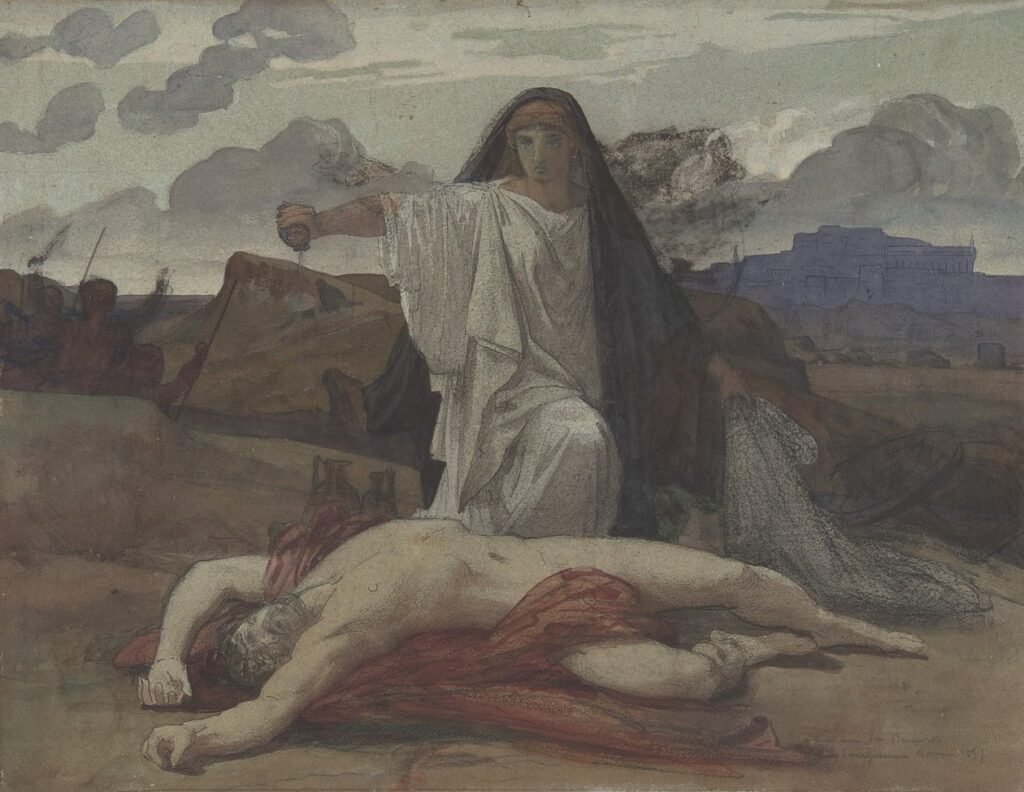
Lecture on Antigone and Conscience’s Cost.
The iron peg had bitten into the lime-washed wall before any of us learned our letters, and it held its small burden with the patient cruelty that belongs to cheap metal: a tragic facepiece, mouth cut open as though breath itself had been sentenced, brows swollen into that fixed anguish that artisans shaped for distance, while the hall’s weak bulbs gave it a waxen pallor that felt half devotional and half forensic. I kept it there on purpose, near the door where coats collect rain, for the thing behaves like an oath once you grant it a vantage; it observed the hands that fumbled for notebooks, it registered the throat that cleared before speech, it measured the back row where a conscience hides behind a sleeve. You could call it a prop, yet it carried the older gravity of the prosōpon—that Greek stage-face whose material life tended toward linen, wood, glue, paint, and the quick rot of use—while the absence of surviving originals leaves us with painted pottery, later descriptions, and the stubborn testimony of theatre’s architecture.¹
A draught came in under the door, as Irish weather enjoys doing when it wants a vote in a seminar, and the facepiece trembled on its peg with a faint clink of wire against iron; that small sound, which resembled a coin dropped into a bowl, reminded me of dust on a corpse, for Sophocles placed dust at the centre of his argument, as though the smallest grit could outweigh a decree. Antigone entered the play carrying a sister’s rawness and a daughter’s pride, and she carried also the knowledge that burial carries civic meaning, given that a polis claimed jurisdiction over the dead in the same way it claimed roads and taxes, while the household claimed the dead by tenderness, by shame, by the stubborn continuity of blood. When Creon made his proclamation over Polyneices, he acted as a man who had tasted civil war and feared relapse into faction more than he feared the gods below, and he spoke with that tone administrators adopt when they want the world to seem as tidy as a ledger, while he treated a body as a symbol, a warning fixed to the gate of Thebes.
The mask looked on without blinking, and I confess that I loved it for that coldness, for a human face blinks its way into compromise, whereas a carved visage holds its court without fatigue.
You sat with your pen poised as though you expected a definition, and the hall’s faint smell of wet wool pressed theology into the air, while I asked you to imagine Thebes as a place of hard light, where limestone gives back the sun with a glare that scours the eyes, and where the road to the gates carries a taste of chalk and mule sweat; in such a place, the dead man left unburied becomes an object that rots in public, and the rot becomes pedagogy. Sophocles gave us guards who spoke like tired labourers, men who wanted wages and shade, and he gave us a king who treated speech as masonry, each word placed to hold the wall of authority upright. Antigone replied with fragments that carried a girl’s ferocity—I knew I would die—while she placed the claim beyond any human statute through that bitterly calm insistence on ordinances that live outside ink. Creon answered as though he had swallowed the city’s seal-ring, which meant that he heard her piety as sedition, and he heard kin-love as an infection of policy. When you read that exchange in the safety of a room, theory can feel clean, yet dust in the fingernails refuses cleanliness, and the act of sprinkling grit over a brother’s skin becomes the hinge that turns philosophy into consequence.
A cough rose from the third row, and the facepiece answered with silence carrying more accusation than any heckler.
I held a piece of chalk, which shed powder onto my thumb, and that powder let me speak more honestly to the dead, for Antigone’s courage arrived through powder and not through slogans; she bent, she scooped, she poured, she risked the eye of a watchman who had been paid to see. The guard who caught her behaved as men do when a small task becomes a cosmic problem, and he spoke in that aggrieved voice of the underpaid, while he dragged her before Creon as though delivering stolen property. Sophocles wrote the scene with a cynic’s intelligence, for he let the state appear first through minor functionaries, through those who enforce orders they never authored, while they protect themselves by claiming obedience. Creon’s anger grew from a very old terror, the terror that a public ruler would seem weak, given that he had just inherited a city shaken by brother against brother, and weakness in a polis tastes like blood. A king who fears mockery begins to love rigidity, and rigidity begins to demand tribute, and a decree that began as a political signal becomes a metaphysical quarrel.
The mask hung there, and the nail held fast, and the hall’s air thickened as though winter had decided to sit among us.
When Antigone stood before Creon, she carried a young woman’s plain clothing, a peplos pinned at the shoulders, cloth folded into a practical drape that left the arms free for work, while Sophocles allowed her speech to do the ornament that garments refused; her words arrived as bare stone, each syllable struck for endurance. Creon answered with the imagined costume of office, with the posture of command, with the assumption that civic health depends upon a single voice, and he spoke as though plurality were treason. Antigone spoke as a daughter of Oedipus, while she carried the stink of that household’s curse like smoke in cloth, yet she also spoke as any sister might, given that burial belongs to intimacy, to hands that remember a body living. Sophocles, who understood Athens and the theatre’s civic ritual, pressed this conflict into the audience’s ribcage by making both claims plausible, while he refused the comfort of a tidy verdict; he made your mind wobble, and he made your stomach tighten, and he made the gods feel close enough to hear. Even Ismene’s hesitation, which could look like cowardice in a moral pamphlet, gained dignity as soon as the scene gave her a throat and trembling breath, for she loved her sister while she feared the city, and fear can also love.
A short laugh, half defensive, escaped someone near the window, and the mask remained grave, as though laughter itself required permission.
I wanted you to feel the state’s stubbornness as a physical substance, as something that weighs on the tongue, so I asked you to picture the edict as a plaque, bronze hammered thin, hung where citizens pass, letters cut deep enough to catch shadow, while wind carries dust that lodges in the grooves; such objects belonged to Greek civic life, and their authority depended upon display, upon the outward certainty of inscription. The cruelty, therefore, belonged to a recognisable political logic: the city punished the dead in order to discipline the living. When Creon forbade burial, he performed an extreme version of a civic habit that Greek communities practised in various ways when they wanted a traitor’s corpse to remain a lesson.² A body left for dogs became a public text, and every passer-by became a reader, even the illiterate. Antigone’s response, which could seem at first like private piety, became public defiance, for she acted under the gaze of guards, under the threat of stone, under the weight of royal pride. Her conscience behaved like a knife pressed into her own palm, because it cut the hand that gripped it, and it cut also the hand that tried to seize it away.
The facepiece trembled again, and the small sound resembled a verdict being stamped.
A lecture hall invites abstraction, yet Sophocles wrote for a theatre where bodies sat under open sky, with the smell of sweat and sun on stone benches, while a festival gathered citizens into a shared rite that blended religion with politics; you therefore commit a quiet violence when you treat the play as a neat diagram. Antigone’s speech carried heat, Creon’s reply carried iron, and their collision gave off sparks that burned bystanders, and Sophocles kept those bystanders present—Ismene who trembled between loyalty and caution, Haemon who stepped into his father’s presence with the tender danger of a son who loved yet refused submission, Tiresias who arrived with blindness that saw further than any king. When Tiresias spoke, he brought with him the smell of burnt offerings gone wrong, for the seer reported that fire refused to take, while birds tore each other in the air, while the altars received polluted flesh. The gods entered through failed ritual, through the stubborn refusal of sacrificial smoke to behave, and the state’s obstinacy turned into a cosmic problem that courts and councils could never settle.
Your eyes went toward the hanging face, perhaps because you expected counsel, while it offered only carved anguish.
I kept returning to the peg because it resembled Creon’s own fixation, for he too hung his identity on a single hook: authority. A ruler can endure much when he carries plurality inside himself, yet Creon carried a solitary rigid self, and that self demanded worship. He spoke as though the city were his body, and any dissent became an infection, and Antigone’s act became a fever to be cut out. Sophocles, with the cold humour of a dramatist who had watched councils behave like frightened animals, allowed Creon to accuse Antigone of arrogance, while the accusation rebounded like a stone thrown at a wall, because royal pride sat behind each sentence Creon uttered. Antigone’s own pride burned, and Sophocles refused to polish her into a plaster saint, for she spoke with a fierce exclusivity—I was born to share in love—while she clung to the irreplaceability of a brother with an argument that bruised modern ears.³ The play therefore carried the discomfort of a heroine whose purity held splinters, and splinters lodge in the reader’s skin.
The hall grew quiet, and motion came only from rain sliding down glass like slow script.
When Haemon entered, he brought the smell of youth, of hair still clean, of a cloak worn for display, and he spoke with the careful diplomacy of a son who knew that a father’s pride can explode like a clay jar dropped on stone. Haemon appealed to civic listening, to the idea that a king gains strength through heed, while he offered the image of a tree that bends in flood and survives, and Sophocles let that image sting, for Creon, who feared appearing pliable, answered with the harshness of a man who heard advice as humiliation. Their quarrel unfolded as a domestic tragedy inside the larger civic tragedy, and the scene became unbearable because love remained present, while violence also remained present, and the two presences twisted around each other like rope. When Creon threatened to execute Antigone before Haemon’s eyes, he committed a cruelty that exceeded politics, for he weaponised intimacy, and that act began the chain of deaths that returned to him like a boomerang carved from bone.
The mask on the nail held its mouth open, and the room’s air felt thinner.
Antigone’s punishment carried a special theatrical cruelty, for Creon chose a living tomb, and Sophocles knew what he was doing when he made the sentence spatial; he turned a moral quarrel into architecture. A stone chamber offered a paradoxical mercy, given that it avoided direct bloodshed while it permitted slow death, and it permitted also the state’s hands to remain ceremonially clean. Antigone walked toward that chamber with bridal language on her tongue, while she called the vault her marriage-bed, while she spoke to the dead as though they waited with wreaths, and the lyricism broke the audience’s heart because it revealed how death begins to masquerade as union when life offers only coercion. Under such pressure, law ceased to look like law and began to look like a curse, while kinship ceased to look like comfort and began to look like a trap, and conscience ceased to look like freedom and began to look like a sentence.
A chair creaked, and the sound carried the embarrassment of anyone who shifts to avoid feeling too much.
I watched your faces, and I watched also the hanging visor, and that fixed mouth gave me the courage to speak to God without piety’s varnish, for the play forced a theological question that every polity tries to avoid: what happens when a civic ordinance clashes with a divine demand that carries older authority. Antigone invoked the gods below, the gods who guard burial and oaths, while she placed her confidence in a law that lacked inscription yet endured, and Creon treated that claim as revolt. Sophocles, who lived in a world where religious rites and civic identity braided together, staged the quarrel in order to show how authority, when it overreaches, wounds the sacred that gives authority its legitimacy. Tiresias therefore functioned as the drama’s instrument of cosmic accounting, for he spoke of pollution that spread through the city’s altars, and he presented the king with a stark arithmetic: a corpse left for dogs poisons the entire community. When the seer described birds with flesh in their beaks, he gave the audience a world where politics rises into the air as carrion, and the sky itself becomes a tribunal.⁴
The stage-face seemed to lean forward, while it remained fixed, as though it had heard such arguments for two and a half millennia.
When Creon finally yielded, the yielding came late, and Sophocles made lateness the real villain, for the tragedy’s engine runs on delayed understanding. Creon rushed to bury Polyneices, and he hurried to free Antigone, while the verbs turned frantic, while the palace became a place of running feet, while the king’s dignity collapsed into a man’s panicked scramble. Sophocles shaped this reversal as a punishment that resembled mercy, for Creon gained insight at the hour when insight could only deepen pain. Antigone had already hanged herself, and Haemon had already pressed steel into his own body after he failed to kill his father, and Eurydice, receiving the news, had already chosen her own death, cursing Creon with her last breath. A ruler’s stubbornness therefore ripened into a harvest of corpses, and the state’s pride became a private devastation, and the polis paid for its king’s vanity with blood that flowed inside the household, where politics likes to pretend it never enters.
You breathed out, and the breath carried a tremor, and the mask hung above us like a cold moon.
Notice how Sophocles punished the state through the family, for that structure revealed the ethical cost with cruel clarity: the king who claimed to protect civic order destroyed his own line, and the edict designed to stabilise the city left the palace emptied. Under such pressure, the opposition between public law and private affection began to look too tidy, for Sophocles showed how the public penetrates the private, and how the private returns to haunt the public, and how each realm borrows legitimacy from the other while it pretends independence. Antigone’s act began as kin-duty, yet it became a civic scandal; Creon’s order began as policy, yet it became domestic slaughter. The hanging face became my witness for this entanglement, for it too belonged to both spheres: it served ritual, it served art, it served public gathering, while it hid a human face that sweats and trembles behind it. Under the mask, breath condenses, saliva collects, the strap irritates skin, and the actor’s eye searches for a mark on stone; even performance teaches that civic spectacle depends upon bodily discomfort.
A voice rose from the back, tentative, and it asked whether Sophocles offered a lesson or only despair.
—Instruction arrives through despair—said I, while my hand left a chalk smudge on the desk—provided you accept that teaching can cost blood.
The mask watched that exchange, and its carved mouth held the shape of a scream that never finished.
Consider the ethical event that occurs when you read this play inside a modern state, where bureaucracy replaces kings, where decrees arrive through paperwork, where violence hides behind procedure, where the refusal of burial takes subtler forms—an unmarked grave, a delayed funeral, a body kept as evidence, a family held in waiting until grief turns rancid. Sophocles asked you to see that stubborn authority loves abstraction, because abstraction frees it from the cry of the singular person; Creon’s fixation on the traitor’s example therefore required the erasure of Polyneices’ humanity, and it required also the erasure of Antigone’s embodied grief. Antigone resisted through a bodily rite, through dust in the palm, through the bending of the spine, through the willingness to risk punishment for a gesture that can appear tiny to a ruler yet enormous to the gods. The conflict therefore lived in the body before it lived in argument, and every attempt to turn it into tidy doctrine fails, for the play’s moral weight rests in sensation—in the smell of decay at the gates, in the grit beneath fingernails, in the taste of fear in a guard’s mouth, in the coldness of stone where a young woman walked toward a chamber that served as her bridal-room.
The lights flickered, and the mask’s shadow slid across the wall as though time itself had blinked.
When I speak about conscience, I speak about an inner tribunal that carries its own torches, and Sophocles showed how that tribunal can become tyrannical, for Antigone’s integrity carried a hardness that excluded, and her certainty bruised those who loved her. Yet Creon’s authority carried a deeper peril, because it carried the coercive force of the city, and it could transform personal fear into public harm. The play therefore refused easy heroes, while it offered instead a landscape of competing fidelities, each demanding sacrifice. Greek tragedy often placed family curses inside civic crises, and Sophocles inherited that practice from a tradition whose other surviving plays reveal parallel anxieties, given that Aeschylus had already staged fratricide and the city’s fearful accounting in Seven Against Thebes.⁵ Under that tradition, a king’s voice can turn into a weapon, while a sister’s vow can turn into a blade, and the chorus stands between them like a crowd at a roadside accident, compelled to watch.
Rain kept speaking to the roof, and your pens kept whispering.
A detail that tends to escape the tidy moral lecture involves the guard, because he carried an ordinary man’s terror of punishment, and his terror trained him to flatter power. The watchman arrived with that comic cowardice tragedy loves to borrow from the marketplace, while he stammered about his innocence, while he begged to avoid blame, while he admitted that profit and self-preservation pull a man’s tongue more strongly than justice does. Sophocles allowed the audience to laugh, and the laughter made the later deaths feel sharper, because laughter loosens the chest just before the blow lands. That is part of why the object on the nail matters for a lecture: a mask can contain comedy and grief in the same carved mouth, and the transformation from one register to the other occurs through the same wood and paint, as though Sophocles insisted that the city’s ethical life must include both, because a community that loses its capacity for self-mocking humour tends to become Creon-like, rigid, punitive, hungry for obedience.
The hanging face caught a sliver of light, and its eyeholes looked like wounds.
Tiresias, arriving with his guide, brought a different kind of theatre into the theatre, because a blind seer requires the audience to feel how insight can exist without vision. Greek culture associated mantic authority with the gods, and the seer’s words therefore carried a civic weight that exceeded any magistrate’s seal, which meant that Creon’s refusal placed him against more than a girl; he placed himself against a sacred infrastructure.⁶ When Creon accused Tiresias of corruption, he behaved like a modern politician who assumes that every warning must hide a bribe, because cynicism becomes a defence when one’s own pride begins to crack. Tiresias answered with the bluntness of a man who has seen too much, and he described a world where sacrifice fails, where hearth-fire refuses its ritual function, where birds scream in unnatural frenzy. Under such imagery, the city becomes a body sick at the altar, and the ruler becomes the infection.
The stage-face did what a witness does: it endured.
A classroom can tempt you into treating Creon as a monster, and Antigone as a spotless martyr, yet Sophocles placed flaws into both, which meant that the ethical event demanded participation rather than applause. Creon’s initial motive carries a civic plausibility, because civil war destroys trust, and rulers in the aftermath of internal conflict often fixate on unity as the highest good; that fixation can begin as prudence, while it ends as brutality when it refuses limits. Antigone’s motive carries a religious plausibility, because burial rites belonged to the gods below as well as to family honour; that plausibility can begin as piety, while it ends as isolation when it refuses to see the claims of the living. Martha Nussbaum described this tragic condition through the language of vulnerability, where goodness remains fragile because the world’s competing claims force loss into every choice.⁷ Under that lens, Antigone’s nobility gains a shadow, while Creon’s civic concern gains a stain, and the audience becomes morally complicit because every judgment carries its own violence.
Your posture changed, and the change carried discomfort that looked like thought.
Thucydides, writing about Athens during the plague, described a collapse of burial customs, and his sentence—fragmented, exhausted—carried the stink of bodies and the desperation of survivors.⁸ Under plague, he told how rites broke, how people acted in despair, how order fell away, and the passage carries a quiet kinship with Sophocles’ nightmare, because it shows how a community’s treatment of its dead reveals its moral health. When a state prevents burial, it acts as a self-made plague, and Creon’s Thebes becomes diseased by decree. Antigone’s dust, placed over flesh, becomes an attempted antidote, and the antidote carries a cost that the healer must pay in her own blood. Under such conditions, conscience stops resembling a private comfort, and it begins to resemble a tool that can be used to dig, to bury, to strike, to bleed.
The mask remained suspended, and its still gaze felt like a trial without appeal.
When the messenger brought news of Haemon’s death, Sophocles forced the audience to hear consequences in the messenger’s breath, because the messenger carried the scene into language with the urgency of a witness who tries to outrun horror. Eurydice, hearing, withdrew into the house like a candle carried into a crypt, and her later death functioned as the tragedy’s final tightening of the knot, because it proved that Creon’s violence, though directed outward at a “traitor” and at a “disobedient” niece, returned inward into the bedchamber. Under Greek norms, women’s laments could carry immense social power, even when men pretended to govern everything; Nicole Loraux wrote about lament as a voice that unsettles civic order, because mourning brings the household’s pain into public hearing.⁹ Eurydice’s curse therefore operates as the household’s revenge upon the state: a queen’s dying words strip the king of legitimacy more ruthlessly than any vote.
The hall’s radiator clicked, and the sound resembled bones settling.
A question remains, and it must be asked with hands dirty, because Sophocles refused to let clean hands speak with authority: what does a life of destructive action do when it seeks escape from the complexity it created. Creon wanted simplicity, which means that he wanted a world where rule and obedience align, where policy produces order, where the city’s enemies remain outside the wall, where kinship remains subordinate to decree. He attempted to compress the world into a single line, and tragedy punished him by expanding the world into a labyrinth. Under that labyrinth, every attempt at control produced a fresh strand of consequence, and consequence pulled him deeper. Antigone, choosing death through her own hand, sought an exit that looked like purity, yet Sophocles refused to present her suicide as pure triumph, because the play’s universe treats self-killing as both agency and ruin, as both refusal and surrender. Creon, surviving, carried the longer punishment: survival with knowledge.
The mask hung above us, and the nail held it as firmly as a verdict holds a guilty man.
A final image must remain shapeless in the way water remains shapeless even when you pour it into a measured jug, so I returned to the peg when the room emptied, when coats lifted from hooks, when your footsteps faded down the corridor, when the building settled into night. The wind pressed against the door with soft insistence, and the facepiece swung a fraction, and the wire loop tightened on the iron, and the painted surface caught the last strip of fluorescent light. In that small motion, I saw Creon alone in Thebes, carrying his dead as invisible burdens, walking through a palace where the air had turned sour, where every doorway recalled a quarrel, where every stone remembered a cry. He sought release from the tangle he made, and he found only the corridor of his own acts, which led him back to the same door again and again, until his feet learned the pattern and his soul learned the trap. Under that imagined weight, my hand rose and touched the mask’s rim, and the coldness travelled into the finger like a warning, and the nail’s blunt head felt like the simplest instrument of sentence; and as the face swung slightly, catching the draught, it offered Creon’s last fate in miniature: a life held up by a single point, turning gently in moving air, forever facing outward, forever unable to step down.
Scholia:
- Oliver Taplin, Greek Tragedy in Action, Methuen, London, 1978, pp. 35–67.
- Robin Osborne, Greece in the Making 1200–479 BC, Routledge, London, 1996, pp. 274–286.
- Sophocles, Antigone, Translator Hugh Lloyd-Jones, Harvard University Press, Cambridge, MA, 1994, pp. 1–96. A lecturer who treats the play’s famous appeal to unwritten ordinances as a slogan commits an act of soft violence against Sophocles’ craft, because the Greek phrase carries a compact pressure that English tends to spill. The term often rendered as ordinances can shade toward sacred practices, ancestral claims, and divine mandates, while its force changes depending upon whether the listener hears Antigone as a pious girl, a rebellious citizen, or a doomed heir of a cursed house. Lloyd-Jones keeps the line taut, which serves the drama’s atmosphere of constraint, yet any translation must carry loss, because the Greek idiom compresses temporal depth and ritual authority into a music that resists paraphrase. A living room, a classroom, or a parish hall can therefore turn the line into a badge, and a badge quickly becomes a weapon for self-righteousness. Sophocles, however, arranged the scene so that the badge cuts its wearer. Antigone speaks under threat of death, which means that fear and conviction coexist in her throat; even her courage carries a tremor, even her certainty carries heat that can scorch. A shared ethical event occurs when the audience feels that tremor in their own bodies, because that bodily resonance prevents the mind from treating Antigone as a plaster icon. The play requires you to see her abrasive exclusivity—her willingness to wound Ismene, her willingness to make Haemon’s love secondary, her willingness to claim a unique bond with a brother in language that strains modern instincts—while you also see the holiness of burial as a social and religious act that binds the community to the underworld’s demands. Under that pressure, the phrase about unwritten ordinances stops behaving like a banner and starts behaving like a sacrificial knife: it grants the speaker dignity, while it also demands blood. A translator cannot solve that ethical knot, yet a translator can keep the knot visible, which Lloyd-Jones tends to do through restraint. The lecture’s duty involves returning the line to dust and breath, because dust and breath remain the play’s true medium.
- Jean-Pierre Vernant and Pierre Vidal-Naquet, Myth and Tragedy in Ancient Greece, Translator Janet Lloyd, Zone Books, New York, 1988, pp. 15–48. Vernant and Vidal-Naquet offered a way to see tragedy as a civic machine that processes myth into social reflection, which means that the play becomes less a private moral tale and more a public ritual of thought. That approach helps a lecturer hold the audience inside the polis, inside the festival, inside the shared listening where citizens experienced themselves as a community capable of judgement. Under that frame, Creon’s voice ceases to be merely personal; it becomes an index of political anxiety, the anxious desire to consolidate authority after internal fracture. Antigone’s act ceases to be merely familial; it becomes a public challenge that exposes the limits of political power when the sacred asserts its older jurisdiction. Yet the structural brilliance of their approach carries a risk, because structure can tempt the reader to treat human pain as an example for theory. Sophocles resists that temptation through the play’s sensory insistence: birds with flesh in their beaks, dust poured over skin, a stone chamber sealed, a mother’s curse spoken in the house’s shadow. A lecture that leans too hard upon structural explanation can inadvertently perform the same abstraction that Creon performs when he turns Polyneices into a symbol. The better use of Vernant and Vidal-Naquet involves allowing their civic lens to sharpen the stage’s political stakes, while the lecturer keeps the bodily stakes visible, because bodies remain tragedy’s currency. Their work also clarifies why the chorus matters: the chorus functions as the community’s breathing, the community’s hesitation, the community’s fear of excess, and that communal voice frames the conflict as an event that threatens everyone, not only a royal household. When the chorus oscillates between admiration and alarm, between reverence for law and reverence for the gods, it performs the audience’s own moral dizziness. In that dizziness, a city rehearses its conscience. The hanging mask in the lecture hall can serve as an analogue for that rehearsal, because a mask belongs to civic spectacle, and civic spectacle depends upon bodies, and bodies bleed when spectacle becomes policy.
- Martha C. Nussbaum, The Fragility of Goodness: Luck and Ethics in Greek Tragedy and Philosophy, Cambridge University Press, Cambridge, 1986, pp. 50–86. Nussbaum’s language of fragility can feel gentle, yet the concept carries iron. Greek tragedy exposes a world where ethical purity remains impossible, because competing claims demand sacrifice, and any choice that honours one claim injures another. That insight suits Antigone with particular cruelty. Antigone honours burial, and burial in Greek imagination binds the living to the dead through rites that secure a place in the underworld; that honour appears as reverence, while it also appears as exclusivity when she hardens her devotion into a refusal to recognise other duties. Creon honours civic stability, and stability after civil conflict can feel like oxygen to a city; that honour appears as prudence, while it becomes brutality when it treats dissent as contamination. Under Nussbaum’s lens, the audience cannot escape moral involvement through easy condemnation, because each side contains an intelligible ethical core, and the tragedy occurs precisely because the intelligible cores clash. Her approach therefore helps a lecturer resist the temptation to sanctify Antigone or demonise Creon, while it invites the listener to inhabit the discomfort of mixed judgement. Such inhabitation becomes an ethical event when it touches the listener’s own life, because modern people also carry multiple claims—family obligations, civic responsibilities, religious commitments, professional codes—and the claims collide in ways that force loss into the heart of choice. Tragedy trains the soul to endure that loss without turning it into cynicism. Under that training, the hanging mask becomes a practical symbol: it looks fixed and readable from afar, yet the human face behind it sweats, aches, and breathes in partial darkness. Moral life behaves similarly, because its public forms—laws, rituals, codes—appear stable, while the private body experiences cost. Nussbaum helps the reader name that cost without turning it into sentimentality, because fragility, in her sense, belongs to the best human goods.
- Judith Butler, Antigone’s Claim: Kinship Between Life and Death, Columbia University Press, New York, 2000, pp. 1–32. Butler’s intervention turns the play toward the politics of recognition, which means that kinship ceases to appear as a simple natural fact and begins to appear as an institution that grants legitimacy to some bonds while it marginalises others. That shift matters for a contemporary audience, because modern states regulate mourning and burial through legal categories that determine who may claim a body, who may arrange rites, who may speak publicly as kin. Under that modern pressure, Antigone becomes a figure who exposes the violence that hides within legitimacy itself. Yet Sophocles’ world still contains gods, altars, and ritual pollution, so a lecturer must avoid importing modern categories so aggressively that the ancient dread dissolves. The productive tension arises when Butler’s focus on kinship as a contested field meets Sophocles’ insistence on the underworld’s authority. Under that meeting, Antigone’s dust becomes more than piety; it becomes a claim made with the body against a civic order that tries to dictate the terms of grief. Creon’s decree becomes more than governance; it becomes an attempt to monopolise meaning by controlling the dead. The lecture can therefore become ethically shared when it invites listeners to feel how denial of burial functions as a form of political speech, a speech that targets the living through the dead. Butler also helps the reader see Antigone’s isolation with sharper edges: her devotion protects a brother, while it also narrows her world until death begins to resemble marriage, and that narrowing can serve as a warning about conscience itself. A conscience that refuses relational complexity can turn into an internal tyrant, even when its cause holds genuine sanctity. In a room where people carry private griefs that bureaucracy has complicated—paperwork, delays, institutional suspicion—Butler’s reading can make Sophocles’ dust feel uncomfortably current, while the hanging mask keeps the audience aware that theatre remains a civic technology for facing such discomfort together.
- G. W. F. Hegel, Phenomenology of Spirit, Translator A. V. Miller, Oxford University Press, Oxford, 1977, pp. 266–274. Hegel’s reading behaves like a magistrate who drafted a verdict before witnesses entered, and the allure of that confidence has tempted generations of lecturers who enjoy the tidy symmetry of two ethical powers colliding: the household’s claim and the polis’ claim. That symmetry grants an elegant diagram, yet Sophocles wrote flesh, and flesh refuses diagrams when pain begins to move. Hegel deserves gratitude because he made the tragedy philosophically unavoidable, while he granted Antigone a seriousness that earlier moralising readings sometimes denied; suspicion must accompany that gratitude because his system tends to domesticate the play’s grime—dust, bird-torn carrion, a guard’s sweat—into a conceptual drama whose blood remains figurative. A lecture that wants to operate as an ethical event can therefore hold Hegel close enough to learn from him, while it keeps him far enough away to prevent his machinery from replacing Sophocles’ sensory argument. Antigone’s act begins in a hand that scoops earth; Creon’s decree begins in a mouth that fears mockery; Haemon’s death begins in a son’s wounded love; Eurydice’s suicide begins in a mother’s silent arithmetic. Hegel’s categories clarify the structure, yet the play’s ethical force arrives through the way categories break under pressure, because Antigone’s devotion carries sharp exclusions, because Creon’s policy echoes recognisable civic habits, because the gods speak through ritual failure instead of through abstraction. A reader who inherits Hegel’s opposition as a template can miss the play’s more unsettling claim: household and polis remain entangled, so each attempt to purify one realm by attacking the other breeds catastrophe. The nail that holds the mask offers a better guide than any diagram, because it shows how a single fixed point can suspend a whole face, and how suspension can resemble stability until the wind turns.
- Thucydides, History of the Peloponnesian War, Translator Rex Warner, Penguin Books, London, 1954, pp. 152–158.
- Nicole Loraux, The Mourning Voice: An Essay on Greek Tragedy, Translator Elizabeth Trapnell Rawlings, Cornell University Press, Ithaca, 2002, pp. 19–44.
- Robert Parker, Polytheism and Society at Athens, Oxford University Press, Oxford, 2005, pp. 140–166.
- Aeschylus, Seven Against Thebes, Translator Alan H. Sommerstein, Harvard University Press, Cambridge, MA, 2008, pp. 1–78.