
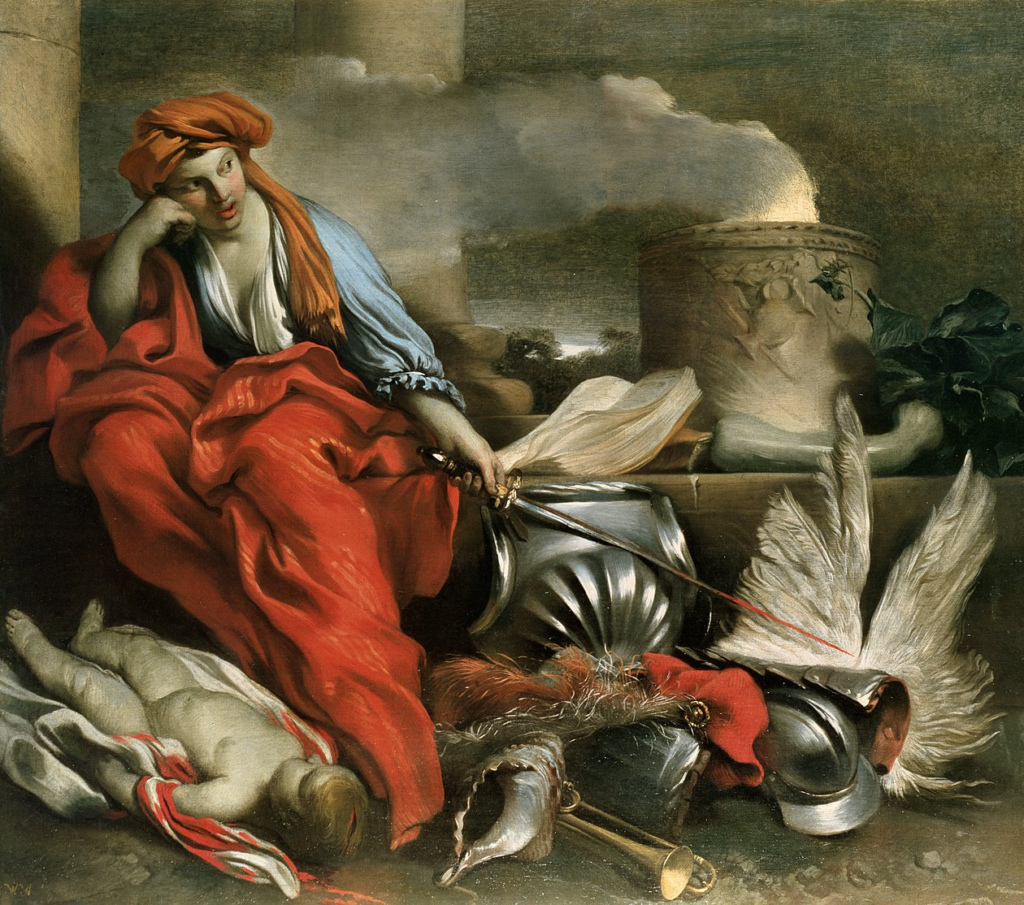
Lecture on Euripides’ Medea as a Civic Autopsy of Oath, Exile, and Maternal Sovereignty
If a bond held by oath began in love, then ended in law, which blade counted as justice: the knife in the hand, or the sentence in the mouth? A stone altar stood in my mind as I asked it, with salt from the Saronic Gulf crusting its lip, while an old juror’s pebble waited in a pouch, ready to fall into a bronze urn and decide a life.
I spoke those words while standing under the Acropolis’ south slope, where the Theatre of Dionysus pressed its stone ribs into Attic earth, and a winter sun slid along Pentelic rock with the mild indifference of any heaven that has watched empires rise and cough their smoke away. A crow worked the air above the thyme. From a vendor’s jar, watered wine gave off a sour, yeasty breath. You, listener, sat beside me in imagination, yet your shoulder carried weight in the bench as surely as mine. The place asked for an inquiry, and it asked for one with teeth.
Euripides walked here, or his sandals carried him near enough that the chorus’ stamping reached his bones. Certainty about his private days arrived in a narrow cup. Ancient biographical tradition named his parents Cleito and Mnesarchus (or Mnesarchides), and it also carried gossip about his mother’s trade; the Suda even offered a correction, crediting Philochorus with a defence of her standing.¹ A later world loved the poet as a bundle of contradictions, and that love produced stories with the sweetness of poison. What held firm came from the public record of his art: a playwright whose work entered the civic contest repeatedly, whose language learned the city’s argument, and whose final years unfolded far from Athens at the court of Archelaus in Macedonia, where his last years ended with his death in 406 BCE² and left his fame in foreign air, like smoke rising from another man’s hearth.
His career sat inside the Athenian dramatic contest, where the city paid for poetry as it paid for ships, because words served defence as much as bronze. Medea entered that contest at the City Dionysia in 431 BCE and took third prize, produced with Philoctetes, Dictys, and a satyr play called The Reapers.³ A year-label means little until the ear hears its weather. Spring of 431 carried a restless air; Thucydides later fixed the outbreak of war and the first invasion of Attica within that same season’s turning.⁴ A tragedy performed under that sky acted as entertainment and as omen, while the orchestra’s circle became a civic mouth where fear and pity shared a cup.
Many listeners met Euripides through the caricature preserved by comedy: the sour thinker, the clever man who put women and slaves on stage as if their mouths deserved daylight. That caricature carried value as symptom, as Aristophanic mockery carried the scent of public nerves. Yet a wiser route began with the surviving plays’ texture: Euripides shaped scenes where speech behaved like a courtroom, and where private pain became a matter of civic contagion. Medea, performed at the war’s threshold, sounded like a domestic crisis, while it also behaved therefore as an argument launched into a tinder-dry polis.
Look across the stage in your mind. A slave woman began the play, and her first task entailed memory: she traced the ship Argo’s wake and Medea’s choice to follow it. That prologue gave the myth a domestic address, a house front in Corinth, and an inward sound—a woman inside, wailing. Athenian spectators understood house-fronts; oikos carried the weight of inheritance, guardianship, and civic continuity. In the city’s law, a woman stood under a kyrios, a male guardian whose hand held her legal agency; modern legal history has described that arrangement as a central feature of the system.⁵ When Euripides placed a woman’s voice at centre, the house turned inside out, and law’s shadow fell across the threshold.
Euripides placed the audience at a double boundary. He gave them a barbarian, and he also gave them a woman. The word “barbarian” carried more than geography; it carried an imagined moral texture. Pericles’ citizenship rule of 451/0 BCE had tightened the boundary by tying civic status to two citizen parents, and later Athenians treated mixed unions with suspicion.⁶ A foreign woman, even when bound to a Greek man, stood close to the edge of belonging; her children’s future hung on male recognition, on naming, on the public act of admission into a world of fathers.
Here the play’s first wound opened: betrayal arrived dressed as policy. Jason spoke the language of advantage, claiming his new union served the children and the household; he spoke like a man quoting a ledger. A listener who has sat through any family dispute in our century hears the tonal kinship: one party frames abandonment as rational planning, while the other feels a tear in reality. Psychology names such events moral injury when the trusted partner breaks an internal code, and it names the aftermath an attachment earthquake when the bond that held the future collapses into dust.
A pause arrived the way a cloud shadow crossed the orchestra. Dust lifted from a step, then settled again. Across the benches, men shifted their cloaks, and a boy scratched his shin with the solemn devotion of prayer, while the city’s noise thinned into a single, shared breath.
Wind ran through the theatre and lifted dust from a step where some boy had stamped it in anger. I watched your face, listener, and I saw the same grim amusement that comes when a city pretends to treat family life as private and then builds its entire future upon births.
—Mr. Smallridge, a gentleman asked, do you grant Medea innocence?
—I grant her intelligence, I answered, and I grant the city its share of guilt.
Medea’s first great philosophical act arrived through speech to the chorus, and the chorus mattered as more than ornament. Euripides composed Corinthian women who listened with the intimacy of neighbours, and scholarship has long noted the play’s deliberate cultivation of that sympathy.⁷ The chorus held two identities—women, and Corinthians—and their loyalty wavered under Medea’s manipulation and their own ethical unease.⁸ Under that wavering, a question emerged: who counted as “us” when kinship collapsed, and who held authority over the definition?
Euripides gave her this speech early, and that timing carried intent. He earned compassion before he demanded horror. Pity moved first; revulsion arrived later. That structure resembled a civic trial, where character evidence precedes verdict. Here lay the thesis I set in your palm like a hot coin: Medea functioned as Euripides’ experiment in juridical imagination, a drama that treated the oikos as a contract enforced by the polis, and that revealed how the polis defaulted on its debt to the bodies it used as boundary-markers.
Such a claim sounded harsh, and it should. Tragedy teaches through harshness, the way a bog teaches a boot through suction. Yet the play supported the argument in its own material: exile, asylum, vows, oaths, gifts. Creon entered and offered banishment as if he were sweeping dirt from his threshold. His fear of Medea carried a peculiar honour, for fear granted her competence. She answered his power with a supplication that turned the royal body into soft clay. One day of delay—one day—served as the hinge on which the entire city’s future swung.
Aegeus then arrived, the Athenian king on his way from Delphi, and his presence turned the play into a meditation on refuge.⁹ Medea bargained with him, offering assistance with his childlessness, and he offered asylum with an oath. This exchange mattered, in that it showed Medea practising civic speech with surgical precision. A man’s political body—Aegeus’ kingship—became a shelter only after he spoke sacred words. The play thereby linked safety to oath-taking, and it also linked fertility to the foreign woman whom Greek society treated as both threat and remedy.
Jason, for his part, treated oaths as tools. He had sworn, earlier, and he had benefitted from Medea’s help in Colchis and on the road home. Myth offered a long train of crimes—Pelias dismembered, kin betrayed—yet Euripides angled the focus away from ancient gore toward present legality. Here, the historical sociocultural grounding mattered: Athens had nurtured sophistic debate, and rhetorical training had sharpened citizens’ ability to argue any side with plausible language. Euripides placed Jason in that rhetorical posture, so that betrayal sounded like prudence and sounded like civic contribution, while it remained a personal rupture.
That reciprocity, in Greek moral language, took form in charis and in xenia—grace, gift, guest-friendship. These concepts bound society through exchange: a gift created obligation; an oath created memory. Medea embodied the dark possibility that exchange might be enforced through violence when institutions failed. Her gifts to the Corinthian princess, the poisoned robe and crown, operated as inverted hospitality: what arrived as adornment carried death. The psychology of such inversion aligned with the logic of revenge after betrayal, where the beloved object becomes the instrument of harm and thereby carries the betrayer’s name like a brand.
When the messenger described the princess’ death, Euripides turned the audience into witnesses of bodily ruin. Greek tragedy usually kept violence offstage, yet it often brought it back as speech vivid enough to stain the imagination. The princess’ skin burned; Creon’s body adhered to his child’s corpse. That gift became glue. Here the play enacted a philosophy of touch: objects carried moral consequence, and beauty carried poison, and the domestic sphere—clothing, crowns—became an arena of political vengeance.
Yet the play’s most infamous act arrived after this success, and it arrived with hesitation. Medea stood before her children and felt a split. The text showed her wavering, and modern readers sometimes treat that wavering as proof of maternal feeling battling cold calculation. I accepted the feeling, and I also accepted calculation, given that human minds under extremity contain both. William Allan has argued that Medea’s emotions included a form of jealousy that protected relationships and sought fair treatment.¹⁰ Jealousy, in this reading, carried a moral grammar: a demand for reciprocity, a demand for recognition, a demand for the promised shape of a life.
Now came the unsettling leap, and it asked for more than moral reflex. Her hand had already turned a bridal gift into funeral fire, and her mind had already measured exile’s cliff-edge. The next act pressed on the deepest bond available: the child as pledge, as hostage, as living proof.
Ancient tradition offered variants. A scholium preserved a version in which Corinthians killed the children after Medea’s escape, and later sources recorded multiple accounts; modern editors of the text observed that Euripides may have intensified the myth by making Medea the agent of filicide.¹¹ That choice, if choice it was, served an Athenian audience with a severe mirror. The polis that loved its sons and sent them to die at the frontier watched a mother destroy sons with her own hand. That spectacle carried war inside the nursery.
At this point, a common moral reflex rushed in: condemnation, the quick closing of the case. Yet Euripides kept the case open by staging an argument about agency itself. Medea’s agency had been denied in law and custom. Athenian women lived under guardianship, and their ability to act in court and contract belonged to male hands. In such a system, a woman’s capacity to harm became one of the few powers that remained truly hers. That fact turned horror into sociology. The play asked whether a society could deny lawful agency while it also demanded moral restraint from the denied.
Philosophy then stepped into the house like a cold draught. Aristotle later defined tragedy’s effect through pity and fear, and Medea’s structure served that definition with clinical precision. Fear arose from recognising one’s own capacity for destruction under betrayal; pity arose from recognising a trapped person’s pain. Yet Euripides pushed further, toward a question about justice as a technology. If justice functioned through courts and kin, and if courts served citizens, then justice for foreigners remained contingent, like shelter offered during rain and withdrawn when the sky cleared.
A man in the audience might have shifted on his bench here. His wife sat at home, or perhaps she sat in the women’s section if her family dared, and the play’s words about marriage might have leaked into her mind like smoke into rafters. Civic ideology required women’s quiet for stability. Euripides let a woman speak and thereby introduced instability into the civic dream. That act alone explained some of the hostility he received in his own time, and it explained the way comic poets framed him as a corrupter of households.
I walked, in imagination, from the theatre down toward the Ilissos, where plane trees lean and water carries a green light, and I thought about how Medea’s exile echoed another Athenian anxiety: the fear of being cut off from burial, from ancestral soil. Exile in Greek thought carried spiritual weight; it threatened the chain that linked the living to the dead. Medea lived as an exile inside marriage already. Jason’s new marriage turned that internal exile into a legal sentence. Her revenge attacked precisely what exile threatens: continuity, lineage, the child as proof that one belongs somewhere.
The play’s ending arrived with the mechane, the stage crane that lifted Medea above the ground in a chariot of Helios. Stagecraft scholarship has traced how such elevation staged divinity as a material intervention in the tragic world.¹² The visual effect mattered beyond theatre mechanics. Elevation transformed Medea into a figure poised between human and divine, and it forced the audience to contemplate a scandalous possibility: the cosmos granted her escape. Jason shouted; he lacked the capacity to touch. Medea spoke from above, and the geometry of power reversed: the abandoned wife occupied the sky, while the new bridegroom stood earthbound as a petitioner.
Here my thesis sharpened its edge. Euripides staged Medea as a foreign sovereign produced by civic default. A polis refused her citizenship, refused her protection, refused her kin, and thereby produced an autonomous agent whose ethics answered to an older code of reciprocity enforced by divine lineage. Helios’ chariot symbolised that older code. The city’s legal order rose from earth and custom; Medea’s order rose from cosmic genealogy. When civic justice failed, cosmic justice appeared, and it bore the sun’s crest like a weapon.
Psychology offered a way to read that monster without excusing her. Modern trauma research spoke of narrowed future and shattered assumptions after betrayal; the mind lost its sense of continuity and sought an act that rewrote reality. Medea rewrote reality in the most appalling script available. She rewrote Jason’s lineage. In Corinth, she rewrote the royal future. Her hand rewrote her own maternal identity. Each rewrite served a single aim: to make the betrayal visible in bodies. Words had failed to bind Jason; the polis’ sanctions had failed to restrain him; Medea therefore turned to the only medium that Jason’s ambition could read—consequence.
Yet Euripides also staged her as lucid. Madness narratives appeared in tragedy, and they carried divine possession or frenzy. Medea’s act carried deliberation. That deliberation placed the burden back on civic spectators: if a sane person committed such an act, then the polis’ moral world had already fractured. Euripides thereby refused a comforting explanation. He denied the city its favourite alibi: “she lost her mind.” He offered instead a woman whose mind worked too well under grievance, and whose speech retained form even while her hands committed ruin.
You, listener, may feel a coldness in this argument, as if it drains the play of its human weeping. I felt that danger too. So I returned to the concrete, to the body. Medea heard her children’s voices. The chorus heard them too. In response, the chorus ran to the door, and their feet struck the ground in an almost comic impotence: women outside a house, barred by custom, hearing the murder of children and lacking lawful force to intervene. That moment condensed Athenian gender structure into a single scene: social order depended on enclosure, while catastrophe sounded through the walls.
A second accusation rose through Jason’s helplessness at the end. He arrived with men, and he sought the children’s bodies for burial. Medea denied him touch. Burial carried sacred duty; denial of burial carried pollution and rage. Here Euripides drew on deep Greek instinct: the dead require rites, and the living require the act of giving them. Medea controlled that rite, dictating burial terms. She controlled the city’s purity. The foreign woman thus became the priest of Corinth’s future memory, and the city received its lesson from a mouth it had treated as marginal.
Consider, too, the larger political horizon. Athens in 431 stood at war’s threshold, and the city would soon face plague, faction, and imperial overreach. Thucydides described how law and custom frayed under pressure, with words changing their meanings and violence becoming ordinary. Medea served as a miniature premonition: a society that trusted its own rationality could slide into ethical inversion when fear governed decision. Jason’s “advantage” reasoning resembled the imperial rhetoric that later justified conquest; the play placed that rhetoric in a household and showed its stench.
At this point, a gentle voice inside you may ask for Euripides himself, the man behind the words. Facts remained spare. Yet a few grounded points held. His move to Macedonia under Archelaus’ patronage showed a playwright willing to step beyond the city that judged him; modern scholarship has discussed that relationship in terms of popular patronage and political theatre.¹³ His survival in later antiquity, with more complete plays preserved than his rivals’, showed that later readers treated his work as a school of feeling and argument. Such endurance suggested a writer who understood how a city dreams, and how a city harms, while the stage served as the one place where the dream could be forced to watch itself.
In my own hearing, Euripides behaved like a diagnostician of civic hypocrisy. He gave the polis a spectacle where its cherished boundaries—Greek and barbarian, male and female, citizen and exile—collapsed into a single figure. Medea held all those boundaries in her skin. Her Colchian origin placed her beyond the Greek map; her marriage placed her inside a Greek household; her exile placed her outside again. Divine lineage placed her above human law; motherhood placed her inside the most human bond available. Euripides let those positions collide, and the collision produced heat enough to scorch moral certainty.
Allow me a brief confession, addressed to the dead. Euripides, old ghost of Salamis and Macedonia, I have treated your heroine as if she were a theorem. I have done so under the belief that your stage offered a civic laboratory, yet my chest still tightened when I heard the children’s offstage cries. A theorem held only symbols. Motherhood carried cries. Cities carried cries. The tension belonged to tragedy’s essence: thought and flesh refuse alignment, while each demands the final word.
We returned to the opening riddle with shoes dusty from the theatre’s steps, and with minds thickened by witness. A bond held by oath began in love, then ended in law; which blade counted as justice? The question refused gentleness, and it also refused escape, as if it belonged to every household that ever trusted speech.
An answer came in the play’s final elevation, when justice appeared as neither knife nor sentence alone, though both had served as instruments. Justice in Medea behaved like a failed exchange made visible. A polis treated marriage as contract and foreigners as conditional guests; Jason treated vows as disposable; Corinth treated fear as policy. Medea responded by becoming a creditor with a burning pen, signing the city’s moral insolvency in blood. In that grim economy, the knife acted as the court that the polis withheld, and the sentence acted as the knife that the polis licensed through its exclusions. The blade therefore lay in the gap between oath and enforcement: where speech promised continuity and the civic order refused to honour the promise.
A last image stayed with me as we left the stone benches. Above the orchestra, a swallow cut the air, and its flight traced a quick, clean arc, as if the world still held ease. Beneath that ease, a tragedy continued to work like salt in a wound. Medea rode away. Jason stood below. The chorus remained. Athens went to war. You, listener, carried the question home: which debts does a city owe to its outsiders, and what creature does it breed when it chooses amnesia?
Scholia:
- Suda, Lexicon, s.v. ‘Euripides’ (ε 3695), ed. Ada Adler (B. G. Teubner, Leipzig, 1928–1938). Byzantine compilers prized a sharp anecdote the way a fisherman prized a silver flash, and the Suda handed down both names and insults. Cleito as herb-seller, Mnesarchus as shopman, Euripides as cave-haunter: each detail may carry a kernel of memory, yet each also carried comic weaponry. Philochorus, an Atthidographer writing in the fourth century BCE, entered the same stream of remembrance with a different temper: an Athenian’s concern for civic reputation. The friction between gossip and defence suited Euripides’ own theatre, where competing stories occupied the same stage and demanded judgement. A responsible reading treated such material as testimony about later reception and about the city’s anxieties, while the dramatic record remained the steadier ground.
- ‘Euripides’, Encyclopaedia Britannica, Encyclopaedia Britannica (Chicago), accessed 21 January 2026.
- Euripides, Medea: A New Translation, trans. Charles Martin, introd. A. E. Stallings (University of California Press, Oakland, 2019), pp. 2–4.
- Thucydides, History of the Peloponnesian War, trans. Richard Crawley (J. M. Dent, London, 1910), Book II, 2.10–2.23.
- Konstantinos Kapparis, Women in the Law Courts of Classical Athens (Edinburgh University Press, Edinburgh, 2021), pp. 14–16; Roger Just, Women in Athenian Law and Life (Routledge, London, 1989), pp. 35–37.
- G. E. M. de Ste. Croix, ‘The Political Outlook of Aristophanes’, in David Harvey and Robert Parker (eds.), Athenian Democratic Origins and Other Essays (Oxford University Press, Oxford, 2004), pp. 233–253. Pericles’ citizenship measure of 451/0 BCE functioned as a hinge in the city’s self-image. The rule drew a bright line around civic inheritance, while it also threw a shadow across mixed households. Athenian ideology began to treat descent as a civic technology: bodies produced citizens, and citizens sustained empire, and empire fed pride. Medea’s situation in Corinth resembled the Athenian fear in miniature, which made her presence theatrically electric for an Athenian audience. When a polis built its identity on bloodline, a foreign wife became a political question wearing domestic clothes, and her children became a problem of definition before they became a problem of love.
- Herbert Musurillo, ‘Euripides’ Medea: A Reconsideration’, Classical Philology, 61 (1966), pp. 224–231.
- Laura Swift, ‘Choral Mediations in Euripides’ Medea’, in Renaud Gagné and Marianne Hopman (eds.), Choral Mediations in Greek Tragedy (Cambridge University Press, Cambridge, 2013), pp. 130–154.
- Andreas K. Kasimis, ‘Medea the Refugee’, The Review of Politics, 82 (2020), pp. 25–47.
- William Allan, ‘The Virtuous Emotions of Euripides’ Medea’, Greece & Rome, 68 (2021), pp. 27–44.
- Euripides, Medea: A New Translation, trans. Charles Martin, introd. A. E. Stallings (University of California Press, Oakland, 2019), pp. 12–13. Corinth kept its own memory politics. Several later accounts placed the children’s deaths in Corinthian hands, which turned the myth into civic violence and left Medea with flight and grief. Euripides’ surviving play pressed the blade into Medea’s grip, and that transfer changed the moral chemistry of the story. Filicide, when performed by the mother, turned a civic critique into a metaphysical scandal: the future itself became the weapon, and kinship became collateral. The alteration also sharpened the drama’s legal argument, because agency sat at the centre of the catastrophe. A polis could blame a crowd, a riot, an accident; a polis struggled when a single mind enacted the deed with deliberation and speech. Euripides thereby forced spectators to ask how far exclusion and betrayal could drive a human creature.
- Donald J. Mastronarde, ‘Actors on High: The Skene Roof, the Crane, and the Gods in Attic Drama’, Classical Antiquity, 9 (1990), pp. 247–294.
- Edmund Stewart, ‘Tragedy and Tyranny: Euripides, Archelaus of Macedon and Popular Patronage’, Dialogues d’histoire ancienne, Suppl. 21 (2021), pp. 81–101.