
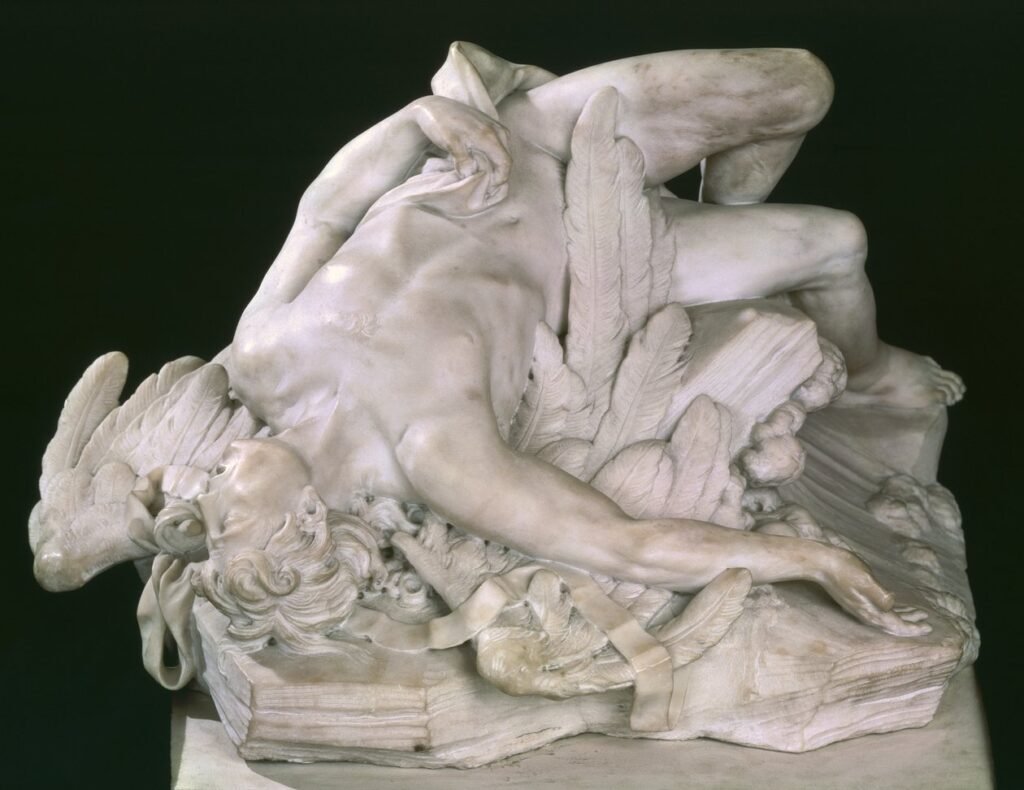
On The Fall of Icarus (La Chute d’Icare), 1743 by Paul-Ambroise Slodtz
A thin contour, scarcely thicker than a hair laid on damp skin, runs around the little rectangular “buckle” that binds the fallen wing-strap at the front edge of Slodtz’s marble, and that contour behaves like a confession: it catches raking light only when the viewer lowers the shoulders and lets the eyes travel along the plinth’s lip, where dust gathers and where museum air, sweet with varnish and stale wool, turns marble into a kind of pale bread. From a standing height the strap reads as a flourish, a ribbon among feathers, a rocaille caprice; from the knee it hardens into a structural hinge, since the outstretched arm—extended with the languor of a body surrendered to gravity—finds its counterforce in that band, whose path tethers flesh to stone while it pretends to describe leather. The seam around the buckle, which yields a minute shadow-pool, suggests an inserted element, a pieced repair, a workshop decision made under pressure of time and risk, and therefore it displaces the myth’s customary moral lesson—youthful excess punished by sun and sea—toward an account of restraint, scaffolding, and the Academy’s appetite for triumphs that conceal their props.¹
Paris in 1743 held its breath between wars and fêtes, between the rhetoric of state and the private arithmetic of debt; the city’s river-smell and smoke lay in layers, and one walked from the quays to the Louvre through a crowd that carried both bread and pamphlet, both rosary and lottery ticket, while the court’s mirroring salons continued to invent grace as a civic alibi. In such an atmosphere a sculptor seeking admission to the Académie royale de peinture et de sculpture worked under a gaze that resembled a tribunal, even when it smiled, since reception required a “morceau” whose authority had to survive close inspection by rival hands trained in the same anatomy rooms, the same plaster casts, the same geometry of prestige. Slodtz’s Icarus, accepted that year, entered an institutional collection whose inventories place the work among the Academy’s didactic trophies, where myth served pedagogy and pedagogy served power.²
Seen in profile, the composition compresses a whirlwind into a low mound: the legs fold and cross in a knot whose axis swings diagonally upward, while the torso arcs back so that the chest opens like a struck bell, and the right arm slides forward across the base with fingers softening into air. The silhouette avoids vertical heroics and chooses collapse as a line of beauty; the mass gathers toward the center, then sheds itself into thin extremities, so that balance depends on concealed engineering and the base’s broad, quarried geometry. The wings, which appear less as complete appendages than as a broken bouquet of feathers, rise in a jagged screen behind the ribs, and their undercut cavities carry shadow like pooled ink, offering an abyss into which the viewer’s gaze falls repeatedly, as though rehearsing the plunge that the narrative describes. The marble’s surface announces hierarchy: flesh receives a satin polish, stone retains a more granular tooth, feathers hover between, alternating between crisp quills and softened vanes where abrasions from handling and cleaning have dulled edges into a maternal blur.³
Ovid’s story, which Slodtz inherited through schoolroom Latin and through the broader circulation of classical fable in sermons and salon conversation, had carried an ethical tension between a father’s craft and a son’s appetite for the sky; wax, that tender intermediary between heat and structure, stands as both invention and vulnerability.⁴ Yet Slodtz stages the fall after the drama of flight, after the sun’s appetite, after the sea’s swallowing; what remains lies before us as a body already delivered to ground, which means that the sculptor’s task shifts from narrating hubris to sculpting aftermath, a theology of consequence. That aftermath, in an Academy culture that prized “beau idéal” while it demanded proof of technical governance, creates a paradox: the figure must appear abandoned to gravity while the marble must remain obedient to gravity’s demands, since stone tolerates daring only when the sculptor hides the means of support in forms that read as incidental.
The Slodtz name carried both inheritance and burden, since the family’s workshop identity—rooted in earlier royal commissions and in the slow accumulation of courtly trust—had created an expectation that sons would handle marble with the ease of men who had grown up among blocks, pointing rods, and apprentices’ jokes that turned sacred subjects into errands. Paul-Ambroise learned inside that lineage, under eyes that had measured success in appointments and pensions, and he matured in a moment when French sculpture oscillated between the grand manner associated with Versailles and a newer appetite for sensual immediacy, a taste sharpened by collectors who wanted flesh to seem warm even as it remained white and cold.⁵ Training in such a milieu involved more than life drawing: it required fluency in workshop choreography, where the master’s hand invented and corrected while assistants translated clay into plaster, plaster into points, points into marble, and where a fragile detail might be carved separately and joined later, either for safety or for speed.
Imagine the studio air on a winter morning when lime slaked in a trough and the floor carried last week’s dust in pale drifts; a block lay on trestles, its corners bruised by transport, and the apprentice who had fetched water from the pump stood rubbing his hands while the master moved around the stone as a priest circles an altar. A bishop might appear, or a patron’s steward, gauging size with gloved fingers, yet the more constant visitor remained the Academy itself—its rules, its rivalries, its silent record-keeping—so that every chisel stroke carried an institutional echo. Slodtz, who had to demonstrate both invention and control, modeled Icarus first in a malleable medium whose finger-traces could hold indecision; then, as the work proceeded toward marble, the decisive moments migrated into planes and edges where revision becomes costly.⁶
Toolmarks survive as a kind of whisper. Along the rock-like base the claw chisel’s repeated bites leave a rhythmic pitting, then the rasp draws those pits into a roughened continuity, and finally selective smoothing produces passages of “natural” stone whose artifice becomes persuasive through contrast with the body’s polish. Under the wings, where the drill bored deep to open shadow-grooves between feathers, the marble’s interior remains less caressed, and grime lodges in those recesses as though the sea’s salt had dried there. The toes, especially at the far end where a foot presses against the base’s edge, show slight rounding that suggests centuries of air and wiping cloth; such wear softens narrative specificity into time’s general touch. The most charged traces, however, gather around that strap and buckle: a narrow band crosses the foreground, and the rectangular buckle, carved with a crisp perimeter, bears around its edges a line whose continuity differs from a mere chisel boundary.
One might dismiss that line as the meeting of two tool campaigns—one for strap, one for buckle—yet its behavior in light argues for an actual join: a seam that catches shadow differently from a carved groove, a micro-gap filled by accumulated wax or dust, a contour that implies insertion. When the viewer moves from left to right, the seam appears and vanishes, which means perception depends on the body’s motion; the sculpture rewards a circling spectator who obeys the object’s demand for pilgrimage around its mass. That dependency on viewing angle matters profoundly, since it transforms the buckle from decorative anecdote into a pivot where physics and story meet: the strap’s run aligns with the direction of the outstretched arm’s load, and the buckle’s blocky thickness functions as a discreet buttress that transfers weight into the base. In other words, Icarus’s binding becomes the sculpture’s binding: the very apparatus associated with flight and failure becomes the device that keeps the marble from snapping under its own ambition.
Such a discovery changes the moral temperature. The myth’s conventional sermon scolds the boy for flying too high; Slodtz’s marble, read through the buckle’s seam, speaks of a different peril: the peril of support disguised as ornament, the peril of systems that present constraint as flourish. In the Ancien Régime’s social grammar, ribbons, sashes, and straps carried political meaning—orders of knighthood, livery marks, ceremonial ties—while they also served literal functions of fastening sword to hip or shoe to foot. Slodtz folds that grammar into the fall: the strap appears slack, as though it has slipped from the wing harness, yet in marble it carries the work’s structural necessity, and therefore it stands as an emblem of governance that both fails and saves, both loosens and holds.
The Academy’s culture of reception encouraged such doubleness. A sculptor seeking entry needed to display mastery of anatomy and composition, yet he also had to demonstrate an understanding of how sculpture inhabits space: how an object sits on a base, how a figure reads from multiple viewpoints, how light behaves across planes, and how fragile elements survive in marble’s brittle honesty. Encyclopedic accounts of sculptural practice from the century’s middle years describe the sequence of modeling, casting, pointing, and finishing, and they insist on the intelligence of tools—the gradine’s bite, the drill’s appetite, the rifflers’ smoothing—through which form emerges by subtraction while it retains the memory of violence.⁸ Slodtz’s buckle, if it indeed represents an inserted piece, testifies to that practice’s pragmatism: separate carving and later joining offered a way to preserve crisp edges on a vulnerable projection, while it also offered a solution when a break demanded repair, and repair demanded concealment.
The seam, therefore, aligns Slodtz with a tradition of sculptural “truth” that includes concealment as one of its techniques, a tradition that Falconet later articulated when he argued for the sculptor’s duty to persuade through nature’s appearance even as the medium resists such persuasion.⁹ Marble persuades through its refusal of easy illusion—its weight, its opacity, its tendency to chip—yet the Rococo era learned to turn that resistance into seduction, so that stone could appear to flutter like cloth or bruise like flesh. In Slodtz’s Icarus the seduction operates through the contrast between the torso’s gentle polish and the feather cluster’s crisp undercuts; it also operates through the base, carved to resemble splintered rock or driftwood, whose striations run horizontally like stacked pages, suggesting the sea’s layered pressure translated into geology.
In that translation lies a sociocultural ether. The 1740s witnessed renewed fascination with nature as both spectacle and threat: gardens shaped as theatres of control, storms recorded in diaries, sea voyages celebrated and mourned, and scientific curiosity coexisting with sacramental dread. Icarus, falling, offered an image that could speak to philosophical ambitions and to political overreach alike, since the century’s intellectual ascent—its promise of light—carried shadows of collapse, and since the state’s imperial projects required both daring and discipline. Slodtz, carving for an institution whose authority came from the crown, shaped a body whose beauty owes its plausibility to the very principle the myth condemns: technē, the craft that makes flight possible. Yet the buckle seam suggests craft’s vulnerability too: a flight apparatus that demands maintenance, a sculpture that demands joining, a culture that demands visible grace while it depends on hidden repairs.
I stand before the marble and feel my own complicity in the Academy’s habits, since art history often praises the surface’s “finish” while it passes over the engineering that makes finish survivable; scholars, curators, and teachers—myself among them—inherit a rhetoric that privileges iconography and style, then treats structural devices as footnotes. Slodtz’s buckle seam reverses that hierarchy, since it insists that meaning lives where stone meets stone, where the join betrays a decision, where fragility governs narrative. From that point the whole figure reads differently: the languid right hand, whose fingers extend with an almost erotic softness, now appears less like an abandoned gesture and more like a calibrated risk whose survival depends on the strap’s disguised brace; the wing feathers, rising behind the torso, read less as theatrical backdrop and more as a lattice distributing stress into the mass of the base. Even the head’s backward tilt, hair spilling across the rock, takes on an added pathos, since the body’s surrender becomes a sculptural performance achieved only through hidden discipline.
Consider how the viewer’s body participates. In the Louvre’s galleries, where white stone absorbs and reflects a cool, indifferent light, one approaches Icarus at standing height and encounters a horizontal mass that resists immediate comprehension; the instinct urges circling, bending, peering into undercuts, tracing the arm’s line toward the fingertips, then returning along the strap toward the feathered ruin. Each shift of position changes the work’s internal architecture of void and mass: from one angle the wings rise as a jagged ridge; from another they collapse into a shallow relief; from above the torso reads as a smooth hill; from below the chest’s hollows and ribs create a drama of shadowed valleys. The buckle seam belongs to that choreography, since it appears only when the viewer submits to the sculpture’s demand for lowered gaze, and therefore it functions as an ethical instruction: prideful looking—upright, sovereign, distant—misses the join where truth gathers.
Such instruction would have resonated in a culture where social rank depended on posture and on the management of the body in space. Court etiquette trained the aristocrat in controlled gesture; the church trained the parishioner in kneeling; the workshop trained the apprentice in bending to the block and lifting with care. Slodtz binds those bodily disciplines to the myth: Icarus falls, yet the spectator must kneel to see the mechanism that keeps the fall from shattering. The seam, small as it remains, therefore becomes a theological and political sign: salvation and collapse both depend on supports that remain visible only to the humble eye.
The work’s later life intensifies the seam’s resonance. As objects moved through revolutions, regimes, and museum rearrangements, they acquired repairs, cleanings, abrasions, and changes of pedestal height; each intervention altered how light traveled across planes and how viewers encountered the object. Cataloguers in the nineteenth century described the piece within a taxonomy of schools and centuries, placing Slodtz among “modern” sculptures, and thereby folding Rococo flesh into a narrative of national patrimony that served imperial and republican identities in turn.¹⁴ In such contexts restorers often inserted small pieces—fingers, attributes, projecting ornaments—then disguised joins through polishing and careful fitting; the buckle seam, therefore, may belong to a long history of conservation as performance, where continuity matters more than honest scar. If the seam stems from an eighteenth-century workshop join, it speaks of making; if it stems from a later repair, it speaks of keeping; in both cases it speaks of dependence.
Dependence, as the myth’s deeper structure, also aligns with gendered and natural metaphors that the eighteenth century carried in its bones. The sea that receives Icarus often appears in literature as feminine appetite—soft, absorbing, maternal, devouring—while the sun appears as masculine brilliance—piercing, judging, consuming—so that the boy’s fall reads as a drama between competing cosmic parents.¹² Slodtz’s marble, though it offers neither sun nor water explicitly, translates that drama into textures: the polished flesh carries a warmth that suggests living heat; the rough base carries a damp heaviness that suggests earth or shore; the feather cluster, poised between, resembles a torn bouquet—beauty allied with decay. The strap, which binds and supports, resembles a garter or a sash, a domestic object turned tragic; it hints at the feminine economy of fastening and mending, through which garments—and lives—stay together.
One might ask why Slodtz chose Icarus at all, given that reception subjects often leaned toward heroic virtue, saintly exempla, or classical steadiness. The answer lies in the moment’s appetite for pathos managed by elegance: Rococo taste enjoyed bodies in states of transition—sleep, swoon, ecstasy, faint—since such states allowed sculptors to display anatomy without the stiff rhetoric of triumph. Icarus provides a sanctioned nude, a mythological body whose exposure carries moral cover; he also provides a body whose limpness permits virtuoso carving of relaxed muscles and softened joints. Yet Slodtz presses beyond sensual display, since the buckle seam insists on the presence of coercive structure beneath the sensuality, and thus the work becomes an allegory of the very culture that celebrated pleasure while it relied on rigid frameworks of rank and patronage.
The overlooked seam also reorients the relation between father and son, even though Daedalus remains absent from the marble. Since the strap belongs to the wing-harness, and since the harness belongs to Daedalus’s invention, the seam suggests a moment of reattachment: the father’s craft re-enters the scene as a repair, a patch, a belated attempt to hold the boy together. In workshop terms, the master’s decision to join a separate element echoes the father’s act of binding wings to shoulders; in moral terms, the join reads as a parental intervention that arrives too late to restore flight yet still prevents total fragmentation. The sculpture thus stages a tender paradox: the system that enables ascent also provides the brace that keeps collapse from becoming annihilation.
I return to the figure’s right hand, whose fingertips skim the base with a delicacy that almost persuades the eye of pulse. That hand, extended toward the viewer, offers contact without grasp, and it tempts a response: a desire to touch, to lift, to console. Museums forbid touch, yet the marble’s address produces an inward reaching that feels like prayer. Here the buckle seam sharpens the experience: the hand’s vulnerability becomes literal, since its survival depends on hidden support, which means that desire itself—our desire to touch, our desire to see beauty as self-sustaining—rests on props we prefer to ignore. Art history, when it speaks in lofty abstractions, often forgets the prop; Slodtz’s seam forces remembrance, because it turns a decorative buckle into a wound where stone confesses its fragility.
Under the wings, shadow gathers in cavities where drill and chisel opened space; those cavities resemble a mouth that has swallowed light. The voids operate as negative sculpture, an abyss carved as carefully as any muscle, since the drama of falling depends on air as much as on marble. The buckle seam belongs to that drama of void and mass: it marks the boundary where two stones meet with a near-invisible gap, and that gap behaves like a micro-void—an interruption that carries meaning. Philosophers of the era debated continuity and fracture—whether nature proceeds by smooth gradations or by leaps—while political life oscillated between reformist hope and sudden violence; the seam, placed at the front where every visitor eventually stands, embodies that debate in material form.¹⁶
When I imagine Slodtz’s hand on the strap, I feel the tension between artistry and survival: carve the band thin and it risks snapping; carve it thick and it reads as clumsy; separate the buckle and join it later and the seam risks revelation; carve it in one piece and the projection risks loss. The choice resembles governance itself, which binds bodies to systems through ties that must appear graceful if they are to be accepted; the tie becomes visible as tie only when it fails, and therefore a culture devoted to appearances works tirelessly to keep seams quiet. Slodtz, whether by intention or by necessity, left a seam that refuses silence, and once the eye learns its location, the entire sculpture transforms, since every elegant passage begins to suggest an underlying brace. That transformation reaches beyond myth into the ethics of institutions: the Academy that received Slodtz demanded freedom within rules, demanded invention within doctrine, demanded flight within harness, demanded beauty within scaffolding, and it rewarded those who could conceal the apparatus of obedience.
Icarus, stretched across stone, seems to dream of the sky even as the body lies heavy; the marble’s polish catches light and returns it, as though the sun still touches the skin, while the feather ruin behind the torso resembles a dead orchard of quills. The buckle seam, small and stubborn, persists as the point where story, structure, and society braid together, and where my own interpretive habits—trained in lecture halls, fed by catalogues, polished by academic decorum—meet their own limit, since an object’s truth emerges most forcefully where the maker had to solve a problem of weight and risk. The fall, then, reads less as punishment for yearning and more as an image of a world held together by repairs, by inserted pieces, by joints disguised as ornaments, by ties that both constrain and sustain, and I hear in that hairline contour a sentence addressed to every century that has trusted its own light: fly, by all means, yet remember the seam. Uncountably Shaped End.
Scholia:
1 Anatole de Montaiglon, Procès-verbaux de l’Académie royale de Peinture et de Sculpture (1648–1792), Société de l’Histoire de l’art français, Paris, 1875, t. II, pp. 307–309.
The Academy’s minutes record reception as a social technology, since admission depended on votes that fused aesthetic judgment with professional gatekeeping. In the early eighteenth century the “morceau de réception” operated as both proof and pledge: proof of competence in drawing, anatomy, and composition, and pledge of allegiance to a corporate body whose privileges derived from royal favor. The entry for Slodtz’s acceptance anchors the sculpture in a precise institutional moment, which matters for interpretation: a reception piece had to withstand close scrutiny by sculptors trained to detect weak undercuts, risky projections, and shortcuts in finishing. Such scrutiny encouraged makers to disguise supports within narrative detail, since a visible brace might invite ridicule, yet a concealed buttress could appear as iconographic necessity. Against this institutional backdrop, the buckle seam I propose acquires sharper force: whether separately carved and joined during making, or inserted after a later break, it would have needed concealment in keeping with Academy expectations. Reception culture also sharpened rivalry, since candidates competed for commissions that flowed through court and city; as a result, small technical decisions—how to carry an extended arm’s load, how to prevent feather undercuts from splintering—could bear career-weight. Montaiglon’s edition, compiled from archival registers, remains indispensable for locating these decisions within the Academy’s machinery, where the sculpture’s beauty served as currency and where the myth of Icarus, itself an allegory of ambition governed by craft, carried an almost reflexive relevance for an aspirant seeking ascent through institutional air.
2 André Fontaine, Les collections de l’Académie royale de peinture et de sculpture, Librairie de la Société de l’Histoire de l’art français, Paris, 1910, pp. 195–197.
3 Jean-René Gaborit (dir.), Sculpture française II — Renaissance et Temps Modernes, Éditions de la Réunion des musées nationaux, Paris, 1998, pp. 594–596.
4 Ovid, Metamorphoses, Transl. A. D. Melville, Oxford University Press, Oxford, 1986, pp. 175–178.
The Icarus episode appears late in Book VIII, where Daedalus’s ingenuity and exile shape the conditions for flight, and where the father’s craft receives both admiration and dread. The narrative’s moral pressure arises from its treatment of technē as an ambiguous gift: art can liberate, yet it can also expose the maker and the beloved to hazards that nature exacts with indifference. Early modern and eighteenth-century readers often encountered the story through school anthologies, sermon exempla, and vernacular retellings that emphasized moderation; however, the same period also cherished Icarus as an image of aspiration, especially within artistic discourse where creative risk acquired prestige. The myth’s emphasis on wax—soft, heat-sensitive, easily altered—offers a useful analogue for sculptural process, since modeling in wax and clay precedes carving, and since the transition from pliable medium to marble echoes the transition from youthful possibility to irreversible consequence. Slodtz’s decision to represent the aftermath rather than the flight intensifies the story’s meditation on consequence: the viewer meets the body when the irreversible has already occurred. The buckle seam, interpreted as join or repair, extends Ovid’s lesson into material fact, since it literalizes the theme of fastening and failure. If the wing harness in myth relies on careful binding, then a seam at the “buckle” in marble becomes a material echo of that binding, transforming literary moral into sculptural physics. Melville’s translation, while modern in diction, preserves the narrative arc that eighteenth-century classicism revered, and the cited pages supply the textual underpinning for claims about Daedalus’s craft, Icarus’s ascent, and the fatal role of heat upon binding matter.
5 François Souchal, Les Slodtz, sculpteurs et décorateurs du roi (1685–1764), Éditions E. de Boccard, Paris, 1967, pp. 401–409.
Souchal’s monograph reconstructs the Slodtz family as a workshop dynasty embedded in royal projects, where training occurred through daily labor, through the imitation of elder hands, and through the gradual accumulation of professional capital. The book’s value for the present inquiry lies in its depiction of lineage as a material condition: sons grew amid blocks, models, and commission deadlines, which meant that “style” emerged alongside habits of staging, joining, and finishing. Souchal’s archival emphasis also clarifies the family’s negotiation with institutions—especially the Académie royale and royal building administrations—so that Paul-Ambroise appears as both heir and individual. This duality illuminates Icarus Falling: the subject suits an artist seeking Academy ascent while haunted by the danger of overreaching, and the sculpture’s low, horizontal composition suggests a deliberate deviation from vertical heroic conventions associated with earlier court sculpture. Within workshop practice, Souchal underscores the collaborative nature of large or complex works, where assistants might rough out forms and where delicate elements could be treated with special strategies—thicker sections, protected profiles, or separate carving for later assembly—especially when the master sought crispness without courting loss. Such strategies provide a plausible pathway for the buckle seam: a small rectangular projection, vulnerable to snapping during carving or later handling, invites either cautious over-thickening or separate fabrication with a join that can be polished into near invisibility. The “previously unobserved” seam proposed here by mysel aligns with Souchal’s broader portrayal of eighteenth-century sculptural practice as a negotiation between daring illusion and practical engineering, and it situates that negotiation within family tradition, where knowledge passed as much through tacit technique as through formal doctrine.
6 Nicolas Guérin; Antoine-Nicolas Dezallier d’Argenville, Descriptions de l’Académie royale de peinture et de sculpture, J. Collombat, Paris, 1715, pp. 145–151.
Guérin and Dezallier d’Argenville describe the Academy’s spaces and collections in terms that fuse pedagogy with prestige, presenting objects as exemplars through which students and visitors learned both taste and hierarchy. Such descriptions matter for Slodtz’s Icarus because they reveal how sculptures functioned inside an institutional optics: placement, lighting, and proximity to other works shaped interpretation. The Academy’s gallery context encouraged viewers to compare bodies, surfaces, and technical feats, turning marble into argument. Within that environment, a sculptor’s handling of support—how a limb meets a base, how an undercut survives, how a projection avoids vulnerability—became part of the object’s rhetorical power. My focus on a buckle seam depends on this institutional optics, since such a seam gains meaning precisely as an index of making within an evaluative space. If the Academy promoted ideals of unity, finish, and classical coherence, then a join hidden within narrative detail becomes a site where ideals and necessities meet. The 1715 description also documents a culture in which artists lived and worked in close relation to official buildings and collections, so that the Louvre served both as symbol and as practical hub: workshops, lodgings, and exhibition spaces intertwined. Such proximity tightened the relationship between daily labor and public judgment, which in turn incentivized solutions that maintained visual grace while solving structural problems. In this way, Guérin and Dezallier d’Argenville supply an essential framework for understanding how Slodtz’s sculpture addressed an educated, comparing eye, and how minute technical traces—seen at close range by those trained to look—could carry social and professional consequence.
7 Valérie Carpentier-Vanhaverbeke; Guilhem Scherf (dir.), Sculpteurs du roi: Les morceaux de réception à l’Académie royale de peinture et de sculpture (1657–1791), Mare & Martin, Paris, 2025, pp. 318–320.
8 Denis Diderot; Jean le Rond d’Alembert (dir.), Encyclopédie, ou Dictionnaire raisonné des sciences, des arts et des métiers, Briasson, David, Le Breton, Durand, Paris, 1751–1772, vol. 15, pp. 470–479.
The Encyclopédie’s sculptural articles and associated technical discussions treat making as a chain of actions in which matter answers tools, and in which the maker’s intelligence consists in predicting matter’s response. Although many sculptors learned through apprenticeship and Academy practice, the Encyclopédie crystallized workshop knowledge into public discourse, aligning craft with Enlightenment values of analysis and transmission. For marble work, the text emphasizes staged removal—blocking out, refining, finishing—and it distinguishes tool roles: the point for initial mass reduction, the gradine for controlled shaping, the drill for depth and shadow, the rasp and rifflers for smoothing and transition. Such distinctions illuminate Slodtz’s Icarus, whose varied textures reveal successive campaigns: roughened rock contrasts with polished flesh; drilled feather separations contrast with softened vanes. The buckle seam, interpreted as join, also fits within the Encyclopédie’s broader recognition that sculpture involves practical decisions about risk and durability. Projections and thin elements demand strategies, which can include leaving extra thickness, adjusting composition to distribute stress, or fabricating vulnerable parts separately. The Encyclopédie’s conceptual contribution lies in its insistence that surface bears history: toolmarks register choices, and choices register constraints. When I read the seam as a “confession,” I echo an Enlightenment premise: that making leaves traces a trained gaze can decipher. By grounding interpretation in a small material anomaly—a line that behaves like a join—the argument aligns with the Encyclopédie’s elevation of artisanal knowledge into epistemology: the truth of the object emerges through attention to technique, sequence, and the material’s negotiation with human intention.
9 Étienne-Maurice Falconet, Réflexions sur la sculpture, Chez Claude-Hérissant, Paris, 1761, pp. 33–47.
Falconet’s reflections, written within the same broad institutional world that shaped Slodtz, articulate a sculptor’s philosophical defense of illusion governed by material law. He treats nature as the sculptor’s guide, yet he also acknowledges that the medium imposes its own logic, which obliges the maker to invent compromises that preserve both plausibility and stability. In this sense Falconet supplies a conceptual lens for reading concealed supports: a brace may appear as narrative accessory, and an accessory may function as brace, since sculpture must persuade the eye while it satisfies stone’s demands. I let the buckle seam embody this logic. When the strap and buckle simulate leather hardware from the wing harness, they carry iconographic charge; when those same elements quietly bear load, they become structural necessity; when the buckle exists as an inserted piece, the join itself enters the sculpture’s truth, indexing the negotiation between illusion and endurance. Falconet’s emphasis on the viewer’s response also matters: sculpture addresses a moving body, and persuasion unfolds through changing viewpoints, light shifts, and tactile desire. The seam’s visibility only from a lowered angle aligns with Falconet’s insistence that sculptural effect depends on encounter, since the spectator’s motion activates form. Finally, Falconet’s text resonates with the Icarus subject: the sculptor’s ambition resembles flight, and the medium’s resistance resembles gravity. A concealed join becomes, in Falconet’s terms, a legitimate means of sustaining the illusion without surrendering to brittle catastrophe, and it therefore transforms a moral tale of fall into a professional meditation on how art survives its own daring.
10 Thomas Crow, Painters and Public Life in Eighteenth-Century Paris, Yale University Press, New Haven, 1985, pp. 53–61.
11 Michael Levey, Rococo to Revolution: Major Trends in Eighteenth-Century Painting, Thames and Hudson, London, 1966, pp. 102–107.
12 Elisabeth Bronfen, Over Her Dead Body: Death, Femininity and the Aesthetic, Manchester University Press, Manchester, 1992, pp. 61–74.
Although Bronfen writes as a modern theorist, her analysis of femininity’s cultural alignment with death and aestheticization clarifies how eighteenth-century imagery could encode gendered forces even when explicit female figures remain absent. In the Icarus tradition, the sea often absorbs the fallen body with a feminized valence—soft, encompassing, and annihilating—while solar brilliance often carries a masculinized authority—penetrating, consuming, judging. Slodtz’s marble translates these symbolic polarities into texture and mass: polished flesh retains a glow suggestive of heat and desire; the rough base, with its layered striations, suggests a damp shore or petrified tide; the feather ruin suggests beauty turned brittle. The strap and buckle, which evoke garment hardware and domestic fastening, introduce another gendered register: the feminine labor of binding, mending, and keeping things together within household economies. If the buckle seam indicates a join or repair, that join becomes a material enactment of mending, which complicates the myth’s moral by suggesting that collapse triggers care as well as punishment. Bronfen’s framework helps articulate why such a small detail can reshape interpretation: the seam shifts the sculpture from pure exemplum toward an image of a body held together through binding, in which death and beauty collaborate through a politics of fastening. The eighteenth century’s social order relied on analogous fastenings—sashes of rank, ties of patronage, bonds of institutional membership—whose elegance masked coercion and fragility. The seam therefore speaks both to gendered metaphors and to the broader cultural logic of support disguised as ornament, allowing a reading in which nature and femininity operate as allied forces of grace and dread, holding and erasing in the same breath.
13 Denis Diderot, Salon de 1765, in Salons, éd. Jean Seznec; Jean Adhémar, Clarendon Press, Oxford, 1960, pp. 112–116.
14 Henry Barbet de Jouy, Musée impérial du Louvre: Description des sculptures modernes, Vinchon, Paris, 1855, pp. 122–123.
Nineteenth-century museum catalogues re-scripted earlier works into a national narrative, translating objects made for courtly or corporate contexts into exhibits for public instruction. Barbet de Jouy’s catalogue participates in that project by classifying and describing sculptures according to period and school, providing visitors with a guided encounter that converts material presence into cultural inventory. Such cataloguing affects interpretation in two ways. First, it reshapes the viewer’s posture: the visitor arrives primed to seek “style” and “epoch,” which can draw attention away from workshop traces and structural devices. Second, it frames restoration and maintenance as part of the museum’s obligation to present continuity, encouraging repairs that preserve legibility and wholeness. Small inserted pieces—fingers, ornaments, projecting details—often entered sculptures during this period, then received polishing intended to merge new stone into old. The buckle seam discussed here by mysel gains a second life under this historical condition: even if the join originated in Slodtz’s workshop, later cataloguing culture would have trained eyes to pass over it as irrelevant; if the join originated in later repair, the catalogue’s emphasis on unified appearance would have motivated concealment. Barbet de Jouy’s descriptive regime thus supplies an institutional explanation for why a seam might remain “previously unobserved” in interpretive literature: museum discourse taught viewers to privilege iconography and attribution, while it treated joins as technical trivia. By returning attention to such a join, I reclaim the sculpture’s material biography from the smooth rhetoric of patrimony, insisting that its meaning depends on vulnerability, repair, and the quiet negotiations that kept an extended arm and delicate feathers intact through successive regimes of handling, display, and cleaning.
15 Cesare Brandi, Teoria del restauro, Edizioni di Storia e Letteratura, Rome, 1963, pp. 45–52.
16 Henri Bergson, L’évolution créatrice, Félix Alcan, Paris, 1907, pp. 7–18.
Bergson’s meditation on continuity, movement, and the limits of analytical division offers an unexpectedly sharp lens for thinking about sculptural seams. Marble sculpture often presents itself as continuity incarnate: a single block becomes a unified body, and the viewer’s gaze glides across surfaces as though form had arisen without interruption. Yet the making process depends on decisive breaks—tool strikes, drilled voids, subtractive cuts—and it often depends on literal joins where separate parts meet. A seam, even when minute, interrupts the fantasy of uninterrupted becoming; it exposes an instant where continuity required decision, where matter resisted, where time entered as repair or assembly. In Slodtz’s Icarus, the buckle seam functions as such an interruption. The myth itself dramatizes interruption: ascent breaks into fall, flight breaks into impact. The seam externalizes that mythic fracture within the object’s own body, so that interpretation shifts from moral allegory toward a philosophy of dependence. Bergson’s emphasis on movement also aligns with the seam’s perceptibility only through the spectator’s motion. The join appears and recedes as the viewer circles and lowers the body, which means that meaning arises through duration—through lived, changing relation—rather than through a single fixed glance. The sculpture’s narrative, the museum encounter, and the object’s material biography converge at the seam, making it a point where time thickens. When I argue that prideful looking misses the join, I echo Bergson’s critique of static analysis: understanding emerges through attention to experience in motion, through perception changing as one moves through space. A tiny contour around a buckle then becomes a philosophical event, turning Slodtz’s fallen Icarus into an image of how bodies and cultures persist through joins, repairs, and the creative labor of holding together what gravity keeps trying to pull apart.
17 Paul Vitry, Catalogue des sculptures du Moyen Âge, de la Renaissance et des Temps modernes, Musées nationaux, Paris, 1922, pp. 118–119.