
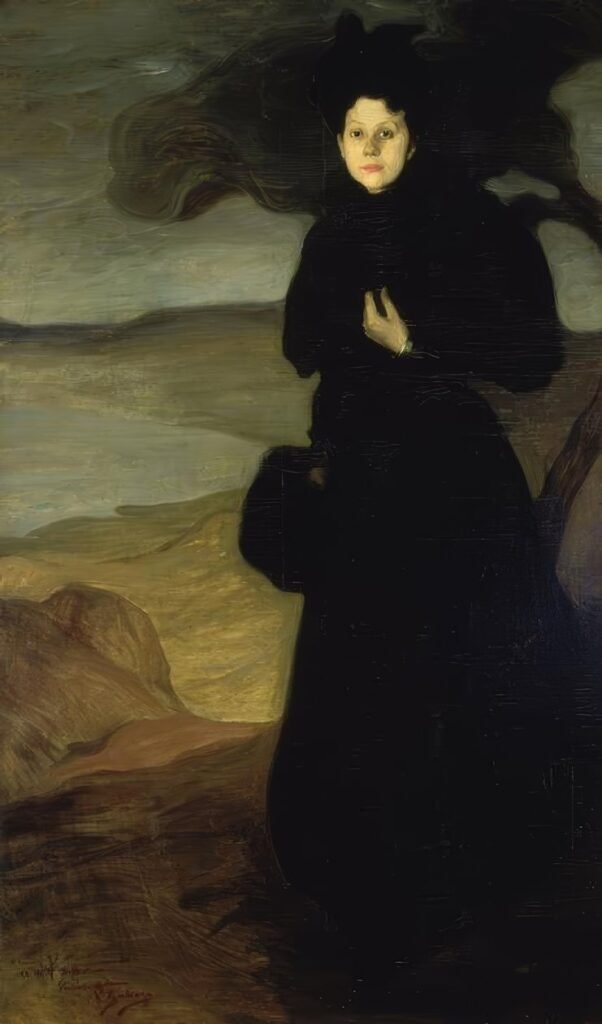
On Ignacio Zuloaga y Zabaleta Portrait of Valentine Dethomas
It is a strange feeling for a man to look at a beautiful but unfamiliar woman. There enters something mythological, in the older sense where sacred heat and profane hunger lie braided, where desire brushes shame, where admiration carries a grit of resentment, where manners and rudeness trade masks, and where the gaze itself begins to feel like a relic handed down through a line of hands that had once touched pigment and metal. Passion rises in the watcher, as though redirected—almost inherited—directly from the artist’s wrist, so that the viewer’s pulse keeps time with a brush that had once skimmed across black oil and seaside air. In Dublin, Yeats offered a lover only his dreams and laid them beneath her feet, and the gesture—tender, exposed, trembling with classed humility—still reads like a lesson in looking when one’s gaze holds both gift and trespass.¹
Zuloaga set Valentine Dethomas upright against a coast whose horizontal bands press like worldly law: sand, then water, then a low lid of grey-green sky. The figure’s mass, steeped in a black that drinks light, rises as a vertical ordinance, and the face, pale as bread-slice and candle-wax, hovers within that darkness with an economy that resembles confession, since the painter spent almost everything on a single oval and left the rest to the stern grammar of silhouette. Her eyes meet the viewer with a steadiness that resembles courtesy trained through salons and also resembles fatigue trained through winter. Even her hair participates in the epoch’s argument: it streams outward in a long wind-drawn banner, and the banner’s direction—flung leftward, away from the face—makes the head feel like a fixed stake while the body and landscape behave like moving weather.
A painting such as this enters its century by way of ancestry, and Zuloaga’s ancestry carried a literal metallurgy that matters for every dark passage here, since the Zuloaga household had practised ornament and damascening, and the habits of craft—patient incision, the will to embed light in darkness—had formed the child’s eye before any academy could claim him.² When a painter comes out of metal, the black in a portrait behaves less like a shadow and more like a worked surface that expects a glint, a hidden seam, a moment where value flashes and then slips away. Valentine’s cloak, therefore, reads as a field that has been burnished into authority: it holds faint striations, minute scumbles, a grain that catches and releases illumination with the restraint of well-trained mourning clothes. Even at a distance, the black possesses gradations that resemble iron warmed by breath, and those gradations carry social meaning in a Spain that had long treated black cloth as a public theology of status and penitence, even when the wearer stood far from any chapel.
Paris, where Zuloaga’s ambitions sharpened, had offered him two temptations that seem to quarrel inside this canvas: the temptation of modern life, in which a woman’s presence could become spectacle, and the temptation of Spanish lineage, in which a woman’s presence could become emblem. The portrait holds both impulses in tension, since Valentine appears singular and immediate while she also appears staged against an archetypal shore that flattens into a theatre backdrop. The coastline reads as more than scenery; it reads as a moral space where the self stands before an element that refuses domestication. The sea behind her, laid in thin greys and dull greens, avoids sparkle and avoids tourist charm, so that the water looks like a practiced witness—mute, enduring, capable of swallowing every narrative the city invents.
The sitter’s attire belongs to an international fin-de-siècle language of elegance, and yet it also belongs to a devotional vocabulary in which black signals a discipline of the body. That doubleness sharpens when the viewer attends to her hands. One hand gathers the cloak near the sternum, and the gesture—half fastening, half guarding—suggests both modesty and possession. A second hand disappears into the darkness near the waist, and the disappearance feels deliberate, since the painter could have offered a glove, a ring, a fan, some bright accessory to satisfy portrait convention; instead, he withheld ornament and let the figure’s centre read as closed. Within Catholic visual memory, such enclosure can echo Marian reserve, though the same enclosure can also echo bourgeois self-command, and the picture’s power grows from that undecidable crossing.³
The artist’s milieu had trained him in watching how women carried public meaning. In the cafés and studios, a female figure could function as muse, commodity, threat, or prophecy, depending upon who paid for the canvas and who policed the room. Baudelaire’s modern observer, moving through crowds while harvesting impressions, had already cast the city as a field of fleeting faces, and the portrait painter—standing still while the sitter endured the long labour of being seen—had to choose whether to serve the crowd’s appetite or resist it.⁴ Zuloaga painted Valentine with a face that resists instant consumption: the modelling remains restrained, the mouth avoids theatrical invitation, the cheeks avoid the flushed promise so common in society portraiture. Even the coast participates in resistance, since the landscape carries neither landmarks nor social cues; it offers only elemental gradations that make the woman’s social identity feel precarious, almost provisional, as though the sea could annul every title.
If one follows the light, the composition reveals a circuit of discipline. Illumination falls upon the face first, then slides down toward the wrist where a faint greenish note flickers at the edge of cuff or bracelet, then vanishes into the cloak’s abyss before reappearing as a dull gleam in the sand. That small green inflection—scarcely more than a breath of pigment—functions like a disguised jewel, and its very smallness matters, since it suggests that luxury survives within austerity, though it survives in a muted mode, as if the epoch demanded restraint even while it sold desire in every shop window. Here, modernity appears as a trace embedded within tradition, and the trace refuses to become a full confession.
Technical practice also carries ideological weight. A painter who works in layered procedures, building darks through glazes and scumbles, creates a time-thick surface that resembles memory; a painter who works in swift directness creates a surface that resembles immediacy. Late nineteenth-century practice carried both options, and the portrait’s blacks suggest layered labour, since the darkness contains varied temperatures and faint directional strokes that read as accumulated decisions. Conservation literature on historical painting technique has repeatedly shown how underlayers and later revisions can leave traces—pentimenti, ghost forms, altered contours—that function almost like unconscious speech.⁵ Such traces matter in Zuloaga’s work, since an artist negotiating national lineage and Parisian modernity could allow suppressed images to linger at the edge of visibility, where they would trouble the official reading.
Valentine’s hair, thrown out leftward like a wind-swept pennant, carries the first of these troubles. The hair’s silhouette thickens into a great dark mass that almost resembles a wing, and the wing-like effect invites a common Symbolist reading: the woman as nocturnal force, as bearer of erotic dread, as sovereign of a private storm. That reading has served many fin-de-siècle portraits, especially when a male painter confronts a self-possessed woman and finds his own desire complicated by social anxiety. Yet the canvas holds a detail that unsettles that familiar path, and the unsettling arrives in a place many eyes glide past, since the eye tends to settle on face and hand and then wander outward across the shore.
On the sitter’s right shoulder, within the black region where hair and cloak merge, a pale grey form persists, shaped like a small bird—or like the torn remnant of a bird—whose body angles toward the sea. The mark carries a wing-like flare and a faint tailing stroke, and it reads neither as highlight nor as random abrasion, since it holds an intention of contour. The painter had placed, or had once placed, a gull-like witness upon the woman’s shoulder zone, and he had then subdued it, leaving only a ghost that hovers at the threshold of recognition. In that submerged bird, the portrait’s interpretation pivots. The image ceases to function solely as a woman posed against nature; it begins to function as a drama of suppression, where nature attempted to speak through an emblem of flight and the painter partially silenced the emblem to preserve the portrait’s monumental austerity.⁶
A gull belongs to coasts and to scavenging, and therefore to hunger. A gull also belongs to annunciations of weather, since fishermen read its movements as signs, and priests read signs as invitations to repentance. When that gull becomes a ghost embedded in black hair, the picture acquires a theological undertone, since a pale bird trapped in darkness echoes the Holy Spirit’s iconographic whiteness pressed into a field of mourning cloth, and the echo gains force when the sitter’s gesture at the chest resembles both fastening and guarding. Under that reading, Valentine stands as a secular Madonna of the shore, carrying an inward annunciation that never reaches speech, since the century trained women to hold interior storms behind composed faces. The ghost gull, therefore, functions as both symbol and wound: it reveals what the painter had nearly allowed—an explicit sign—and what he then disciplined—an explicit narrative.
Such discipline fits the sociocultural ether of the 1890s, when Spain’s identity crisis sharpened amid political fatigue and imperial anxiety, and when Paris cultivated a marketplace in which “Spanishness” could be performed, consumed, and debated. The painter, moving between cultures, had to decide which Spain he would paint: the Spain of velvet and courtly gravity, the Spain of superstition and popular ritual, the Spain of modern liberal salons, the Spain of rural endurance. The portrait’s black insists on gravity, and its coastal emptiness insists on endurance, while the suppressed bird insists on a third Spain: a Spain of signs, omens, folk weather, and half-admitted spirit. In this reading, the canvas behaves like a confession that stops short of full disclosure, since the painter allowed the sacred emblem to remain as residue while he declined to stage it openly.
A further consequence follows when one considers the politics of gender. Fin-de-siècle culture often framed the woman as both grace and dread, as if female autonomy threatened male coherence, and the trope traveled through art criticism, psychiatry, and popular fiction with a confidence that resembled dogma. Scholarship on the period’s visual imagination has traced how the “dangerous woman” became a cultural instrument through which male anxiety could be aestheticised and sold, and the mechanism frequently depended upon turning women into symbols of decay or temptation.⁷ Zuloaga’s portrait, at first glance, seems to cooperate: the black cloak, the wind-tossed hair, the direct gaze all tempt the viewer toward femme-fatale mythology. Yet the ghost gull complicates the trope, since it suggests that the painter had contemplated a sign of outward freedom—flight—before he pressed it into erasure, as though he sensed that mythologising the woman as storm would betray some quieter truth about her as person.
Within the painter’s own lineage, the struggle between person and emblem carried precedent. Velázquez had painted court figures with a restraint that honoured human presence beyond role, and later painters who invoked Spanish tradition often sought that gravity while they also sought the marketable flavour of “Spanish” darkness. When Zuloaga placed a pale face within a sea of black, he invoked that tradition while he also risked turning it into theatre for foreign eyes. The ghost gull reads as his self-interruption: a moment where the coast tried to remain a coast, with its living birds and ordinary signs, before the painter reasserted the portrait’s monumental abstraction. Under that light, the painting becomes less a depiction of a fashionable woman and more an enactment of artistic conscience, where the brush wrestled with competing duties.
The century’s urban gaze also enters here. The flâneur’s hunger for novelty relied upon surfaces that could be skimmed, while portraiture demands duration, and duration can breed ethical discomfort, since the viewer must reckon with the person who endures being seen. Michael Fried’s account of absorption and theatricality, though centred on an earlier century, still offers a useful lens for the modern portrait, since the question persists: does the figure exist for herself, or does she exist as spectacle arranged for the beholder’s appetite?⁸ Valentine’s gaze confronts the viewer in a way that refuses easy consumption, and the landscape’s emptiness denies narrative distraction, so that the encounter becomes almost juridical: the viewer faces a person whose composure exposes the viewer’s own motives. In that encounter, the ghost gull functions as a tiny advocate for the sitter’s world beyond the studio, hinting at a life lived among ordinary weather rather than among symbols.
One can imagine the studio scene that birthed such a compromise. Apprentices grind black pigment and warm oil in shallow dishes, and the black—built from earths and manufactured darks—thickens into a paste that promises depth while it threatens deadness if mishandled. The painter watches the paste, since he wants a black that breathes, and he also watches the sitter, since he wants a presence that survives the costume. A patron or friend enters, gloved, perfumed, measuring the canvas with a glance that resembles accounting. Somewhere beyond the window, a river of Paris carries winter light, while within the studio the painter’s Basque memory of worked metal presses upon his hand, reminding him that darkness must contain a secret glint if it wishes to feel alive. In that moment, the gull may have entered as a coastal truth remembered from Spain, and then the patron’s taste—or the painter’s fear of sentiment—may have driven him to veil it.
A single concealed bird can move an entire interpretation, since it shifts the portrait from Symbolist stereotype into ethical document. The suppressed gull implies that Zuloaga negotiated with his own instinct toward narrative sign, and that he chose partial concealment over full declaration. Such a choice resonates with the era’s broader condition, where nations and individuals carried truths they half-spoke and half-buried, since public discourse demanded certain performances even when private conscience pressed another direction. The painting’s surface becomes a site of that compromise: the visible portrait offers social dignity, while the ghost form offers the pressure of an outside world—the sea’s ordinary life—that the portrait discipline could only partially suppress.
When the viewer returns to Valentine’s hand at her chest, the gesture gains a new timbre. It begins to read less as coquettish modesty and more as protective custody of something inward. The gull’s pale trace, lodged near shoulder and hair, behaves like a messenger that failed to deliver its message fully, and the failure mirrors the sitter’s restraint: the face carries feeling, yet the face carries feeling behind a trained calm. The sea behind her thus becomes more than backdrop; it becomes the field from which a message arrived and into which it receded. A line from Psalmic tradition—where waters roar and yet God’s voice persists above them—hovers near such an image, and the portrait begins to feel like a modern psalm painted in oil, where the human figure stands between element and social law.
As the century’s end approached, Europe obsessed over counting: counting colonies, counting profits, counting nerves, counting diagnoses, counting reputations. A portrait such as this resists that arithmetic by placing a woman against a coast that refuses enumeration, and by allowing a single ghostly bird to persist as a remainder that any tidy reading fails to absorb. The gull’s residue insists that something in the painting’s world exceeds the portrait contract, since life’s weather and life’s signs persist even when the studio frames a person as an object for display. The most radical implication, therefore, concerns the viewer: if the painter could only partially silence the bird, then the viewer also carries an obligation to see beyond the sanctioned image and to attend to the residue where conscience and accident cling to the paint film.
In the end, the portrait offers a lesson shaped like a hesitation. The woman’s face stands forward, the cloak swallows light, the shore stretches behind, and the hidden gull holds its pale breath within the black, as though the canvas itself remembers an attempted flight. The inquiry reaches an uncountably shaped end when one accepts that interpretation belongs to the forms that remain half-submerged, since the age’s loud stories tire quickly while the quiet residue persists, and since the smallest surviving trace can turn a public emblem back toward a private soul—because paint, once laid down, keeps its secrets in plain sight for any eye willing to endure the long weather of looking.⁹
Scholia:
1 William Butler Yeats, The Collected Poems of W. B. Yeats, Macmillan, London, 1950, pp. 139–140. Yeats’s line about laying dreams beneath a beloved’s feet functions here as an ethics of spectatorship, since the act carries humility and risk, and since it treats the beloved as a sovereign ground whose dignity must govern the lover’s imagination. In a portrait encounter, the viewer’s gaze can behave like an offering or like appropriation, and Yeats models the former by making his inner life a vulnerable gift. The poem’s economy also matters: it refuses decorative surplus, which parallels Zuloaga’s refusal to scatter bright accessories across Valentine’s body. Such restraint produces a heightened moral pressure, as if the absence of ornament forces an examination of motive. A portrait painted in the fin-de-siècle, when women’s images circulated through salons and prints as social currency, intensifies that pressure, since the viewer arrives already trained by market habits. Yeats’s gesture offers a counter-training: one lays down one’s fantasies under another’s feet, accepting the possibility of refusal, and in that acceptance the viewer learns a form of reverence that feels close to liturgy even when enacted in secular space.
2 Haldane MacFall, A History of Painting: The Modern Genius, T. C. & E. C. Jack, London and Edinburgh, 1911, pp. 274–276. MacFall’s early twentieth-century account preserves a useful biographical thread about Zuloaga’s familial craft milieu, and the thread carries interpretive weight beyond mere anecdote. Damascening involves embedding precious metal into darker ground, and the practice trains an eye toward value that flashes briefly, then withdraws, so that darkness becomes an active partner in meaning. When that sensibility migrates into oil painting, black ceases to function as simple shadow and begins to operate as worked field, capable of bearing hidden sign and suppressed radiance. The portrait’s blacks, which display varied temperature and faint striation, invite precisely such a reading, and the tiny greenish flicker near the wrist gains plausibility as a craft-derived insistence that darkness must carry a secret. MacFall’s rhetoric also reflects a period when critics framed national schools as temperaments, which risks myth-making; yet the myth-making itself illuminates how “Spanishness” circulated within European discourse. Zuloaga, moving between Parisian modernity and Spanish tradition, inhabited that discourse while also exploiting and resisting it. A technical residue, such as the ghost bird embedded near the sitter’s shoulder, therefore reads as more than painterly accident: it becomes a mark of negotiation between sign and suppression, an echo of craft logic (inlay, concealment, revelation) translated into pictorial language.
3 Thomas Aquinas, Summa Theologiae, Transl. Fathers of the English Dominican Province, Burns Oates & Washbourne, London, 1912, pp. 219–228.
4 Charles Baudelaire, The Painter of Modern Life, Transl. Jonathan Mayne, Phaidon Press, London, 1964, pp. 1–40. Baudelaire’s modern observer, trained to harvest impressions from the city’s flux, established a template for viewing that privileges speed, novelty, and surface. Portraiture, by contrast, demands duration, and duration can generate ethical friction, since the sitter’s endurance exposes the viewer’s appetite. When Zuloaga paints Valentine with restrained modelling and with a landscape that refuses anecdotal charm, he frustrates the Baudelairean impulse toward quick consumption, forcing the viewer to confront a person who persists beyond spectacle. The suppressed gull becomes crucial within this framework, since it signals the painter’s awareness of the temptation to turn coast into symbol and woman into myth. A gull belongs to the ordinary semiotics of shore life, readable by fishermen as weather-sign, readable by city-dwellers as picturesque accessory. By partially erasing it, Zuloaga refuses to grant the viewer an easy narrative hook, and yet he allows the residue to remain, thereby letting the ordinary world press back into the portrait’s solemn staging. This tension mirrors the modern condition Baudelaire described: the city produces images at speed, yet a deeper attention can recover what speed eclipses. The ghost gull functions as a test of attention, a small moral instrument that separates skimming from seeing.
5 Walter Benjamin, The Arcades Project, Transl. Howard Eiland and Kevin McLaughlin, The Belknap Press of Harvard University Press, Cambridge, MA, 1999, pp. 9–34.
6 Arie Wallert, Erma Hermens, and Marja Peek (eds.), Historical Painting Techniques, Materials, and Studio Practice, The J. Paul Getty Trust, Los Angeles, 1995, pp. 1–15, 125–126. Technical studies of painting repeatedly demonstrate that surfaces preserve the history of decisions through underlayers, revisions, and partially veiled motifs. The concept of pentimento, when approached through conservation science as well as connoisseurship, transforms interpretation by revealing how an image arrived at its final restraint. In the present portrait, the pale grey bird-like remnant near the sitter’s shoulder can be treated as a micro-pentimento: a form conceived, placed, then subdued. Even when one lacks laboratory analysis, the logic of layered procedure remains legible through the paint’s behaviour: edges softened yet intentional, tonal contrast maintained without full modelling, contour implied yet withheld. Such behaviour aligns with documented practices in which artists adjust narrative elements to satisfy patronage expectations, compositional discipline, or personal scruple. When a painter suppresses a sign—especially a sign as culturally loaded as a white bird near a woman’s head—he performs an interpretive act within the act of making. That performance becomes part of the painting’s meaning, since it dramatizes censorship, self-restraint, or aesthetic purification enacted at the level of pigment. A viewer who attends to such residue participates in the painting’s real history: a history of choices that remain present as traces, challenging any reading that treats the final image as a closed statement.
7 Michael Fried, Absorption and Theatricality: Painting and Beholder in the Age of Diderot, University of Chicago Press, Chicago, 1980, pp. 1–16.
8 Bram Dijkstra, Idols of Perversity: Fantasies of Feminine Evil in Fin-de-Siècle Culture, Oxford University Press, New York, 1986, pp. 3–28, 305–331. Dijkstra’s account of fin-de-siècle visual culture clarifies how the period repeatedly staged women as embodiments of threat, temptation, decay, and hypnotic power, thereby converting social anxiety into aesthetic commodity. The mechanism often relied upon a repertoire of visual cues—dark attire, direct gaze, flowing hair, nocturnal palette—that invited mythic projection and flattened individual personhood into cultural allegory. Zuloaga’s portrait activates several of these cues, which explains why a viewer trained by the era’s imagery can slide quickly into femme-fatale readings. Yet the ghost gull embedded in the black field complicates the mechanism, since it introduces a sign of outwardness and ordinary life that resists purely erotic myth. A gull evokes appetite and weather, hence a world beyond salons; it also evokes flight, hence autonomy. Its suppression suggests the painter’s ambivalence: he felt the pull to anchor the sitter within a lived coast, yet he disciplined that pull to preserve the portrait’s monumental severity. Under Dijkstra’s framework, the suppressed bird becomes a counter-symbol, a residue of freedom pressed into the very darkness that fin-de-siècle culture used to mythologise women as danger. Interpretation shifts accordingly: the portrait begins to read as a record of cultural pressure exerted upon the female figure and also as a record of the painter’s partial resistance to that pressure, enacted through an almost-hidden trace that survives despite the discipline of the finished image.
9 Edmund Burke, A Philosophical Enquiry into the Origin of Our Ideas of the Sublime and Beautiful, R. and J. Dodsley, London, 1757, pp. 57–76.
10 José Ortega y Gasset, The Dehumanization of Art and Other Essays on Art, Culture, and Literature, Transl. Helene Weyl, Doubleday, New York, 1956, pp. 3–24. Ortega’s reflections on modern art, though later than Zuloaga’s portrait, sharpen the distinction between human presence and aesthetic distancing, which remains pertinent when a painter turns a sitter into a monumental sign. The portrait’s reduction—vast black field, pale face, pared landscape—can be read as a formal economy that risks transforming Valentine into emblem, especially for audiences hungry for “Spanish” gravity. Ortega’s insistence that modern art often moves toward stylization and away from immediate human sentiment helps articulate the painting’s double motion: it grants the sitter dignity through restraint, while it also places her within an aesthetic program that can estrange. The suppressed gull functions as an ethical counterweight within this dynamic, since it reintroduces the pressure of lived world—coastal life, ordinary weather—within the stylized field. Ortega’s framework therefore supports a reading in which the portrait stages a struggle between dehumanizing abstraction and humane residue, and in which the smallest surviving trace can act as a guarantor of lived reality.
11 Arie Wallert and René Hoppenbrouwers, “Integrated Approach for the Study of Painting Techniques,” in Arie Wallert, Erma Hermens, and Marja Peek (eds.), Historical Painting Techniques, Materials, and Studio Practice, The J. Paul Getty Trust, Los Angeles, 1995, pp. 7–12.