
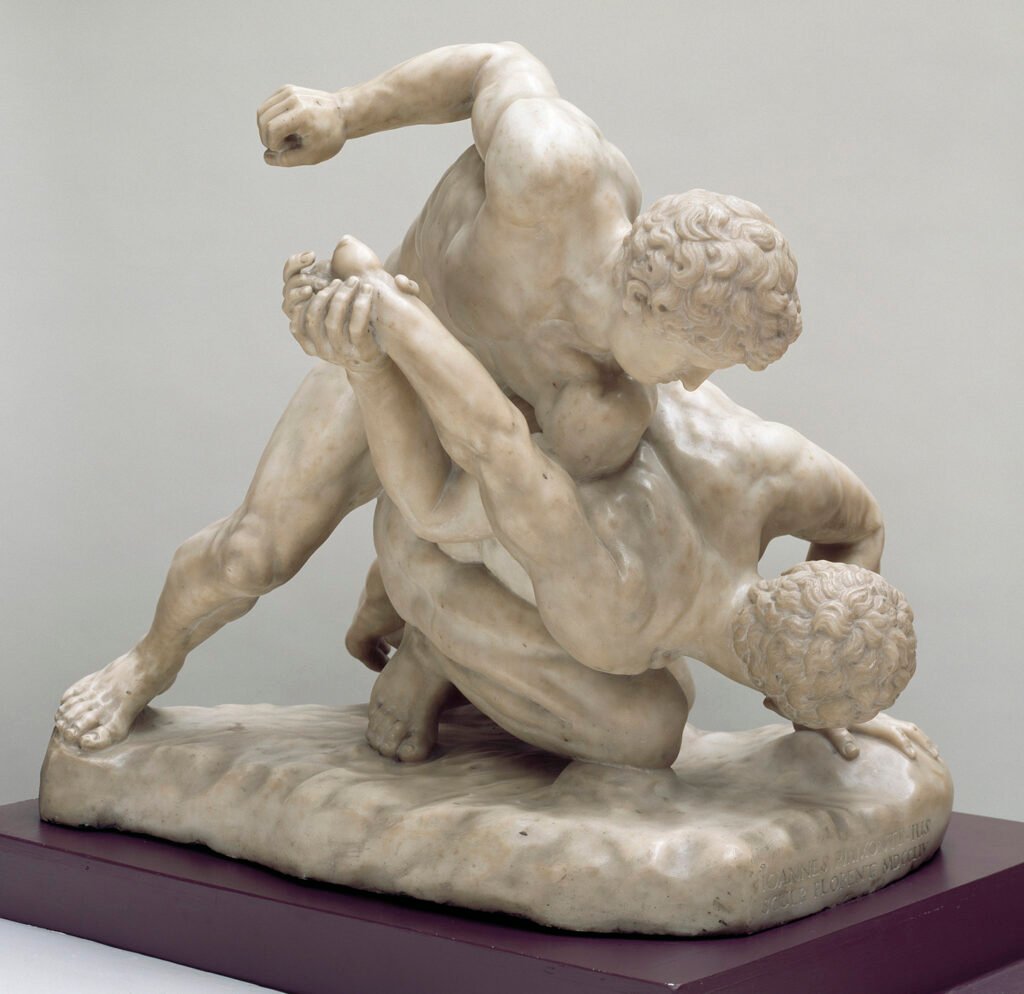
A thin crescent of marble, scarcely broader than a fingernail, rings the wrist of the upper grappler where his left hand clamps the other man’s forearm, and as the gallery light slides across that tightening circle it behaves like a quiet confession, since it reads as a join: a hand made apart, then persuaded into unity, then polished into plausibility, then left with a faint discontinuity that the moving body of the viewer may catch only when the neck bends and the stance shifts, as though the sculpture demanded a small bodily bow before it would yield its secret.¹ The seam lodges precisely at the point where force concentrates, where tendon becomes intention, where victory would travel from shoulder to fist, and so the object’s most violent moment—this exquisite torsion of flesh translated into stone—depends upon an act of assembly that interrupts the fantasy of instantaneous mastery. I speak from within the work’s spatial field, with its two nude athletes pressed into one sculptural knot, with the base spreading like a low patch of earth beneath their skidding feet, with the skin of the marble holding a pale haze of age and handling; and as I stand close enough for breath to fog the polished planes, guilt enters as a companion, since any learned gaze that praises antique form also participates in the commerce that uprooted antiquity, copied it, sold it, shipped it, and then installed it as proof of taste within another land’s hall.
Florence in 1754 carried a different weather from the Florence of Cosimo III, though the stones of the city remembered the Medici as a tongue remembers a prayer. In a studio near the Santissima Annunziata, where carts rattled over paving and where river damp crept under shutters, Piamontini’s apprentices would have slaked lime for plaster, warmed wax for taking impressions, and sharpened chisels until the metal sang, while a patron’s agent, gloved and impatient, watched measurements as if counting future praise. The master’s own hand, trained into the rhetoric of musculature, needed tools and bodies around it, since marble of such scale—about the height of a strong child, yet dense as a quarried hill—required a workforce that could turn, lift, and brace the block so that undercuts might open without collapse.¹ A bishop might pause in such a place, though a banker’s man more often entered, and the studio air would have mixed devotion with sweat, for the same hands that shaped saints for chapels also shaped pagans for collectors, and the century’s Catholic seriousness—ever alert to decorum—learned to tolerate antique nudity when it served erudition.
Piamontini’s lineage, grounded in Florence’s late-Baroque sculpture, ran through his father Giuseppe, whose reputation rested upon refined modelling and a Medicean taste for learned allusion, and the son’s formation occurred within the paternal bottega before academy structures conferred public standing.² The household’s craft education began with clay, since clay obeys hesitation, and a young sculptor who pressed a thumb into wet earth could rehearse anatomy without the irrevocability of stone; yet the son’s later work, especially in the copying of celebrated marbles, demanded a different discipline, since fidelity to an admired original required measurement as much as inspiration. The father had already inhabited a world where small bronzes, terracottas, and courtly commissions circulated among collectors who prized finish and graceful invention; the son inherited that world even as it began to tilt toward an Enlightenment appetite for antiquity understood as archaeology, connoisseurship, and moral exemplar.² A Florentine proverb speaks of the apple rolling close to the tree, and here the apple rolled into a different century’s dust, where the tree’s shadow still cooled the ground.
Academy life furnished a further scaffolding for such a career, since the Accademia del Disegno offered social certification, access to patrons, and a forum in which antique models could be studied under institutional blessing.³ Piamontini’s matriculation, his later offices, and his entanglement with large civic commissions place him within Florence’s bureaucratic artistry, where sculpture lived beside finance, ceremony, and statecraft.³ After the Medici line ended and Lorraine governance reshaped the city’s administrative nerves, artists navigated a regime that valued public display—triumphal arches, dynastic imagery, the choreography of power—while also managing a cosmopolitan influx of travellers whose wallets and notebooks turned Florence into a classroom for Northern Europe. That dual audience, local and foreign, required a sculptor who could speak both dialects: the devotional language of Tuscan piety and the antiquarian language of the Grand Tour.
Joseph Leeson, first Earl of Milltown, belonged to that travelling aristocracy whose wealth, built within Ireland’s complex political economy, sought cultural legitimacy through Italian art, and the commission for Piamontini’s marble copies—signed and dated 1754—formed part of a larger strategy of self-fashioning.⁴ When such patrons acquired antique-derived groups, they purchased more than objects: they purchased an aura of Rome and Athens, translated through Florentine hands into a portable credential. In the act of commissioning a copy, Leeson also commissioned a certain story about himself, since a hall adorned with wrestlers and listening slaves could suggest philosophical sobriety, classical virtue, and the cultivated leisure of a man who could afford to travel while others laboured.⁴ As an Irishman moving through Tuscany, he participated in an imperial web that linked property at home with prestige abroad, and I, standing here in a museum that received Milltown gifts, feel the moral grit of that web under the tongue.
The antique model that haunted Piamontini’s work lived in the Uffizi, where celebrated marbles drew crowds whose footsteps polished floors and whose attention polished reputations.⁵ Connoisseurs argued over titles and restorations, though the argument’s heat mattered less than the shared conviction that antique bodies carried a kind of truth: a balance between violence and order, between athletic frenzy and formal clarity. In such galleries, the ancient wrestler group—understood through prints, casts, and the living experience of circling it—functioned as an education in seeing, since the eye had to follow spirals of limb and torque, and the mind had to reconcile the sculpture’s instability with its compositional coherence.⁵ Piamontini, working within that culture of looking, built a Florentine response to a Hellenistic challenge, and he did so while the eighteenth century, reading Winckelmann’s emerging ideals and Diderot’s didactic ambitions, edged toward a belief that classical form could discipline modern taste.
Workshop method, in such a context, combined bodily intuition with mechanical mediation, since copying at high fidelity often relied upon casts, point measurements, and systems of transfer that allowed a sculptor to preserve proportions while adapting scale.⁶ Plaster casts taken from the antique—sometimes themselves derived from earlier casts—could be set upright in the studio, where calipers and pointing devices mapped surfaces into a grid of depths, and where the marble block, squared and rough, slowly received those depths through successive campaigns of chiselling. Tool sequences mattered: the point chisel to break mass, the tooth chisel to establish planes, the rasp and abrasive to soften transitions, and each stage left traces that an attentive viewer may still detect where the finish thins and the stone retains a faint granular drag.⁶ Fabrication also demanded prudence, since deep undercuts around intertwined limbs risked fracture; and it is here, in the dangerous intimacy of arm crossing arm, that the seam at the wrist begins to look less like an accident than a decision.
The group’s massing, when approached from the front-left, gathers into a diagonal that runs from the upper man’s lifted fist down through his arched back into the lower man’s braced shoulder, and then flows into the extended leg that presses the base like a lever against earth. The figures interlock as a single organism, though each torso retains a distinct rhythm: one convex, swelling and predatory, the other compressed, resisting and twisting. The void between their bodies behaves as an active agent, since pockets of air under arms and between thighs catch shadow and create depth that the museum’s light animates as one walks. The base, carved as a low terrain with uneven edges, stabilizes the drama by offering an implied ground, yet its roughness also carries the memory of the block’s original state, as if the stone wished to remind us of quarry and labour while the bodies above insist on ideal flesh. Across the surface, polished planes on shoulders and backs invite touch, whereas tucked recesses under elbows hold a matte texture that suggests a tool’s reach ended where risk began; and along the hair, drilled curls catch light like a net, tightening the head’s volume against the softer modelling of neck and cheek.
The most easily missed feature appears where the upper man’s left hand grips: a shallow encircling ridge at the wrist, with a slight change in polish and a hairline discontinuity that becomes visible only when the viewer’s eye aligns with it along the forearm’s length. It looks like a join, since the circle reads as the boundary between two carved elements, and its location corresponds to the zone where a sculptor, fearing breakage during carving or transport, might choose to carve the hand separately and attach it with a dowel, then disguise the union with careful finishing.¹¹ The seam’s presence shifts the narrative of force, since the grip—ostensibly the sculpture’s guarantee of embodied continuity—emerges as the sculpture’s most constructed moment, and the violence that appears immediate becomes, in its material truth, mediated through a workshop’s logic of parts. The join also bears an allegorical weight, since it enacts a small fracture within the sculpture’s promise of classical wholeness, and it situates that fracture exactly where one man seeks dominion over another, as though Piamontini’s marble insisted that control always travels through compromise. I feel the irony sting, since academies taught students to admire antique unity, yet the modern copy’s unity required an artisan’s discreet surgery.
When the seam enters awareness, the interpretation of the group turns, since the wrestlers cease to serve solely as a celebration of antique athleticism and begin to speak of eighteenth-century labour, risk management, and the ethics of replication. Piamontini’s contemporaries praised a copyist who became “a slave to the originals,” and that phrase, preserved in correspondence around Florentine agents, carries a moral chill along with its compliment, because it frames fidelity as bondage.⁸ The wrist seam literalizes that bondage: the hand, as instrument of mastery, arrives as a separate piece compelled into service, and its compelled unity mirrors the copyist’s compelled obedience to an ancient model. A theology of the hand haunts Western sculpture—God’s hand creating Adam, saints’ hands blessing, tyrants’ hands grasping—yet here the hand’s very attachment dramatizes dependence, and the antique’s authority becomes a kind of invisible patron, pressing upon the modern sculptor’s choices as firmly as any count’s purse.
The wider sociocultural ether deepens the sting. Irish and British travellers who bought such works participated in a circuit where artistic labour in Florence met capital extracted from estates shaped by colonial governance, and the marble group, installed in a great house, performed taste as power.⁸ I speak as a man of letters who has benefited from such circuits, since universities, museums, and catalogues have thrived upon collections built through unequal histories, and my own sentences, scented with incense and mud, still draw salary from institutions that guard these objects. A rural Irish gatekeeper would call it simple: a strong man takes what he can, then calls it inheritance. Yet within the sculpture’s knot of limbs, the wrist seam suggests a counter-moral, since it shows that strength, even in stone, requires joining, dependence, and hidden aid.
Later life altered the object’s skin and setting. In an Irish house such as Russborough, where marble stood against darker architectural materials and where fireplaces breathed soot, the sculpture would have accumulated grime within undercuts and a warmer tonal veil on exposed planes, and cleaning campaigns—whether careful conservation or domestic scrubbing—would have shifted its sheen.¹⁰ Relocation into a museum introduced controlled light and interpretive labels, and it invited viewers who carried fewer genealogical ties to Milltown yet carried modern questions about bodies, violence, and display. The base’s edges show small abrasions that suggest handling, and a darkened spot on a knuckle may record either stone’s natural veining or an old repair that absorbed dirt differently. The wrist seam, surviving these journeys, functions as a witness, since it outlived the studio’s dust and the patron’s pride, and it now addresses a public gaze that values process as much as finish.
A metaphysical question rises as I circle: what kind of truth lives in a copy, when the copy bears within its body the trace of its own making? The antique wrestlers, whether Greek bronze or Roman marble, belonged to a world where athletic violence carried civic meaning, where contest staged virtue, and where gods hovered as patrons of strength. Piamontini’s Florence, though Catholic and courtly, still understood contest, since the city’s factions, its guild rivalries, and its court politics trained citizens to read struggle as a public language. Women and nature, allied forces of grace and dread, appear indirectly here: the marble itself, quarried from mountain wombs, carries the patience of geological time, while the absence of female bodies in the scene intensifies the masculine theatre, as though eros had been pressed into combat and tenderness had been rerouted into force. Yet the wrist seam reintroduces tenderness through its very fragility, since a joined hand depends on delicate alignment, on careful adhesion, on the sculptor’s unwillingness to gamble everything on a single vulnerable bridge of stone.
Eighteenth-century discourse around sculpture, shaped by encyclopedic pedagogy and by emerging art history, treated technique as a moral matter, since finish signalled virtue and clarity signalled reason.⁹ In that climate, a join line could be read as blemish, yet it also could be read as candour, as an admission that bodies, whether marble or social, hold themselves together through seams. Restoration culture of the century offers a parallel: antiquities restored with inserted limbs, dowels, and matching stone carried seams that announced both care and intervention, and those seams shaped how viewers understood authenticity.¹¹ Piamontini, copying an antique already surrounded by debates about restoration, produced a work whose own joining practice echoed the era’s broader habit of making wholeness through addition, and the viewer who perceives the wrist seam perceives that echo as a structural metaphor.
As the century advanced, Winckelmann’s language of noble simplicity and quiet grandeur began to discipline European eyes, and even when such ideals arrived a decade after Piamontini’s date they clarified what had already been forming: a hunger for antiquity as moral measure.¹² Yet the wrestlers, with their compressed torsos and their near-violent intimacy, resist any easy serenity, and the wrist seam intensifies that resistance, since it reveals that grandeur itself can depend upon joined parts, upon hidden armatures of craft. When I kneel slightly to see the seam and then rise again, my own body performs the work’s demand: truth arrives through movement, and interpretation arrives through the humility of changing angle. A peasant watching weather knows that clouds teach their shape by shifting; sculpture, too, teaches by requiring the watcher to wander.
Uncountably Shaped End arrives as the seam’s circle lingers in the mind like a rosary bead worn smooth: a small ring of stone around a wrist, holding together a hand that grips, holding together a copy that claims antiquity, holding together a history that calls itself taste while it carries the weight of money, travel, extraction, and longing, so that looking becomes an act of conscience as well as sight.
Scholia:
1 Adrian Le Harivel, National Gallery of Ireland: Illustrated Summary Catalogue of Prints and Sculpture, National Gallery of Ireland, Dublin, 1988, pp. 588–589.
2 Dimitrios Zikos, PIAMONTINI, Giovanni Battista, in Dizionario Biografico degli Italiani, Istituto della Enciclopedia Italiana fondata da Giovanni Treccani, Rome, 2015, pp. 1–7. Zikos’ entry, although housed within a national biographical enterprise, carries the texture of archive work, since it moves from parish records through academy registers and into the financial paperwork of commissions, allowing a reconstruction of Piamontini’s social embeddedness that suits a sculptor whose surviving oeuvre often travels under the sign of “copy” or “after the antique.” The notice that Giuseppe Piamontini, in his autobiographical statement for the revised Abecedario pittorico tradition, presented the young Giovanni Battista as advancing under paternal direction matters for reading workshop inheritance, since it frames formation as both familial pedagogy and public credential. Equally important, the entry’s attention to wax models supplied to Carlo Ginori, and its documentary anchoring in the Archivio Ginori Lisci, clarifies how a Florentine sculptor’s “material intelligence” could span marble, terracotta, wax, and bronze, with each medium teaching a distinct lesson about risk, finish, and reproducibility. This matters for The Wrestlers, since a sculptor accustomed to producing waxes for porcelain translation would have understood the logic of modular parts and transferable forms, even when working in marble. The entry also illuminates a micro-politics of space: studios, academy rooms, church cloisters, and civic projects overlap, so that sculptural practice unfolds as a civic profession shaped by patrons ranging from the last Medici electress to foreign travellers. Such a milieu helps explain why a wrist join could serve as both a structural precaution and a quiet signature of workshop pragmatism.
3 G. Pratesi, ed., Gli accademici del disegno: Storia e documenti (XVI–XVIII secolo), Olschki, Florence, 2000, pp. 213–220.
4 Sergio Benedetti, ed., The Milltowns: Art Collectors in Georgian Ireland, National Gallery of Ireland, Dublin, 1997, pp. 98–105.
5 Francis Haskell and Nicholas Penny, Taste and the Antique: The Lure of Classical Sculpture, 1500–1900, Yale University Press, New Haven and London, 1981, pp. 266–268. Haskell and Penny treat the antique as an agent within European desire, since their narrative insists that classical sculpture never functioned as a stable inheritance but operated as a moving target shaped by display practices, restoration habits, travel itineraries, and the mutable prestige of collections. Their discussion of how specific antiques became “famous,” and how fame generated a cascade of casts, prints, and copies, offers a crucial frame for Piamontini’s labour, since The Wrestlers belongs to a lineage of reiterated forms whose authority arose through circulation. The emphasis on the Grand Tour as an educational rite clarifies why a marble group of nude athletes could enter an Irish aristocratic interior as a badge of learning, even when the subject’s physical intimacy brushed against Christian decorum. Their attention to restoration culture further supports an interpretive link between eighteenth-century practices of joining ancient fragments and modern practices of constructing faithful copies: both operations manufacture wholeness under the sign of antiquity. When the historian meets the seam around Piamontini’s wrist, that seam may be read as a local symptom of a broader European habit described by Haskell and Penny: authenticity performed through carefully managed interventions, with the intervention’s visibility shifting according to light, angle, and the viewer’s willingness to look closely.
6 Denis Diderot and Jean le Rond d’Alembert, eds., Encyclopédie, ou dictionnaire raisonné des sciences, des arts et des métiers, Briasson, David, Le Breton, Durand, Paris, 1751–1772, pp. 1–12.
7 Roberta Roani Villani, “Copie dall’Antico: F. Harwood e G. B. Piamontini,” Antologia di Belle Arti, vol. 43–47, issue 1, 1993, pp. 108–115.
8 Cynthia O’Connor, “Dr James Tyrrell, Agent at Florence,” Studies: An Irish Quarterly Review, vol. 69, issue 274, 1980, pp. 137–144. O’Connor’s essay, built from correspondence and the practical realities of agency, gives a human timbre to the transaction history that often clings to sculpture like dust on undercuts. The Florentine agent emerges as a broker of taste, translator of local workshop reputations into terms that Irish patrons could trust, and manager of the slow time of carving, packing, and shipping. The celebrated phrase describing Piamontini as “remarkable for being a slave to the originals” matters beyond anecdote, since it crystallizes an eighteenth-century value system in which submission to an antique prototype could constitute excellence, even while the language of slavery carried social implications that modern readers can scarcely hear without moral friction. O’Connor’s discussion also helps reconstruct the “viewing-angle dependency” that governs such sculpture: patrons who could not stand before the work during production relied upon drawings, descriptions, and the agent’s authority, which means that trust functioned as an invisible structural member of the object’s biography. When the sculpture later entered Irish houses and, later again, a national museum, the same networks of trust—curatorial, scholarly, institutional—continued to frame the object’s meaning. A wrist seam that exposes material dependence therefore resonates with the object’s documentary dependence, since both reveal that apparent autonomy, whether of an athlete’s grip or a collector’s taste, rests upon joined systems.
9 Nicholas Penny, The Materials of Sculpture, Yale University Press, New Haven and London, 1993, pp. 120–131.
10 Aidan O’Boyle, “The Milltown Collection,” Irish Georgian Society Journal, Irish Georgian Society, Dublin, 2009, pp. 38–40.
11 Amanda Claridge, “Ancient Techniques of Making Joins in Marble Statuary,” in J. J. Pollitt, ed., Art Historical and Scientific Perspectives on Ancient Sculpture, Yale University Press, New Haven and London, 1994, pp. 135–151. Claridge’s study of ancient joining practices supplies a technical vocabulary that helps interpret later sculptors’ choices without reducing them to mere “repairs.” Ancient sculptors and restorers used dowels, clamps, and carefully shaped join surfaces so that seams could follow anatomically persuasive paths, which means that a join often served as a compositional tool as well as a structural necessity. That insight matters for Piamontini, since a Florentine copyist trained amid antiquities and their restorations would have absorbed an inherited pragmatics: the hand, carved separately, could be attached at a wrist where musculature and bracelet-like shadow allow a boundary to hide in plain sight. Claridge also underlines the role of surface finishing in seam concealment, since abrasives and polishing can blur boundaries while leaving a subtle tonal shift that raking light later reveals. When such a seam appears in a modern copy, it can be read as a deliberate accommodation between fidelity and survivability, especially in a composition dense with undercuts and vulnerable projections. In interpretive terms, the join invites a reconsideration of “authenticity” as a spectrum of material decisions: a copy that admits its assembly may carry an honesty about process that parallels the ancient world’s own acceptance of joined construction. The seam around the wrist, positioned at the locus of domination, therefore becomes more than a technical footnote; it becomes a material sign that power—whether bodily, artistic, or social—operates through attachments, alignments, and concealed supports that reveal themselves only to a gaze willing to move, stoop, and submit to the sculpture’s demands.
12 Johann Joachim Winckelmann, History of the Art of Antiquity, transl. Harry Francis Mallgrave, Getty Research Institute, Los Angeles, 2006, pp. 31–45.