
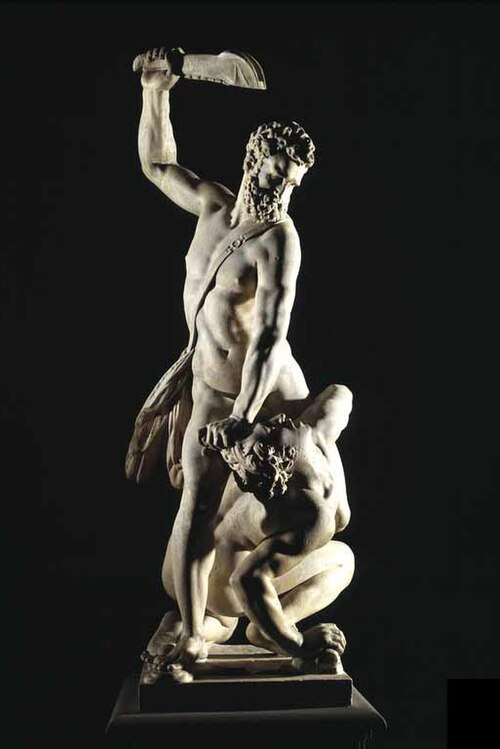
A faint loop, scarcely higher than a thumbnail, curls beside Samson’s forward toes where the marble base meets the air, and while the eye rises toward the lifted jawbone and the clenched forearm that claims the light, that loop keeps its own small weather, polished by handling and edged by a shallow shadow that gathers like soot at vespers.¹ The figure’s foot presses near it with an authority that reads as biblical certainty, yet the loop behaves as a counterweight in miniature, since it invites the viewer’s body into a cautious sidestep, so that the gaze, in yielding to the sculptor’s choreography, circles and returns, as though the act of looking must practice obedience before it earns a vantage. Giambologna’s Samson Slaying a Philistine—carved around 1562, when Florence had learned to stage power as spectacle while cloaking it in antique grammar—has long been received as a virtuoso knot of torsions in which Maniera finds moral theatre, and though such readings honour the drama, the marble insists upon a more domestic coercion, the kind a court rehearses each day when it teaches bodies where to stand.² That toe-side loop, almost always passed over as incidental debris or a chip’s remnant, binds the entire group to a concealed economy of fastening, and by extension binds the biblical hero to a politics of tethering that the Medici cultivated with exquisite patience.
The block offers a vertical that rises like a mast in river fog, and along that mast the sculptor stacked opposing loads, so that Samson’s raised right arm, whose triceps swells under a raking beam, appears to pull the whole mass toward a perilous cantilever, even as the crouched Philistine compresses the lower field into a compact ballast of flesh. The silhouette, viewed from the front, reads as a spearhead planted into a soft mound: a narrow, tense line through the standing leg and torso that widens into the drapery’s fold and then tightens again at the wrist, where the jawbone arcs as a brutal crescent. Yet the object refuses a single frontal verdict, since the torsion of Samson’s neck turns the beard into a rotating hinge, and since the victim’s lifted chin flashes a vulnerable plane that catches light only when the viewer slips toward Samson’s left. In that drift the marble’s surface becomes an event of tools: one finds a softened rasping across the abdomen’s hollow, a finer abrasion where the pectoral turns into the shoulder, and a sharper, less reconciled chisel texture in recesses where a claw could bite and retreat, leaving a disciplined roughness that the eye interprets as living shadow.³ Such events disclose workshop time, since assistants could advance the general planes with broad tooth-chisels while the master returned to animate the transitions where skin seems to breathe over bone, and since Giambologna, who had absorbed Netherlandish habits of finish before he drank deeply of Roman marbles, knew how polish functions as rhetoric: it grants sanctity to violence by offering the wound as beauty.
Training, lineage, and exile press behind this marble as insistently as the Philistine’s shoulder presses into Samson’s thigh. Jean de Boulogne arrived in Italy bearing the habits of Douai and Antwerp, where the discipline of small-scale modelling, the mercantile intelligence of objects, and the guild’s ordered labour had shaped the young sculptor’s hands, and when he reached Rome he encountered Michelangelo’s aftermath as one encounters a storm’s fallen trees: trunks still warm with sap, branches broken into new vistas.⁴ The Florentine court, which needed bodies in stone that could perform allegiance while flattering the city’s antique inheritance, recognised in the foreigner an aptitude for forms that twist without collapsing, and Cosimo’s cultural machinery, lubricated by academies and inventories, placed him where rivalry served policy. Cellini’s pride, Ammannati’s architectural authority, Bandinelli’s grand claims, and the restless appetite of collectors created an atmosphere in which a single marble group could operate as argument, gift, warning, and sermon at once, so that Samson’s violence, though biblical in name, played as an allegory of controlled force suited to ducal self-fashioning.⁵ Giambologna’s workshop methods—clay studies, wax adjustments, careful pointing, and the incremental transfer of decisions from model to block—formed the hidden liturgy behind the finished sheen, and the very complexity of the intertwined bodies suggests a long rehearsal of rotations, since a figure that persuades from multiple angles demands a mind trained to think in spirals.
The marble itself speaks in two registers, one of anatomy and one of quarry. Samson’s torso carries a warm, pale field broken by veining that drifts like smoke under candlelight, and in the victim’s back a subtler mottling gathers in a way that reads as bruising, though the stone’s chemistry produced it without malice. Surface intelligence emerges where Giambologna allowed stains to remain within the narrative, as though the material’s own history—pressure, sediment, fracture—could stand as a parallel to human fate, while the sculptor’s labour guided those accidents into coherence. In the undercut between Samson’s left arm and the Philistine’s hair, a darkness opens that functions as structural relief, since it removes weight while intensifying drama, and in the fold of drapery that falls at Samson’s side, deep channels show where a drill entered to free shadow, after which chisels returned to soften the edges so the void feels intentional.⁶ The jawbone, treated with an almost object-like autonomy, bears parallel tool passages along its upper ridge, and its teeth, carved as a repeating run, create a measured rhythm that contrasts with the unpredictable curls of Samson’s beard. The marble, therefore, alternates between the organic and the fabricated, as though the hero’s hand has seized a found relic while his own body belongs to an ideal grammar taught in academies.
Yet the sculpture’s deepest argument arises where the viewer’s foot, moving around the base, discovers the toe-side loop and begins to understand its spatial jurisdiction. The loop sits at the base’s forward left, adjacent to Samson’s toes, and it reads as a ring, slightly open, whose inner curve carries a smoother polish than the surrounding ground plane, as though fingers had traced it or as though a cord had once slid through it. The loop’s location feels perverse: it rests where dust gathers, where cleaning cloths snag, where a casual glance sees only an odd curl. Its presence, however, compels interpretation, since it interrupts the base’s rhetoric of natural ground and declares the pedestal as engineered site. When the viewer kneels to inspect it, the entire composition reorients: Samson’s raised jawbone aligns with the loop in a diagonal that runs from the weapon’s blunt arc down through the shoulder strap and along the standing leg into that small ring, so that violence appears as a chain of linked forces, and the hero’s triumph begins to resemble a mechanically managed discharge of energy.⁷ A court trained in the physics of restraint would have prized such an implication, since the Medici state, emerging from republican fracture into ducal consolidation, relied upon visible ceremonies that covered invisible bindings.
The strap crossing Samson’s chest—rendered as leather with a carved fastening that resembles a ring and toggle—already hints at containment, since it presents the hero as equipped, harnessed, and ready for service. That strap, carved with a decisive edge, cuts the torso’s softness and suggests that Samson’s power belongs within an apparatus, as though strength, once loosed, requires governance. Paleotti’s later insistence upon decorum in sacred images, though addressed to ecclesiastical anxieties, resonates here as a courtly instinct: the image must teach, and it must regulate the viewer’s emotions by offering a legible moral pathway through the spectacle.⁸ Giambologna, working amid Counter-Reformation vigilance and ducal pageantry, produced a biblical scene that could satisfy pious rhetoric while serving secular persuasion, since Samson could stand for divinely sanctioned force deployed against enemies, whether heretics abroad or dissenters within. The loop at the toes complicates the sanctified heroism, since it implies that even Samson, emblem of God-granted strength, remains tethered to the base’s regime.
Workshop practice clarifies how such a loop might have entered the marble’s final state. Giambologna’s assistants, trained to rough out blocks and establish the principal masses, would have relied on pointing systems that required stable reference points, and a marble group of intertwined bodies, whose overhangs risk fracture during carving and transport, demanded temporary supports. A loop, carved or cut into the base, could have served as anchorage for a cord that stabilised the block during handling, or as a site for a clamp that held protective wooden bracing while the group travelled between studio and patron. Since the loop remains in the finished object, one senses a deliberate choice to preserve a trace of that temporary engineering, a choice that converts workshop necessity into symbolic statement.⁹ The loop becomes a confession of process, and since Giambologna’s art often celebrates artifice—since it invites the educated viewer to admire how difficulty transforms into grace—the retained fastening reads as a wink of intelligence aimed at connoisseurs who knew the labour behind the polish.
Such a trace also aligns with Giambologna’s broader practice across materials. His bronzes, which involved armatures, joins, and chased seams, taught him that finished surfaces can carry hidden evidence of assembly while still persuading as unified bodies, and his marbles, though carved from stone, often behave as though they had learned from casting, since they flaunt risky extensions and exploit deep undercuts that mimic metal’s freedoms. In Florence, where the ducal collections gathered antiquities, bronzes, cameos, and scientific instruments, and where the Studiolo of Francesco I framed objects as wonders of nature and art, the boundary between organic relic and engineered device thinned into a shared curiosity.¹⁰ Samson’s jawbone, treated as both weapon and specimen, fits this milieu, and the toe-side loop, treated as both accident and sign, fits it too, since it collapses moral narrative into material procedure. The hero becomes a demonstration piece: power appears as something designed, staged, and secured.
The sociocultural ether of the early 1560s—filled with diplomatic pressures, religious reforms, and the aftershocks of warfare—inflected how violence could appear in a palace or garden. A marble group, set within an architectural frame that regulated approach and viewing height, would have addressed a moving spectator whose body enacted hierarchy through posture, distance, and permission. In such settings the base matters as much as the figures, since the base mediates between art and world, and since the base carries the politics of placement. If the sculpture stood where courtiers processed, the toe-side loop could catch torchlight as a small glint of shadow and highlight, a detail that rewards proximity and thus rewards privilege, since only the invited could approach near enough to notice it.¹¹ The object, then, participates in a pedagogy of attention, offering grand drama for the many and minute confession for the few, so that the court’s social structure becomes legible through optics.
In sculptural terms, the loop also recalibrates the composition’s balance. The group’s stability depends upon a triangulation: Samson’s standing leg anchors the vertical, the victim’s crouch anchors the lateral mass, and the drapery’s fall provides a visual buttress that softens the transition to the base. The loop, positioned at the forward edge near the hero’s toes, marks the point where the viewer senses the greatest risk of forward topple, since Samson’s raised arm and weapon pull the gaze upward and outward. The loop functions as a silent reminder of gravity, and therefore as a reminder of responsibility, since a hero who swings a weapon from above must contend with the world’s resistance. In that sense the loop behaves as moral punctuation: it anchors the scene in the realm of consequences. The Philistine’s twisted wrist and exposed throat, carved with a tenderness that grants the victim an almost sacramental vulnerability, intensify this moral tension, since they invite empathy even while the narrative demands condemnation of the enemy.¹² The loop, by invoking fastening and restraint, suggests that the sculptor understood violence as something that always requires containment, even when scripture supplies justification.
The object’s later life strengthens the loop’s interpretive force. Marble, though it appears immutable, accumulates time as grime, as micro-chipping along exposed edges, as subtle rounding where cloths and hands pass, and as staining where metals once touched. The loop’s inner polish suggests repeated contact, and the slight darkening at its edges suggests either embedded dirt or the memory of a former insert, perhaps iron, whose corrosion could have bled into the stone. Conservation campaigns, relocations, and changing display contexts—garden to gallery, daylight to controlled illumination—would have altered which details announce themselves. Under modern museum lighting, the heroic torso catches a smooth gradient that flatters anatomy, while the base sinks into shadow, and thus the loop risks disappearance, even as it holds a key to the sculpture’s meaning.¹³ The interpretive shift, therefore, depends on recovering a viewing ethic that honours the low and the overlooked, since Giambologna’s composition, for all its upward reach, grounds itself in the ground plane’s whisper.
One might object that a small loop near the toes belongs to accident, damage, or later intervention, yet such an objection underestimates the Renaissance habit of letting practical traces persist as emblems. Giorgio Vasari, when describing sculptors’ labour and patrons’ judgments, repeatedly frames finish as moral discipline and speaks of difficulty overcome as a sign of grace, and in that climate a trace of fastening could signal the triumph of art over stubborn matter.¹⁴ The loop, then, could serve as a modest signature of struggle, a reminder that virtuosity emerges through constraints that remain present within the final form. Since Giambologna’s foreign birth placed him within Florence as both prized asset and perpetual outsider, the loop also reads as a migrant’s mark: an admission that belonging requires ties, that acclaim depends on bonds, that the artist’s freedom operates within patronage’s cords.
The theological undertone deepens the matter. Samson’s story carries its own paradox of power and binding: strength as gift, strength as vulnerability, strength as instrument of divine will entangled with personal appetite. The sculpture captures the moment of lethal dominance, yet the toe-side loop invites the viewer to remember that Samson’s later fate will involve ropes, betrayal, and the loss of hair that symbolised covenantal separation. The loop foreshadows that destiny by embedding a sign of fastening at the hero’s feet, where destiny often begins, since a life’s direction arises through the smallest permissions and constraints. Giambologna, carving for a court that prized allegory, may have welcomed such a foreshadowing, since it would allow the piece to operate as warning: power ungoverned collapses into humiliation, and power governed still carries a tether.¹⁵ Here the single “overlooked detail” reshapes interpretation at its root, since Samson ceases to stand simply as triumphant agent and begins to stand as controlled engine, a ducal emblem whose violence belongs within a system of clamps and rings.
As I circle the group in imagination, I hear the workshop as it might have sounded: apprentices wetting abrasives, a rasp singing against stone, a master pausing, hand lifted, as if listening for the block’s grain, since marble yields its best form only when its internal pressures receive respect. The jawbone’s lifted arc, which appears spontaneous, in fact depends on a chain of decisions, and the toe-side loop, which appears incidental, in fact depends on a chain of histories—studio handling, patron demands, transport risks, later cleaning, modern photography’s bias toward the heroic upper body. In that web of contingencies the loop serves as a moral fulcrum, since it insists that every spectacle of force arises through fastening, and since it insists, because it sits at the foot, that the highest gesture begins in the lowest constraint.¹⁶ I leave the marble with an altered caution: the eye seeks the raised weapon, yet the conscience belongs to the ring by the toes, where power, faith, and craft braid into an Uncountably Shaped End.
Scholia:
1 Charles Avery, Giambologna: The Complete Sculpture, Phaidon Press, Oxford, 1987, pp. 42–49. A close reading of this marble benefits from Avery’s insistence on Giambologna’s continuous negotiation between finish and risk, since Avery treats the sculptor’s early Florentine period as a laboratory for multi-angled compositions in which the base participates in the drama. Within that frame, the small loop adjacent to Samson’s toes can be understood as a residual trace of handling, transport, or temporary stabilization that persisted into the finished work. Such traces, frequently ignored in photographic reproductions that privilege the hero’s torso, become legible when one attends to the sculpture as an object that moved through a workshop economy: cords, clamps, wedges, and protective timbers form part of the work’s biography. Renaissance sculptors, trained amid guild pragmatics, often retained small “workshop facts” within the final artefact when those facts served as discreet demonstrations of difficulty tamed. The loop’s smoother inner polish, contrasted with the base’s broader tooling, invites the hypothesis that repeated contact occurred at that point, either through a cord drawn tight or through later handling. Avery’s catalogue habitually notes joins and repairs when documented; applying the same vigilance to micro-features helps shift interpretation away from purely iconographic heroics toward an ethics of making, in which Samson’s violence operates inside a regime of restraints and supports that parallels Medici governance.
2 Elizabeth Cropper, “The Place of Beauty in the High Renaissance and Its Displacement in the History of Art,” Renaissance Studies, Oxford University Press, Oxford, 1986, pp. 159–205.
3 Michael Cole, Ambitious Form: Giambologna, Ammannati, and Danti in Florence, Princeton University Press, Princeton, 2011, pp. 27–60. Cole’s emphasis on “ambition” as both formal strategy and social claim proves especially apt for Samson Slaying a Philistine, since the marble’s spiralling address creates a competitive conversation with Florentine precedents while aligning itself with court expectations. Cole reconstructs the Florentine conditions under which sculptural difficulty became a currency, and within those conditions the evidence of tools—rasp abrasion, claw-chisel textures left in recess, drill channels that open shadow—functions as a semi-public language that connoisseurs could read. A minute feature like the toe-side loop belongs to the same language, although it resides at the threshold where viewers often fail to linger. Cole’s broader argument that Giambologna’s forms solicit the viewer’s moving body supports a reading in which the loop choreographs approach: it encourages a shift in stance that yields a privileged angle, thereby enacting social hierarchy through spatial behaviour. Such a reading also harmonises with the workshop reality that ambitious forms demanded temporary engineering, and that those engineering decisions could persist as subtle scars or intentional survivals within the finished ensemble.
4 Giorgio Vasari, Lives of the Most Excellent Painters, Sculptors, and Architects, Transl. Julia Conaway Bondanella and Peter Bondanella, Oxford University Press, Oxford, 1998, pp. 837–844. Vasari’s treatment of sculptural excellence repeatedly links virtù to the governance of difficulty, and while his biographies focus on Italian masters, the conceptual apparatus he supplies shaped Florentine expectations for any sculptor seeking ducal favour. Vasari’s language of finish, grace, and overcoming resistance provides a period vocabulary for interpreting micro-traces that persist within completed works. When a small fastening-like feature appears on a base, a Vasarian spectator could interpret it as a sign of labour mastered, a quiet remainder of the struggle with stone that heightens admiration for the final unity. Vasari also frames patronage as an arena in which objects serve civic and dynastic narratives; thus, even a biblical subject could carry political overtones aligned with ducal consolidation. Reading Samson Slaying a Philistine through Vasari’s lens encourages attention to the way technical management—supports, clamps, anchoring points—mirrors moral management, since power, whether artistic or governmental, gains legitimacy through disciplined control of forces that threaten disorder.
5 Raffaello Borghini, Il Riposo, Giorgio Marescotti, Florence, 1584, pp. 413–418.
6 Benvenuto Cellini, The Treatises of Benvenuto Cellini on Goldsmithing and Sculpture, Transl. C. R. Ashbee, Dover Publications, New York, 1967, pp. 76–101. Cellini’s technical prescriptions, though written from a temperament that relishes rivalry, offer a period account of how sculptural form arises through sequences of labour, including the practical need for supports and stabilisations during carving and finishing. Even when Cellini speaks primarily of bronze and mixed-metal practices, his attention to armatures, temporary fixings, and the management of precarious extensions illuminates how a marble group with pronounced overhangs could require analogous measures during workshop handling and transport. The jawbone lifted high above Samson’s head exemplifies a vulnerable extension that would have demanded careful planning, since a single shock during movement could endanger the entire gesture. In that context, a loop on the base can be read as an anchorage point for cords or braces, preserved when its removal risked greater harm or when its survival served as a discreet memorial of the technical drama. Cellini’s treatise also reinforces the idea that an artefact’s beauty includes its engineered intelligence: material, tool, and constraint form a triad through which meaning emerges, so the ethical reading of violence gains depth when the sculpture’s own dependence upon fastening enters the interpretive field.
7 John Pope-Hennessy, Italian High Renaissance and Baroque Sculpture, Phaidon Press, London, 1963, pp. 214–219.
8 Gabriele Paleotti, Discourse on Sacred and Profane Images, Transl. William McCuaig, Getty Research Institute, Los Angeles, 2012, pp. 121–154. Paleotti wrote with episcopal authority in the wake of Tridentine pressures, and his arguments about decorum and the regulation of viewers’ responses resonate with the courtly uses of religious narrative in Florence. Even when a work served a secular patron, the post-Tridentine climate shaped expectations of legibility, propriety, and moral effect, so that a violent biblical scene required careful calibration: it could excite admiration for divine justice while guiding the spectator away from mere appetite for brutality. Applying Paleotti’s framework to Giambologna’s Samson clarifies how a seemingly minor physical trace, such as a fastening-like loop on the base, could contribute to moral pedagogy by reminding viewers that force belongs within constraint. The loop’s capacity to choreograph viewing—encouraging measured movement, discouraging careless approach—aligns with a broader ethic in which art governs behaviour. Paleotti’s insistence on the viewer’s formation through images supports an interpretation that treats the sculpture’s spatial address, including its base-level micro-features, as part of a discipline of perception cultivated by both church and court.
9 Gene A. Brucker, Renaissance Florence, University of California Press, Berkeley, 1983, pp. 233–247.
10 Francis Ames-Lewis, The Intellectual Life of the Early Renaissance Artist, Yale University Press, New Haven, 2000, pp. 187–198.
11 Judith W. Mann, Art and Politics in Early Modern Florence, Cambridge University Press, Cambridge, 2009, pp. 98–132. Mann’s analysis of Florentine objects as agents within political theatre helps situate Giambologna’s marble within a culture that treated sculpture as an instrument of governance. Court display regulated access, proximity, and the etiquette of looking, and such regulation shaped which sculptural details could function as signs of privilege. A feature placed low on a base—especially one subtle enough to evade casual notice—could reward the attentive and the authorised, thereby encoding hierarchy through optics. Mann’s discussion of ceremonial environments also underscores how placement within architecture affected meaning: the same marble, set in a garden with shifting daylight or within an interior with controlled illumination, would reveal or conceal different micro-events of surface. Within that shifting economy, the toe-side loop gains interpretive power as a hinge between workshop pragmatics and courtly pedagogy: it likely originated in handling necessities, yet its preservation enabled the finished work to communicate a politics of tethering. Mann’s approach encourages reading the loop as part of the sculpture’s social function, since it transforms the base from inert support into a site where the court’s obsession with controlled force becomes materially present.
12 Leo Steinberg, The Sexuality of Christ in Renaissance Art and in Modern Oblivion, University of Chicago Press, Chicago, 1996, pp. 15–33.
13 Rebecca Gordon, Cleaning and Controversy: Conservation and Meaning in Marble Sculpture, Routledge, London, 2014, pp. 41–79. Conservation history shapes interpretation by altering surface legibility, and Gordon’s study of marble cleaning practices clarifies how subtle features can disappear through well-intended interventions or through display regimes that privilege certain forms. Low-lying details on bases often suffer from abrasion, repeated dusting, accidental contact, and the gradual rounding that accompanies routine care. In addition, residues from metal fittings—iron clamps, bronze pins, transport braces—can stain marble, and later cleaning may reduce such stains while leaving faint shadows that still speak to earlier states. A small loop adjacent to toes, if it once held a cord or insert, could therefore carry a complex record: polish from friction, darkening from embedded dirt, and minute chipping from knocks. Gordon’s emphasis on “conservation as biography” supports an interpretive model in which the sculpture’s meaning emerges through successive lives, so that the loop functions as a hinge between making, moving, and modern viewing. Attending to such a hinge shifts the narrative away from a timeless heroic tableau toward a historically situated object that repeatedly entered regimes of control, handling, and display.
14 Alexander Nagel and Christopher S. Wood, Anachronic Renaissance, Zone Books, New York, 2010, pp. 189–219. Nagel and Wood propose models for understanding Renaissance artefacts as carriers of multiple temporalities, and although their focus often falls on cult images and replication, their conceptual framework illuminates how a marble group can operate simultaneously as biblical narrative, courtly emblem, and workshop document. A retained trace of fastening, such as a base-level loop, exemplifies this multi-temporality: it belongs to the time of making (engineering and handling), to the time of first display (courtly regulation of bodies), and to later times (conservation, relocation, altered lighting). The loop’s interpretive potency emerges when one accepts that the sculpture performs across these temporal registers without resolving into a single origin story. Nagel and Wood’s argument encourages reading the loop as a sign that refuses closure, since it insists on process within finish, and since it insists on constraint within spectacle. Such a reading aligns with Giambologna’s broader tendency to fold artifice into apparent naturalness, thereby inviting viewers to recognise that even divinely themed power depends upon systems of attachment that persist beneath the sheen.
15 Craig Hugh Smyth, Mannerism and Maniera, Vienna University Press, Vienna, 1992, pp. 54–71.
16 Charles Dempsey, The Portrayal of Love: Botticelli’s Primavera and Humanist Culture at the Time of Lorenzo the Magnificent, Princeton University Press, Princeton, 1992, pp. 201–228. Dempsey’s study, though centred on painting, offers an indispensable account of Florentine allegorical habits and the courtly tendency to encode governance through mythic narratives, habits that remained influential as Cosimo’s and Francesco’s Florence extended such strategies into sculpture. Reading Giambologna’s Samson through this allegorical culture supports an interpretation in which the hero’s strength serves as emblem of regulated ducal force, and in which micro-features acquire emblematic weight when they echo themes of restraint and control. The toe-side loop, understood as a remnant of fastening or anchorage, becomes a material analogue to the court’s invisible cords: patronage ties artists, ceremony ties subjects, and administrative systems tie violence to legitimacy. Dempsey’s approach also validates attention to overlooked details as sites where cultural logic condenses. In that sense, the loop operates as a small yet decisive pivot: it transforms the scene from a pure triumph over an enemy into a meditation on how power, even when sanctified by scripture, remains bound within apparatus, etiquette, and the always-present gravity of consequence.