
Listen to the Lecture:
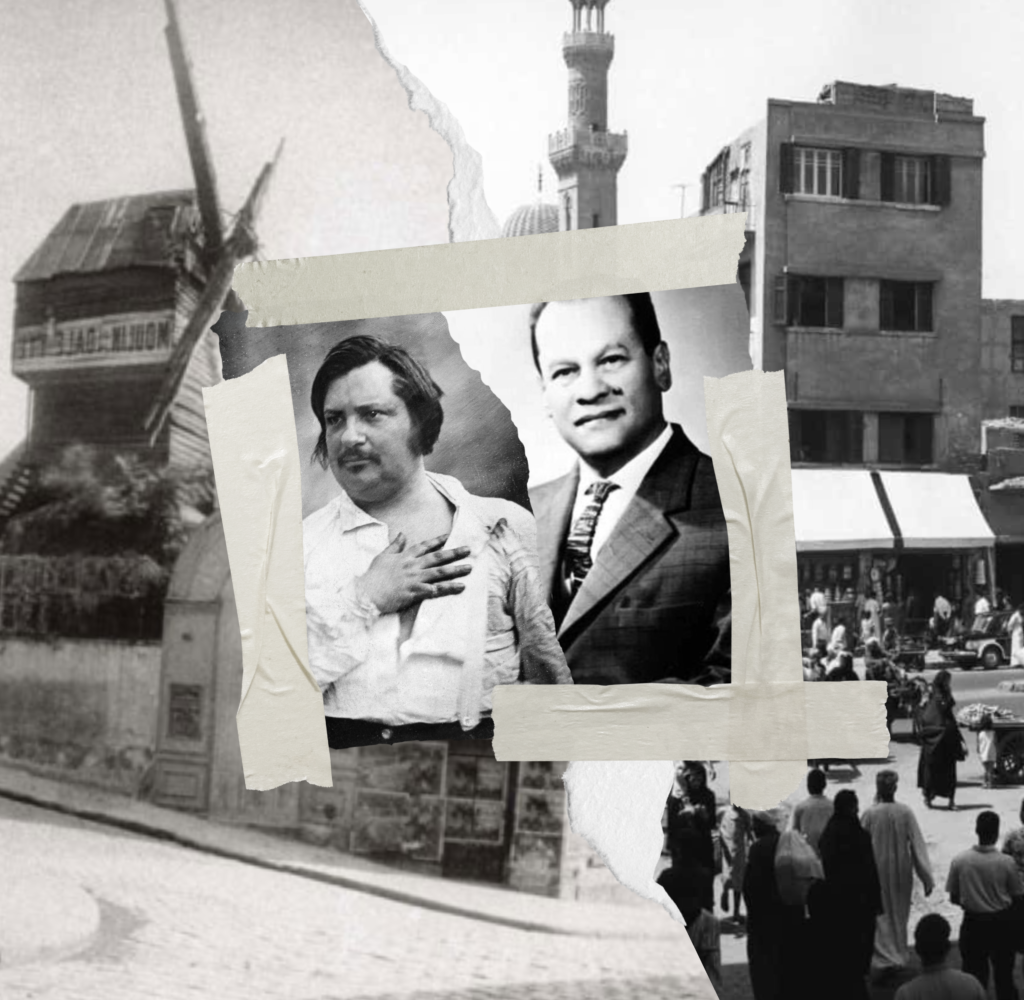
Lecture on Paris vs Cairo — the city as judge
Fog came down on Tours with the patience of a parish priest, and the river Loire carried its pale plates of light past warehouses and courtyards where a clerk could learn the weight of paper long before he learned the weight of a sentence. In that town, on 20 May 1799, a child arrived into a household that had already made a religion of ascent: a father born Bernard-François Balssa,¹ who had walked from artisan origins toward office and respectability, and who had filed away his old name as though it smelled of the tannery, and a mother, Anne-Charlotte-Laure Sallambier, whose Parisian merchant blood supplied money and an air of entitlement that sat oddly beside provincial damp stone. The marriage itself carried a dissonant arithmetic—youth beside age, capital beside ambition—and the son, Honoré, grew up with that imbalance ringing in his ear like a coin dropped on a church floor. A wet nurse received him in infancy, and the early separation from the parental body, followed by a household manner that kept children at distance, left its own bruise, one that later reappeared as governesses, tyrants, abandoned girls, and the strange hunger for maternal patronage that would stain his love life with gratitude and shame.²
A boy of ten found himself at the Oratorian school in Vendôme, where discipline wore the mask of salvation, and where the lack of spending money became a social mark that the rich boys could read faster than Latin. Honoré carried the experience into his fiction as memory transmuted into architecture: corridors that swallow young men, dormitories that train the body into submission, masters who praise piety while measuring futures in grades and obedience. When he later flooded Paris with young provincials—Rastignac, Lucien, countless unnamed aspirants—he drew upon the sensation of being watched while being starved, a sensation that teaches a child the first lesson of modern society: appearance governs judgement, while inner worth waits outside the door like a beggar. That early lesson mattered for Balzac’s later “science of manners,” since the discipline of classification begins with humiliation; the humiliated mind studies its enemies with a cold clarity.³
Paris entered him as a fever once he reached it as young man and would-be writer, and the fever carried an economic scent: printer’s ink, paper dust, candle smoke, the sour breath of creditors waiting on stairwells. A family wished for law and office, since those professions promised stability and a civic place, yet Honoré preferred the garret and the page. The choice looked romantic in retrospect, yet it unfolded as a chain of practical hardships: hack work under shared pseudonyms, hurried novels written as commodity, and a craving for recognition that never satisfied itself with modest praise. The city’s literary market taught him that genius alone rarely paid rent, and he took the lesson with such literalness that he tried to become the market itself—publisher, printer, typefounder—so that the apparatus of books would belong to him as property. That ambition carried the stamp of the era: post-Revolutionary France had witnessed a redistribution of power, and the new god of the street wore the face of money, a god whose sacraments arrived as contracts and promissory notes.
A small workshop appeared in Paris in the mid-1820s with presses, lead type, workers, and a young supervisor, and the writer who would later dissect capitalism tried to master its tools with his own hands. Balzac acquired hand presses and large quantities of type, hired staff, and placed his name on the business as though authorship and ownership could fuse into one sovereign identity. He learned, through failure, how machines devour cash, how delays become interest, how a single misjudged order becomes a year of chasing payments. Bankruptcy hovered; rescue arrived by narrow margins; debts remained like a tattoo on the soul, and by 1828 the burden ran into tens of thousands of francs. The experience formed more than an anecdote: it became an education in the inner mechanics of modern life, where a person’s future could be mortgaged, quantified, sold, then resold, until the self resembled a ledger entry. When his novels later filled with usurers, bankers, lawyers, speculators, and ruined fathers, the writer described a world he had already inhaled.⁴
Debt, once it enters the bloodstream, reorganises time. Balzac worked in brutal rhythms, sleeping in chopped fragments, drinking coffee in quantities that became legend, then revising proofs with a ferocity that terrified printers and delighted creditors who sensed a new book as fresh collateral. He wrote an essay on coffee’s pleasures and pains that reads like a confession offered to a stimulant, and the myth of fifty cups a day survives, even as sober observers argue over numbers; yet the relevant fact sits less in arithmetic than in temperament: the man treated his body as fuel for production, and he treated production as an ethical duty owed to fame, love, and the debt register. A manuscript, in his hands, rarely moved from draft to print in a clean line; he returned to galleys with additions, substitutions, expansions, and rearrangements, as though the printed page remained a battlefield where meaning could win ground at the last moment. Paris, built in layers, found its mirror in his method.⁵
His private life joined the same economy of longing and transaction, though the currency shifted from francs to tenderness. Women older than he, women titled, women married, women unreachable—each became, at various times, a gate to society, a maternal refuge, or an erotic gamble. Madame de Berny, often remembered as “Dilecta,” offered him patronage, affection, and a kind of schooling in aristocratic tone, while his later pursuit of the duchess de Castries and other grand figures revealed a hunger for rank that matched his adoption of the particle “de” after 1830, a self-ennobling gesture that carried both comedy and desperation.⁶ The scandal here lived in the open secret of Parisian life: everyone knew everyone’s desires, yet everyone acted as though a curtain existed. Balzac turned that moral theatre into a subject, then lived it with a mixture of vanity and self-mockery that still stings when one reads his letters beside his fiction.
Then came “L’Étrangère,” a voice from the eastern edge of Europe, writing anonymously from an estate that belonged to another world of snow, serfdom’s shadow, and Polish aristocratic pride. Ewelina Hańska, born Rzewuska, married to Count Wacław Hański, began a correspondence that grew into a long attachment sustained by letters, delays, travel, illness, and the tedious legal tangles of inheritance. Widowhood in 1841 made marriage conceivable, yet obstacles persisted, including the estate’s status and a daughter’s inheritance; the lovers moved in an orbit where property and family duty dictated pace. Balzac travelled repeatedly eastward in pursuit of her, tasting a different Europe while his health weakened under years of overwork. The marriage finally occurred in March 1850, then the husband died within months in Paris, leaving a romance that reads, in retrospect, like a novel written by Fate with a cruel efficiency.⁷
Balzac’s grand design—the work that later readers call a cathedral of prose—grew out of that personal chaos and out of a historical moment that begged for diagnosis. France after Napoleon lived through Restoration, July Monarchy, and the approach of 1848 with its gathering storms, and the social order behaved like a body undergoing forced surgery while awake. An old aristocracy retained titles, salons, and manners, while the bourgeois class expanded its wealth and influence through commerce, finance, and the law; the new hierarchy looked fluid, yet it enforced itself through invisible codes, especially in Paris where one address could raise a person’s value as swiftly as a title once had. Balzac named his project La Comédie humaine and framed it as a history of manners and “social species,” borrowing the language of natural science, while refusing science’s cold comfort; his pages feel clinical in observation, yet they burn with pity, contempt, fascination, and the secret wish that the world might recover a form of honour that money had begun to counterfeit.
The publishing story behind that monument carried its own drama, full of contracts, revisions, and the author’s obsession with control. Balzac’s texts circulated through journals and volumes across years, often appearing in forms that he later rewrote, expanded, and reorganised as the larger architecture clarified in his mind. The “Furne” edition of La Comédie humaine—issued by Furne with partners Dubochet, Hetzel, Paulin—appeared in sixteen volumes between June 1842 and August 1846, with an additional volume later, and it mattered since it represented an edition shaped under the author’s eye, closer to what contemporaries read than later posthumous arrangements. The effort required a particular kind of stamina: he had to keep writing fresh material to feed the market while simultaneously revisiting earlier work to align it with the growing system of “Scenes,” cross-references, recurring characters, and social typologies. A man already hunted by debts chose a path that multiplied labour, since unity demanded revision, and revision demanded time that creditors wished to consume.⁸
When you place that Paris beside Cairo, the temptation appears to treat the comparison as a pleasant academic mirror game. Cairo refuses that reduction, since it carried an imperial wound and a religious heartbeat that altered the moral chemistry of every street. Naguib Mahfouz entered the world in December 1911 in Old Cairo, in a lower middle-class Muslim family whose rhythms mixed piety, bureaucracy, and the tight solidarities of neighbourhood life. His name itself bore an origin story: his difficult birth involved an obstetrician celebrated enough to lend his name, Naguib Pasha Mahfouz, and the child inherited that doctor’s name as a sign of gratitude and survival.⁹ He grew up as the youngest of seven, with siblings much older, a household arrangement that produced the social feeling of an only child amid adults. His father, Abdel-Aziz Ibrahim, worked as civil servant with a conservative temperament, and his mother, Fatimah—illiterate, yet culturally curious—took her son on excursions to museums and monuments, giving him an early sense that the nation possessed both antiquity and a modern civic face.
A boy watched the 1919 Revolution unfold, and even if childhood memory retains fragments—chants, flags, sudden fear, rumours of soldiers—the experience engraves the idea that politics enters the street as bodily event. Mahfouz’s family moved in 1924 from al-Jamāliyya to al-‘Abbāsiyya, a shift from dense old quarters toward newer suburb, and the move carried symbolic force: old Cairo’s lanes gave way to broader roads and a slightly different social air, and the future novelist learned to feel the city as layered entity, where each district carries its own manners, tempo, and moral expectations. He studied philosophy at the Egyptian University, receiving his degree in 1934, and then entered the civil service, a path that echoed his father’s world while granting the son a vantage point from inside the state’s machinery. The bureaucratic desk, with its stamps and files, offers a peculiar education in modern power: decrees travel through hands, lives become cases, and language itself becomes instrument of order.¹⁰
Mahfouz’s working life moved through several offices and roles, including service at Cairo University, then the Ministry of Islamic Endowments, later cultural administration connected to censorship and cinema, before retirement in 1971. That career shaped his fiction in two ways: it trained him in the patient observation of ordinary people as they negotiate rules, and it placed him close to the state’s cultural gatekeeping, where permission, prohibition, and the delicate management of public morals formed part of daily practice. A transfer in 1945 took him to a library at al-Ghuri Mausoleum, and he conducted interviews with residents of his childhood neighbourhood for a “Good Loans Project,” an archival-human act that resembles fieldwork. The writer, seated with locals, listening to stories, absorbing idiom, learned how a city speaks about itself when power listens. Such experiences later fed his portrayal of “the lane” as microcosm, a recurring spatial unit through which he could study humanity as condensed society.¹¹
His early writing began with historical novels—projects inspired by a desire to cover Egypt’s pharaonic past in a long series—before he turned toward contemporary Cairo and toward the social novel, a shift driven by an inner historical pressure: the modern period demanded narrative witness. He wrote the Cairo Trilogy before the 1952 Revolution, completed it in that earlier era, then withheld it from publication until 1956–57, a delay that carries interpretive weight. The Revolution brought a new regime with new limits and new sensitivities, and silence becomes a strategy when the writer senses that speech carries cost. When the Trilogy finally appeared, it emerged as retrospective anatomy of a world that had already slipped into memory, and that temporal gap allowed Mahfouz to write with the double vision of participant and chronicler. Sources across journalism and scholarship affirm that the work was written before 1952 and published later, which makes the Trilogy resemble a sealed bottle opened after the shoreline has already shifted.¹²
The family behind the Trilogy carried elements of his own memory while remaining its own invented organism. The al-Jawād household stands on Bayn al-Qaṣrayn in al-Jamāliyya, and the street name anchors the narrative in a real coordinate, a choice that serves as pledge: the story belongs to a particular stone and dust. The patriarch, al-Sayyid Ahmad, rules at home with a pious severity, while he lives a second life of pleasure outside, a double existence made possible by the city’s scale and by masculine privilege; the wife Amina embodies an older ideal of domestic virtue and sheltered existence, while the children splinter into divergent responses to modernity—nationalist activism, sensual indulgence, intellectual doubt, ideological zeal. A reader hears in Kamal’s philosophy degree and interior struggle an autobiographical echo, and Mahfouz admitted that he gave Kamal features of himself, including philosophical formation and a mind that perceives contradictions between religious principles and Western scientific discoveries. The point extends beyond self-portrait: the novelist turned his own divided education into a character’s wound, allowing private conflict to stand for the nation’s wider crisis.
Balzac’s family world and Mahfouz’s family world appear far apart in geography, yet a similar social desire threaded through them: the desire for respectability. Balzac’s father climbed through office; Mahfouz’s father served as civil servant; both households treated work as moral posture. Each writer inherited, therefore, a disciplined relation to social standing, and each writer betrayed it in his own way—Balzac by gambling on art and commerce with reckless hunger, Mahfouz by placing the ordinary lane under the intense light of literature, thereby elevating lives that elite culture might prefer to treat as background noise. Their mothers offered another parallel that carries psychological sharpness. Laure Sallambier’s distance left Balzac thirsty for maternal substitutes among patrons and lovers; Fatimah Mahfouz’s excursions into cultural sites gave her son an image of Egypt as layered inheritance, antique and modern, sacred and civic. Maternal action and maternal absence alike become formative scripts, and both men wrote, in their distinct keys, as sons haunted by the maternal figure’s power to grant legitimacy.
Scandal hovered around both lives, though it wore different masks in different climates. Balzac’s scandals belonged to Parisian society’s appetite for gossip: romantic entanglements, social climbing, the uneasy spectacle of a writer courting titles and duchesses, the constant chase of money, the flamboyant performance of genius as personal brand. His life appeared as a case study in modern celebrity’s early form, where private desire turns into public chatter. Mahfouz’s scandal arrived in theological and political form, bound to questions of blasphemy, authority, and the permissible limits of allegory. In 1959 he published Children of Gebelawi in serial form in Al-Ahram, and the work provoked opposition from religious authorities; intervention from President Nasser reportedly played a role in allowing the serial to appear, while book publication remained banned in Egypt for decades, with the first full printing occurring in Lebanon in 1967. The scandal here operated as public argument about sacred representation, yet it also functioned as power struggle: who possesses the right to interpret religion in a modern nation?¹³
Serial publication, a practice that shaped both literary cultures, deserves attention, since it shaped form as well as fate. Balzac wrote within a French market that rewarded instalments, sensation, and speed, and the nineteenth-century periodical press formed a machine that fed on narrative, turning chapters into monthly or weekly commodities while inviting writers to adjust course in response to demand and payment. Mahfouz wrote within Arabic newspaper culture where serialisation in venues such as Al-Ahram turned novels into public events unfolding over time, shared by readers who discussed characters as neighbours. Serial form invites a particular rhythm: the chapter ends with tension, the reader returns, the city itself seems to await the next instalment. That rhythm helped make Cairo’s lane feel communal, and it helped make Paris feel like a system whose pieces interlock across volumes. The reader becomes citizen of the fiction through repeated return, and the city becomes a habit.
A hard moment for Mahfouz came decades later, when controversy moved from page to knife. On 14 October 1994, as he sat in a car on the way to a regular gathering, he was stabbed in the neck by an extremist connected with al-Gama’a al-Islamiyya, and the act drew on incitement associated with the cleric Omar Abdel-Rahman. He survived, yet the injury limited his writing capacity and altered his remaining years. Reports from the period and later retrospectives describe the attack’s context within Egypt’s violent 1990s, when militants sought symbolic targets, and when the writer’s earlier allegory continued to serve as grievance for those who had never read it yet wished to punish it. A body that had served the page became battlefield, and the event casts a retrospective shadow on his earlier cautious privacy, including his quiet marriage in 1954 to Atiyyatallah Ibrahim and his habit of shielding domestic life from media curiosity.¹⁴
Balzac’s own hard moments unfolded less as assassination and more as slow attrition, yet the effect could resemble a prolonged siege. Creditors haunted him; sleep fragmented; health deteriorated; travel drained him; the long pursuit of Hańska demanded energy while returning uncertain reward. The end arrived in 1850, after marriage and return to Paris, with the body giving way under the accumulated weight of labour and strain. A detail that often appears in cultural memory—his coffee excess—functions as symbol for a wider truth: the man worked as though time could be conquered by force of will, and the modern economy of publishing rewarded that mania until the body refused. His death, arriving soon after the long-awaited marriage, reads like a cruel joke of Providence; yet it also fits the logic of his own fiction, where desire often achieves its object at the precise moment when the object loses power to heal the desirer.
The deeper sociocultural link between these two writers emerges when one watches how each treated the city as moral instrument. Paris in Balzac’s hands acts as laboratory where money redefines virtue; Cairo in Mahfouz’s hands acts as crucible where tradition, colonial pressure, and modern ideologies reconfigure the family and the self. Balzac witnessed a France where post-Revolutionary mobility tempted every ambitious soul, and he watched the bourgeois ethos translate love, friendship, and family into exchange. Mahfouz witnessed an Egypt negotiating British power, nationalist fervour, and the pull of Western cultural forms, while older religious and patriarchal structures fought to preserve their claims. Both cities turned private life into a public matter: in Paris through gossip, credit, and reputation; in Cairo through communal scrutiny, honour codes, and political surveillance. Each novelist turned that pressure into narrative energy, so that the reader feels the city’s hand on the character’s shoulder.
Balzac’s own fiction repeatedly returned to family as arena where society’s new laws reveal themselves with a particular cruelty. A father’s love becomes bank; a daughter’s marriage becomes investment; a son’s ambition becomes a bet placed on patronage. The tragedy of Père Goriot, ruined by devotion to daughters hungry for rank, belongs to the same moral universe as Balzac’s business failures: love enters a market, then gets priced, then gets consumed. In that sense Balzac wrote his own life in coded form, and his coded life returned as social critique. His adoption of an analytical voice—classifying “types,” dissecting motives—resembles a defensive measure against his own susceptibility to illusions; a man who fell for dreams of profit and noble love learned to protect himself by turning dream into specimen.
Mahfouz treated family with comparable seriousness, yet his moral horizon carried different sacred textures. The al-Jawād house begins as a miniature empire ruled by patriarchal decree, then gradually loosens as children encounter education, politics, erotic desire, and new ideologies. The change unfolds through scenes of meals, prayers, quarrels, visits, street marches, arrests, weddings, funerals—the slow grammar of life. Amina’s domestic confinement holds religious and cultural legitimacy, and her yearning for the street carries the ache of a soul sensing the world’s breadth. The sons embody divergent responses: Fahmy’s nationalist sacrifice, Yasin’s indulgence, Kamal’s doubt. Grandchildren later embody ideological polarities that grew in Egypt’s twentieth century. Through those lives, Mahfouz traced how public history enters the living room, and he showed how the nation’s future forms inside arguments between father and son long before it forms in speeches.
The publishing environments that shaped each author altered what each could say, and altered how each said it. Balzac wrote amid a French press and publishing market that rewarded sensation, yet permitted sharp social exposure, provided it arrived dressed as fiction. He could portray bankers and politicians with thin disguises, and readers took pleasure in recognition. Mahfouz wrote within a twentieth-century Egyptian context where censorship and religious authority could constrain explicit critique, while allegory and realism offered different routes around restriction. His later move into more symbolic modes—exemplified by Children of Gebelawi—showed how a writer can shift register when realism alone grows politically perilous. After finishing the Trilogy he paused for years, then returned with works that carried sharper political charge, shaped by disappointment with post-1952 realities. The state’s presence, experienced through his civil service roles, gave him intimate knowledge of the gate’s hinges.
A moral difference also emerges in how each writer handled belief. Balzac, despite fascination with mysticism and Catholic imagery, presented a world where faith often functions as social currency or as consolation for the weak, while the powerful kneel before money with a sincerity that resembles worship. He treated the confessional as theatre at times, and he portrayed priests as players in social games, though he also granted genuine sanctity to certain figures. Mahfouz, shaped by Islamic culture and by philosophical study, placed faith at the centre of daily time—calls to prayer, Qur’anic cadence, ritual—while showing how modern doubt enters through education, colonial encounter, and inner crisis. Kamal’s struggle embodies the modern predicament: a mind trained to seek coherence meets a world where coherence fractures. The lane offers communal meaning, then ideology offers a different meaning, then love offers a third, and each meaning claims the heart with persuasive force; the soul, pulled in several directions, becomes its own battleground.
Balzac’s relationship with science, which he borrowed as metaphor, carried its own irony. He wrote of “social species” and of classification, yet his method remained deeply literary, saturated with moral judgement and with metaphysical dread. The nineteenth century’s hunger to know society like nature promised certainty, yet Balzac’s pages reveal uncertainty at every corner: chance interrupts plans, passion derails rationality, the city swallows the innocent. In that sense his “science” resembles theology wearing a lab coat. Mahfouz, trained in philosophy and living through Egypt’s twentieth-century ideological storms, offered a parallel tension: he used realist observation to present social truth, yet he also sensed that truth slips away when power, belief, and desire collide. The writer who worked inside censorship understood that representation always meets constraint, whether the constraint arrives as editor, cleric, party, or the writer’s own fear.
When the Swedish Academy honoured Mahfouz in 1988, it praised a body of work rich in nuance and alternating between clear-sighted realism and evocative ambiguity, and the Nobel Prize turned a largely local fame into global attention. The event produced its own mixed consequence: translation surged, curiosity rose, yet the writer’s public status also intensified the risk profile, sharpening the symbolic value of his body as target. He lived with that paradox: global acclaim, local controversy, and a private temperament that disliked journalistic intrusion. His quiet marriage and guarded domestic life, including two daughters and a preference for ordinary routine on the Nile’s west bank, offered a counter-gesture to celebrity’s hunger. Balzac, by contrast, pursued fame with theatrical energy and found himself trapped by it, since fame raised expectations while debts demanded constant new output. Both lives illustrate how literary success behaves as double gift.
A student reading Balzac and Mahfouz side by side might seek a tidy thesis about urban novels and national transformation. The flesh of the matter resists tidiness. Balzac wrote from within a France rebuilding itself after revolution, where law, property, and class renegotiated their boundaries in the capital’s rooms and streets; Mahfouz wrote from within an Egypt negotiating imperial dominance, nationalist awakening, and post-colonial disappointment, where the state’s shadow fell across cafés and homes. Their “human comedies” resemble each other in scope, yet the moral temperatures differ. Paris shines with a cold brilliance that tempts with status; Cairo breathes with communal intimacy that can comfort and suffocate in the same hour. Their protagonists seek freedom, yet each freedom carries a price demanded by the city’s prevailing code.
A small scene can carry the argument more faithfully than any abstract claim. Imagine Balzac at his desk at night, Paris outside like a beast inhaling, and a messenger’s knock arriving with yet another demand for payment; he bends back over proofs, scratches margins with furious additions, and the printer groans at the cost of resetting type, while the author keeps rewriting since he believes perfection might redeem his life. Imagine Mahfouz in a government office, a file open, a stamp hovering, and his mind drifting toward al-Jamāliyya’s lanes, toward the call to prayer, toward the boy he had been during 1919, and toward the family he would place on Bayn al-Qaṣrayn; he returns home, writes in disciplined sessions, then walks into the city, listening, watching, absorbing. Each scene carries an ethic: witness demands labour, and labour exacts a toll.
A confession belongs here, addressed to the young reader who believes that novels rise from pure inspiration. Balzac’s monument grew through commerce, debt, revision, and social hunger; Mahfouz’s monument grew through bureaucratic routine, strategic silence, delayed publication, and a constant awareness of cultural limits. The writer, in each case, lived inside forces that his fiction later exposed. Literature, in their hands, became an act of survival and an act of accusation at once, since it preserved human life against the state, the market, the cleric, the salon, the creditor, the gossip, and the inner tyrant each person carries.
An ending that resolves everything would lie. Balzac’s Paris keeps producing new Rastignacs and new Goriots whenever money promises ascent; Mahfouz’s Cairo keeps producing new Kamals whenever education fractures inherited faith. The city remains a teacher whose lessons carry blood. If a “Human Comedy” exists as mode, it exists as refusal of comfort: it offers the reader a map drawn in sweat, showing where families break, where ideals turn into bargains, where love enters history’s machinery and emerges altered. The writer stands at the edge of the street, listening, recording, then paying the bill with his body.
Balzac died within months of securing the woman he pursued for years; Mahfouz lived long enough to watch a knife punish an allegory written decades earlier. A strange mercy hides inside those facts: each life reveals the cost of telling truth under pressure, and each oeuvre remains as a city made from sentences, where readers still walk, still smell coffee or dust, still hear the call to prayer or the rattle of a carriage, still recognise themselves with a shiver.
Scholia:
1 Graham Robb, Balzac: A Biography, W. W. Norton & Company, New York, 1994, pp. passim. Bernard-François Balssa had entered Parisian administrative life with the ear of a man who understood how a syllable can function as a social document. Robb records the father’s deliberate reshaping of “Balssa” into “Balzac” during his climb into office, a move conventionally dated to the period of his establishment in royal administration, with the new form in use by 1776. The motive lay in acoustic class-marking: “Balssa” rang provincial and artisanal; “Balzac” carried a smoother prestige, a sound that could walk into an antechamber without being stopped by laughter. The son later repeated the paternal gesture, when he added the particle “de” after 1830, a self-awarded heraldry that carried comedy and hunger in the same breath.
2 Graham Robb, Balzac: A Biography, W. W. Norton & Company, New York, 1994, pp. passim.
3 Pierre Barbéris, Balzac et le mal du siècle, Gallimard, Paris, 1970, pp. passim.
4 Graham Robb, Balzac: A Biography, W. W. Norton & Company, New York, 1994, pp. passim; André Maurois, Prometheus: The Life of Balzac, trans. Gerard Hopkins, Harper & Row, New York, 1965, pp. passim. The printing-house episode reads as apprenticeship in the metaphysics of credit. Biographers agree on the sequence: Balzac sought mastery over the machinery of books—presses, type, labour, contracts—and the machinery answered with debt, since capital vanishes faster than ink dries, while delays breed interest like mould in a cellar. The financial wound then reorganised his time, turning the novel into repayment, revision into collateral, speed into bodily sacrifice; the Paris of bankers and usurers arrived with such authority in his fiction since the ledger had already entered his blood.
5 Honoré de Balzac, Treatise on Modern Stimulants, trans. Kassy Hayden, Wakefield Press, Cambridge, Massachusetts, 2016, pp. passim.
6 André Maurois, Prometheus: The Life of Balzac, trans. Gerard Hopkins, Harper & Row, New York, 1965, pp. passim.
7 Stefan Zweig, Balzac, trans. William and Dorothy Rose, Viking Press, New York, 1946, pp. passim.
8 Honoré de Balzac, Avant-propos (1842), in La Comédie humaine, ed. Pierre-Georges Castex, Gallimard (Bibliothèque de la Pléiade), Paris, 1976, pp. passim; Roland Chollet, “Histoire du texte,” in Balzac: La Comédie humaine, Presses Universitaires de France, Paris, 1983, pp. passim. The “Furne” label names a collective publishing enterprise and a moment of authorial engineering. Castex’s Pléiade apparatus and Chollet’s textual scholarship clarify the practical reality behind the romance of “a single monument”: Balzac re-gathered scattered publications, re-ordered them, and re-wrote them under the pressure of a market that demanded fresh instalments. That double labour—feeding the street while rebuilding the cathedral—formed the structural cruelty inside the project: unity required revision, revision required time, time belonged to creditors, and the city’s judgement arrived as deadlines and contracts.
9 Rasheed El-Enany, Naguib Mahfouz: The Pursuit of Meaning, Routledge, London, 1993, pp. passim. El-Enany preserves the naming story as a Cairo gesture of gratitude shaped by institutional prestige. The difficult birth brought the family into contact with the celebrated obstetrician Naguib Pasha Mahfouz, and the child received the doctor’s name as survival-mark and social thread, binding private body to public authority before language could begin. In a writer who later made the lane into a governing organ, the first governance arrived as a borrowed name, a small emblem of how Cairo distributes identity through neighbourhood, institution, and memory.
10 Roger Allen, The Arabic Novel: An Historical and Critical Introduction, Syracuse University Press, Syracuse, 1995, pp. passim.
11 Rasheed El-Enany, Naguib Mahfouz: The Pursuit of Meaning, Routledge, London, 1993, pp. passim.
12 Rasheed El-Enany, Naguib Mahfouz: The Pursuit of Meaning, Routledge, London, 1993, pp. passim; Roger Allen, The Arabic Novel: An Historical and Critical Introduction, Syracuse University Press, Syracuse, 1995, pp. passim. The temporal gap between composition and publication functions as moral optics. Both El-Enany and Allen treat the Trilogy as written before the Revolution of 1952 and issued in the later 1950s, a delay that allowed Mahfouz to publish the old world under a new regime’s shadow. The result resembled sealed testimony: the family drama carried the intimacy of lived memory while bearing the chill of retrospective judgement, as though the living room had already begun to echo with the future’s verdict.
13 Naguib Mahfouz, Children of the Alley, trans. Peter Theroux, Doubleday, New York, 1996, pp. passim; Sabry Hafez, “The Modern Arabic Novel,” in The Cambridge History of Arabic Literature: Modern Arabic Literature, ed. M. M. Badawi, Cambridge University Press, Cambridge, 1992, pp. passim.
14 Mary Anne Weaver, “The Novelist and the Sheikh,” The New Yorker, Condé Nast, New York, 23 January 1995, pp. passim; Rasheed El-Enany, Naguib Mahfouz: The Pursuit of Meaning, Routledge, London, 1993, pp. passim. Weaver’s report, read beside El-Enany’s biographical frame, shows how a book’s quarrel can migrate into the body. The stabbing of 14 October 1994 belonged to the violent climate of the 1990s, when militant rhetoric recruited older controversies, and a novelist’s allegory could be treated as a legitimate target. The marriage in 1954 and the guarded domestic life functioned as counter-strategy: privacy as shelter, routine as armour. A city that judges through rumour, sermon, and decree also judges through symbolic violence, and the writer’s throat, cut yet surviving, became a public parchment where the argument kept writing itself.