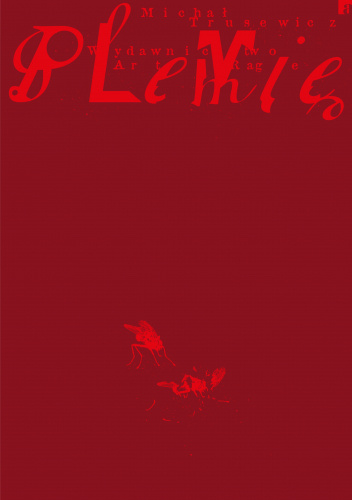
The book lies on the table like a clot of dried blood: a red square, almost monochrome, the title Plemię barely legible, letters drifting across the cover like insects caught in twilight. You reach for it and the paper feels thin, 140-something pages, a volume that promises speed and delivers weight. On the back, a short blurb speaks of a tribe that lives “under the world,” a nameless boy who keeps their archive, and a language full of old crones’ and old men’s tongues, all those banished syllables that return from the ditch with mud on their faces.
The tribe lives “underneath,” we read, below order, below property lines, beneath cadastral maps. A swarm more than a people, they double and breed, cursed and necessary at once. Their archivist, an unnamed boy, speaks in a voice permanently occupied: by vagrants and fools, by the dead and the badly remembered. Through him the book records scraps of lives cut short by war, illness, poverty. Reviews and publisher notes agree on those coordinates: a collective existing beneath the official world, a narrator who believes that memory alone opens any path toward common life and toward revolt against those “who live on the underside of the world and organise order.”
A critic in Twórczość draws the first clear map: Plemię tells of an undefined group whose shared consciousness the narrator records and passes on, a community woven from many generations, bound to exclusion and to subterranean life, dangerous for the surface order precisely because their presence threatens the arrangement above. The plot, he suggests, consists mainly of encounters or hauntings through which that group slowly shapes a sense of self. He notices smells of decay, clouds of flies, a loneliness that bites the narrator’s legs at night; he senses war in the background, mass graves only half-covered, and the book’s flirtation with Electronic Voice Phenomena, that strange practice of listening to graves with a tape recorder, hoping that the dead may whisper through static.
So the novel moves between archive and séance. Every page carries some small ritual of registration: a name, a crippled habit, a way of spitting, a family anecdote of someone who “stepped into eternity” without grimace. The boy writes for those who never received epitaphs. This resembles the work of Augustine in his Confessions: memory as both wound and cathedral, interior yet shared. Except that Trusewicz places his cathedral under the earth, close to worms, closer to Dante’s Malebolge than to any basilica, and he lets the nave fill with dialect words and gutter jokes. Language itself gains a fleshy texture here: thick with earth, buzzing with flies, crossed by sudden liturgical echoes. When the text speaks of loneliness swarming with legs and scratching him during sleep, we enter a psychology in which depression appears less as mood and more as infestation.
The boy archivist lives with chronic overload: too many dead, too many fathers, too many voices piled on his tongue. Psychologically, this feels close to what Enzo Traverso calls “left melancholy,” a grief linked to defeated revolts and betrayed solidarities that refuses disappearance and keeps scratching at collective memory. Trusewicz himself has spoken about an injustice that never leaves the shared mind, that stays somewhere in the language, producing distortions in perception and in artistic representation. In Plemię those distortions appear as glitches in grammar and vocabulary, shifts in register, grotesque comparisons that keep tipping the prose toward nightmare and laughter at once. The tribe’s underworld becomes less a fantasy country and more a picture of historical losers: peasants, conscripts, migrant labourers, the unnamed dead of two totalitarianisms and one hard transformation. Their exile under the world mirrors the political and economic under-class position of many Polish families after 1945 and again after 1989.
One should remember where the author comes from. Michał Trusewicz, born in 1995, grew up in Dębno in Western Pomerania, a town that for centuries bore the German name Neudamm and lay within Brandenburg. After the Second World War, the German population left and Polish settlers arrived, many of them from territories lost east of the new border, many from rural backgrounds. The town carries that layered past in its bricks: former paper mills, cloth factories, Lutheran cemeteries with erased names, a marathon famously long-running, an oil field nearby. Trusewicz, as the Dębno city website eagerly reminds its citizens, studied Polish philology at the University of Warsaw, edited the literary magazine Wizje between 2019 and 2021, and writes as critic, poet, and prose author. Before Plemię, he released the poetry volume Zakwity (2016), the poems Frakcje (2021) and a first prose book, Przednówki (2021), a compact, hallucinatory remembrance of childhood after the mother’s death “under the light,” where the window remains open so that the world can drift in.
Emerging from such a background—a small Recovered Territories town with its erased German layers, a capital-city philology education, editorial work among young Warsaw writers—Trusewicz belongs to a generation that arrived after communism yet inherited both its ruins and its archival passions. The nomination of Plemię for the Nagroda Literacka Gdynia in 2025 and for the Identitas programme, which sends selected authors to a polar island, marks him as one of the more striking new names in Polish prose, although he still stands far from the big-press mainstream. That distance matters; the book feels stubbornly local and stubbornly experimental at once, as if the Kosa river, the districts of Dębno, the villages around, all decided to speak through a microphone plugged into a soundboard built by Henryk Bereza and Marian Pankowski.
Everyone repeats the formulation: “a debut novel immersed in the tradition of Pankowski, Pilot, Gombrowicz.” The description comes from the publisher’s note but critics accept it. Twórczość hears many echoes: sentences that might belong to Gombrowicz, a smell of later Pankowski with his open, confessional voice, hints of Schulz in the swelling spring full of life and death. Trusewicz himself, in a long interview for the magazine Zakład, lists among his closer kin Andrus Kivirähk’s The Man Who Spoke Snakish and the grotesque films of Jan Švankmajer; he speaks about “anti-fairy-tale,” about piling unspeakable elements on top of each other while remaining faithful to clay, blood, bodily fluids, low humour. The tribe’s world therefore stretches between high Polish modernism and Central-European folk surrealism, between Gombrowicz’s contempt for noble poses and a plebeian impulse that keeps bringing spittle and dung into the sentence.
What separates Plemię from nostalgic rural prose lies in Trusewicz’s conscious sabotage of “literature in the folk mode.” He says openly that he distrusts books that turn peasant life into a kitschy mirror, full of ready images and sentimental reconstructions of suffering. Instead of such a museum display, he prefers a hall of warped mirrors where the reflection of the village exaggerates itself, mutates, grows horns. The book even contains a scene of makeshift theatre which the author, with some glee, calls a slap across the muzzle of writers who ask a machine to “generate a Polish village hollowed out by serfdom’s evil, with torn shirts, frayed slips and a cow in the background.” The psychological effect of this strategy feels double: readers receive neither noble martyrdom nor pastoral balm, only a persistent reminder that historical wrongs pass through grotesque bodies and broken jokes, not through tasteful sepia.
Language forms the true engine. The narrator’s speech continually changes gears: from liturgical flourish to crude insult, from childhood metaphor to near-scholarly reflection, loaded with words drawn from almost every region of Poland. A critic notes Lwów slang, Poznań dialect, Kujawy words, Świętokrzyskie expressions, Vilnius and Silesian flavours, all mingling in a single paragraph. In the Identitas jury’s description, Plemię reaches toward “roots of language, constructed and glued from folk dialects of the whole country,” aligning that linguistic montage with an interest in “low-status folk community” and with a visceral imagery of slime, rot, bristle. During the Zakład conversation, Trusewicz reveals his toolbox: contemporary dialect dictionaries, Oskar Kolberg’s ethnographic archives, old albertusy (popular storybooks and jesters’ literature), ribald hunting verse, folk epics, ritual songs and sowizdrzalski, trickster-style pamphlets. These he bends, scorches, files down, so that the resulting lexicon feels off-balance and strange, a “glitch,” in his word, which reflects the ontological uncertainty of characters who have been pushed outside the usual frames of existence.
Philosophically, that glitch matters more than plot. One can read Plemię as a correction to transparent realism, a refusal of so-called zero-degree narration. Trusewicz treats language as medium and ghost at once. The dead speak through dialect, through archaic curses, half-remembered psalms. The present generation hears them as interference, a static that bends normal sentences, similar to those Electronic Voice Phenomena recordings where voices of the murdered supposedly hide inside white noise. The book therefore belongs to a broader current in contemporary Central-European fiction that ties political trauma and social exclusion to questions of speech and silence. The tribe lives underground in the same way that social memory of class violence or peasant subjugation lives underground: seldom mentioned in official narratives, yet active within the idiom, in jokes, sayings, provincial turns of phrase.
Psychologically, the nameless archivist stands at a crossroads between individual neurosis and collective caretaking. He suffers bites from loneliness, swollen legs, various psychosomatic miseries; yet he also performs liturgy for his people’s dead, ensures through his writing that their stories attain even a minimal shape. The activity recalls the “memory work” that second and third generations of trauma families carry out: children of deportees, of Shoah survivors, of collectivisation victims who assemble fragments into narrative because their parents never received space to speak. In Poland, where the peasant majority historically remained largely voiceless in literature and in public discourse, such work acquires a specific intensity. The tribe’s archive may therefore stand for notebooks hidden in drawers, unwritten stories of post-war settlers in towns like Dębno, a mixture of east-border nostalgia and fear of return, German ghosts and Polish ones arguing over the same field.
Trusewicz’s nonfiction activity confirms this archival impulse. In 2023 he unearthed a forgotten early poem by Stanisław Lem, published in 1938 in a weekly newspaper, an artefact that pushes Lem’s literary debut back by eight years. The discovery emerged through tedious microfilm work, turning pages for another project and suddenly meeting a signature. This patience with dust and index cards returns in Plemię, transmuted into myth: the boy who composes his tribe’s story performs the same labour in fantastic mode. He remains in love with small documents: a gesture, a dialect word, a nonsense phrase dropped by a drunk uncle during a village wedding.
Where shall we place Plemię within Polish literary history? On one axis, the book continues Henryk Bereza’s long campaign for language that follows the living tongue, disrespectful toward official norms. Bereza spoke of Pankowski’s late work as “senioral,” a phase that embraced confession without borders; Plemię at times adopts a similar mode, a voice that sprawls into monologue without clear external frame. On another axis, the novel converses with the recent publishing boom of “peasant histories,” both scholarly and literary, which reassess the role of villagers and farm workers in the creation of the Polish state and in its modernization. Trusewicz openly distances himself from a certain solemn tone within that trend; he dislikes books that treat rural life primarily as raw material for moral outrage or pornographic misery. His strategy involves laughter, freakishness, excessive language, through which trauma gains a stuttering, nervous expression rather than a museum label.
Sociologically, one could say that Trusewicz writes from a hybrid position: child of small-town western lands, educated among big-city humanities, active as critic in magazines such as Czas Kultury, Twórczość and Odra. The tribe’s multi-dialect language mirrors his own circulation between regions and registers. The underground community bears traces of the Recovered Territories’ demographic history: settlers from eastern Galicia and Volhynia rubbing shoulders with central-Polish families, all inhabiting former German houses, often with half-erased inscriptions in Gothic script still visible in attics. Trusewicz compresses those patterns into speech. A single sentence may contain a Lwów verb, a Poznań noun, a village curse from Świętokrzyskie, followed by a Catholic paraphrase of the Psalms and then a modern slang flourish. The result feels like a linguistic model of post-war Poland itself: patchwork, improvised, yet persistent.
Philosophically, the book keeps circling three questions. First: who counts as “we,” when the past fills the present with ghosts? Second: what does freedom mean for people whose ancestors lived centuries under someone else’s whip or badge? Third: how does one speak when every language carries compromise—official jargon, Church clichés, sentimental folk pastiche? Trusewicz approaches those questions through what he calls “weirdness” in the sense of Mark Fisher: the intrusion into reality of elements that obviously fail to fit, whose presence nevertheless demands recognition. Weirdness here does political work. A corpse that keeps whispering, a dialect word that suddenly interrupts a polished phrase, a clownish uncle whose joke slices through solemn ideology—all these figure those lives that the official story would prefer to leave buried.
At the same time, Plemię carries strong theological undertones, though always crooked. Religious language appears alongside tavern speech; one paragraph sounds like a distorted psalm, another like a confession overheard in a confessional where priest and penitent both drink cheap vodka. The tribe’s underworld resembles a parody of purgatory: souls queue, complain, swap memories, yet the boy archivist listens with a patience that Aquinas would recognise as a virtue of memoria, that intellectual habit through which past events inform present judgement. In that sense, the book offers a kind of negative catechism for contemporary Poland, where the Church’s institutional authority erodes, yet the symbolic vocabulary of sin, guilt, sacrifice and redemption continues to structure interior life.
One returns finally to that book on the table, the red square with insects. Since late 2024, Plemię circulates through smaller bookshops and online stores; readers rank it somewhere in the respectable middle on popular portals, a sign of engagement, perhaps also of difficulty. Municipal bulletins in Dębno report proudly that their young writer received a regional scholarship to finish it and now enters lists for Gdynia and Identitas. In Polish terms, he stands at that uncomfortable threshold where serious criticism pays attention yet the wider public still hesitates. From this vantage, the novel already performs the work it describes: an archive under the world’s floor, waiting for someone younger to break the planks.
You read, then close the book. The language still seethes in the mouth, like yeast that refuses to die. Somewhere outside, on the fields around Neudamm-Dębno, wheat grows over old trenches and migration routes; above them, wind mumbles through electric wires. The tribe in the novel may consist of ghosts, yet its figures resemble people one can meet at a rural bus stop or in a cheap hostel near Warsaw’s Zachodnia station. Plemię offers no peace. The book ends and the dead still demand sentences. The archive continues in the reader’s head, with that uneasy feeling that every language about Poland—my own, yours—quietly stands on someone else’s bones.