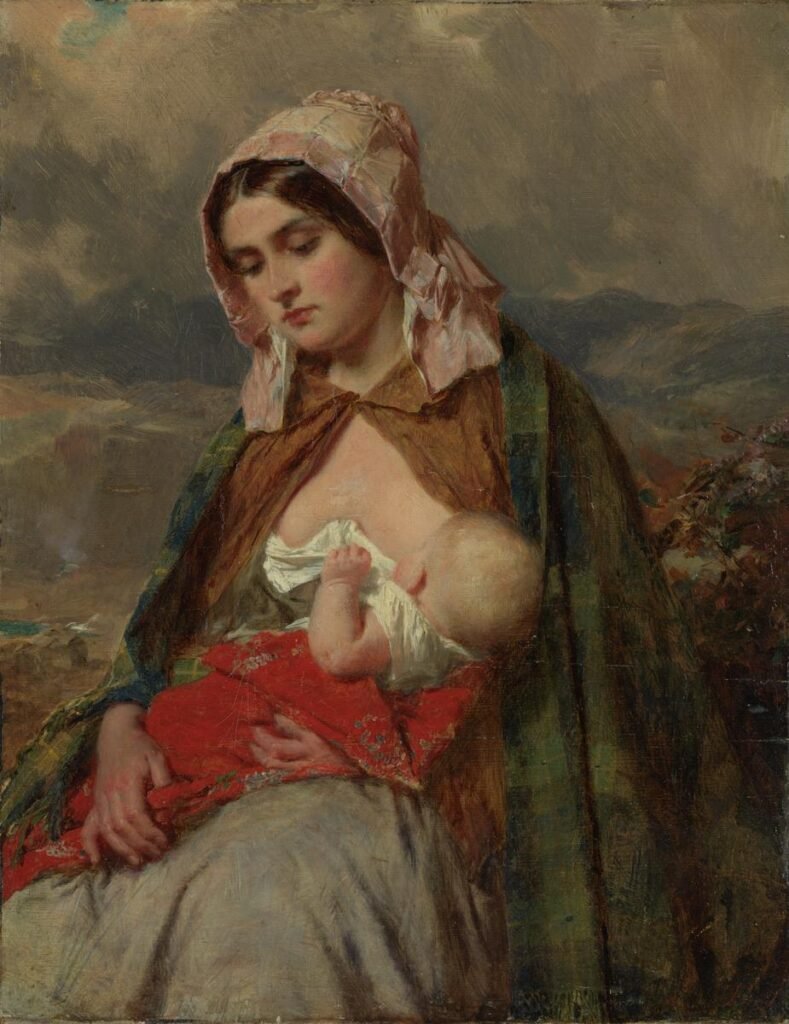
You meet her first as a hush in the corner of the room, a patch of Highland weather transplanted into gallery air. A young woman sits close to the picture plane, three-quarter view, head inclined so that the line of her gaze falls somewhere into the hollow between breast and child. A pale pink cap, flimsy as worn muslin, frames a face with dark brows and a mouth held in a quiet, undecided line. Around her shoulders lies a brown shawl; over that an enveloping green tartan cloak drops in heavy folds, drawing the Highlands over her like a flag turned into clothing. At the centre a white breast, handled with infinite tact by the painter, meets the searching mouth of an infant. The child’s head glows with that pale, almost translucent blond of very early life; one soft arm rests upon a red shawl scattered with tiny floral forms. Your eye moves, as Faed intends, from the oval of the mother’s face down to the child and then out across the shawl, where the mother’s left hand lies spread. Those fingers, reddened, slightly swollen, edged with the faint grime of labour, carry more history than the distant hills behind her. In that hand a whole century presses forward: the Clearances, the migration, the shift from clan land to industrial wage. The canvas looks modest, yet it conducts affairs of empire through one woman’s tired skin.
Thomas Faed understood such hands from the inside. He came out of Galloway in the south-west of Scotland, born at Barlay Mill, a place where waterpower bit into wood and grain and where mechanics, farmers, and millworkers shared the same air. His father kept a millwright’s trade¹ and his mother kept the home and a brood of children who turned toward drawing almost as naturally as other families turned toward the sea. Three sons—John, James, and Thomas—passed through the Edinburgh Trustees’ Academy, that stern nursery of Scottish painting where pupils learned perspective, anatomy, and the grammar of chiaroscuro under the eyes of Sir William Allan and Thomas Duncan.² The boy from the millyard mastered academic discipline yet carried with him memories of rural women who smelled of smoke, starch, and wind. When he moved to London in 1852 and entered the orbit of the Royal Academy, he entered a world of mahogany furniture, engraved bookplates, and middle-class sentiment; yet the subjects that made his name remained Scottish domestic dramas, often Highland, always charged with affection for the poor and wary knowledge of what polite society demanded as entertainment.
The year 1870, when Highland Mother entered that polite world, lay deep inside the long aftermath of the Highland Clearances. Large parts of the Gàidhealtachd had already seen the conversion of clan land into sheepwalk and sporting estate; whole communities had departed for Nova Scotia, Ontario, Otago.³ At the same time the Highlands gained new prestige as romantic playground for Britain: Walter Scott’s novels, the royal residence at Balmoral, and the paintings of Landseer and others fixed a visual code of tartan, antlers, collies, and mist. The Londoner who paused before Faed’s canvas in the Academy galleries carried that entire mythology behind the eyes: noble poverty, faithful dogs, brave clansmen on bleak passes. Faed accepted certain elements—tartan, moorland, melancholy sky—yet he chose a scene where landlords, factors, and huntsmen withdraw. Instead of deer and dirks he gives you a nursing woman and the clouded landscape that shelters her, as if he wished to concentrate the entire Highland question into maternal care.
Composition supports this act of concentration. Reading the structure, you trace a broad triangle whose summit lies at the crown of the pink cap and whose base extends across the woman’s lap. That geometry, so beloved of Renaissance Madonnas, stabilises the figure and creates a sense of inward turning weight. Within the larger triangle another, more compact shape forms around the child: red shawl, white garment, bare arm, round head pressed into the breast. The diagonals reinforce each other. One runs from the mother’s left hand, along the infant’s body, into the breast and up toward the face; the other falls from the cap, through the line of the nose and lips, down across the brown shawl toward the child. Your gaze shuttles along these paths like a shuttle in a loom, pulled again and again to the encounter of mouth and breast, then to the protective hand upon the shawl. The background recedes into broad, atmospheric sweeps: dull green hills, a band of pale water, a sky with bruised clouds. Faed handles those spaces with a more open brush, as though the weather itself remains in motion while the central pair holds a kind of patient suspension.
Colour choices intensify the sense of place and feeling. The overall register sits in peat-browns, iron greys, and deep, slightly cooled greens. Against that grounded, almost earthy palette, Faed sets three notes of heightened chroma: the pink of the cap, the red shawl around the infant, and the faint blush in the mother’s face and hands. The tartan cloak carries dark blue and black threads within the green; it signals Highland identity with quiet firmness, without the theatrical exuberance of full dress plaid. That pattern wraps her body and spills beyond it, as if clan memory itself enfolds the young woman. The red shawl, by contrast, likely belongs to a world of industrial weaving; its repeating floral sprigs suggest a printed or machine-loomed design, a product perhaps of Paisley or Glasgow. In that meeting of ancient tartan and manufactured shawl, Faed lets the old Gaelic order brush against modern commerce, the croft against the factory, in the very cloth that warms the child.
The handling of flesh carries another sort of meaning. The breast appears with remarkable discretion: edge softened, modelling delicate, highlight almost shy. Victorian painting often treated nursing through allegory or tucked feeding away behind curtains; here the act lies in full view, yet the painter arranges the infant’s head and arm so that the moment retains privacy. The mother’s face holds neither theatrical grief nor smiles for the spectator; her eyes fall, lashes touching cheek, as though her thoughts wander among worries that the viewer cannot enter fully—rent, harvest, the health of the baby, the fate of absent kin. Skin around the knuckles swells slightly; the joints show redness, as if chafed by lye and cold water from constant washing. That detail—those hardened fingers resting on the red shawl—forms the hinge of the entire work, since it carries, in miniature, the collision between ideal motherhood and physical strain. The hand announces that this serene Madonna works; she hauls pails, digs potatoes, carries peat, and yet at this instant she anchors the infant with absolute steadiness.
Religious associations move quietly through the painting. A seated young woman, wrapped in a cloak, child in her lap, head bowed: the mind reaches at once for centuries of Mariological imagery. Faed, son of Presbyterian Scotland, paints a Highland Virgin without halo, throne, or overt sacred attribute. The sky behind her takes the role of gold ground translated into weather; the heather and low shrubs echo the roses and lilies of earlier devotional pictures in a rough, Highland key. Marian art traditionally held together purity and fecundity, contemplation and labour; Faed’s woman, with her raw hands and unadorned clothes, draws that iconographic inheritance down into crofter reality. Anglican and Catholic viewers in London could read a quiet echo of the Mother of God, while Presbyterian Scots might recognise a sanctification of their own mothers and grandmothers, women who spent more hours at the byre and hearth than in painted chapels.
The Victorian cult of domesticity enters as well. Mid-nineteenth-century Britain sang about mothers: sermons on the Christian home, poetry about the “angel in the house,” conduct manuals that described woman as centre of moral influence. Faed feeds that appetite yet complicates it. Here mother and child form the entire household; no husband stands behind, no second child tugs at a sleeve, no cat curls by the fire. She carries responsibility in solitude. Her clothes show careful patching and mending rather than glamorous poverty; one senses thrift born of scarcity. The red shawl around the infant appears as the family’s single luxury, a purchased item that marks the child as treasure. You feel an ideology of motherhood passing through the image—self-sacrifice, patience, silent endurance—yet that ideology sits within a harsher economic frame, where love cannot guarantee security.
Political undercurrents run just below the surface. Faed, who had painted The Last of the Clan and other emigration scenes with clear reference to clearance policy, needed only a few signs to recall that wider narrative. Scottish art of the nineteenth century often carried such hidden debates inside ostensibly domestic scenes.⁴ The very title, Highland Mother, signals that we stand in a region marked by dispossession. The water glimpsed in the middle distance alludes to loch, firth, and sea routes that carried people away to colonies and industrial towns. The absence of cottages or neighbours around her hints at a thinned population; the moorland stretches broad and unsheltered, as if sheep already claimed the former crofts. Yet Faed avoids any direct motif of eviction, such as the sheriff officer or the burning roof; instead he gives the viewer the generation that follows. The infant who feeds at her breast may later board an emigrant ship or enlist in a Highland regiment; the picture suggests that empire draws nourishment from mothers in the glens.
Comparison with other Highland images of the period clarifies Faed’s decision. Earlier painters such as David Wilkie liked crowded interiors where family, animals, and utensils filled the frame; Edwin Landseer created celebrated scenes in which dogs shared space with Highland families during meals or worship.⁴ In those canvases the poor remain picturesque and socially coherent; the interior offers warmth, humour, and anecdote. Faed strips his scene to essentials. Dog, father, hearth, and paraphernalia vanish. He sets the woman outdoors, under a sky heavy with cloud; the nearest creature besides the baby takes vegetal form in the bushes beside her. Through that simplification he shifts attention from Highland community as a type toward Highland loneliness as a state. His woman shares blood and language with the crowds in The Last of the Clan yet here sits far from dock or harbour, in a pause between labour and the next demand.
Faed’s own position complicates the image further. By 1870 he lived as a respected London academician, painter to patrons who saw in his work a blend of sentiment, narrative clarity, and technical finish. His Scottishness carried a certain glamour, adding colour to soirées and studio visits. At the same time he belonged to that array of Scots who had left the homeland for work in the imperial centre—writers, engineers, physicians, merchants. When he paints a Highland mother, he paints from a double consciousness: insider memory of a rural world and outsider vantage from metropolitan success. The canvas almost carries the mood of a prayer for forgiveness directed toward the women who stayed, while their sons and brothers, including the artist himself, sought fortune elsewhere. Through her he acknowledges the origin of his own skill: the mother who fed him, the countryside that shaped his eye, the language patterns that still murmured in his ear while he conversed with aristocratic sitters.
Return for a moment to that small, reddened hand. Art history usually turns toward faces and grand gestures, yet here the hand bears the weight of meaning. It serves as a manual icon of the Highlands under capitalism: strong, abraded, half-hidden, tender around the young. The redness may come from cold water, harsh soap, peat-smoke, and continual friction with rough cloth. Faed paints every knuckle with patient attention; he does not sentimentalise the damage, yet he gives each joint a roundness that suggests resilience. The baby’s arm, pale and smooth, lies across the same shawl, and the distance between the two skins measures the temporal gap between generations. You see the price paid so that the child’s flesh can remain unbroken for a while longer. That attention to manual detail places Faed in conversation with broader nineteenth-century concerns about labour, class, and sympathy. The industrial novelists of the 1840s, the social investigators, the preachers in city missions all urged their audiences to picture the lives of the poor; Faed participates in that moral pedagogy through portrait rather than pamphlet.
Philosophers of the Scottish Enlightenment considered sympathy a foundation of ethics: the capacity to imagine another’s experience and feel with that person. Adam Smith described this movement of the heart in terms that reach easily toward visual art.⁵ A century later painters such as Faed translated that concept into visual form. Standing before Highland Mother, the viewer undergoes a small exercise in sympathetic imagination. The child, with its universal appeal, opens the door; the mother’s face, concentrated yet tired, holds you there; the rough hand seals the bond. You begin to sense the cold air around her, the weight of the infant, the ache between shoulder blades, the uncertainty of tomorrow’s meal. The painting trains the eye toward attentiveness that might then extend beyond the gallery—toward beggars in the street, servants in households, emigrants on the quays. Whether that transformation occurred in each spectator remains an open question, yet the image offers itself as an instrument for such change.
There also lies a meditation on presence and absence. The landlord stays unseen, as do the laird’s house, the kirk, the school, the market. Yet all those institutions press upon her life: rent, doctrine, limited schooling, prices for wool and fish. She sits at the meeting point of systems far larger than herself, and Faed renders that global entanglement through a local act of feeding. Milk flows from body to child; wealth flows from sheep and game across oceans; images flow from Highland studio sketches to London exhibition rooms and then through engravings into parlours across Britain. The painting quiets these torrents into a single pool of attention where viewer and subject share time.
When you finally step back, the work begins to speak across centuries. Contemporary eyes recognise in her the mothers on ferries, in refugee camps, on train platforms, who grip infants while borders shift and economies collapse. The tartan may belong to a specific region, the hairstyle to a particular decade, yet the combination of care and weariness carries through. Art from the nineteenth century often arrives with period costume and unfamiliar codes; here those codes thin out, leaving a human relation as clear as the pale curve of the child’s skull against the breast. The painting asks you to hold that relation in mind, to acknowledge that every policy, every clearance, every migration starts and ends in such households, in such hands.
So the young woman in the green plaid, painted by a millwright’s son turned London academician, occupies more than a small rectangle of pigment. She stands as emblem of a Highlands that fed an empire with its children, of a rural Scotland absorbed into industrial Britain yet still carrying its own cadence. Within the small drama of feeding, Faed binds together theology, politics, and memory: Marian echoes from medieval panels, sympathy theory from Edinburgh lectures, debates over landlord power and crofter rights, his own ache for a homeland held at a distance. Her eyes remain downcast, private, yet her presence fills the air in front of the canvas. You leave the room, yet some part of you still feels the roughness of that hand against red wool, and some part of you measures your own comforts against the silent labour of women who feed nations from the shadows of windy hills.
Footnotes:
- The Faeds: A Biography, Mary McKerrow, Canongate, Edinburgh, 1996, pp. 15–52.
- The Scottish School of Painting, William D. McKay, Duckworth, London, 1906, pp. 205–210.
- The Highland Clearances, Eric Richards, Birlinn, Edinburgh, 2008, pp. 1–40.
- Scottish Art 1460–1990, Duncan Macmillan, Mainstream Publishing, Edinburgh, 1990, pp. 160–190.
- The Theory of Moral Sentiments, Adam Smith, ed. D. D. Raphael and A. L. Macfie, Oxford University Press, Oxford, 1976, pp. 9–25.