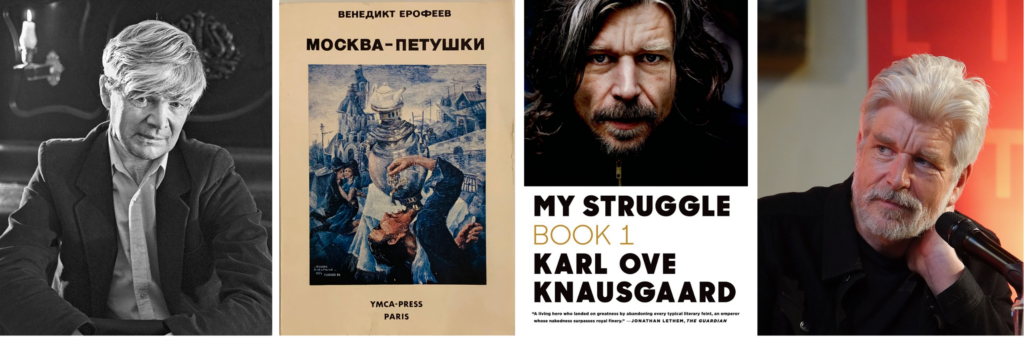
The colossal railway clock, suspended in the chill atmosphere of the worn-out platform, announced the terminus of hope, a specific late-socialist gravity where all motion achieved no consequential departure, having long since slipped into that hour when the machine of history continued its grind without destination. Beneath the heavy, iron-dust sky, a man in a coat frayed to the consistency of damp linen clasped a bottle, a private ember of spirituous heat pressed against the ribs, while the wind, sharp with the memory of stale tobacco and the old smell of cabbage boiled down for the bitter security of the state, carried the faint, tired ghost of nostalgiia¹. The journey of this Soviet late commuter, the fictional Venedikt Yerofeyev, intoxicated to the verge of a desperate, ragged vision, charted an interior topography of revelation that the official maps of the Rodina² could neither verify nor suppress. This selfsame continental ache, merely shifted across the span of some thirty calendars and a thousand kilometres of forested littoral, manifested upon a Scandinavian platform, the concrete edge delimited by a canary-yellow warning line that asserted civic order with a shrill, geometric confidence. There, beneath a fine, needling drizzle, the tall Norwegian father, Karl Ove Knausgaard, his shoulders bowed slightly under the accumulating weight of small, verifiable tasks, anchored a child’s pram with one hand and a thin plastic bag of groceries with the other, his attention a precise, jumpy arithmetic split between the local green train and the absolute, demanding presence of his progeny. For the one who found his idiom in the spectacular disintegration of the self and the other who sought truth in the grinding friction of quotidian sobriety, both figures align in the spectral statio phantasmatis³, that terminus of the mind where chronology misfiles its own schedules, neither man having shared a cigarette on any stretch of real-world track. Since the ordered structures of the political system, whether promising collective purpose or personal autonomy, finally yield a single, aching human truth, the consequence becomes legible in the gesture: a weary, almost clownish act of enduring the inherited blend of existential shame and domesticated boredom. Their fractured voices, one slurring a visionary toast to nothingness, the other murmuring a precise, sober lament for the life he found unlived, together articulate the difficult grace of those who have discovered the compass without north.
Yerofeyev came into the world in 1938 in Zapolyarny, far north in the Murmansk region, during the last hardening of Stalin’s rule, in a mining settlement where ice gnawed at buildings and state propaganda gnawed at language. His father, a railway worker, soon fell under accusation as an “enemy of the people” and departed toward the camps ; the children moved through barracks, orphanages, and the grey corridors of Soviet institutions where portraits of leaders watched from every wall. In such surroundings, the state drilled into young bodies a canon of hymns and slogans, yet those same institutions also taught a bleak lesson about contingency: any life could vanish into paperwork, any father into the archipelago. Alcohol entered that landscape less as diversion and more as parallel faith, a liquid catechism shared in workers’ barracks and cramped communal kitchens. Yerofeyev absorbed the classics in Moscow State University for a brief glittering stretch, then proceeded to drink, quarrel, skip military obligations, and earn expulsion ; after that, he surfed along the underside of the Soviet labour market as cable-layer, odd-job man, clerk, and genius of the unofficial conversation. His learning, therefore, proved a volatile distillation: the grand, echoing despair of Pushkin and Dostoevsky mixed with recipes for potent home-brew, the high, fractured shimmer of Symbolist poetry set against the crude rhythm of railway slang, a streetwise theology picked up between the chilled vodka kiosks and the close, sweating air of cheap dormitories.
Karl Ove Knausgaard first saw daylight in Oslo in 1968, inside a clean, well-lit laboratory of social engineering, an utterly different experiment in human order. Norway, across the years of his childhood on the southern coast around Tromøya and Kristiansand, had moved with purpose from postwar frugality toward an oil-boosted prosperity. Lutheran churches still anchored the townscape, their spires casting thin shadows; yet, the new, governing creed arrived from the mouths of civil servants and economists who spoke of security, equality, and the welfare model as if these ideals formed a rigorous secular covenant, a guarantee of civic safety. The Norwegian child walked through school corridors decorated with safety posters and international art reproductions, entered well-stocked libraries, and watched television that offered children’s programming and political debates in calm tones. Inside the house, however, a stricter rhythm dominated. Knausgaard’s father, a schoolteacher with a taste for alcohol, enforced silence and discipline with a gaze that turned every mislaid sock into a moral failure ; later in life, the same man drank himself into such ruin that his sons encountered his corpse amid bottles, filth, and the sour stench of bodily collapse in a small house on Jæren. Out of that collision—Nordic welfare exterior, private tyranny and addiction interior—grew the long, anxious, obsessive project Min kamp⁴, six volumes published between 2009 and 2011, together more than three and a half thousand pages, each one circling back to the father and the impossibility of living without betraying someone.
Political weather presses into both oeuvres with quiet insistence. Yerofeyev composed Moskva–Petushki between 1969 and 1970, during the Brezhnev era often dubbed “stagnation” by later commentators: heavy industry creaked on, party congresses repeated the same formulas, and censorship boards patrolled public speech, while everyday citizens dealt privately with shortages, corruption, and an air of spiritual asphyxiation. The book travelled first as samizdat⁵ typescript, copied by hand or on illicit machines, passed from friend to friend ; official Soviet publishing only dared to host an abridged version in 1989, when glasnost⁶ had already cracked open the façade. Knausgaard, by contrast, published in a media ecosystem that rewarded exposure. Norway in the early twenty-first century cherished transparency as civic virtue ; when Min kamp appeared, newspapers ran features on the real people behind the names, talk shows interrogated the author about his uncle’s fury and his ex-wife’s pain, and the legal code concerning privacy rights suddenly rubbed up against the old Lutheran urge to confess everything in full daylight. Yerofeyev faced blue-pencilled censors and KGB watchers; Knausgaard faced lawyers, gossip columnists, and relatives with smartphones. Both, in their separate corners of Europe, stepped into the same old quarrel between individual testimony and collective comfort.
On the Moscow–Petushki line, Yerofeyev sent his alter ego Venya onto a suburban train that departs from grimy Kursk Station, surrounded by kiosks selling poor tobacco and spirits, with the Kremlin behind and the promised paradise of Petushki ahead, a small town he invests with improbable gardens, eternal benches, and a beloved woman waiting with arms open. What follows across some hundred kilometres of track appears on first glance as picaresque drunken misadventure, every carriage full of labourers, petty officials, and women with plastic bags and tired faces, while Venya drinks mixtures of cologne, port, floor polish, and fortified wine with solemn recipes and names worthy of alchemical treatises. Yet as the journey lengthens, the text slides sideways into a liturgy of insult and praise. The protagonist, his focus sharpened to a precarious edge by the fierce alchemy of alcohol, compelled the logical scaffolding of Hegel’s dialectic, the solemn, painstaking register of biblical exegesis, the Florentine descent of Dante Alighieri’s vision, and the utilitarian moral code of Engels’ industrial philosophy to clash within the rattling frame of the carriage. Since his tongue knew no discipline save the sudden, inspired articulation of truth, he scattered verified citations and brilliant, spirit-drenched distortions alike, a quick, furious downpour of language that bound the monumental utterances of high culture with the crude, vital rhythm of the Soviet street song. The resulting alloy of sublime and squalid found an integrity beyond the reach of the State’s official decree, transforming the crowded coach into an unexpected agora peripatetica⁷—a traveling public square—where the celestial host, the infernal shades, and the uniformed ticket inspection officer traversed the same narrow aisle in continuous, democratic procession.
Contemporary scholars rightly align the book with postmodernist satire, yet its spiritual architecture draws power from the Russian religious renaissance of the early twentieth century that still lingered underground : Nikolai Berdyaev’s insistence on the irreducible dignity of personality, for instance, and Lev Shestov’s wild rebellion against any rational system that tries to bind human freedom inside logical necessity. Venya refuses role and category ; he drinks like a worker, quotes like an intellectual, prays like a medieval fool in motley. That stance carries a philosophical weight heavier than the bottle in his hand. Berdyaev in The Destiny of Man argued that personality arises as creative centre, never fully captured by social categories, always engaged in an unpredictable collaboration with divine freedom. Yerofeyev stages precisely such a personality inside a setting that treats individuals as units of labour and statistics. Venya occupies the lowest rung of Soviet respectability—from the party’s point of view he counts as defective material—yet his consciousness roams across centuries and disciplines. Every time he lifts a mug of some horrifying mixture with a poetic name, he affirms an almost theological liberty: the right to reshape the official world-picture with jokes and blasphemies. Lev Shestov loved the figure of Job, who sits on his ash heap and demands an answer from God without philosophical politeness; Yerofeyev’s drunk travels through a secularised version of that landscape, addressing the heavens through a cracked megaphone filled with ethanol vapour and bad breath. Laughter in these pages does not lighten the mood; it tightens it, since every brilliant riff exposes once again how little room Soviet life left for unregistered, anarchic, joyfully perverse speech.
Across the map, Knausgaard answered a different yet related spiritual climate. Norway enjoyed full elections, independent courts, and shelves of imported philosophy, yet beneath that civic comfort a quieter anxiety grew, one that the Norwegian pessimist Peter Wessel Zapffe diagnosed as the fate of a species saddled with a consciousness far too sharp for its own good. In his 1933 essay Den sidste Messias⁸ Zapffe described human beings as creatures whose intellect had evolved beyond any adaptive need, generating a surplus of awareness that exposed them to death, futility, and the absurd scale of the cosmos ; societies, in his view, survive only through four mechanisms that fence in this raw awareness: isolation, anchoring, distraction, and sublimation. Knausgaard’s six-volume project walks straight through those fences. He declines isolation by dragging every private humiliation into print ; he loosens anchoring by dismantling family myths and childhood stories ; he resists distraction, since he tracks even the blandest routines—shopping, cooking, carrying prams up stairwells—with forensic attention ; and he mistrusts sublimation, because he keeps dragging literary reflection back into the kitchen or onto the balcony where the washing machine hums. Reading Min kamp feels at moments like watching a Zapffe experiment conducted in real time: what happens if one man refuses nearly every available anaesthetic and offers his overdeveloped consciousness entirely to description.
Within that experiment pulses a more intimate theological tremor. Søren Kierkegaard, still the great Lutheran ghost in Scandinavian thought, described despair as a sickness of the self, a misrelation between what a person already is and what that person can become before God. Knausgaard grew up in a family where church language had lost much of its public force, yet guilt, judgment, and the sense of an all-seeing eye had scarcely faded ; the father’s glare replaced the divine gaze, and later the imagined reader’s stare replaced both. In Min kamp the narrator moves between nappies and lectures, drinking sessions and literary festivals, always with a low, pleading undertone: does this version of myself deserve existence, does memory align with fact, does language absolve or condemn. Arne Næss, the Norwegian philosopher of “life’s philosophy”, suggested that authentic existence emerges when lived practice and values enter honest dialogue at the level of everyday choices; Knausgaard subjects his own life to such dialogue with almost masochistic thoroughness. Every trivial object—ashtray, coffee mug, plastic bag—appears as evidence in a ceaseless trial where the defendant and the judge share one face.
Now lay the two central books side by side on a table: Moskva–Petushki, slim, dense, explosive, once illegal, born in samizdat ; and Min kamp, a bulky, state-sanctioned shelf of volumes, sold in hundreds of thousands of copies, debated in glossy magazines. Yerofeyev gave one heroic drunk a single extended passage through a frozen empire and allowed his reader to glimpse a world where every station name, every slogan, every hangover hides a metaphysical question; Knausgaard gave his reader childhood, adolescence, divorce, fatherhood, literary prizes, Hitler essays, and domestic paralysis, presented with an almost shameless embrace of minutiae. Both works force a rethinking of what counts as worthy material for serious literature. Yerofeyev drags into view the poor, the intoxicated, the semi-literate railway drinker and presents him as heir to Dante and Job. Knausgaard devotes pages to dishwashing, teenage masturbation, and nappies heavy with urine, yet threads through those scenes reflections on Hitler’s Mein Kampf, on Paul Celan, on Edvard Munch, on the imagery of angels across Christian art. In each case, a democratic impulse runs deeper than any slogan: human dignity extends across the entire spectrum of experience, from sublime vision to vomit on linoleum.
Russian and Scandinavian philosophy supply a set of backlights for this democratic impulse. Berdyaev’s personalism, with its focus on creativity and freedom as the core of personality, hovers behind Yerofeyev’s refusal to let Venya sink into mere stereotype. Merab Mamardashvili, the Georgian-Soviet philosopher of consciousness who loved lecture form and treated awareness as daily labour, also breathes through those pages : Venya’s drunken vigilance, his hyper-attentive commentary on every absurdity around him, reads like a corrupted cousin of Mamardashvili’s ideal of reflective life, a saint of intoxicated attention staggering through Soviet reality. On the Norwegian side, Zapffe’s dark anthropology and Kierkegaard’s anguished Christianity shape Knausgaard’s sense that existence carries an inbuilt surplus of suffering, while Næss supplies a more gentle, ecological strand, evident in the way landscape and weather seep constantly into his memory scenes. These philosophical lineages seldom appear as academic references ; they surface in tonal choices, in the way each writer measures the human against history, cosmos, and God.
The delicate, stinging irony inheres in the two literary postures, standing separate on the continental shorelines of the European experience. Venedikt Yerofeyev, the Soviet dissident and samizdat satirist, articulated his wisdom inside a culture whose State power punished the unwatched sentence with a finality that brooked no appeal ; the consequence of his defiance demanded a shield, which he found in the character of the chronic drunkard, the man authorities could dismiss at a glance as unreliable, the essential clown whose pronouncements held no civic weight. Karl Ove Knausgaard, the free citizen writing under the high dome of Scandinavian democracy, found himself operating in a system that positively encouraged the confessional impulse , yet his narrative strategy, pushing this societal permission to its absolute limit, fractured the tacit code of family discretion, forcing an unwelcome, blinding scrutiny upon relatives and former partners who had sought only the quiet refuge of private life. A difficult truth shadows both commitments: veritas⁹, the act of truth-telling, arrives fatally entangled with a specific form of betrayal. Venya, the fictionalised figure of Yerofeyev’s fractured vision, betrayed the mandated façade of socialist optimism, but in that very gesture he inflicted a more immediate harm upon his own body, sacrificing his liver, his capacity for routine care, and any chance for an ordinary, unburdened existence; Knausgaard, conversely, exposed the fragile, living weave of familial intimacy, justifying the destruction of privacy by asserting that such radical exposure served a higher, unassailable honesty. Since the ethical traditions of Europe have long praised the virtue of sincerity and the difficult grace of authenticity, the critical reader receives no comfortable absolution, no easy, unitary answer. Instead, these authors present two extreme, kinetic test-cases: a powerful demonstration of what happens to the core self, and to those bound within its immediate orbit, when the desperate demand for narrative veracity outstrips the ordinary, necessary ethic of protection, transforming the act of writing from a private, contemplative pursuit into a force of public, often destructive, consequence.
Return, finally, to the platforms with which we began. On the worn-out Soviet one, Venya misses trains, climbs into the wrong carriage, invents new cocktails from cleaning fluids, and addresses God with foul-mouthed tenderness as the loudspeaker croaks out bureaucratic instructions. On the sleeker Scandinavian one, Knausgaard balances a pram, a pack of nappies, and his own smoking habit, while somewhere in his pocket or bag lurks a notebook filled with observations that may later wound the very child he currently buckles into a seat. Late socialism around Venya produced queues, shortages, and a spiritual vertigo that encouraged flight into vodka and absurdity. Late capitalism around Knausgaard produced shelves of self-help, surveillance through social media, and a subtler vertigo in which every life felt potentially like content. Yerofeyev responded with a single comet of a book, brief in length yet carrying more quotation, theology, and obscenity than many can manage in a lifetime. Knausgaard responded with a flood, six volumes that drown the reader in the rhythm of existence. Between them stands a crooked yet luminous proposition: that human consciousness, whether soaked in spirits or in coffee, whether crushed by police or by politeness, still yearns to speak in its own accent, stretched into sentences that do justice to humiliation and hilarity alike. In that sense, the hand of the history clock on the platform points less toward systems and more toward a stubborn, slightly ridiculous dignity. Venya, with his cracked lips and misbuttoned coat, carries Berdyaev’s vision of creative personality into the third-class carriage, where only cheap vodka acknowledges his freedom. Knausgaard, trudging through Norwegian rain with a supermarket bag tearing at the handle, turns Zapffe’s gloomy theory about surplus consciousness into an everyday practice of description that refuses anaesthesia. Each shows in his own manner that philosophy does not belong exclusively to lecture halls or core texts ; it surfaces when a drunk debates Engels with a railway worker or when a father asks himself, hand on the pram handle, whether his child will forgive a book that names every quarrel. Somewhere between Kursk Station and a small Swedish balcony, the great European stories of the twentieth century—totalitarian terror, social democracy, religious afterlives, secular boredom—meet inside individual heads that still insist on speech. From those heads, two books emerged that continue to trouble their readers, half blessing, half curse, as long as trains run and platforms gather people who wait and think and smoke and remember.
Footnotes:
¹ nostalgiia (Russian): A complex, bittersweet yearning for the past, often tinged with melancholy.
² Rodina (Russian): Fatherland, a term imbued with patriotic and emotional significance for the Soviet state.
³ statio phantasmatis (Latin): A phantom station or imaginary stopping place.
⁴ Min kamp (Norwegian): My struggle; shares a title with Hitler’s Mein Kampf.
⁵ samizdat (Russian): Self-published, underground literature distributed by hand in the Soviet Union to bypass state censorship.
⁶ glasnost (Russian): Openness; the Soviet policy of increased transparency in government institutions and activities, introduced in the late 1980s.
⁷ agora peripatetica (Greek/Latin): A travelling public square; referring to Aristotle’s Peripatetic school which taught philosophy while walking (peripatos).
⁸ Den sidste Messias (Norwegian): The last Messiah.
⁹ veritas (Latin): Truth.