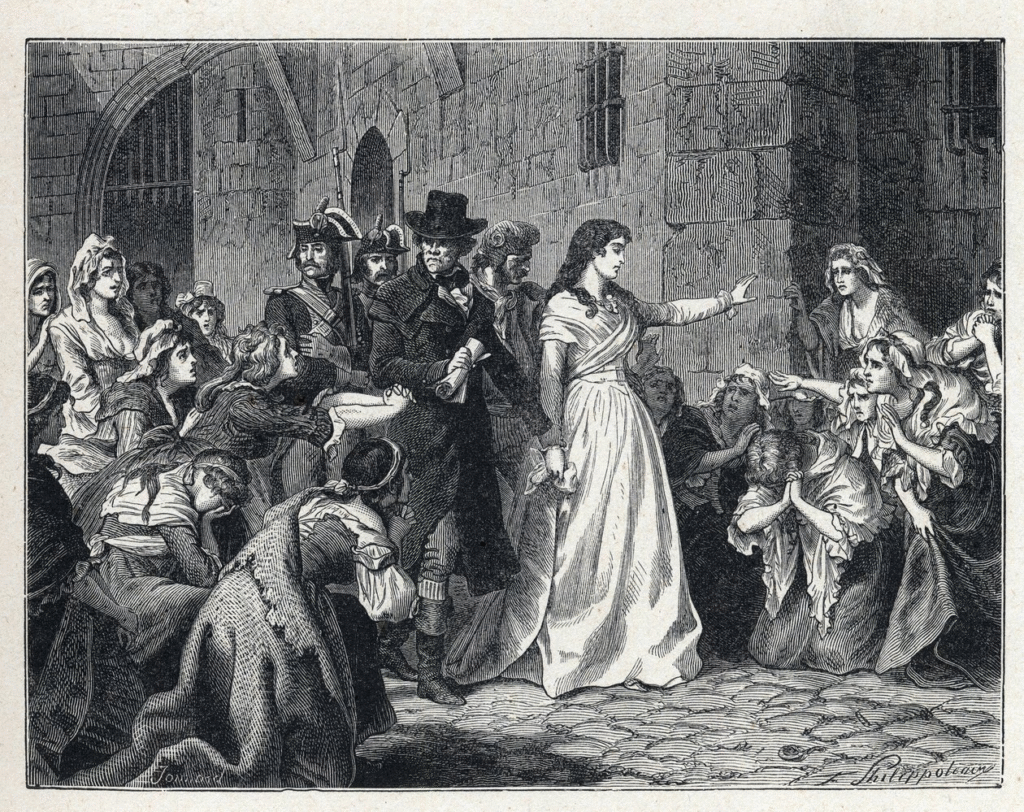
The paving stones of the Place de la Révolution absorbed the sharp, indifferent tincture of the November dawn; a pale, metallic light gathered around the oaken frame of the guillotine, where the national razor rested with that polished, lethal calm which already contained the day’s arithmetic of severed lives in its glacial sheen. Marie-Jeanne Roland de la Platière, who had watched the grand, soaring promise of the Republic thicken and sour into this perfect, technical homicide, now stood upon the raised scaffold, her gaze drifting past the reassuring green of the Tuileries and the distant, unresponsive spike of a church tower toward the empty plinth where Louis’s statue had once reigned. That absence now carried a new monument: an engine of consequence whose crude geometry achieved a terrifying completion. A raw wind, scented with damp wool, coal smoke, and the faint tang of spent powder, lifted the narrow ribbon in her cap so that the silk fluttered with an almost childish obstinacy, a slight, quivering sign set against the heavy equipment of the moment—liberté—a word she herself had inscribed with the ardour of a believer, had demanded in letters and petitions from the very assembly that consigned her to this platform. In that heightened interval before the blade’s plunge, she sensed with a comprehension that philosophy’s lamp had never granted, that the term she loved carried an appetite, that the ideal she cherished fed first upon those who invoked it most fervently, compressing a limitless aspiration into the sharp, absolute boundary of a single, irreversible second. She inclined her head and accepted the executioner’s hand, his gestures slow, courteous, almost paternal through long practice, guiding her toward the upright board, the last charged breath before the world became the rush of falling metal. In that extremity she discerned how freedom had seldom spread as a common breath through a body politic; it arose, instead, as a claim that one sovereign will seized, held for a brief, blinding season, and then surrendered under compulsion to another, a perpetual mechanism whose sole durable product lay in a magnificent word that justified its own workings while the planet’s inhabitants laboured in chains of varying fineness. Ô Liberté, que de crimes on commet en ton nom!—her final, sorrow-weighted sentence, released into the stone amphitheatre of the square, sealed the judgment: once separated from material consequence, once detached from ground, the word turns into a perfect tool for its own betrayal.1
The oldest layers of that betrayal seldom arose from the clamour of Parisian crowds or from the violent decrees of the Committee of Public Safety alone; their first outlines took shape in the clean brightness above the Athenian agora, where a citizen stepped forward and claimed eleutheria—freedom as self-possession, as the condition of one who rules and escapes rule—thereby sketching a vision of self-determination that relied, with a grave and careful silence, upon the bodies who remained outside the circle of the polis.2 Those excluded lives, slaves and women and foreigners, provided the necessary shadow-field against which the citizen’s luminous autonomy could stand out. Plato, when he described the ideal Politeia, anchored liberty in rigorous self-command: the soul’s upward movement toward the Good demanded an early, severe discipline, a submission of appetite to reason so complete that the highest liberation appeared as an accomplished obedience to the best element within.3 Aristotle, with his tranquil assurance that certain human beings bore a nature inclined toward servitude, expressed in cool conceptual language the zero-sum structure of this first Western freedom: the master’s ascent toward contemplative excellence required a bound other, whose unchosen labour carried the material load of that ascent. The Roman order inherited and hardened this duality, drawing a precise legal line between sui iuris and alieni iuris, between the person under their own law and the one submerged under another’s authority; the paterfamilias enjoyed such sovereignty over his household that his decisions reached all the way into life and death, a concentration of license that reveals, with merciless clarity, how every proclamation of a natural, universal freedom scrapes against the granite of historical practice.4 Seneca answered this with the Stoic refuge of an interior citadel, a moral fortress whose lord obeyed reason alone, yet even his admired inward liberty unfolded as a retreat into the mind’s cloistered space, an admission that the res publica operated as a field of unrelenting external command.
The Christian centuries shifted the axis from the marble square to the inward theatre of conscience, translating civic liberty into libertas spiritus, an emancipation from sin’s bondage and from death’s terror, staged before the gaze of God in place of that of the assembled city. Yet within that same Christian horizon, the word libera attached to a woman’s name carried a double edge: in legal registers it distinguished her from a bondswoman and granted her, in principle, the capacity to hold land, receive a dowry, consent to marriage, and enter contracts, while daily practice surrounded almost every such act with layers of male guardianship, so that her decisions flowed through the hands of father, husband, or lord and her freedom curved back toward masculine authority. Canon lawyers spoke of free consent as the heart of marriage and held that the sacrament rose or fell on the mutual words of man and woman; at the same time they repeated older judgments that classed women with minors, reduced the authority of their testimony, and confined them to a sphere where spiritual equality before God coexisted with juridical dependence upon men.5
Within that framework, women across Europe heard preaching on libertas spiritus as a promise that the Lord of heaven regarded their consciences directly. A peasant girl could walk into a parish church and listen while the priest proclaimed that every baptised soul carried liberum arbitrium, that grace touched women and men alike, and that the theatre of conscience opened in each heart under an all-seeing divine gaze. Yet once a woman attempted to translate that inner liberty into visible authority, she met structures of law and custom that re-routed her initiative through male control. Widows who appeared in charters as persons with libera potestas over their property depended on male witnesses, kinsmen, and bishops to validate significant transactions; heiresses whose titles named them sovereign ladies discovered that their guardians selected husbands, negotiated alliances, and sometimes confined their movements, while clerical doctrine praised their piety and at the same time urged obedience within marriage as the mark of a godly household.
Joan of Arc brought that tension into an almost unbearable clarity. She emerged from Domrémy as a free rural girl, neither serf nor noble, and yet she stepped into history by appealing to a freedom that reached far beyond social classification. Her voices, as she described them, summoned her directly, and inside that summons she discovered a conscience bound first to God and to the saints, a bond that placed royal counsellors, captains, and bishops on a secondary plane. When she rode into Orléans in armour, standard in hand, she presented herself as a laywoman who claimed spiritual liberty with unshakable confidence: a virgin entrusted with a mission, who interpreted obedience to God as authorisation to lead armed men, to speak in councils of war, and to rebuke hesitant commanders. Her body remained female, her dress became male, her soul stood in a space where divine command outweighed every earthly superior.
Once captured and delivered to Rouen, that inner freedom encountered the discipline of an ecclesiastical tribunal. Learned clerics questioned her with great persistence, turning again and again to one central demand: would she submit her visions and voices to the judgment of the Church as represented by her judges? Joan’s replies circled around a hierarchy quite foreign to them; she affirmed reverence for Holy Church, yet she insisted that her first obedience lay with the voices that had come from God and that those voices required her to persevere. The trial therefore settled upon the visible scandal of her clothing.6 Medieval doctrine allowed cross-dressing only in narrow and carefully guarded circumstances, often in tales where women disguised themselves entirely and passed as monks in order to safeguard chastity. Joan, by contrast, prayed and fought and argued openly as a woman in soldiers’ gear. When threats of death pressed upon her, she accepted a change to women’s dress for a short moment, then resumed male garments in prison, partly for protection against her guards, partly in fidelity to the command she heard from the voices. For the judges, that return to military clothing sealed the case: what she experienced as conscience purified before God appeared to them as obstinate refusal to bend, and the same Church that preached liberation from the slavery of sin delivered her to the stake in the marketplace.
Across the social scale, Eleanor of Aquitaine embodied another shape of medieval female freedom. As duchess in her own right, she inherited a rich principality, received homage from vassals, and issued charters under her own seal. Marriage to Louis of France crowned her as queen; she travelled on the Second Crusade with her own Aquitanian following, a high lady whose presence on campaign signalled the reach of her authority. When that marriage ended through an annulment on grounds of kinship, the dissolution returned Aquitaine to her hands, and contemporaries described her again as a free lady who held her lands by hereditary right. Her union with Henry Plantagenet, future king of England, extended her influence across a vast territory and placed her at the centre of a dynasty that would dominate Western politics for generations.
Yet Eleanor’s life reveals the tight circle around such grandeur.7 Her father arranged her first marriage as an affair of dynastic policy. Her second husband eventually confined her, when she supported their sons’ rebellion, in guarded castles where she lived under watch for years. She remained duchess of Aquitaine in law, yet the keys and gates lay in the hands of men loyal to the king. Only when Henry’s power faltered and, later, when Richard required her strength as regent and emissary, did doors open, horses stand saddled, and messengers obey her word once more. In her later travels through Aquitaine to gather oaths for Richard, in her negotiations over royal marriages, she appeared again as the living axis of lordship and memory for the realm; yet that flourishing of freedom followed long seasons of seclusion imposed by her husband’s will.
Placed side by side, Joan at the stake and Eleanor in royal confinement disclose a shared structure. Christian teaching affirmed that Christ redeemed women and men without distinction, that every soul bore the divine image, and that grace ennobled the humble as fully as the mighty. Canon law insisted on a woman’s free consent in marriage; theology praised certain queens, widows, and virgins as models of courage and holiness; liturgy and sacrament treated female communicants as full participants in the mystery of salvation. At the same time, the same canonists, preachers, and moralists repeated interpretations of Genesis and the Pauline letters that placed woman under male rule in household and Church, treated her as more susceptible to deception, and restricted her from sacramental office.
The language of freedom therefore rose everywhere in relation to women and at the same time diverted their acts into male channels. In records, a woman appears as libera mulier and thus distinct from a slave; in marriage law, her spoken consentio gives binding force to the union; in theology, her rational soul stands fully equipped for the ascent toward God. Yet when she commands troops, as Joan did, tribunals circle her like a ring of iron; when she governs a duchy, as Eleanor did, kings and counsellors encase her in arrangements, prisons, and negotiations that secure male direction. The Christian centuries redirected liberty from the public square to the interior court of conscience, and women took that teaching with great seriousness, shaping lives of prayer, prophecy, and rule from its materials. At the threshold where inward freedom touched visible power, however, the shared world of law and custom usually yielded to men, so that a woman called free in every register still lived her freedom under the shadow of another’s hand.
The Renaissance crowned a few singular figures with an almost terrifying liberty charged with terribilità: a Michelangelo who carved bodies that strained against stone and destiny alike, a Machiavelli who spoke of virtù as an energy able to bend Fortuna for a moment.8 Their self-will signalled the human capacity to press upon history with ferocious intent; yet the peasant and the street-sweeper drew little nourishment from these meteors, whose orbit required patronage, favour, extraordinary talent. Their “freedom” appeared as an exception that confirmed a rule of ordinary unfreedom across the fields and alleys of Europe. The Baroque age, with its vaulting ceilings and orchestrated chiaroscuro, transformed power into spectacle: the absolute monarch stood at the centre of a carefully staged world where each subject occupied a visible position, caught within an arrangement that appeared both theatrical and rational. Velázquez, in the charged stillness of his court portraits, captured this arrangement with merciless grace: bodies, fabrics, insignia, and glances compose a grid in which every figure echoes the king’s authority even when the sovereign’s face remains outside the frame.9 Within such a world, personal self-determination rarely pierced the surface; the courtier’s very gestures relied upon a script of etiquette, a voluntary masquerade enforced by ambition and fear.
When such a structure began to crack, the Enlightenment promised a clean demolition of gilded cages, yet produced in their place a more abstract, larger enclosure. The visible body of the king gave way to Hobbes’s Léviathan, to Rousseau’s general will, to the sovereign State conceived as a rational totality.10 The individual received, in exchange for local forms of authority and consequence, a theoretical freedom without clear limit, written in declarations and constitutions. Rousseau, when he announced the paradox that one might be compelled to be free, supplied a blueprint for systems in which refusal of the collective design counts as betrayal of one’s own rational nature; civic disobedience turns into a kind of metaphysical self-mutilation, easily repressed in the name of the common good. Voltaire and his circle, engaged in a necessary struggle against arbitrary imprisonment, censorship, and clerical power, pressed through satire and argument to secure protections for speech, property, worship, and they focused upon liberty as release from overt constraint. They fought frontal assaults on conscience and intellect, yet seldom dwelt upon the quieter operations of a market and factory system already forming behind the scenes. In place of chains at the wrist came contracts that linked wage to hunger, an equality of formal rights that concealed a brutal inequality of conditions. When the nineteenth century swung into its age of engines and smoking chimneys, liberty slid further toward a purely economic register: a freedom of contract celebrated as sacred, even when the only available choice lay between starvation and the sale of every waking hour to an employer.11 Marx, dissecting such arrangements with patient fury, showed how the worker, emancipated as a legal subject, surrendered labour-power as a commodity under compulsion from the very fact of survival. George Eliot, when she set Maggie Tulliver’s spirit inside the grinding demands of kin, debt, and reputation, perceived with painterly precision how the century’s moral ideals suffocated under economic necessity; freedom appeared in that narrative as a brief spark in a wet, heavy wind.
Alongside this transformation within Europe, where liberty migrated from palace corridors into declarations of abstract right, another theatre of freedom and unfreedom widened across the Atlantic, under a hotter sun and a far harsher discipline.12 A ship left a European harbour with cloth, guns, and trinkets in its hold, slid down the African coast to anchor offshore from a fortified trading post, and there, amid bargaining in many tongues, human bodies joined the cargo. Men, women, and children, bound together, descended into the fetid dark of the hold, where weeks of the Middle Passage turned flesh into figures for insurers and merchants, while above deck officers argued over tonnage, spoilage, and expected return. On the far side of the ocean, islands lined with sugar cane waited: Jamaica, Barbados, Saint-Domingue, each plantation a kind of open-air factory where labourers who had just survived the crossing entered a cycle of work from first light to exhaustion under the overseer’s whip.13 Freedom within this system gained a new grammar: the European trader, planter, and investor enjoyed freedom of contract, freedom of the seas, freedom to deploy capital, and these liberties drew their energy from bodies treated as instruments, from African captives stripped of every recognised claim to self-ownership.
On a Caribbean plantation the Enlightenment appeared in the shape of ledgers, clocks, and rational plans for profit. The owner, perhaps an absentee landlord in London or Bordeaux, received annual accounts that listed enslaved persons in columns beside cattle and machinery, each entry with a price, an age, an estimated remaining span of productive years. Local managers experimented with new milling devices, refined schedules to extract the maximum labour during harvest, and consulted treatises on agriculture that described human beings as another resource to be organised. Slaves rose before dawn, cut cane under a sun that scorched skin and vision alike, carried bundles to the mill where gears screamed and splinters flew, then trudged back to cramped quarters, with scant time for song or story before sleep. Punishment—branding, shackles, the stocks, the lash—formed an entire vocabulary of terror through which planters enforced obedience. In that landscape, the term “free” acquired a precise, chilling edge: a free man meant a European, or sometimes a mixed-race overseer, whose skin colour and status exempted him from the field and positioned him among those who supervised pain. The very clarity of this distinction gave modern freedom its racial contour, a double silhouette where liberty emerged through the shadow of someone else’s permanent captivity.
In European cities, at roughly the same hour when a conch shell called field gangs to work, men in wigs and fine coats debated the rights of man amid tobacco smoke and candlelight. A philosopher drafted a treatise on government that grounded legitimate rule in consent and property, yet invested in companies whose dividends came from slave voyages; another denounced superstition and arbitrary imprisonment, while happily accepting gifts of sugar and coffee that relied on a labour regime more absolute than any feudal lord had ever wielded. Pamphlets proclaimed that human beings entered the world with certain unalienable rights, even as colonial codes on the Atlantic rim defined enslaved Africans and their descendants as movable goods. A thinker like Montesquieu, whose ironies about slavery exposed its cruelty, remained a voice among many who treated the institution as a distant question, a matter for satire more than focused reform. The Encyclopédie celebrated human reason, mechanical ingenuity, and global trade, and in its enthusiasm for industry and exchange one can sense how plantation economies slipped into a narrative of progress, as though the suffering of the enslaved formed a regrettable yet acceptable price for the spread of civilisation.
This fracture appeared with greatest starkness in the founding of the United States. Inside the hall at Philadelphia, men drafted a declaration that announced all men as created equal, endowed with rights to life, liberty, and the pursuit of happiness, yet many of the same hands bore ink stains from keeping plantation account books, and many of the same minds calculated how any assault on slavery might shatter the fragile union of colonies. Washington rode back from the war to Mount Vernon, where enslaved workers maintained the estate that signalled his rank; Jefferson composed meditations on republican virtue at Monticello, surrounded by men and women he owned, whose lives and families remained at the mercy of his decisions. They spoke often of tyranny and freedom, of resistance to royal overreach, and they pictured liberty as independence for property-owning citizens, especially white men capable of bearing arms and paying taxes. Enslaved people appeared within this vision as a difficult anomaly, sometimes described as unfortunate dependents, sometimes as a population supposedly unready for self-rule, often as assets without whom debt-ridden gentry would face ruin. Double standards here moved from abstraction into architecture: the same house contained a library filled with treatises on natural rights and a cellar where chains hung from beams.
Yet the enslaved themselves heard the new language of rights and transformed it into a weapon. Runaway advertisements in colonial newspapers reveal men and women who spoke English, French, or Spanish, sometimes with additional African languages, who understood geography well enough to aim toward maroon communities in the hills or sympathetic docksides, and who refused the status assigned to them in law. During the American Revolution, thousands sought British lines in response to proclamations that promised freedom to those who fled rebel masters; others joined patriot militias in hopes that military service would secure their release. The rhetoric of liberty, once uncaged, seeped into quarters and fields, into secret gatherings where scripture and whispered news intermingled, and it worked upon the imagination of enslaved communities at least as powerfully as upon white intellectuals. The Haitian Revolution later offered the most radical enactment of this process: in Saint-Domingue, the enslaved population rose, fought armies from three European empires, and redefined universal freedom in concrete terms, declaring that colour forever lost any claim to justify bondage on their soil.14 Their struggle revealed how seriously enslaved people received Enlightenment ideals, and how little room many European and American elites wished to grant those ideals when applied without restriction.
The abolitionist movement grew from this clash between ideals and interests, conscience and profit. In Britain, Quaker meetings wrestled with the contradiction between belief in an inner light within every person and participation in commerce that treated countless souls as expendable.15 Merchants who experienced religious awakenings sold their shares in slave-trading ventures, wrote confessions of complicity, and urged others to withdraw from the traffic. Evangelical preachers thundered against the cruelty of the Middle Passage and the horrors of the lash, while former slaves such as Olaudah Equiano narrated their passage from capture to freedom, placing before readers scenes of suffocating holds, terrified children, and families torn apart at auction. Petitions flowed into Parliament from towns whose inhabitants resolved to boycott slave-grown sugar, and campaigns for the abolition of the trade adopted strategies that resembled modern mass politics: pamphlets, public lectures, petitions, and the mobilisation of moral outrage. The driving idea behind these efforts blended Christian universalism with Enlightenment notions of natural right: every human being, by virtue of possessing reason and a soul, deserved personal liberty, security of the body, and the chance to direct a life without fear of sale.
In the United States, abolitionism took shape within a sharper conflict, since slavery stood at the republic’s core, woven into its fiscal structure and its political balance. Northern religious radicals denounced slavery as a sin that stained the nation, while free Black communities organised conventions, printed newspapers, and supported escape networks along the routes later known as the Underground Railroad. A figure like Frederick Douglass, who had escaped bondage, spoke with a double authority: he knew the lash from experience and the language of rights from reading, and in his speeches he turned the founding documents against those who revered them, asking how a country that celebrated independence each summer could keep millions in chains. Abolitionists exposed scenes that polite society preferred to keep hidden: children sold away from parents on courthouse steps, women subjected to sexual exploitation by masters, men hunted with dogs after daring to flee. Their denunciations drew strength from a conviction that personhood carried an absolute value, immune to price, and that any law treating a human being as property violated both divine command and the true spirit of republican government.
Behind abolition, then, stood more than simple kindness or a late discomfort with cruelty. Economic transformations played their part: industrial capitalism in Britain drew more and more profit from factories and wage labour, weakening the strategic centrality of plantations for the imperial economy, even as slave-grown cotton remained essential for textile mills. Strategic considerations mattered: after Haiti rose in revolution, fear of further uprisings haunted planters and statesmen alike, and some accepted emancipation as the lesser danger compared with endless cycles of rebellion and repression. Yet at the heart of the movement lay an idea that pressed beyond calculation, one that fused Christian images of shared creation with Enlightenment visions of universal dignity: the thought that freedom belonged to human beings as such, without qualification of race, religion, or origin. Once such an idea took hold in enough minds, every justification for slavery—claims of civilising missions, arguments about supposed natural hierarchy, appeals to ancient precedent—began to appear as evasion, as a refusal to acknowledge what conscience and reason already proclaimed.
Modern liberty therefore emerged as a divided inheritance. On one side, philosophers and revolutionaries articulated doctrines of rights, participation, and personal autonomy, shaping institutions that promised citizens new protections against arbitrary power. On the other side, merchant fleets, plantations, and colonial administrations built fortunes by chaining millions to labour and transporting them across oceans in conditions of deliberate terror. The differentiation of freedom in this period rested upon a line drawn through humanity itself: Europeans, and especially white men of property, counted as full bearers of liberty, while others occupied zones of diminished personhood, from the peasant crushed by debt to the African captive forced to cut cane under threat of the whip. The abolitionist idea—that freedom applies wherever human breath continues—punctured this arrangement and exposed its violence, yet even after legal emancipation the habits, images, and economic structures formed under slavery carried into later systems of racial hierarchy and labour exploitation. To speak of freedom in the modern sense therefore means entering a conversation haunted by holds of ships and fields of sugar, by declarations read aloud in halls far from those fields, by voices from the quarters insisting that the word must stretch wide enough to shelter them as well.
The Russian Revolution promised a final escape from these economic chains, a positive freedom grounded in communal ownership and the abolition of class. Its reality soon revealed a harsher metamorphosis: the market’s tyranny yielded to the Party’s total command. The organs of power reached inward toward the soul as well as outward toward the field and factory; suspicion, confession, planning, and purges fused into a system whose goal lay in comprehensive mobilisation of life. Against this apparatus, Lev Shestov and Nikolai Berdyaev advanced a desperate theology of freedom that refused every rational totality.16 Shestov urged a leap into an ungrounded liberty that breaks with the very logic of Greek necessity and Enlightenment confidence, a freedom willing to collide with impossibility and scandal. Berdyaev, for his part, wrote of freedom as an originating mystery prior to being and law, an abyssal creativity within the person whose suppression under any collective programme amounted to spiritual murder. The underground figures of Dostoevsky, with their anguished insistence upon choice even against interest or reason, embodied this insight: genuine liberty persists, in that vision, as willingness to shoulder the anxiety of self-creation instead of accepting the comfort of a State-scripted identity. The Lwów–Warsaw School, under Kazimierz Twardowski, added another, more austere strand to this rebellion by insisting that concepts acquire moral dignity only when defined with cold clarity. Freedom, for such a discipline, cannot float as an ornament in sentences; it must attach to describable practices, conditions, relations. Once separated from that discipline, the word decays into a pleasing noise—flatus vocis—fit for speeches, slogans, and advertisements. The task of the thinker, within such a lineage, involves an initial refusal: silence until definition, resistance against any use of the term that fails to specify its field of application. Such silence already carries a form of liberty, since it protects language from commandeering by powers eager for sanctifying words.
Across the twentieth century the machinery of control shifted from barracks and prisons toward schools, offices, clinics, and screens.17 Michel Foucault tracked this passage from sovereign power, which displayed its force in spectacular punishments, toward disciplinary regimes that train bodies and minds through surveillance, examination, and normalisation. Byung-Chul Han later extended the diagnosis into the terrain of psyche: in neoliberal orders the subject turns into an entrepreneur of the self, voluntarily exploiting its own capacities under an imperative of performance; the whip moves inside. Gilles Deleuze, responding to a late phase of this transformation, described a world where individuals transform into “dividuals,” streams of coded information that slide through networks, endlessly evaluated and adjusted. Giorgio Agamben, tracing the figure of homo sacer, revealed how modern sovereignty draws its force from the ability to expose certain lives to bare existence outside ordinary protection. Achille Mbembe, advancing this analysis into the postcolonial present, named necropolitics as the contemporary art of deciding whose worlds receive slow suffocation and whose receive breathable air. Under such lenses the mortgage contract, the revolving line of credit, the smartphone app that tracks steps and sleep appear as refinements of discipline, increasingly embraced as instruments of self-realisation.
Orwell offered, in 1984, a fable of such inward discipline crowned by language itself as a cage: Newspeak shrank vocabulary until heretical thought lost available form, the telescreen poured sight and sound into every room while siphoning each gesture outward, and the Ministry of Truth re-scripted yesterday until memory and record fused into a single authorised line.18 Within that city, freedom contracted to one minimal axiom—“two plus two equals four”—a small, stubborn equation that guarded the border between reality and delirium; once that sentence slipped, the human figure inside the system dissolved into a puppet that smiled through torture and greeted its tormentor as saviour. Animal Farm condensed the same drama into a pastoral allegory, where beasts drove out the farmer under banners of equality, then watched as the pigs appropriated milk and apples, reworded commandments by lantern light, and finally paraded past the farmhouse on hind legs while the famous maxim—“All animals are equal, but some animals are more equal than others”—turned political language into a shimmering lie that justified every privilege. In both visions propaganda appeared as an alchemical art that changed cruelty into necessity, greed into duty, and submission into a happy posture; corruption of truth generated a matching deformation of freedom, since any will that moves through falsified descriptions of the world cannot choose its path with clear eyes.
When cinema later shaped The Truman Show, the architecture of control shifted from ministries and party offices toward studios and sponsors: an entire town served as stage, every neighbour as actor, each sunrise and storm as part of a script written for ratings, while the central character lived inside a dome whose sky functioned as blue screen and prison ceiling at once.19 That world no longer required a boot stamping on a face; it relied upon affection, habit, and a sense of comfort. The spectacle delivered gentle entertainments to the audience while the protagonist’s life unfolded as product, storyline, market asset. Contemporary existence increasingly approaches that configuration. Schedules, desires, and fears unfold inside curated environments where feeds, recommendations, and targeted news rearrange perception throughout the day; a person wakes, reaches toward the phone, and enters a corridor of prompts designed by teams of psychologists and engineers. Under such conditions each citizen swings along carefully designed arcs of mood and opinion, like a body on an invisible playground where some distant hand has calculated push and height, and the sense of spontaneity arises precisely from ignorance regarding design. We wander through malls, platforms, loyalty schemes, and scoring systems as if through an enormous entertainment set, while every step, click, and glance flows outward into data centres that refine their grip upon our next step, next click, next glance.
The old totalitarian dream of uniform propaganda that floods every street with marching music has yielded to a subtler order, where each person receives a private stream of persuasion tuned to habits and vulnerabilities. In such a regime truth seldom disappears through crude prohibition; it erodes through endless dilution, through cascades of partial information, rumours, sponsored narratives, fabricated images, and carefully framed statistics. Freedom then assumes the shape of an elective maze: choices multiply while the structure of options narrows in places unseen, and consent emerges from paths that an algorithm has pre-carved in light of past behaviour. Every timeline, every personalised search result, every A/B-tested headline contributes to a kind of permanent experiment conducted upon populations who seldom grasp their role as samples, cohorts, segments. Where twentieth-century biopolitics managed life through vaccination campaigns, census-taking, and welfare programmes, the present moment adds psychopolitics: intimate tracking of attention, emotion, and desire, followed by interventions that steer interior weather toward profitable or manageable states.
The grand sociological experiment of the present therefore proceeds without fanfare. Corporations and states conduct continuous trials upon us: interface changes rolled out to a fraction of users, persuasive messages varied in tone, urban infrastructures monitored to see how crowds respond to signage, policing patterns, pricing shifts. Each of us belongs simultaneously to a consumer segment, a risk profile, a credit category, a security rating; Deleuze’s “dividual” drifts across databases as a bundle of probabilities, and policy responds less to articulated citizens than to statistical creatures assembled from traces. Agamben’s bare life and Mbembe’s necropolitical zones gain fresh digital counterparts: entire districts experience deliberate underinvestment, slow environmental poisoning, militarised policing, while other zones bathe in connectivity, wellness culture, and boutique freedoms. The same technologies that promise empowerment—remote work, instant communication, health tracking—also deliver continuous exposure to evaluation and control, so that the contemporary subject labours to optimise sleep, productivity, attractiveness, influence, until exhaustion arrives as private failure instead of collective diagnosis.
From such materials one may sketch a dark horizon toward which present societies drift, a horizon where every life acquires a second body composed of data, a spectral twin assembled from purchases, locations, keystrokes, biometric traces, and bureaucratic entries. That twin arrives at the counter before the breathing person does: banks interrogate it as credit score and risk profile, security agencies scan it as threat index, advertisers slice it into segments, and the aggregated figure gains more reality inside institutions than the face that once generated those traces. In effect the individual undergoes a fresh casting into a form proportioned to the needs of creditor, regulator, and marketer, so that the model suits balance sheets and risk matrices more faithfully than it reflects memory or conscience. Across Europe this process now receives a legal envelope in the shape of the European Digital Identity framework: member states must provide at least one Digital Identity Wallet, a standardised container for credentials, licences, qualifications, and payment access, accepted across borders and integrated into both public services and major private platforms.20 Within that wallet-centred order, the lines around money also shift. Anti–money laundering reforms fix an EU-wide ceiling on large cash payments in the business sphere and instruct obligated entities to intensify checks on lower thresholds, while rules on cross-border cash declarations tighten scrutiny at external frontiers. Cash withdraws step by step into narrower spaces—small daily purchases, private exchanges among acquaintances—while high-value transactions pass increasingly through channels that leave detailed, durable traces.
At the same time, the monetary centre of gravity tilts toward projects explicitly designed to entangle sovereignty with digital traceability. The digital euro, moving through phases of design and negotiation, promises central-bank money in electronic form, available through wallets and capped per person, promoted as defence of European autonomy against the dominance of foreign payment giants and as safeguard of monetary stability within an economy that already conducts most transactions electronically. Official discourse emphasises privacy features and offline functions, yet the architecture itself invites a future where the line between payment instrument and surveillance device grows increasingly thin: every transfer can fall under automated screening, every pattern of spending can enter risk engines, every deviation from statistically defined normality can trigger questions or suspension. Worldly freedom in such a landscape depends upon the discretion of those who control thresholds, flags, and limits on holdings; refusal of a transfer or closing of a wallet may appear as technical compliance with rules even when lived experience registers something closer to sanction.
The single currency presents a parallel story at the level of states. The euro binds much of the continent into a common monetary space, simplifies trade, and anchors price stability through a single central bank; it also removes from national governments the ability to steer exchange rates or set independent interest paths. Countries that remain outside, such as Poland, live inside an interesting tension. Under its accession treaty Poland carries an obligation, in principle, to adopt the euro once convergence criteria are satisfied, yet successive governments argue that the zloty shielded the economy during the 2008 financial crisis and Eurozone debt storms, and recent finance ministers have stated in public that the country remains unready for entry. Polling over the past decade shows a population divided, with a persistent majority wary of surrendering monetary sovereignty and anxious about price rises and loss of policy flexibility. Behind that hesitation stands an intuition that unification of currency, digital identity, and payment infrastructure may create a plane of control that lies far from local parliaments’ reach, a plane where decisions about capital flows, liquidity, and access to means of payment arise from bodies that answer only indirectly to national electorates.
Freedom shrinks whenever truth absorbs sustained injury, and the new digital architectures strike at truth twice over: they shape what appears in the field of vision and they manufacture machine-readable portraits of each citizen that claim to express reliability, loyalty, and worthiness. Every decision requires some minimum clarity regarding world and self; once the decisive descriptions live inside models that serve creditors’ prudence, regulators’ anxiety, and platforms’ hunger for engagement, that clarity fractures. As long as powerful institutions command the tools that shape collective perception—search engines, recommendation systems, mass data analytics, synthetic media—and at the same time monopolise the systems that assign credit scores, risk tags, and access to legal tender, the struggle for liberty migrates ever further into the terrain of epistemology: who defines evidence, which experiences count as real, whose pain or exclusion receives recognition and redress. A future faithful to Orwell’s deepest insight would feature fewer banners and more dashboards, fewer public executions and more quiet exclusions from credit, housing, cross-border transfers, or mere visibility on the platforms where social existence now unfolds. The cage would glow with appealing colours, the swings would glitter under festival lights, and the experiment would continue, round after round, wallets linked to scores linked to limits, until enough participants learn to read the instruments, intrude upon the design, and insist that freedom requires, at its core, a community capable of speaking truth together without scripts and of defending spaces—financial, digital, bodily—where the person exceeds the model built in its name.
The State, observing and learning from these corporate systems, moves from iron bars to fibre-optic cables. Surveillance rarely relies upon heavy cameras on poles when every citizen carries a lens, a microphone, a GPS transponder in their pocket, eager for connection. One can speak here of surveillance capitalism: a mode in which human experience turns into raw material mined for behavioural data, fed into prediction models, sold to advertisers and political campaigns. In such an arrangement, the boundary between public and private authority erodes; governments purchase data from companies, companies receive privileges from governments, and both share an interest in legible, predictable subjects. Cashless transactions, sold as hygienic and convenient, draw every minor purchase into a permanent, analysable record. When bread, bus tickets, medicine, and alms leave a digital trace, the possibility of an opaque corner in one’s life—an unregistered gift, a hidden refuge, a discreet act of dissidence—shrinks. Unfreedom thus acquires a new, chilling definition: a condition of total transparency, where each gesture, each movement, each need forms part of a real-time map wandering across servers.21
Legal systems, uneasily aware of these asymmetries, attempt a counter-stroke in the form of the so-called “right to be forgotten,” codified in the language of a “right to erasure.” The article grants an individual the claim to have personal data deleted once it becomes unnecessary for its original purpose, once consent has been withdrawn, or once processing occurs unlawfully, subject to exceptions for freedom of expression, public interest, and legal claims. In commentary, jurists interpret this right as a gesture toward “data subject empowerment,” a fragile effort to tilt the informational balance back toward the person by granting a power of disappearance. Yet the architecture of digital memory resists such gestures with peculiar tenacity. Data proliferates across mirrored servers, backups, caches, archives; one database hands records to another under the cover of “legitimate interest.” Forgetting, once the default in human affairs, yields to a regime of near-perfect memory in which every click, every search, every altered photograph may remain accessible indefinitely unless someone deliberately engineers decay into the system. The right to erasure, placed into this environment, resembles a wooden oar applied to the hull of a steel leviathan: a necessary symbolic strike whose physical effect remains faint. Requests must be formulated in legal language, directed at controllers who often sit in other jurisdictions; each appeal, each email, each form submission generates new entries in logs, new time-stamps, new traces.
The individual who attempts a divorce from the digital world enters a theatre of paradox. The moment a weary user whispers erase me into a search bar, the system hears a fresh query and spins out a stream of tailored offers: step-by-step “account deletion wizards,” privacy dashboards scented with pastel reassurance, third-party services that promise, for a fee, to chase down one’s traces across the net. Every click in this process demands further data: confirmations of identity, answers to security questions, scans of documents, proofs of address. Each attempt to vanish lays a new sediment of information into the servers one tries to escape. The right to be forgotten therefore unfolds as a never-ending petition addressed to an apparatus that lives precisely from remembering. Every partial success—one image delisted, one profile closed—leaves shadows in backups, in logs, in screenshots stored on strangers’ phones. The person who longs for erasure discovers that the very word forget has become monetised; the market sells tools of disappearance that deepen dependence on the infrastructures that made forgetting scarce. In that loop, the concept of freedom begins to mock itself: the more fiercely one claims the liberty to leave, the more closely one’s movements must be monitored in order to confirm consent and execute the withdrawal. The prison gates slide back with a ceremonious hum, yet the entire corridor leading outward is lined with new cameras.
Alongside this tightening mesh, the future of the body itself enters a laboratory.22 Gene editing promises the removal of hereditary disease, yet also opens avenues for pre-selecting traits; predictive medicine correlates genomes and lifestyles with risk profiles; brain–computer interfaces experiment with direct links between intention and machine. Donna Haraway, in her cyborg figuration, evoked beings who cross boundaries between organism and apparatus, species and code; Yuval Noah Harari sketches a trajectory in which algorithms know a person’s desires with greater acuity than reflective consciousness and in which a quasi-religion of “Dataism” venerates the circulation of information as highest value; Nick Bostrom, from another angle, warns of superintelligent systems whose goals diverge from human well-being, raising the spectre of an intelligence explosion that sidelines human agency altogether; Bernard Stiegler, meditating on memory and youth, describes technology as pharmakon, remedy and poison entwined, since devices which extend attention and recollection also weaken the underlying capacities through disuse. Under such conditions, freedom slides away from a simple question of juridical status toward a question of which technical supports to welcome into one’s nervous system and which to hold at bay; liberty appears less as a bare absence of chains and more as the art of deciding how deeply the machine may nest in the flesh, which sensors may cling to the skin, which implants may converse with synapses. The dream of “opting out” confronts a new difficulty here. A person may reject wearables, disable recommendation feeds, avoid neural interfaces, yet medical systems, insurance schemes, and educational platforms drift toward default expectations of continuous monitoring; the citizen who refuses such intimacy with devices gains a different profile inside databases, a figure marked as opaque, unpredictable, possibly high-risk. In that world the free subject begins to resemble a patient who selects treatments inside a hospital whose walls extend across the planet: the menu still offers choices, yet each option has been pre-filtered by invisible triage, and refusal of the entire regime demands exile from many circuits of work, care, travel. Freedom frames itself, under this prediction, as a discipline of selective entanglement, a practice of knowing where to accept augmentation and where to protect zones of uninstrumented life, and the future conflict may unfold less between humans and machines than between those who safeguard such zones and those who regard every opaque pocket as a failure of optimisation.
The war over reality itself intensifies these pressures. Paul Virilio, meditating upon the speed of images and information, foresaw an age where events arrive in such rapid succession that perception struggles to condense them into judgment; deepfakes now blur the line between recorded evidence and pure fabrication, armies of bots inflate certain narratives, recommendation systems design personalised news streams that supply each viewer with a different world. Orwell envisioned a single Party rewriting facts in archives; the present veers toward a stranger configuration where countless micro-propagandas swirl through feeds, each tuned to a profile. Hannah Arendt held that freedom in the political sense requires a shared world where people appear before one another, speak, act, and recognise facts in common; once that shared world fragments into millions of curated environments, political debate ceases to function as deliberation about common concerns and disintegrates into adjacent monologues. Each person feels sovereign within a bubble whose contents confirm existing inclinations, the capacity to receive contradiction dwindles, and persuasion gives way to performance; under such circumstances, even the fiercest assertion of independence risks becoming a gesture without traction, a cry inside a room whose walls absorb sound and answer with a fresh playlist.
Contemporary warfare turns this condition into a battlefield.23 During the Russian invasion of Ukraine a deepfake circulated in which Volodymyr Zelensky appeared on a hacked news feed, calling upon Ukrainian soldiers to surrender, an artefact swiftly exposed yet powerful enough to seed doubt and to demonstrate that a single synthetic clip can target morale as directly as artillery targets armour. At the same time, Russian legislation introduced heavy prison terms for so-called “fake news” about the army, with courts treating any account that departed from official language about the “special military operation” as actionable falsehood; independent outlets closed, journalists faced prosecution, and an entire population learned that certain descriptions of the war belonged to the realm of crime. In such an atmosphere a seemingly simple datum—whether a column has crossed a river, whether a town has changed hands, whether casualties include civilians—travels through three incompatible grammars: the state bulletin, the independent reporter, the smartphone witness. Each statement meets a counter-statement, each image encounters claims of manipulation, and truth retreats from the level of isolated facts toward the slower terrain of corroboration across many sources, a terrain that frightened, busy citizens rarely have time to cultivate.
The recent phases of the war in and over Palestine expose a parallel drama.24 After the explosion at al-Ahli Arab Hospital in Gaza City, Israeli officials, Palestinian authorities, foreign governments, newsrooms, and open-source investigators produced clashing narratives about responsibility: some pointed toward an Israeli airstrike, others toward a misfired rocket launched from within Gaza; later analyses emphasised different probabilities yet insisted upon the need for full investigation. Digital forensics organisations examined craters, trajectories, and intercepted audio; social media users shared selective clips, graphics, and transcripts that supported their prior loyalties. A single phrase—“hospital bombing”—therefore carried mutually exclusive images depending on the feed: massacre, tragic accident, staged fabrication. Alongside these disputes over events on the ground, Palestinian voices confronted systematic constraints in the digital sphere. Human-rights organisations documented large-scale takedowns and shadow restrictions of posts on major platforms, many of them reporting abuses or mourning relatives, while Palestinian digital-rights groups recorded thousands of moderation actions against accounts that attempted to narrate everyday life under bombardment. In parallel, Western capitals debated bans on certain protest groups and tightened speech laws, while studies of platforms revealed imbalances in the visibility of various narratives, driven both by algorithms and by the demographic profiles of users. Here again, the right to information, the actual flow of images, and the lived experience of civilians unfold on separate planes that seldom converge: governments issue communiqués shaped by strategic aims, legacy media filter material through editorial lines and legal constraints, and people in shelters upload fragments to feeds where content moderation, automated promotions, and disinformation campaigns interlace. War thus advances far beyond trenches and air corridors into an arena where images, captions, and content policies function as artillery, and an unverified clip shared to millions can redirect outrage, justify escalation, or suffocate sympathy more swiftly than a convoy can cross a bridge.
Within such a landscape freedom acquires a new contour. Political liberty once meant chiefly the ability to speak, assemble, publish, vote; today it also demands a right to conditions under which truth remains discoverable at all, a right to infrastructures that permit honest disagreement over a stable description of events. If every image immediately meets accusations of forgery and every casualty figure meets accusations of propaganda, citizens drift toward a sullen agnosticism in which they treat all narratives as instruments of power and withdraw from engagement. That withdrawal pleases every actor who gains from unaccountable violence, since scrutiny weakens when audiences cease to believe that verification lies within reach. A humane prediction for the decades ahead therefore rests upon a race between two tendencies. On one side, states, armies, and corporations refine information warfare, fusing psychological operations with artificial intelligence, financial incentives, and legal regimes that punish inconvenient truth-telling; on the other, networks of journalists, archivists, cryptographers, and ordinary witnesses build alternative institutions for shared verification—distributed archives of battlefield footage, citizen observatories anchored in international law, public-interest algorithms designed to expose contradiction instead of smoothing it away. Freedom, within such a possible future, frames itself as membership in communities committed to that slow, costly labour of truth, communities which accept that genuine liberty requires more than formal rights on paper: it requires common worlds that resist erasure, courts and parliaments that hear evidence from beyond official channels, platforms that disclose their own mechanisms and accept constraint in the name of public reason. If such communities fail to consolidate, the path leads toward a civilisation where each person lives inside an exquisitely tailored vision, where war arrives as a sequence of choreographed clips, and where the word freedom survives chiefly as a marketing term for the right to choose among illusions.
During the first months of the pandemic a strange choreography emerged around every handset and screen. News dashboards counted deaths and ICU beds in real time, curves rose like fever graphs, and social feeds stitched together fragments from Wuhan, Bergamo, New York. The World Health Organization began to speak of an “infodemic,” an overabundance of information in which accurate guidance and deliberate falsehood mixed until ordinary judgment struggled to separate them.25 Social platforms amplified this turbulence: posts about miracle cures, rumours of impending lockdowns, conspiracies about bioweapons, and genuine warnings all travelled through the same channels, propelled by algorithms tuned for engagement. For many citizens, fear and solidarity joined forces; they accepted lockdowns, contact-tracing apps, curfews, and later health passes as a necessary entrance fee for collective safety. Others experienced the same measures as a voluntary narrowing of life prompted by partial knowledge: they saw rules appear first as rumours in their feeds, presented through graphs and slogans, and only later as formal decrees. In both cases freedom framed itself through the lens of risk as defined by that turbulent flow. A person who believed hospitals approached collapse could read self-isolation as a moral duty; a person who distrusted official numbers could read the same isolation as self-censorship imposed by panic. The platform architecture shaped these intuitions by privileging some voices and burying others, while still presenting the resulting stream as spontaneous public conversation.
The controversies around the World Health Organization’s early role sharpened that tension between trust and suspicion. Chinese doctors in Wuhan raised alarms in late 2019; local authorities disciplined some of them, while officials released limited information during the first weeks. China shared the genetic sequence of the virus with the WHO in January 2020, yet evidence of sustained human-to-human transmission reached the global public only gradually. Throughout that month the Organisation praised Beijing for a vigorous response, language later described as overly generous in light of emerging signs that Chinese authorities had withheld epidemiological data and suppressed early warnings. An independent review eventually concluded that both China and the WHO could have acted earlier: Chinese authorities, the panel argued, should have imposed stronger measures in January, while the WHO’s emergency committee met late and declared a global emergency only after evidence of spread already mounted. Inside these timelines, one glimpses an institution that must rely on the goodwill of member states for information, that weighs diplomatic access against public candour, and that speaks with a single global voice during a crisis where delays of days or weeks carry enormous consequence. Freedom, for populations following these announcements on their phones, hinged upon the perceived reliability of that voice. Praise for China created reassurance in some quarters and suspicion in others; both reactions coloured later responses to travel bans, mask mandates, and quarantine rules.
Vaccines drew the same ambivalence into sharper focus. Within months of the virus’s emergence, companies and public laboratories launched unprecedented development programmes; mRNA platforms reached emergency or conditional authorisation after compressed clinical trials and rolling reviews. Regulators and coalitions of medicines agencies insisted that scientific rigour remained intact and described elaborate pharmacovigilance systems designed to detect rare side effects once mass vaccination began. At the same time, ethicists and methodologists pointed toward gaps in transparency: trial protocols and raw datasets appeared slowly; several analyses urged broader access to underlying data, warning that limited transparency eroded rational confidence even when headline results looked strong. Social media turned these uneasy questions into polarised camps. One post framed the vaccines as the clearest expression of scientific solidarity in recent history; another depicted the same rollout as a pharmaceutical coup, supported by governments who allegedly concealed adverse events. Between these extremes, many citizens experienced a subtler dilemma. They wished to protect relatives, to reopen schools and workplaces, to resume travel; they also sensed that full transparency about trials, contracts, and long-term monitoring had not yet arrived. The decision to accept a jab thus combined trust in institutions, assessment of personal risk, and exposure to curated streams of encouragement or alarm. Freedom here appeared as an act of faith under conditions of partial evidence, a wager in which one’s body entered a network of promises and uncertainties.
The Ursula von der Leyen “Pfizergate” affair condensed these macro-dynamics into a single symbolic episode.26 During frantic months in 2021 the president of the European Commission conducted high-level negotiations with Pfizer’s chief executive over a vast contract for vaccine doses, reportedly through a mixture of calls and text messages. When journalists and civil-society groups later requested those texts under EU transparency laws, the Commission replied that it could not locate the messages and treated them as short-lived personal communications instead of official documents. The European Ombudsman judged this handling maladministration, and the EU’s General Court subsequently annulled the Commission’s refusal, faulting its explanation and affirming that text messages can fall under access-to-documents rules. The court decision did not guarantee that the messages still exist; phones have been replaced, backups may have vanished. Yet the episode placed a question at the centre of European public life: if crucial decisions about life, death, and the shape of collective freedom—who may travel, who returns to work first, which age groups receive which product—arise from conversations whose traces slip beyond archival reach, how can citizens evaluate the chain of reasoning that led to those decisions? The same technological mediums that permitted rapid coordination between Brussels and pharmaceutical headquarters also permitted a level of informality and evanescence that undercut later efforts at democratic oversight.
Social media platforms amplified and refracted these institutional tensions. During successive waves of contagion major companies introduced labels, content demotion, and removals for material deemed misleading about COVID-19, often in coordination with health authorities. Governments praised these interventions as defence against lethal falsehoods, since rumours about bleach injections or mask conspiracies could translate into real harm. Critics, including parliamentary committees and civil-rights groups, replied that opaque moderation policies and automated enforcement sometimes swept up legitimate criticism of policy or scientific debate alongside fringe hoaxes. In practice, the information sphere sorted itself into layered realities: official channels that echoed WHO, CDC, ECDC, and national health ministries; mainstream media that attempted synthesis yet also followed their own editorial instincts; alternative outlets that framed every guideline as evidence of tyranny; and innumerable personal accounts posting from hospital wards, care homes, and living rooms. Each layer fed the next. Screens presented citizens with dashboards of case numbers, colour-coded travel rules, QR codes for domestic and cross-border movement, all embedded in a relentless commentary stream. Many people complied with restrictions because they accepted these streams as honest attempts at guidance; others complied because workplaces, airlines, and restaurants embedded requirements into their own systems, so that refusal threatened livelihoods and social ties even for those who remained unconvinced.
In this sense the pandemic years offered a rehearsal for the broader trajectories sketched earlier. Freedom framed itself less as a binary between obedience and rebellion and more as a series of constrained choices inside architectures built from code, law, and epidemiological models. Citizens granted platforms the power to shape their fears, granted health passes the power to open gates in airports and at theatre doors, granted distant negotiators the power to determine which vaccine lay at the end of that QR code, all while receiving only partial visibility into how those decisions formed. Controversies around WHO diplomacy with China, around the timing of emergency declarations, around the completeness of early reports from Wuhan, around trial transparency and missing text messages inside the Berlaymont—each episode chipped at trust, yet each also revealed the immense pressure under which institutions operated. The inquiry, from the standpoint of freedom and truth, concerns less the guilt or innocence of any single actor and more the emerging pattern: an increasingly dense web of expert bodies, private platforms, and executive offices governs collective risk; social media supplies both oxygen and smoke; and ordinary individuals navigate this environment through screens that supply torrents of data but only faint insight into the forces that select and frame that data. In such a world the defence of freedom may depend upon a renewed insistence on procedural clarity—who knew what, when, and on which evidence—as much as upon grand declarations of rights.
Meanwhile the planet that bears these shimmering networks enters a phase of fever. Climate science charts planetary boundaries; hydrology and agronomy trace the stresses upon water and soil; epidemiology follows the loops by which pathogens travel through densely linked populations. Under such constraints, the old image of liberty as unchecked expansion, as infinite choice among commodities and destinations, reveals a suicidal core. Amartya Sen’s account of freedom as capability—real opportunities to achieve valued functionings—points toward another vocabulary.27 In a century of fires, floods, and migrations, genuine freedom may involve the shared capacity to drink water, to breathe tolerable air, to remain housed in regions that escape permanent inundation or unliveable heat. The radical decision may involve accepting limits on travel, consumption, fertility, in order to secure those basic capabilities for future inhabitants one will never meet. The citizen of such a world stands most free where they voluntarily bind themselves to rules that sustain a common world: carbon quotas agreed through painful negotiation, resource governance that favours those yet unborn, legal protections for non-human creatures and landscapes that cannot speak. Liberty without a world loses all meaning; the term becomes a mask for pillage.
In that light, few contemporary figures carry more symbolic weight than the digital nomad reclining with a laptop under a tropical parasol, framed by the turquoise and the co-working space’s fern. Popular images present such a life as pure emancipation: work from anywhere, live outside the office, wake beside one ocean and send invoices across another. Empirical studies paint a more complex portrait. Research on digital nomadism describes a mobile lifestyle in which people “work while travelling and travel while working,” enabled by networked technologies and marketed as radical flexibility. Yet ethnographic and sociological analyses trace how this apparent freedom clings to dense structures of discipline and risk. Digital nomads shuffle visas, juggle time zones, chase Wi-Fi with the devotion earlier ages reserved for wells; they negotiate unstable clients in gig economies, shoulder the constant “meta-work” of arranging flights, lodgings, tax residencies, health insurance. Their independence relies upon a lattice of relatively immobile others: local workers in co-working hubs, service staff in cafés and hostels, municipal infrastructures in cities whose rents often rise as foreign incomes flood in. The freedom to move from Lisbon to Bali to Mexico City depends on border regimes that welcome certain passports and resist others; it leans upon cloud services and international banking systems that record every transaction. In interviews, many digital nomads describe their life as escape from the office, yet also as a condition of perpetual self-management, where every café becomes a potential desk, every friendship a prospective network link, every sunset an opportunity to reinforce a personal brand. The digital nomad thus embodies a distilled version of contemporary liberty: mobility bought at the price of continuous precarity and ceaseless connection, a horizon of apparent boundlessness traced by the invisible fences of visa policy, platform rules, and global inequality.
Out of this long history and these looming horizons an altered thesis begins to glimmer. Freedom refuses the role of accomplished state, finished right, or stable possession. It appears instead as a sequence of lucid interruptions inside systems that exceed individual control. Each such interruption involves at least four elements. First, a clear perception of the structure that surrounds the agent—the bank’s schedules, the algorithm’s biases, the party line, the planetary boundary, the seductive promise of the nomad’s beach. Second, a willingness to incur consequence, to allow action to bear upon body, reputation, livelihood. Third, a reference beyond the self’s comfort: toward neighbours, strangers, future persons, damaged landscapes. Fourth, a gesture of refusal toward the script imposed by power, whether that script whispers grow, obey, perform, or vanish quietly. One might call such configurations intervals of anaclastic liberty: moments where the trajectory of compulsion bends upon itself, re-routed through a conscious decision that neither abandons structure nor collapses into it. The Greek anáklasis names a bending back, a deflection; here the current still flows within a channel carved by forces outside the agent, yet the one who moves in that water, with a minute shift of stance and stroke, steers toward another landing-place than the one ordained.
Such intervals seldom lend themselves to heroic imagery. They occur when a researcher refuses to falsify data despite pressure; when a programmer declines to design addictive features; when a citizen leaks documents exposing unlawful surveillance; when a consumer abandons a pattern of acquisition that a market has coaxed into habit; when communities create pockets of opacity that shield vulnerable members from intrusive systems; when a digital nomad abandons a lucrative contract in a tax haven city in order to regularise work and contribute where they live. Édouard Glissant spoke of a right to opacity, a claim to remain partially ungraspable by dominant categories.28 Within a datafied world, such opacity turns into a shelter where personhood can endure reduction to profile. Freedom here passes through the choice to preserve that shelter and to defend similar shelters for others, even when institutions demand full disclosure. In this sense, liberty abandons the posture of a banner draped across grand narratives of progress and adopts the quieter stance of guardianship over fragile, necessary zones of uncertainty.
Confronting contemporary thinkers sharpens this outline. Harari’s vision, in which algorithms anticipate and direct choices, tends toward a resigned admiration for the efficiency of such systems; the human figure risks dissolving into a relay in a vast data-flow. Bostrom’s warnings about control problems in superintelligence, while urgent, frame freedom chiefly as survival against an external machine competitor. Han exposes how people themselves adopt the role of self-exploiters who volunteer for performance and transparency. Foucault and Deleuze describe mechanisms of power that move from visible punishment to subtle modulation; Agamben and Mbembe reveal the sacrificial shadows and death-worlds sown by sovereign decisions; Arendt and Sen recall that liberty without a shared world and without material capability turns hollow; Glissant and Stiegler illuminate the importance of opacity and of careful inheritance in an age of pervasive technical support. Across these divergent paths, one can discern a hidden convergence: each author, explicitly or silently, recognises that freedom in coming decades will depend less upon insulation from power and more upon the cultivation of capacities inside power’s very circuits. The future subject will swim in networks, thresholds, interfaces; solitude will thin, dispersion of attention will intensify. In such an environment, any concept of liberty that dreams of a pure outside collapses. The only credible strategy moves diagonally: neither escape nor surrender, but re-routing.
From this angle, the old opposition between “freedom” and “bondage” loses sharpness. Every era has woven liberty from threads of subjection; the novelty of the digital–anthropocene epoch lies in the density and immediacy of those threads. The task, then, does not consist in tearing them all away—a fantasy that feeds libertarian and accelerationist dreams—but in choosing which bindings one will accept in order to preserve room for meaningful action. One might adopt, as guiding measure, a simple question: does this attachment—loan, platform, pill, device, doctrine, visa, lifestyle—extend my capacity to act with consideration for others and for the world, or does it drain that capacity while flattering my sense of self? Attachments of the first sort represent constraints that shelter liberty; those of the second kind suffocate while singing its hymn. The future of freedom may depend upon millions of such discriminations performed daily by citizens who maintain critical faculties amid streams of seduction.
The word freedom will likely continue to serve as prosthesis for ideologies eager for a noble limb to conceal their gangrenous core. States will wage war under its banner, corporations will market under its aura, sects will recruit in its name. Complete rescue of the term from such contamination may lie beyond human strength. Yet one can salvage, through disciplined use, a different sense: freedom as a practice of attention and choice within recognised confinement; freedom as loyalty to a shared world over the intoxication of private fantasy; freedom as the steady refusal to hand over one’s capacity for judgment to systems that promise comfort in exchange for trust. In such a definition, liberty neither dissolves into an empty slogan nor ascends into an inaccessible metaphysical region. It takes shape in acts that resemble, at first glance, small corrections in the course of a life: the decision to speak when silence would safeguard career, the decision to abstain where appetite clamours, the decision to share loss or gain across lines of identity and border. In those decisions an unclenched will steps forward, meets consequence with open eyes, and confirms, without slogan, that liberty has never rested in possessions or permissions, but in the courageous governance of one’s own act.
Yet all this prepares only the threshold. The new epoch demands a further step, a theory of freedom suited to a civilisation that surrounds every person with incessant simulation, permanent crisis, and planetary limits. Three great understandings of liberty have already played their drama. The first conceived freedom as release from external chains: emancipation from tyrant, lord, master. The second envisaged freedom as mastery, the self’s capacity to pursue projects, accumulate rights, expand choice. The third elevated authenticity: the quest to live in accordance with inner desire, to cast off imposed roles. A fourth horizon now rises behind these: freedom as readiness for interruption—a willingness to allow the unwelcome fact, the wounded stranger, the burning forest, the silenced neighbour to break through screens and schedules and command response. In a world where algorithms curate perception according to prior preference, the greatest danger for liberty lies in the disappearance of surprise, in the smoothing away of encounters that contradict the self’s storyline. Future unfreedom will seldom arrive as iron decree; it will arrive as perfect comfort, flawless prediction, environments tuned so precisely to taste that nothing truly other gains passage.
Call this emerging idea interrupted freedom. Anaclastic liberty described the bending of a trajectory; interrupted freedom names the source of that bend: the face, the fact, the cry that refuses absorption into the self’s existing pattern. Under this view a society’s true measure of liberty rests less in the volume of choices offered to its citizens and more in the intensity and clarity with which reality can pierce their arrangements. A people remains free only while ambulances, floods, layoffs, uprisings, inconvenient archives, and unwanted testimonies retain power to alter its course. Once shock becomes merely content—another clip in the feed, another graph on the dashboard—freedom slopes quietly toward extinction even while elections continue and rights endure on paper. The decisive struggle of the coming decades will revolve around who controls interruption: whether secretariats of risk management, content moderators, and behavioural engineers filter every disruptive signal, or whether communities cultivate institutions that guarantee the arrival of realities which power would prefer to exclude.
From this perspective one can sketch a prediction bold enough to unsettle complacency. The central conflict of the twenty-first century will unfold between empires of smoothing and republics of interruption. Empires of smoothing devote their ingenuity to erasing friction: they fuse digital identity, programmable money, social scoring, predictive policing, targeted welfare, and immersive entertainment into environments where each citizen moves along optimised paths. These polities speak incessantly of safety, efficiency, resilience. Their roads run clean, their feeds glow with relevance, their threats appear distant. In exchange, they demand a quiet transfer of sovereignty over attention: sensors and models decide which signals reach the citizen and in what form. Within such empires dissent survives only as style; protest marches, critical art, even elections proceed, yet each event passes through interpretive grids that keep the underlying distribution of interruption intact. Disruptive facts—about polluted rivers, off-shored violence, algorithmic bias, corporate capture—circulate as background noise, seldom granted enough shared visibility to force collective change. People feel free, since nobody settles a rifle against their back; yet the gun has turned into a climate-controlled room whose walls continually adjust to head off revolt.
Republics of interruption, by contrast, arise wherever citizens accept that genuine liberty requires exposure to inconvenient truth and create mechanisms to enforce that exposure upon themselves. These mechanisms can take many forms: independent assemblies with subpoena power over data models; public algorithms designed to highlight contradiction instead of hiding it; civic rituals that lift the testimonies of those who pay the highest price for current arrangements—nurses, delivery riders, climate refugees, precarious tenants—into the centre of deliberation. Such republics treat transparency as a shared obligation to let reality enter speech, even when it destabilises comfortable coalitions. They defend zones of opacity for persons—the right to refuse certain forms of data extraction—alongside zones of radical visibility for systems, where code, contracts, and financial flows undergo constant public scrutiny. Freedom in such communities feels less like ease and more like a strenuous joy: the exhilaration of acting together under truths that hurt yet illuminate.
Threats to interrupted freedom already take recognisable shape. First comes anaesthetic abundance: every pain swiftly wrapped in distraction, every scandal drowned in memes, every revelation about surveillance met with a shrug and a binge-watched series. Second arises sacrificial zoning: islands of prosperity insulated from the full consequences of climate change, war, and economic collapse, while other regions absorb flood, fire, and hunger; inhabitants of the islands experience a simulation of stability, buffered from the cries beyond their firewalls. Third emerges synthetic companionship: algorithmic voices and avatars that imitate care, empathy, even spiritual counsel, while at the same time feeding behavioural data into engines of prediction. These three forces converge upon a single aim: to ensure that the average citizen rarely meets the full weight of another’s reality face-to-face, to loosen the link between conscience and consequence. When that link frays, freedom decays into a choreography of preferences inside a theatre maintained by others.
How, then, might a civilisation defend interrupted freedom without sliding into permanent hysteria or chaos? The answer lies neither in nostalgic retreat nor in ecstatic embrace of acceleration, but in the slow construction of what one might call dramatic institutions: structures that stage genuine encounters between conflicting truths and assign them consequence. A citizens’ jury that hears climate science and testimony from coastal villages and then acquires binding authority over municipal zoning already enacts such a drama. A university that protects whistle-blowers inside research, publishes negative results, and refuses money tied to secrecy clauses participates in the same effort. A local cooperative that adopts digital tools yet insists upon regular in-person assemblies where workers and residents confront the impact of their own production upon soil and water mirrors this pattern on another scale. Each case involves a deliberate refusal to let algorithms, markets, or distant executives handle interruption alone; the community reserves a share of unpredictability for itself, and in that reserved space freedom breathes.
The last frontier of liberty, under this theory, will run through attention. Whoever governs attention governs the possibility of interruption; whoever monopolises interruption governs the future. The coming decades will therefore require, alongside traditional rights, a new family of guarantees: rights to mental commons where commercial persuasion yields ground; rights to algorithmic legibility and contestation; rights to periods of untracked life where memory does not instantly convert into metric. These rights will matter little unless people learn again how to endure silence, boredom, and the presence of those who suffer. Freedom’s most daring act may soon consist in staying with an unwelcome fact until it transforms into responsibility, refusing to swipe away the image, refusing to let the feed slide onward. In that steadfastness, in that hospitality toward interruption, humanity may yet salvage a form of liberty equal to the systems it has built—a freedom neither naïve about power nor resigned to it, a freedom that keeps open, against every empire of smoothing, the possibility that a single truthful encounter can re-route an entire life. In such encounters the ancient and medieval figures of liberty return with altered faces: the Athenian citizen, the Roman paterfamilias, the freedwoman recorded in a charter, the peasant girl before her judges, all reappear as reminders that every declaration of rights tends to rest upon someone excluded from its promise. A democratic or postcolonial order attains genuine freedom only when those exclusions cease to serve as the hidden scaffolding of its comfort, and when the intervals of anaclastic liberty widen enough to include the voices once consigned to the edge of the square.
Footnotes:
1 Marie-Jeanne Roland de la Platière, prominent Girondin salonnière and political writer, experienced the Revolution’s turn from hope to Terror with particular acuity; arrested in 1793, she wrote her Appel à l’impartialité des Français and Mémoires in prison while awaiting execution. The line Ô Liberté, que de crimes on commet en ton nom! has long been associated with her last moments on the scaffold as a condensed judgment on revolutionary excess, even though historians differ on its exact wording and on whether she spoke directly to a statue of Liberty or to the people. See: Mémoires de Madame Roland, Marie-Jeanne Roland, Charpentier, Paris, 1864, pp. 421–438; Citizens: A Chronicle of the French Revolution, Simon Schama, Penguin, London, 1989, pp. 771–777.
2 In classical Athens eleutheria conjoined legal status, political participation, and exemption from enslavement; free adult citizen males enjoyed the right to speak and vote in the Assembly, while women, resident foreigners (metics), and chattel slaves carried different or diminished protections. The democracy’s celebrated autonomy therefore rested upon a carefully bounded dêmos and an extensive slave system. See: The World of Athens: An Introduction to Classical Athenian Culture, Joint Association of Classical Teachers, Cambridge University Press, Cambridge, 1984, pp. 53–72; Mass and Elite in Democratic Athens, Josiah Ober, Princeton University Press, Princeton, 1989, pp. 68–104.
3 Plato’s Republic binds justice and freedom to an ordered soul, where reason governs spirit and appetite; the just person enjoys the only genuine liberty, since unruled passion signifies inner slavery. Aristotle extends and hardens hierarchy in Politics I, where he distinguishes those “by nature” suited to command from those “by nature” suited to obey and links slavery to alleged deficiencies of rational foresight. These frameworks legitimised social subordination as reflection of cosmic or psychic order. See: Republic, Plato, tr. G. M. A. Grube, revised C. D. C. Reeve, Hackett, Indianapolis, 1992, esp. Books IV and IX; Politics, Aristotle, tr. C. D. C. Reeve, Hackett, Indianapolis, 1998, Book I, chs. 4–7.
4 Classical Roman private law distinguished persons sui iuris, legally independent, from those alieni iuris, under the power of a paterfamilias whose patria potestas extended over children, wife in manu marriage, and slaves, including in early periods a theoretical dominion over life and death. Stoic thinkers in the imperial age, especially Seneca, redirected liberty toward inner disposition: the sage remains free even in chains, since true servitude arises from passions and opinions. See: Roman Law: An Historical Introduction, Hans Julius Wolff, University of Oklahoma Press, Norman, 1951, pp. 20–39; De Constantia Sapientis and De Tranquillitate Animi, in Seneca: Dialogues and Essays, tr. John Davie, Oxford University Press, Oxford, 2007.
5 From the twelfth century, canonists such as Gratian and his successors crystallised the doctrine that mutual, freely given consent between spouses suffices to create marriage, even against parental will. Yet the same legal culture commonly grouped women with minors and the mentally impaired for procedural purposes, restricted their capacity as witnesses, and maintained extensive guardianship norms in secular law. Charters and court records use libera mulier to distinguish freeborn women from serfs while leaving intact manifold forms of male control. See: Law, Sex, and Christian Society in Medieval Europe, James A. Brundage, University of Chicago Press, Chicago, 1987, pp. 241–321; Women in the Middle Ages: European Women 1000–1500, Eileen Power, Cambridge University Press, Cambridge, 1995, pp. 29–79.
6 The Rouen trial records devote repeated interrogation to Joan’s habit of wearing male dress, particularly the doublet, hose, and short haircut she adopted for travel and war. The judges pressed her to abandon these garments as a sign of submission; her refusal, grounded in claims of divine command and in pragmatic concern for protection in prison, became central to the charge of obstinate heresy. Canonical debates about cross-dressing drew on Deuteronomy 22:5 and on exempla where disguise served chastity, not authority. See: Jeanne d’Arc: Procès de condamnation, ed. Pierre Tisset and Yvonne Lanhers, CNRS, Paris, 1960; Joan of Arc: Her Story, Régine Pernoud and Marie-Véronique Clin, St. Martin’s Press, New York, 1998, pp. 108–163.
7 Eleanor (c. 1122–1204) inherited the duchy of Aquitaine, one of Europe’s richest territories, and through marriages to Louis VII of France and Henry II of England became queen in two realms. Yet her agency oscillated between prominence and captivity: after supporting her sons’ revolt in 1173–1174, Henry confined her under guard for more than a decade, releasing her only for ceremonial occasions. Her later role as regent for Richard I and as negotiator of dynastic marriages demonstrates both the resilience of her status and its dependence on male favour. See: Eleanor of Aquitaine: A Life, Alison Weir, Jonathan Cape, London, 1999; Eleanor of Aquitaine and the Four Kings, Amy Kelly, Harvard University Press, Cambridge, MA, 1950.
8 Giorgio Vasari used terribilità to describe the awe-inspiring, turbulent force perceived in Michelangelo’s works and character—a creative fury aligning with the new Renaissance ethic of singular genius. Niccolò Machiavelli, in Il Principe and the Discorsi, redefined virtù as energetic effectiveness in a world ruled by capricious Fortuna, praising rulers who dared violent innovation to secure the state. Both figures exemplify a liberty reserved for extraordinary individuals positioned within elite networks. See: Lives of the Artists, Giorgio Vasari, tr. Julia Conaway Bondanella and Peter Bondanella, Oxford University Press, Oxford, 1991, pp. 396–432; The Prince, Niccolò Machiavelli, tr. Harvey C. Mansfield, University of Chicago Press, Chicago, 1985.
9 Diego Velázquez’s portraits of Philip IV, his family, and courtiers—above all Las Meninas—stage royal power as a labyrinth of gazes and positions. The king’s presence governs the scene even when he appears only reflected in a background mirror; attendants, dwarfs, and painter align within a choreography that both reveals and conceals authority. Art historians have read these canvases as meditations on representation, but they also function as precise diagrams of Baroque hierarchy. See: Velázquez: Painter and Courtier, Jonathan Brown, Yale University Press, New Haven, 1986, pp. 159–204.
10 Thomas Hobbes imagined the commonwealth as an artificial person whose unity arises from the covenant of individuals who surrender their rights for security; liberty survives as silence of the law, while the sovereign commands an undivided monopoly of force. Jean-Jacques Rousseau, in Du contrat social, replaced the monarch with the volonté générale, insisting that citizens who refuse its demands “shall be compelled to be free.” Voltaire, through satire and polemic, attacked clerical and judicial abuses and promoted civil toleration, yet typically left economic hierarchies under broad scrutiny rather than detailed critique. See: Leviathan, Thomas Hobbes, ed. Richard Tuck, Cambridge University Press, Cambridge, 1991; Du contrat social, Jean-Jacques Rousseau, ed. Bruno Bernardi, Flammarion, Paris, 2001; Traité sur la tolérance, Voltaire, ed. René Pomeau, Gallimard, Paris, 1989.
11 Marx’s analysis of the “double freedom” of the worker—free to sell labour, free from means of production—reveals how formal equality before the law coexists with structural economic compulsion. The wage contract appears voluntary yet arises from dispossession and scarcity. George Eliot dramatises similar tensions in The Mill on the Floss, where Maggie Tulliver’s aspirations and moral imagination clash with the unforgiving logic of debt, inheritance, and respectability. See: Capital: Volume I, Karl Marx, tr. Ben Fowkes, Penguin, London, 1976, chs. 6 and 26; The Mill on the Floss, George Eliot, Penguin, London, 1980.
12 The transatlantic slave trade transported an estimated twelve million Africans across the ocean between the sixteenth and nineteenth centuries, with staggering mortality during capture, the coastal “factories,” and the Middle Passage. Caribbean sugar plantations functioned as industrial complexes built on coerced labour, where human beings endured tropical disease, extreme work rhythms, and routine corporal punishment in pursuit of European demand for sweetness and profit. See: The Atlantic Slave Trade: A Census, Philip D. Curtin, University of Wisconsin Press, Madison, 1969; Sweetness and Power: The Place of Sugar in Modern History, Sidney W. Mintz, Penguin, London, 1986.
13 In the British and French Caribbean, slave codes defined enslaved Africans as movable property and imposed draconian penalties for flight, resistance, or alleged idleness. Planters and metropolitan investors praised the efficiency of plantation management, aligning human lives with machines and draft animals in account books. Modern theorists have read this regime as foundational for later racial capitalism, where the very category of “free” person acquires a white, European silhouette against the background of Black enslavement. See: The Problem of Slavery in the Age of Revolution, 1770–1823, David Brion Davis, Cornell University Press, Ithaca, 1975; Slavery and Social Death, Orlando Patterson, Harvard University Press, Cambridge, MA, 1982.
14 The uprisings that began in 1791 in Saint-Domingue culminated in independence as Haiti in 1804 and the world’s first abolition of slavery instituted by formerly enslaved people. Leaders such as Toussaint Louverture, Jean-Jacques Dessalines, and Henri Christophe framed their struggle in terms of universal liberty while confronting French attempts to restore bondage. The 1805 constitution declared all citizens Black, abolishing legal racial distinction. See: The Black Jacobins: Toussaint L’Ouverture and the San Domingo Revolution, C. L. R. James, Vintage, New York, 1989; Avengers of the New World: The Story of the Haitian Revolution, Laurent Dubois, Harvard University Press, Cambridge, MA, 2004.
15 British Quakers played a decisive role in turning antislavery sentiment into organised lobbying, petition drives, and consumer boycotts during the late eighteenth century, influencing figures such as William Wilberforce and Thomas Clarkson. In the United States, formerly enslaved or self-emancipated voices such as Frederick Douglass fused personal testimony with constitutional argument, exposing slavery as blasphemy against both Christianity and republicanism. See: Bury the Chains: Prophets and Rebels in the Fight to Free an Empire’s Slaves, Adam Hochschild, Houghton Mifflin, Boston, 2005; Narrative of the Life of Frederick Douglass, an American Slave, Frederick Douglass, 1845, many editions.
16 Shestov’s essays challenge the supremacy of rational system-building, invoking Job, Kierkegaard, and Dostoevsky as witnesses to a freedom that disrupts necessity and calculation. Berdyaev, expelled from Soviet Russia in 1922, described freedom as an abysmal principle anterior to being, which no social order can absorb without spiritual catastrophe. In another register, the Lwów–Warsaw School insisted on logical clarity, treating vague invocations of “freedom” as suspect until tied to precise conditions, judgments, and acts. See: Athens and Jerusalem, Lev Shestov, tr. Bernard Martin, Ohio University Press, Athens, 1966; The Destiny of Man, Nikolai Berdyaev, tr. Natalie Duddington, Geoffrey Bles, London, 1937; Kazimierz Twardowski: The Founder of the Lviv-Warsaw School, Jan Woleński, Springer, Dordrecht, 2013.
17 Foucault’s lectures and books trace the emergence of “disciplinary” and later “biopolitical” power, exercised through institutions that classify, train, and observe subjects. Byung-Chul Han describes a subsequent stage in which individuals internalise command and become entrepreneurs of their own capacities. Deleuze’s brief “Postscript on the Societies of Control” sketches a movement from enclosed institutions to continuous modulation, while Agamben’s Homo Sacer series and Mbembe’s writings on necropolitics analyse the zones where law suspends itself and bare life becomes exposed to orchestrated death. See: Discipline and Punish, Michel Foucault, tr. Alan Sheridan, Vintage, New York, 1995; The Burnout Society, Byung-Chul Han, tr. Erik Butler, Stanford University Press, Stanford, 2015; Negotiations, Gilles Deleuze, Columbia University Press, New York, 1995, pp. 177–182; Homo Sacer: Sovereign Power and Bare Life, Giorgio Agamben, tr. Daniel Heller-Roazen, Stanford University Press, Stanford, 1998; Necropolitics, Achille Mbembe, tr. Steven Corcoran, Duke University Press, Durham, 2019.
18 George Orwell’s twin fictions depict totalitarianism as an assault upon the conditions of truth. In Nineteen Eighty-Four Newspeak systematically reduces language to prevent dissenting thoughts, while in Animal Farm the gradual revision of the Seven Commandments demonstrates how power rewrites principle under cover of continuity. Freedom survives for Winston Smith as fidelity to simple arithmetic and unaltered memory, and for the farm animals as long as they recall the original slogans; once these reference points blur, domination enters the very grammar of thought. See: Nineteen Eighty-Four, George Orwell, Secker & Warburg, London, 1949; Animal Farm, George Orwell, Secker & Warburg, London, 1945.
19 Peter Weir’s film The Truman Show (1998) anticipates a world where surveillance merges with entertainment, and where a person’s life becomes a commodity for unseen audiences and advertisers. Later analyses of “surveillance capitalism” describe a real-world counterpart, in which companies collect behavioural data at scale, derive predictions, and sell the power to shape future behaviour, often in partnership with states. See: The Truman Show, dir. Peter Weir, Paramount Pictures, 1998; The Age of Surveillance Capitalism, Shoshana Zuboff, Profile Books, London, 2019.
20 The revised eIDAS framework, embodied in Regulation (EU) 2024/1183, obliges each Member State to offer at least one European Digital Identity Wallet, conceived as a secure application where individuals can store and present identity attributes across borders in both public and private contexts. In parallel, the European Central Bank and EU institutions have advanced proposals for a digital euro—central bank money in electronic form—emphasising resilience, privacy, and strategic autonomy while acknowledging the potential for fine-grained transaction data. See: European Commission, Regulation (EU) 2024/1183 on a framework for a European Digital Identity, Official Journal of the European Union; European Central Bank, Report on a Digital Euro, ECB, Frankfurt am Main, 2020.
21 Cashless payment systems, loyalty programmes, and smartphone applications generate highly granular behavioural data that feed into advertising markets, credit scoring, and sometimes law-enforcement tools. Zuboff argues that such “behavioural surplus” becomes the raw material for a new economic logic in which companies compete to predict and shape future action, thereby compressing the space where individuals act outside observation and commodification. See: The Age of Surveillance Capitalism, Shoshana Zuboff, Profile Books, London, 2019, pp. 94–155.
22 Donna Haraway’s “cyborg” figure reimagines identity as an assemblage of organism and machine, challenging stable boundaries between human and technological. Yuval Noah Harari’s “Dataism” names an emergent creed that prizes data flow above older humanist values, anticipating a moment when algorithms discern desires more acutely than introspection does. Nick Bostrom’s work on superintelligence stresses the difficulty of aligning powerful artificial agents with human aims, while Bernard Stiegler’s reflections on pharmakon describe technical supports as both cure and poison for attention and memory. See: Simians, Cyborgs and Women, Donna J. Haraway, Routledge, New York, 1991; Homo Deus, Yuval Noah Harari, Harvill Secker, London, 2015; Superintelligence: Paths, Dangers, Strategies, Nick Bostrom, Oxford University Press, Oxford, 2014; Technics and Time, 1: The Fault of Epimetheus, Bernard Stiegler, tr. Richard Beardsworth and George Collins, Stanford University Press, Stanford, 1998.
23 In March 2022 hackers briefly inserted a fabricated video into Ukrainian news channels and social media in which President Volodymyr Zelensky seemed to urge soldiers to lay down arms. Analysts quickly identified the clip as a deepfake, citing mismatched proportions and clumsy lip-synchronisation, yet the event signalled a new stage in information warfare, where generative techniques can imitate leaders’ faces and voices to erode trust in any audio-visual evidence. See coverage and analysis in Euronews, 16 March 2022, and in various open-source intelligence briefings on early deepfake use in the Ukraine war.
24 The 17 October 2023 explosion in the courtyard of al-Ahli Arab Hospital became an emblem of contested truth: Palestinian health authorities attributed the blast to an Israeli strike, Israel blamed a malfunctioning rocket fired from Gaza, and international media initially repeated conflicting claims. Subsequent investigations by Human Rights Watch and various newsrooms drew on crater analysis, munition fragments, audio, and satellite imagery to propose differing reconstructions while stressing the absence of full independent access. The event illustrates how, under wartime restrictions, casualty figures and responsibility assessments circulate through rival interpretive frameworks. See: Human Rights Watch, Gaza: Findings on October 17 al-Ahli Hospital Explosion, 26 November 2023; BBC, CNN, and Le Monde analytical reports from October 2023.
25 During the early months of COVID-19 the WHO introduced the term “infodemic” to describe the surge of information—true, false, and ambiguous—spreading faster than the virus and undermining public-health responses. Digital networks circulated conspiracy theories, folk remedies, and politicised interpretations of evolving science, while official messaging sometimes shifted as knowledge advanced, feeding mistrust. See: World Health Organization, The COVID-19 Infodemic, WHO, Geneva, 2020; Managing the COVID-19 Infodemic: Promoting Healthy Behaviours and Mitigating the Harm from Misinformation and Disinformation, WHO, Geneva, 2020
26 In 2021 the European Commission negotiated a major purchase of COVID-19 vaccines from Pfizer–BioNTech, with press reports highlighting the personal involvement of Commission President Ursula von der Leyen and Pfizer’s CEO Albert Bourla, including through text messages. When journalists sought access to these exchanges under EU transparency rules, the Commission answered that such messages fell outside its document-handling system. In May 2025 the EU General Court annulled that refusal, holding that the Commission had failed to justify its position and affirming that text messages can qualify as documents subject to access, even if their physical existence remains uncertain. See: General Court of the European Union, Case T-709/21 The New York Times Company v European Commission, judgment of 14 May 2025; reporting in Financial Times, The Guardian, and Associated Press.
27 Sen’s capability approach defines freedom not as formal choice alone but as the real ability to achieve ways of living one has reason to value, given resources, social institutions, and personal circumstances. In an age of climate disruption this perspective shifts emphasis from ever-expanding consumption toward preservation and fair distribution of basic life-support systems—air, water, land, health—without which other liberties lose substance. See: Development as Freedom, Amartya Sen, Oxford University Press, Oxford, 1999, pp. 35–54; The Idea of Justice, Amartya Sen, Allen Lane, London, 2009, pp. 225–270.
28 For Édouard Glissant, opacity opposes an imperial craving for transparent understanding that often precedes control or assimilation. The right to opacity does not encourage obscurantism; it honours irreducible difference and relational identities that defy exhaustive definition. In contemporary data regimes, where profiling and prediction depend on legibility, defending zones of opacity becomes a mode of safeguarding freedom. See: Poetics of Relation, Édouard Glissant, tr. Betsy Wing, University of Michigan Press, Ann Arbor, 1997, pp. 189–194.
Bibliography:
- Mémoires de Madame Roland, Marie-Jeanne Roland, Charpentier, Paris, 1864.
- The World of Athens: An Introduction to Classical Athenian Culture, Joint Association of Classical Teachers, Cambridge University Press, Cambridge, 1984.
- Mass and Elite in Democratic Athens, Josiah Ober, Princeton University Press, Princeton, 1989.
- Republic, Plato, tr. G. M. A. Grube, revised C. D. C. Reeve, Hackett, Indianapolis, 1992.
- Politics, Aristotle, tr. C. D. C. Reeve, Hackett, Indianapolis, 1998.
- Roman Law: An Historical Introduction, Hans Julius Wolff, University of Oklahoma Press, Norman, 1951.
- Seneca: Dialogues and Essays, Seneca, tr. John Davie, Oxford University Press, Oxford, 2007.
- Law, Sex, and Christian Society in Medieval Europe, James A. Brundage, University of Chicago Press, Chicago, 1987.
- Women in the Middle Ages: European Women 1000–1500, Eileen Power, Cambridge University Press, Cambridge, 1995.
- Jeanne d’Arc: Procès de condamnation, ed. Pierre Tisset and Yvonne Lanhers, CNRS, Paris, 1960.
- Joan of Arc: Her Story, Régine Pernoud and Marie-Véronique Clin, St. Martin’s Press, New York, 1998.
- Eleanor of Aquitaine and the Four Kings, Amy Kelly, Harvard University Press, Cambridge (MA), 1950.
- Eleanor of Aquitaine: A Life, Alison Weir, Jonathan Cape, London, 1999.
- Lives of the Artists, Giorgio Vasari, tr. Julia Conaway Bondanella and Peter Bondanella, Oxford University Press, Oxford, 1991.
- The Prince, Niccolò Machiavelli, tr. Harvey C. Mansfield, University of Chicago Press, Chicago, 1985.
- Velázquez: Painter and Courtier, Jonathan Brown, Yale University Press, New Haven, 1986.
- Leviathan, Thomas Hobbes, ed. Richard Tuck, Cambridge University Press, Cambridge, 1991.
- Du contrat social, Jean-Jacques Rousseau, ed. Bruno Bernardi, Flammarion, Paris, 2001.
- Traité sur la tolérance, Voltaire, ed. René Pomeau, Gallimard, Paris, 1989.
- Capital: Volume I, Karl Marx, tr. Ben Fowkes, Penguin, London, 1976.
- The Mill on the Floss, George Eliot, Penguin, London, 1980.
- The Atlantic Slave Trade: A Census, Philip D. Curtin, University of Wisconsin Press, Madison, 1969.
- Sweetness and Power: The Place of Sugar in Modern History, Sidney W. Mintz, Penguin, London, 1986.
- The Problem of Slavery in the Age of Revolution, 1770–1823, David Brion Davis, Cornell University Press, Ithaca, 1975.
- Slavery and Social Death, Orlando Patterson, Harvard University Press, Cambridge (MA), 1982.
- The Black Jacobins: Toussaint L’Ouverture and the San Domingo Revolution, C. L. R. James, Vintage, New York, 1989.
- Avengers of the New World: The Story of the Haitian Revolution, Laurent Dubois, Harvard University Press, Cambridge (MA), 2004.
- Narrative of the Life of Frederick Douglass, an American Slave, Frederick Douglass, ed. Houston A. Baker Jr., Penguin, London, 1986.
- Master of the Mountain: Thomas Jefferson and His Slaves, Henry Wiencek, Farrar, Straus and Giroux, New York, 2012.
- Never Caught: The Washingtons’ Relentless Pursuit of Their Runaway Slave, Ona Judge, Erica Armstrong Dunbar, Atria, New York, 2017.
- Bury the Chains: Prophets and Rebels in the Fight to Free an Empire’s Slaves, Adam Hochschild, Houghton Mifflin, Boston, 2005.
- Athens and Jerusalem, Lev Shestov, tr. Bernard Martin, Ohio University Press, Athens (OH), 1966.
- The Destiny of Man, Nikolai Berdyaev, tr. Natalie Duddington, Geoffrey Bles, London, 1937.
- Kazimierz Twardowski: The Founder of the Lviv-Warsaw School, Jan Woleński, Springer, Dordrecht, 2013.
- Discipline and Punish: The Birth of the Prison, Michel Foucault, tr. Alan Sheridan, Vintage, New York, 1995.
- The Burnout Society, Byung-Chul Han, tr. Erik Butler, Stanford University Press, Stanford, 2015.
- Negotiations, Gilles Deleuze, Columbia University Press, New York, 1995.
- Homo Sacer: Sovereign Power and Bare Life, Giorgio Agamben, tr. Daniel Heller-Roazen, Stanford University Press, Stanford, 1998.
- Necropolitics, Achille Mbembe, tr. Steven Corcoran, Duke University Press, Durham, 2019.
- Nineteen Eighty-Four, George Orwell, Secker & Warburg, London, 1949.
- Animal Farm, George Orwell, Secker & Warburg, London, 1945.
- The Truman Show, dir. Peter Weir, Paramount Pictures, Hollywood, 1998.
- The Age of Surveillance Capitalism: The Fight for a Human Future at the New Frontier of Power, Shoshana Zuboff, Profile Books, London, 2019.
- Managing the COVID-19 Infodemic: Promoting Healthy Behaviours and Mitigating the Harm from Misinformation and Disinformation, World Health Organization, WHO, Geneva, 2020.
- The COVID-19 Infodemic, World Health Organization, WHO, Geneva, 2020.
- Report on a Digital Euro, European Central Bank, ECB, Frankfurt am Main, 2020.
- Regulation (EU) 2024/1183 on a framework for a European Digital Identity, European Union, Official Journal of the European Union, Brussels, 2024.
- Case T-709/21 The New York Times Company v European Commission, General Court of the European Union, Court of Justice of the European Union, Luxembourg, 2025.
- Gaza: Findings on October 17 al-Ahli Hospital Explosion, Human Rights Watch, HRW, New York, 2023.
- Open Sky, Paul Virilio, tr. Julie Rose, Verso, London, 1997.
- The Information Bomb, Paul Virilio, tr. Chris Turner, Verso, London, 2000.
- Homo Deus, Yuval Noah Harari, Harvill Secker, London, 2015.
- Superintelligence: Paths, Dangers, Strategies, Nick Bostrom, Oxford University Press, Oxford, 2014.
- Technics and Time, 1: The Fault of Epimetheus, Bernard Stiegler, tr. Richard Beardsworth and George Collins, Stanford University Press, Stanford, 1998.
- Simians, Cyborgs and Women: The Reinvention of Nature, Donna J. Haraway, Routledge, New York, 1991.
- Poetics of Relation, Édouard Glissant, tr. Betsy Wing, University of Michigan Press, Ann Arbor, 1997.
- Development as Freedom, Amartya Sen, Oxford University Press, Oxford, 1999.
- The Idea of Justice, Amartya Sen, Allen Lane, London, 2009.