
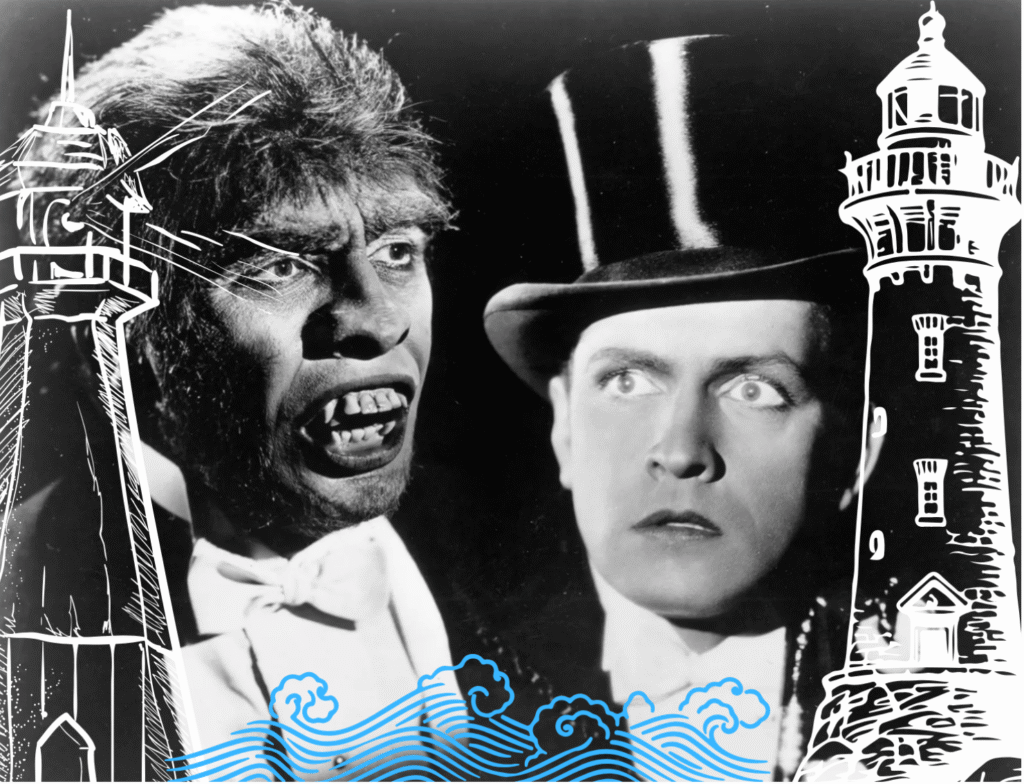
The wind that scours the basalt shoulder of Edinburgh’s New Town carries more than coal grit and North Sea salt; it bears an invisible catechism. Along Heriot Row the sober crescents rise with their measured windows, each façade squared like a moral proposition, while across the cut of what became Princes Street Gardens the Old Town climbs in a blackened spine, closes stacked upon closes, washing strung like flags of surrender above wynds where drains exhale and tenements lean together in whispered complicity. A child who walked between those ridges breathed a doctrine of divided being long before any pulpit or printed page named it. Robert Louis Stevenson absorbed that doctrine with every winter cough. Later readers have traced the dual architecture of Strange Case of Dr Jekyll and Mr Hyde upon Edinburgh’s own divided stone, seeing Jekyll as New Town physician and Hyde as Old Town reveller, the front door upon the square and the back door upon the alley. That reading charts the surface. Beneath it, within the cabinet where the doctor’s powders waited in their labelled jars, Stevenson smuggled a stranger claim, one that his century scarcely possessed a language to receive: salvation resists standardisation because the soul depends upon accident, upon an “unknown impurity” in the very salt of its being.
Before Hyde stamped his small, savage footprint on a London pavement, another figure towered over the Stevenson imagination: the lighthouse keeper. The boy’s lineage ran outward along the ragged coasts of Scotland to Bell Rock, Skerryvore, Muckle Flugga—names that sound already like hexes against chaos.1 Each tower rose from the sea as a rational column driven into madness, courses of dressed stone keyed against Atlantic rage, crowned with rotating lenses that bit the darkness into measured beams. Thomas Stevenson, Louis’s father, devoted his life to such structures, publishing treatises on wave action, harbour works, and optics, and he bound those calculations to an ethic of almost sacerdotal gravity.2 The keepers “served,” as the son later recorded, under rules that governed conduct as strictly as any catechism; one trimmed the lamp with the same seriousness that a minister raised the host.3 The lighthouse expressed a Victorian confidence that chaos yielded to the right combination of mathematics, labour, and machine. Storm, fog, and reef behaved as problems within an equation. The young heir grew in a nursery where drawings of lantern rooms and sea-washed rocks lay beside Pilgrim’s Progress, and where a certain piece of furniture—a cabinet made by Deacon Brodie, the respectable craftsman and nocturnal burglar—quietly announced that every structure harbours a second history.4
That double inheritance—engineered light and criminal carpentry—shapes the architecture of Jekyll’s house and Jekyll’s ambition. By the time Stevenson wrote the novella in a Bournemouth fever, the son had renounced the stern Presbyterianism of his nurse Cummy and the professional gospel of his father.5 He drifted instead toward dreams, feuilletons, sea tales, and a self-education in European thought. Yet the engineer’s instinct never entirely drained from his blood. Jekyll, as narrator of his own disaster, speaks like a man trained to think in mixtures, proportions, and tolerances. He describes his moral conflict in terms of “polar twins,” then records a resolve to “shake and pluck back that fleshly vestment” and divide his being into separate elements, so that “the just might walk steadfastly and securely upon his upward path,” no longer dragged through disgrace by the other self.6 The rhetoric smells of disinfectant and street-planning. Jekyll dreams of a psychic New Town: avenues of clean intention, passions confined to their proper conduits, conscience circulating along gas-lit terraces. He seeks to become the Thomas Stevenson of his own interior world, a designer of breakwaters raised against every interior tide. Chemistry, within that fantasy, supplies the modern sacrament. The draught in the glass replaces the communion cup; the laboratory bench supplants the family pew.
Stevenson surrounds that sacrament with a city that behaves like a machine for concealment. The opening trampling incident unfolds beside a sinister door in a back street, a door that belongs, as readers later learn, to the rear of Jekyll’s own house. Hyde passes through it as if moving along a hidden service corridor of the self. The respectable front entrance admits Utterson and the dinner guests; the back admits impulses and experiments. The same address thus offers two civic faces, as Heriot Row and the Lawnmarket once offered two moral climates along the same ridge. Yet the moral pressure within the tale exceeds simple opposition between square and slum. Stevenson peoples the narrative with professionals of the new metropolis—lawyer, doctor, chemist, servant, bank clerk—each enmeshed in a system of documents and offices. The cheque that compensates the child’s family carries Jekyll’s name; the will that favours Hyde bears legal weight; Lanyon and Poole exchange sealed packets according to specified conditions. Identity circulates through paper. Jekyll’s experiment enters this bureaucratic network as an internal reform: a project for the rationalisation of conscience, undertaken with the same chill faith in process that his father once brought to a tidal survey.
The crucial scene arrives late, when the apparatus begins to fail. Hyde surfaces more readily, unbidden even during Jekyll’s waking hours. An afternoon in Regent’s Park dissolves, and the doctor finds, to his own astonishment, the shorter hand, the bestial configuration, the clothes hanging loose upon a new frame. He scrambles home, mixes the potion, drinks, resumes his old stature; yet the margin of control has thinned. The entire edifice of his plan now depends upon the supply of a certain crystalline salt stored in drawers and cupboards. Stevenson records the crisis with unusual precision. When the stock runs low, Jekyll orders more from his usual chemist, insisting upon the same quality. The replacement arrives, white and chemically “pure,” and the potion refuses to work. Further orders from other firms produce identical results. Only then does Jekyll perceive that his first batch must have carried some unrecognised contamination—an “unknown impurity” that created the necessary reaction between body and draught.7 Hyde, that impossible offspring of a Victorian conscience and a Victorian laboratory, emerged due to a flaw in the materials. The engineer’s son silently inverts his inheritance: the tower stands, the lens turns, yet the flash owes its existence to a microscopic crack.
Inside that speck of foreign matter, Stevenson plants his most subversive theology. Edinburgh Calvinism had taught the Stevenson household that the universe divides between Elect and Reprobate, two predestined orders. The lightkeeper’s vocation harmonised with such belief: an illuminated tower upon a dark sea, a chosen beam among doom-laden waves. Henry Jekyll follows the same diagram yet secularises its terms. Through science he attempts to generate a permanent state of election—an existence where the “just” portion of himself enjoys every upper room, while the “sinner” portion, quarantined and expendable, endures its own fate. The experiment aims at a kind of manufactured grace. The failure of the salt devastates that ambition at the level of principle. For Jekyll the revelation carries a sting sharper than any fear of punishment: his entire project rested upon a contingent accident. Salvation, or whatever passed for salvation in his scheme, emerged through error in the reagent, through some grain that defied assay. In other words, the self does not reduce to a recipe. The elusive element within character, the spark that permits any transformation, belongs to history, chance, and the dirt of the world. Pure salt means paralysis. Impure salt means life—catastrophic, volatile, yet alive.
Viewed through this lens, Hyde ceases to resemble a ready-made demon distilled from Jekyll’s veins and begins to display the jittery profile of unleashed energy. Jekyll, within his confession, repeatedly calls Hyde “pure evil,” and generations of readers have accepted that name through the authority of the dying narrator. Yet the record presents a figure more disconcerting than a theological abstract. Hyde treads with a “light step”; he carries a “flush of pleasurable anticipation”; he experiences thought as “a current of disordered sensual images running like a mill-race.”8 His violence appears impulsive, kinetic, almost mechanical—an over-charge arcing through a conductor. In social terms he resembles the new engines of the age: railway locomotives, steam hammers, rotary presses, each capable of dawn-to-dusk labour yet prone to shattering any body that blunders into their path. Hyde’s trampling of the girl and clubbing of Sir Danvers Carew express a kind of emotional overvoltage. He embodies the “force” that Jekyll’s previous life had channelled through propriety, medicine, philanthropy, and secret vice in outlying streets. Once the experiment attempts to cleave the force from the form, the result splits into a hollowed husk (Jekyll, increasingly spectral) and a runaway current (Hyde, increasingly ungovernable). Stevenson’s inheritance from lighthouse engineering surfaces again here. A tower without flame serves as monument; a flame without tower becomes wildfire. The one requires the other, or both slide toward disaster.
The furniture of the story whispers the same doctrine. The cabinet where Jekyll drinks his draught and writes his last confession recalls, in uncanny miniature, the wardrobe that haunted Stevenson’s own childhood—a piece crafted by Brodie, who fashioned elegant interiors for Edinburgh citizens while climbing their drainpipes under moonlight.9 That blurred boundary between respectable object and criminal provenance imprints itself upon the tale’s central space. Jekyll’s cabinet functions as sanctuary, laboratory, and eventually tomb. Inside its walls the doctor believes he can awaken Hyde without social consequence, as though doors and locks could insulate action from community. Yet the wood carries memory; the architecture remembers its builder. The impurity he tries to expel from his character has already seeped into panelling and frame, into the concrete history of the room. Stevenson suggests that material culture stores human contradiction in its very grain. Cities, furniture, and even chemical stocks bear traces of previous hands and accidents. No New Town fully escapes Old Town timber. Every engineering project rises atop forgotten debris.
Around that haunted furniture Stevenson arrays a set of voices whose very arrangement testifies to the age’s mania for classification. The narrative reaches the reader through a dossier: Enfield’s anecdote, Utterson’s investigations, the maid’s deposition, Lanyon’s sealed letter, Jekyll’s “Full Statement of the Case.” Each document enters at a prescribed moment, under legal or quasi-legal conditions. Truth appears scheduled. The structure resembles a filing system in chancery or a board of inquiry into a maritime disaster, where evidence arrives through sworn testimony and one final envelope opens the inner compartment of the event. Hyde himself never dictates any portion of this archive. He writes, when he writes, in Jekyll’s hand, parodying the doctor’s script upon the laboratory wall or forging notes to mislead the lawyer.10 Hyde therefore occupies the realm of the oral, the unsanctioned, the screaming body caught in the flash of lamplight. The “unknown impurity” inside the salt acquires, in this light, a second meaning: the singular voice that eludes administrative categories. Every new batch of perfect crystals, ground to a uniform standard, excludes that voice. Jekyll’s late recognition that he cannot reproduce his original transformation parallels a deeper recognition that procedures, formulas, and statements fail to capture the grain of experience.
Within that failure Stevenson sketches, almost in passing, a philosophy of history. Victorian Britain trusted in taxonomies—social, biological, legal, imperial. Species, criminals, colonies, even emotions appeared subject to classification. Jekyll’s experiment seeks a comparable mastery of time: a permanent arrangement in which he lives as benefactor and physician while Hyde enjoys quarantined periods of indulgence elsewhere. The unknown impurity tears through that fantasy. It reveals that every age, every self, every city rests upon intractable remnants from an earlier configuration. Old Town fed New Town with servants and scandal; storm fed lighthouse with purpose; childhood tales of hell fed adult nightmares of Hyde. Stevenson names this entanglement through a different image in another context—a “compass without north,” a device that spins under the pressure of competing poles, unable to settle into any single orientation. Henry Jekyll, in his final months, handles such a compass within his own chest. Good and evil refuse to stand at opposite ends of an axis. They braid like currents within the same estuary. To cut one strand, he discovers, unravels the whole rope.
In that sense Strange Case of Dr Jekyll and Mr Hyde performs a requiem for the Victorian dream of mastery at the very height of its confidence. The novella mourns the lighthouse without condemning it, honours the law office while exposing its blindness, respects medical skill while tracing the tremor in the surgeon’s fingers. Jekyll perishes not as a monster devoured by his appetites, but as a professional undone by the limits of his own method. He trusted in repeatability, in the engineer’s faith that a process, once discovered, could be scaled and standardised. Stevenson grants him a single, terrible exception. That first jar of salt refuses to recur; its impurity belongs to the world’s messy specificity. Through that grain, through that irrecoverable difference, the soul enters history. No formula secures it, no institution entirely contains it, no front door fully screens it from the back court where children wake to Hyde’s trampling step.
On a December evening in Samoa, years after lighthouses and lawyers had receded behind palms, Stevenson collapsed with a bottle of wine in his hand as he spoke to his wife, and a blood vessel in his brain opened like a trapdoor. Village bearers carried his body up Mount Vaea by torchlight. The epitaph he had already written waited for the stone: *“Home is the sailor, home from sea, and the hunter home from the hill.”*11 Sailor and hunter share one body there, diligence and appetite joined in a single homecoming. The line completes the insight that burned through the cabinet in Jekyll’s last night: human integrity arrives through integration, through the acceptance of mixed grains in the salt-cellar of the heart. Edinburgh’s wind still moves between New and Old Town; the Stevenson towers still sweep their beams over dangerous water. Yet the most enduring light from that family now arises from a different apparatus: a slim volume in which an “unknown impurity” sabotages every dream of purity and, in the same movement, rescues the soul from becoming a diagram. The heart burns, in Stevenson’s vision, through impure combustion. Safety belongs to machines and tombs; life belongs to those who endure the unpredictable flame.
Notes:
1 Records of a Family of Engineers, Robert Louis Stevenson, ed. David Stevenson, James R. Osgood, Boston, 1879, pp. 3–57.
2 Lighthouse Construction and Illumination, Thomas Stevenson, Adam and Charles Black, Edinburgh, 1881, pp. 1–22.
3 Records of a Family of Engineers, Stevenson, pp. 61–82.
4 Deacon Brodie: Father to Jekyll and Hyde, John Fyfe, Mainstream Publishing, Edinburgh, 1997, pp. 15–33.
5 Robert Louis Stevenson: A Biography, Claire Harman, HarperCollins, London, 2005, pp. 27–68.
6 The Strange Case of Dr. Jekyll and Mr. Hyde, Robert Louis Stevenson, Longmans, Green, and Co., London, 1886, pp. 104–107.
7 Stevenson, The Strange Case of Dr. Jekyll and Mr. Hyde, pp. 132–135.
8 Stevenson, The Strange Case of Dr. Jekyll and Mr. Hyde, pp. 109–111.
9 Fyfe, Deacon Brodie: Father to Jekyll and Hyde, pp. 41–56.
10 Stevenson, The Strange Case of Dr. Jekyll and Mr. Hyde, pp. 118–123.
11 Vailima Letters: Being Correspondence Addressed by Robert Louis Stevenson to Sidney Colvin, ed. Sidney Colvin, Methuen, London, 1895, pp. 279–283.