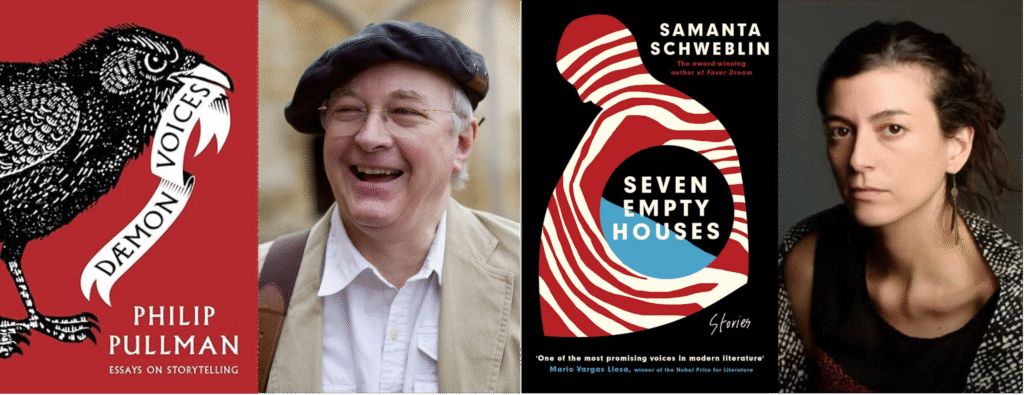
“Philosophy is the art of dying. In learning how to die, one learns how to live.”¹ Simon Critchley’s sentence rises over the present like a pale winter sun, cold yet clarifying, and under that austere light two adolescents stand in different hemispheres: an English schoolboy in a North Welsh classroom, wrists speckled with ink, discovering Paradise Lost as if an electric storm had entered the room, and, far south, an Argentine girl on a bus from Hurlingham to Buenos Aires, watching the border where a pharmacy’s neon glare collides with a makeshift paddock of chickens and tethered horses, the asphalt still wet from a recent shower. Philip Pullman and Samanta Schweblin step into literature from those divergent thresholds—one through the long shadow of empire and Anglican hymnody, the other through the afterglow of dictatorship and commuter suburbs—yet both learn, with unusual intensity, that a life acquires meaning only when one reads every ordinary object as if an ending already presses against it.
Pullman arrived in the world in Norwich during the exhausted aftermath of the Second World War, child of an RAF pilot and a mother who followed the military routes that linked Britain with Southern Rhodesia, Australia, Kenya, and the clouded Atlantic; his father’s death in an air crash during operations connected with the Mau Mau uprising folded personal grief into the oblique rhetoric of colonial “service”, a rhetoric that praised sacrifice while veiling the brutalities of counter-insurgency.² The boy then lived between the clerical rectory of his grandfather in Norfolk and the grey-green landscape of North Wales, an educational path that ran through Ysgol Ardudwy and later Oxford, where English literature offered him both shelter and flint.³ In that mixture of RAF nostalgia, Anglican liturgy, and late-imperial unease, one senses the germ of the Magisterium and its bureaucratic pieties. Schweblin, by contrast, grew up in the Buenos Aires province during Argentina’s re-democratisation, the so-called transición that followed the junta’s fall; she studied film at the University of Buenos Aires, trained her eye on framing and montage, and rode through neighbourhoods where middle-class apartments faced informal plots filled with animals and machinery.⁴ In family conversations about the disappeared and in the quiet dread of economic collapse, domestic interiors acquired political charge. Pullman’s childhood taught suspicion of sanctified authority; Schweblin’s educated her in the uncanny within the familiar. Both respond by filling their fiction with rooms that pulse against their walls.
When Pullman launched The Book of Dust with La Belle Sauvage, he returned to Lyra’s world at an earlier historical temperature and yet a hotter metaphysical climate.⁵ The novel drenches Oxford in a flood whose waters rise with theological as well as ecological menace, and the boy Malcolm, paddling his canoe through submerged suburbs, sees the end of a certain social arrangement in the slow drowning of roads, garden walls, and shopping parades. The eschatological impulse here refuses heavenly spectacle and instead attends to infrastructure: sodden bricks, compromised bridges, the eerie silence of upper-storey windows where curtains cling to the glass like drowned veils. Dust, the charged particle field that undergirds Pullman’s cosmos, thickens around conscious life as a luminous sediment of thought and desire; the Magisterium seeks to halt its circulation, while secret scholars attempt to understand its drift. Subsequent volumes—The Secret Commonwealth and The Rose Field—carry Lyra across railway corridors, refugee encampments, and desert shrines, as rose oil emerges as both commodity and sacrament, subject to smuggling, monopoly, and prophetic rumour.⁶ Dust passes through all these sites as silent adjudicator, favouring curiosity and imaginative generosity, withdrawing from cruelty and instrumental thinking. In a century saturated with data and climate anxiety, Pullman offers Dust as an image of the world’s response to attention: a universe that ripens when regarded with love and contracts when subjected to surveillance or dogma.
Pullman’s well-known declaration of himself as a “Church of England atheist” emerges less as a contradiction and more as an autobiographical koan. His imagination bears the imprint of the 1662 Book of Common Prayer and the King James Bible, yet his distrust of transcendent rulers springs from family loss tied to imperial ventures and from a teacher’s lifetime spent among children whose futures suffered under narrowing regimes of examination, inspection, and league tables.⁷ Within His Dark Materials and The Book of Dust, the Magisterium functions as a fusion of church, state, and corporation, an apparatus that treats human beings as variables in an enormous doctrinal experiment. Achille Mbembe’s description of modern power as a management of death—necropolitics, the right to expose certain populations to slow or spectacular destruction—gives analytical grammar to that institution’s behaviour.⁸ Pullman answers such power with the most intimate of inventions: daemons. Each daemon, the visible animal companion of a person’s inmost self, arrives as fur, feather, or scale; children’s daemons shift shape until adolescence, when they settle with a small, seismic sense of irreversibility. Any regime that severs children from their daemons, as in the experimental station at Bolvangar, reveals its will to extinguish precisely that inner freedom which Dust seeks. The eschaton in Pullman’s universe therefore concerns the fate of embodied subjectivity: whether the human creature will live entangled with animal kin, place, and story, or will yield to a clean, murderous abstraction.
Samanta Schweblin composes her own apocalyptic miniatures at a different scale. In Little Eyes—first published in Spanish as Kentukis—she introduces a consumer gadget whose apparent innocence conceals a vertiginous transformation of intimacy.⁹ The kentuki, a soft-bodied mobile toy shaped like a rabbit, mole, or dragon, houses a camera in its face and a speaker in its belly; one person purchases the device and hosts it at home, while an entirely different person somewhere across the world buys a code that allows remote inhabitation of that body. Schweblin cuts between keepers and dwellers in short, filmic chapters: a Peruvian girl glued to the kitchen of a foreign single father, an elderly European woman who treats her kentuki like a surrogate child, a man whose voyeurism curdles into harassment. The book performs a delicate inversion of Pullman’s daemon logic. Where daemons emerge from an organic bond that precedes all contracts, kentukis emerge from the market, travel through cloud servers, and never quite belong to those who feed or control them. Rosi Braidotti’s description of contemporary subjectivity as “posthuman”, dispersed among technologies, animals, and planetary forces, finds uncanny embodiment in these plush little vehicles.¹⁰ A kentuki always involves at least four agencies—host, dweller, device, and corporation—and no character fully grasps the arrangement. Tenderness, exploitation, boredom, and devotion flow along those circuits in equal measure.
Schweblin’s earlier collection Seven Empty Houses keeps screens largely outside the frame and attends instead to walls, gardens, clotheslines, and cars, yet the sense of an approaching judgment echoes through every story.¹¹ The seven dwellings of the title remain empty only in a superficial ledger of occupants; each space brims with unsaid grievances, small insanities, class disgust, and grief that seeps into furniture. In “None of That”, a mother and daughter drive through wealthy neighbourhoods, at first circling slowly to gaze at other people’s houses, then nudging garden ornaments out of place, and finally invading a home to pocket a minor trinket. An apparently trivial sugar bowl breaks the spell of docile envy and opens a more turbulent relation with property. Across the collection, ageing parents, bored spouses, and sick children inhabit domestic arrangements that wobble under the weight of expectation. Lauren Berlant’s phrase “cruel optimism” describes attachments to fantasies of the good life—stable family, respectable home, upward mobility—that in fact impede any lasting flourishing.¹² Schweblin stages those attachments inside rooms where an object goes missing, a neighbour lingers on the pavement, a garment hangs too long on a chair, and the reader feels an almost physical pressure, as if the house itself desired confession. Argentina’s past haunts these scenes: during the military regime, homes served both as shelters and as theatres of terror, and the unspoken histories of disappearance vibrate behind Schweblin’s quietest images.
Pullman and Schweblin therefore share a peculiar eschatological instinct. Both treat the end of the world less as a single catastrophic rupture and more as a crisis in the way humans pay attention to their surroundings. In Pullman’s universe, Dust thickens around those who imagine, love, and question, while it thins around institutions that treat living beings as instruments. In Schweblin’s, emptiness creeps into houses whose inhabitants cling too tightly to hollow ideals, while kentukis proliferate in cultures that treat surveillance as affectionate presence. The contemporary social field, saturated with data, precarity, and overlapping emergencies, gives both writers their material. Each household becomes an observatory of structural forces: climate breakdown, platform capitalism, the unresolved legacies of empire and dictatorship. When Lyra travels among migrants and oil speculators, when Schweblin’s characters engage in small acts of trespass or digital exhibitionism, the scene enters direct conversation with cultural studies concerns about biopolitics, media ecologies, and the commodification of care.
The historical paths that produced these imaginations, though dissimilar, converge upon the present. Pullman’s formative decades passed through the long recoil of Britain from imperial centre to anxious archipelago, through the educational reforms of the Thatcher and Major years, through debates about secularism, censorship, and children’s reading. He studied English at Exeter College, Oxford, encountered Milton and Blake at close quarters, and soon taught in middle schools where he retold Homeric epics for pupils aged nine to thirteen.¹³ His fantasy grew directly from that classroom practice: stories that smuggle arguments about theology, authority, and freedom into narratives of adventure. Schweblin, for her part, studied amid Argentina’s waves of privatisation and crisis, in a university culture where film theory, psychoanalysis, and political philosophy mingled, then moved to Berlin, a city layered with its own memories of walls, secret police, and divided apartments.¹⁴ Together, these biographical trajectories shape two complementary diagnostic tools for reading late modernity: Pullman’s large-scale mythic machinery, and Schweblin’s microscopic fictions of everyday rupture. Contemporary philosophy—Barad’s entanglements, Braidotti’s posthumanism, Berlant’s precarious intimacies, Mbembe’s necropolitical governance—offers vocabulary for what both already stage in narrative form. Dust behaves like an “agential” field of matter; kentukis expose the posthuman assemblage of flesh and code; empty houses dramatise the cruel optimism of suburban aspiration; the Magisterium and its paramilitary arms operate with chilling necropolitical logic.
Amid such theoretical correspondences, small biographical details acquire unexpected weight. Pullman, a supporter of Norwich City F.C., once contributed affectionate prose to the club’s history and speaks often of his pleasures in tinkering with carpentry, model-making, and his own illustrations; these hobbies tether his public role as grand myth-maker to the textures of English provincial life, of terraces, sheds, and hobby shops near the cathedral close.¹⁵ Schweblin, during a stay in Patagonia, found herself in a wooden cabin with sparse furniture, surrounded by rain and mud, and glimpsed in the mirror a figure straight from a Shirley Jackson story—hair unbrushed, gumboots splashed, mate gourd clutched in her hand—which sharpened her sense of kinship with North American domestic gothic.¹⁶ Pullman’s desk contains railway timetables and Biblical concordances; Schweblin’s notebooks carry fragments about robot vacuum cleaners that behave like pets, seeds for the kentukis’ strange tenderness. Such trivia, far from offering ornamental garnish, reveal how metaphysical fiction germinates in local habit. A football chant, a leaking roof, a nickname for a household appliance: each may furnish the image that condenses an entire eschatology.
Read together, Pullman and Schweblin demonstrate how contemporary narrative can serve as an “art of dying” in Critchley’s sense. Their characters learn, with reluctance, to allow certain worlds to end: Lyra must relinquish the comfort of adolescent certainties about rational disenchantment and recover a chastened romanticism; Schweblin’s wandering mothers and daughters must release their grip on images of respectability that suffocate love. In a social order saturated with end-time discourses—climate deadlines, democratic backsliding, economic tipping points—their work refuses both apathy and apocalyptic intoxication. Instead, they insist on difficult, granular attention to who bears the cost of each ending and which attachments deserve to pass through catastrophe into an altered future. The child and daemon climbing into a canoe above a flooded city, the girl in a cramped apartment entrusting her feelings to a plush camera-creature, the woman who pockets another family’s sugar bowl as if seizing a new fate: such figures stand at the frontier where theology, philosophy, and cultural analysis already intermingle. They remind us that an eschaton always begins in a room, with a small decision over how to treat a vulnerable being—human, animal, mechanical, or spectral—and that in those decisions, repeated across millions of houses and screens, a civilisation learns how to die and, with luck, how to live beyond its previous self.
Notes:
1 The Book of Dead Philosophers, Simon Critchley, Granta, London, 2008, p. 4.
2 Daemon Voices: Essays on Storytelling, Philip Pullman, David Fickling Books, Oxford, 2017, pp. 15–23.
3 Paradise Lost, John Milton, ed. Alastair Fowler, Longman, London, 2007, pp. xiii–xxii.
4 Pájaros en la boca y otros cuentos, Samanta Schweblin, Emecé, Buenos Aires, 2009, pp. 187–193.
5 La Belle Sauvage: The Book of Dust Volume One, Philip Pullman, David Fickling Books & Penguin Random House, London, 2017, pp. 1–37.
6 The Secret Commonwealth: The Book of Dust Volume Two, Philip Pullman, David Fickling Books & Penguin Random House, London, 2019, pp. 241–289; The Rose Field, Philip Pullman, David Fickling Books & Penguin Random House, London, 2025, pp. 52–79.
7 His Dark Materials, Philip Pullman, Everyman’s Library, London, 2011, Introduction, pp. ix–xxv.
8 Necropolitics, Achille Mbembe, trans. Steven Corcoran, Duke University Press, Durham, 2019, pp. 66–78.
9 Little Eyes, Samanta Schweblin, trans. Megan McDowell, Oneworld, London, 2020, pp. 3–45.
10 The Posthuman, Rosi Braidotti, Polity Press, Cambridge, 2013, pp. 55–84.
11 Seven Empty Houses, Samanta Schweblin, trans. Megan McDowell, Riverhead Books, New York, 2022, pp. 1–35.
12 Cruel Optimism, Lauren Berlant, Duke University Press, Durham, 2011, pp. 1–33.
13 His Dark Materials: The Subtle Knife, Philip Pullman, Scholastic, London, 1997, Author’s Note, pp. 279–282.
14 Kentukis, Samanta Schweblin, Literatura Random House, Barcelona, 2018, Afterword, pp. 225–231.
15 Daemon Voices: Essays on Storytelling, Philip Pullman, David Fickling Books, Oxford, 2017, pp. 257–263.
16 We Have Always Lived in the Castle, Shirley Jackson, Penguin Classics, London, 2009, Introduction, pp. ix–xv.