The key in the lock made a metallic clink, but it was different from those you usually hear when a key turns in a mechanism—less a grind than an attempt to start a conversation, one that did not come to fruition because the bolt gave way and obedient hinges allowed the door to open into the house. Yes… houses have their habits and preferences, and this one liked its occupant and never teased him. And believe me, if it had wanted to, it would have been more than a disaster. So, as always, the house welcomed its man, who had made Edinburgh the essence of his life and work—one could say that he carried the city within him, and this was confirmed by every word he spoke or wrote… The fire crackled in the fireplace, and warmth spread pleasantly throughout the study the man entered. He immediately headed for the table that dominated the room, its wide top stretching out like a plain impatiently waiting for the hooves of wild horses galloping towards the setting sun… Or perhaps it was simply a modest lamp without a shade, where an exposed bulb pretended to be the one. And in the warm, yellowish light of the bare lamp, a pen waited—velvety; the man’s hand—soft, a hand that had never known hard work—returned and reached for it… He picked it up, checked the nib on blotting paper, and began to write. As the ink thickened under his wrist, the winter city took shape where stone carried soot on its tongue, walls narrowed the streets until they guarded their secrets, footsteps remembered warm shoes and arguments, and the sky leaned in to listen. When the page stiffened and the sentence formed into stairs, the stairs carried him down until the wooden air breathed yeast, damp wool, and the warmth of bodies that had just departed. His coat held back the cold for a moment as the page, having welcomed its guest, changed the temperature of his blood.
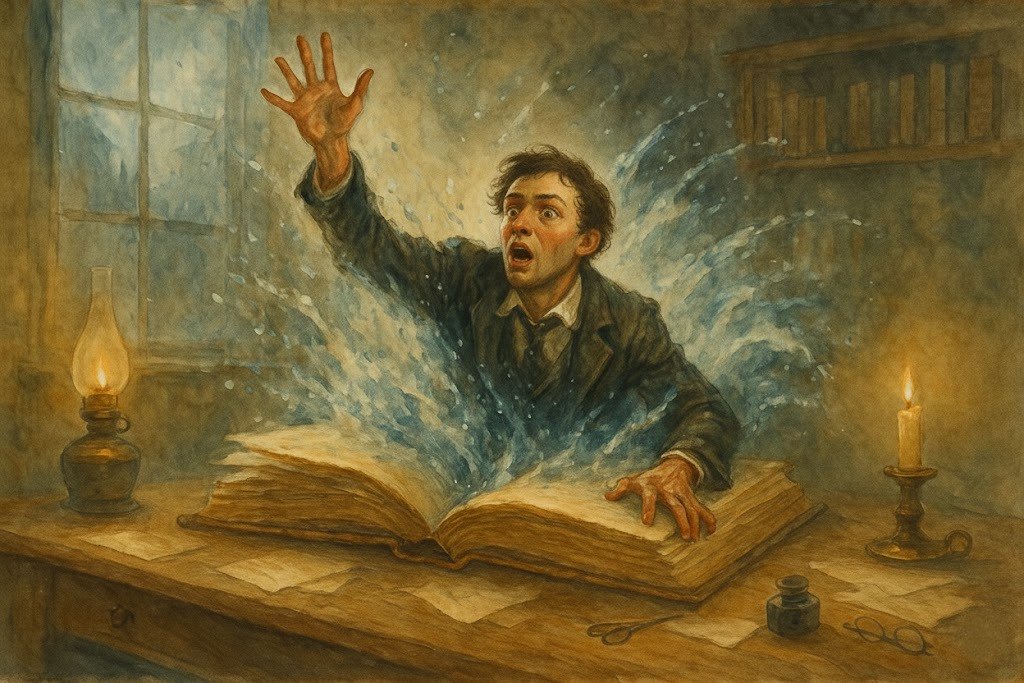
He arrived as a girl whose name wavered when spoken, a flitter on the tongue that sought consonants and found none it trusted. Elspeth, nearly said, and then a hush, as if the air drew back from committing. Her height shifted by thumb-widths, her hair kept two colors at once and allowed light to decide each hour, her profile slipped in and out of clarity as a reflected face does when a boat rocks at its mooring. A body wants coherence before courage; she felt half-formed joints complain like doors that had made it only halfway to their frame. In the vaults under South Bridge, the smells bargained for dominance—malt, river-sour stone, old smoke, a thread of lamp oil—while somewhere above, the sound of a cart insisted on its right to measure distance. The man inside her skull reached for his own hands and met wrists thin as swan-bones. He swallowed, and the swallow belonged to her. He named himself in silence—Martin Smallridge—and the name set no weight in the air. The book carried the weight now.
A heel struck behind her, crisp and assured, the kind of heel that assumes obedience from floors. Lachlan MacUndone climbed into view with a hat brim that curtailed argument and a coat that took up its own charge of authority. His gaze counted things and found each ready for use. He brought his own draught of weather into the passage, and the lamp flinched, as if the flame, too, preferred to keep out of his file. Two souls followed as satellites: Inspector Catriona Vale, cheekbones cut by a sculptor who believed in geometry, and Constable Stubbs, a man poured from a single ladle. Vale glanced at Elspeth and smiled in a way that welcomed and demoted with the same curve.
—On your feet, little string, said MacUndone, a voice like brass polished by a sleeve. He extended a finger toward the dark. —Our corpse enjoys a talent for misdirection. You enjoy a talent for offering the wrong question at the right time. Both talents serve a purpose.
—She enjoys a talent for vanishing as well, said Vale, who admired her own profile in every reflective surface, including men. —Which spares us the trouble of dismissal on occasion.
Elspeth stood. A tremor announced itself from ankle to rib, and she chose to let it travel. The writer measured the quiver, traced it on the inside of her skin, and felt his own habits reach for counsel; counsel arrived as a kind of delay. He pressed his tongue to the roof of her mouth and set a word there as a wedge against fear: work. The word made no remark to the others; it spoke only to breath.
The vaults opened into a room where barrels had retired into duties as tables, and every table carried a witness: a pipe scar, a ring of dried ale, a notch carved by someone who wished to mark height for a child. A boy of eighteen lay in the center upon a door ripped from its hinges, his trousers marked by ash and a smear like the drag of a finger through soot. His hands had set into a prayer that asked for a bowl. A chalk circle surrounded his boots. Beside the door, a wedge of raw tallow burned with thrift and determination. MacUndone circled the boy with the patience of a pensioner testing the soundness of a bench before sitting. Stubbs wrote in a notebook the color of old bread. Vale found a place where her heels could announce her presence in equal measure with the dead.
—A ring for a ring, said Vale, the chalk in her eye like a toy she might pocket. —Whoever drew that boundary admires a stage.
—Whoever drew that boundary admires leverage, said MacUndone, and the word left his mouth with a small private smile at its double life. —Step in, Elspeth.
Her foot hovered. She carried no shoulder in which a teacher had whispered a rule; her gestures often arrived as guesses. She chose the line nearest the boy’s ankle and put her heel down on the chalk. The circle refused her weight. The chalk remained whole. The tallow flame elongated itself like a note held past prudence. She reached toward the door-plank and felt grain rise under her palm to greet her as a familiar. The boy’s fingers, joined as if for a catechism, hid a fold of paper between knuckle and thumb. She worked it free with a care that remembered nurses and mothers, though no face within her offered a memory. The fold unfurled: Undone to be done; lungs for a ladder; touch the smoke where sentences bend; pay the Editor his nine commas.
Stubbs squinted as if letters struggled to remain in place in his mind.
—He writes in riddles, said Vale. —The class that loves riddles also loves leaving other people with chores.
—He writes in hunger, said MacUndone. —Which improves handwriting. Pass it here, girl.
She withheld for half a breath and then handed the paper. The breath mattered; it taught a small lesson: a person grows a piece when a person holds a thing that other hands expect to claim. Her palm kept the feel of the fold—its oily corner, its crease with a memory of heat—and that kept her in the frame a degree more.
The book’s basement learned to make its own weather. A mist like washed milk formed around the lamp and leaned inward until faces arrived at the same distance in which mirrors begin to feel crowded. From that mild fog stepped a man whose clothes carried a faint metallic sheen, as if woven from filings. He moved with the calm of a clerk who believes in counters and drawers. A chain at his waist linked to nothing visible, and yet it checked his stride, as if each step borrowed permission from a sentence in another room.
—Nine commas receive the debt, said the man. He smiled like someone who preferred ledger-paper to sunlight. —A full line earns credit. Fragments incur fees. The name reads Editor to those who care about manners. Payment arrives in punctuation or breath.
—Breath shifts value when spent on you, said Vale without turning her head. —Bring your own.
—I attend where language breaks its oath, said the Editor with equanimity. —The oath breaks when distance collapses. A writer collapsed a distance today. Accordingly, a fee accrues.
Elspeth felt each word in the jaw hinges where the man behind her teeth prepared answers. The man wished to parley. The girl wished to avoid being used as a mouthpiece. The first wish fitted into the second like a ring slipped onto a finger without consent. She spoke anyway, since silence already asked her to serve.
—The breath lies in my chest, she said. —You will take nothing while it serves work.
—A brave line, said the Editor, who enjoyed bravery chiefly when it accounted for costs. —The case requires you. The case will feed me. A fair exchange, if we keep the numbers clean.
MacUndone eased his hat down until the brim shadowed his eyes, a move that always contented him, since it allowed him the upper hand without changing a word.
—We set the rate, he said. —We keep the pace. You will stand aside until called. London sends me to cities where conscience requires hired muscle; you take a number like the rest, sir.
—London sends many things, said the Editor, who much preferred Edinburgh’s stone to London’s smoke. —Some of them wear hats.
The fog retreated as if embarrassed by its own theatrics. The tallow flame shrank to a pin. The boy on the door remained an argument that expected an answer by dawn. MacUndone turned on his heel and declared a plan with the simple grace of someone who received deference as a part of breakfast. Elspeth walked behind him where air gathered after power passed. She noticed that Vale had a gift for letting laughter fill a room like scent even when her face stayed with a cooler shape, and that Stubbs drank with his eyes before he ever lifted a cup. Completed people own easy weight. Incomplete people carry a keen edge. Her own edge pressed the borders of her body and moved the world by millimeters.
Crooked ways under the High Street labyrinths accepted her with the queer friendliness of a place that always expected a stranger to arrive. Steps yielded with a sigh at Foot of Fleshmarket Close; a bolt smell rose where a door kept secrets on both sides; a child’s chalk on a wall laid out a hopscotch grid whose last square read Heaven with an artist’s curl under the H. A woman in a shawl watched from a doorway, her hands in the position of someone who counts coins by touch while speaking about anything except money.
—You work late, hen, she said to Elspeth, because the city teaches civilians to recognize police by posture. —If a man with a cane offers guidance, choose sickness for an excuse. His cane carries a snake for a cap, and the snake smiles.
—I prefer maps with fewer snakes, said Elspeth.
—Maps love snakes, said the woman. —Snakes keep cartographers in work.
They came upon a door chalked with a sigil like a child’s windmill; a faint whiff of arsenic lay in the grain. MacUndone grinned without opening his lips and drove his shoulder into the wood. The lock agreed with the shoulder’s argument. Inside, a little theater arranged itself by habit: pews from a retired chapel, velvet that had once covered something holy, a curtain that learned deceit where it hung. On the stage a man in a plaid waistcoat opened a box with a flourish and invited a skull to rise from velvet and grin for applause. The skull complied only halfway, as if it felt itself miscast.
—True Edinburgh trick, said the showman, whose card named him Ferrand the French, though his vowels served Leith. —Raise the dead with a healthy sense of thrift. I charge a penny for a quarter of a resurrection.
—You owe me three quarters then, said MacUndone, stepping into view with a coat that carried an argument more persuasive than a magistrate’s speech. —Preferably paid in names.
—Names wear out with use, said Ferrand. —Customers arrive for mystery, sir, and leave with smaller purses. Why burden them with information as well?
—Because breath leaves quicker when names stay shrouded, said Elspeth before her resolve could ask permission. —Your skull’s jaw carries verdigris; your velvet sticks with sugar; your pockets ring with coin cut thin as honesty. A boy died on a door within a chalk circle. Help.
Ferrand stared with a mixture of annoyance and interest that masters of small rooms learn early, since survival pivots on attention.
—Little string has a song, he said. —Play on then. Downstairs, under the trap, a choir practices by silence. They call themselves the Quire of the Hollow Moon. The leader kisses a snake that ate its own tail and keeps his cane as a reliquary. He pays in commas and breath. I keep his stage dust-free. We both sleep well, in our different ways.
—Open, said MacUndone.
Ferrand opened. The trap breathed cool. A stair accepted the weight of four people and a borrowed courage. Elspeth went last, since the others owned bodies that required less thought to inhabit. The stair turned her ankles into instruments. Each step announced her as if the wood had whispered a little joke with her name inside, the sort of joke that grows less funny with repetition. At the bottom, a hall widened into a circle room. Its ceiling learned architecture from beehives. Candles discovered niches as if bees had marked points on stone for wax long ago. In the center a fountain coughed a slow cough, though no water gathered anywhere. The floor wore a mosaic of broken plates, a gallimaufry of cheap saints and expensive glazes.
The snake-capped cane leaned against a stool as a bishop might lean against a marble while waiting for a carriage. Its owner arrived with a cap of hair too black to trust and a smile that invited others to share in a joke at their own expense.
—Welcome to the school, said Alastair Greave, whose guild coat bore a soft sheen of success. —Lesson one: illusions earn more loyalty than facts. Lesson two: choose pupils who ask for calisthenics in their soul. As for you, little string, you arrive incomplete, which endears you to me. Incompletion brings pliancy.
—Completion brings cruelty, said Vale with casual charm, since she measured danger by its manners.
—Completion brings appetite, said Greave, and his smile warmed as a stove glows when fed.
MacUndone tugged his cuff until the linen sat like law at his wrist.
—You read your own lines with too much pleasure, sir. A stronger director should cut them.
—A stronger director already cut them, said Greave, glancing upward as if ink fell from ceilings. —And yet a child’s hand holds the scissors today. A twelve-year-old shakes the air above us with a pen like a tuning fork. The page listens. The page will tilt as she wishes. A charming situation.
The fountain hacked again, as if a throat had learned masonry. The Editor appeared with a chime of invisible coin.
—Fees collected soon, he murmured, his voice slipping into the mortar.
Elspeth faced Greave while MacUndone arranged men and exits in his head and Vale found angles for advantage. Stubbs looked brave in the way of a cart horse who has never refused a hill and has no intention of beginning. She raised her chin and wanted, for the first time, a strand of hair to reveal itself with fidelity. The want felt like thirst. The thirst tasted of childhood and a hand across a forehead that erased fever. A word arrived from nowhere, or from a kitchen in Portlaoise where a kettle clicked: Maria. The syllables set a bell in motion somewhere above stone.
A second bell followed, though it sounded of graphite on paper, of a child leaning across a desk in a room that carried her father’s absence the way a coat carries a shoulder’s shape long after the shoulder leaves. Maria held a page that ended mid-sentence because a man had walked into his own book and refused to step back. She read the last line aloud—a girl whose name wavered, a cane with a snake, a fountain that coughed—and enjoyed the taste of the words in her mouth. Then she frowned, because a frown helps a child decide where a story should land. She reached for a pencil and tapped it on the desk to wake luck.
She wrote: Elspeth’s hair steadied into a dark chestnut with a stubborn curl that refused pins when weather leaned damp. The line traveled down, sought its mark, and found scalp. Hair settled with relief across Elspeth’s neck as if it had waited for permission. She breathed, and breath decided to take up residence in earnest. She wrote again: Her voice carried an authority stolen from sisters who defended smaller brothers in alleys where laughter turned cruel, and from a mother who pressed a palm to a child’s eye and taught pain to climb down. Authority entered the throat and made a small home. Elspeth stood a fraction taller. The mosaic underfoot offered her a little more friction.
Greave raised the cane and let the snake kiss his knuckle. Words slithered from him with delicious economy.
—Every book births goats and sheep. I breed wolves for the thrill. Observe.
He struck the mosaic with the cane tip. Plates sang in twelve keys at once. From the beehive ceiling descended masks attached to nothing, smooth faces with holes where features should rise. They rotated slowly, like scholars choosing citations, and then chose speed with a sudden love for mischief. Vale stepped aside without fuss as one mask descended to meet her cheek; she offered it instead the heel of her glove and threw it to Stubbs, who caught it like a bowl and sat on it like a stool, which settled the matter. MacUndone drew a small knife from somewhere polite and committed accuracy with it, slicing a strap that had no visible beginning. Elspeth stood inside a ring of descending ovals and felt their blankness examine her. Blank meets blank with a greedy interest; she felt the pull.
From above: She learned to walk through crowding fancies the way a fisherwoman walks through gulls, with a shout that carries a piece of bread and a decent threat to those with sharper beaks. Maria wrote that without thinking, pulled by rhythm. Elspeth discovered that her mouth had already formed the shout. The masks paused, offended by the lack of deference. She stepped forward and raised a hand as if recommending a pause in a quarrel around a family table. The masks drifted backward with a little sulk, which emboldened her.
—You trade in borrowed faces, said Elspeth to Greave. —I carry one that earns itself as we speak. Place your wager elsewhere.
—A young person with a spine as she learns her name, said Greave, the smile dimming by a candle’s worth. —Charming. The child above edits you toward courage. Courage grows costly.
—Courage pays in breath that belongs to me, said Elspeth.
—Nothing belongs to anyone here without fees, said the Editor, whose ear for opportunity rivaled a banker’s. —Nine commas, Mr. Greave, and a clause to cover damages.
Greave flicked a coin that refused to ring. The coin hung, indecisive. The air changed, as rooms often do when power shifts from a holder to a neighbor. MacUndone took the shift and placed it in his pocket with a habit acquired in rooms where magistrates first decide and only then ask questions.
—Arrest suits you, sir, he said to Greave with the calm of a man who trusts irons more than eloquence. —However, my irons arrived in London. I require rope.
—Rope tenses above the well, said Ferrand, who had crept down as if curiosity wore slippered feet. —I keep it stout for performers who enjoy a fall without consequences.
—Consequences attend every fall, said Vale as she chose a length with a satisfied thumb-press along the fibers. —The difference lies in witnesses.
They bound Greave with an efficiency that pleased Stubbs and insulted their prisoner’s sense of dramaturgy. The masks had drifted to the walls and accepted their retirement like actors who recognized the end of a season. The fountain coughed twice and then learned silence, which made the room feel suddenly older. The child above chewed the end of her pencil and considered endings; endings, when chosen by children, often have the virtue of mercy accompanied by a touch of chaos. She wrote: Greave escaped for exactly seven minutes, long enough to reveal the worst in the good and the best in the bad, and then the rope felt heavy again, as all rope does when judgment returns.
Judgment took its seat among them as footsteps hurried on stone. Men in aprons and shirtsleeves crowded the passage, faces fresh with ale and moonlight, hands carrying tools that knew staves and spades before they learned fists. The barmaid from the doorway led them like a general who understands kitchens make armies as efficiently as barracks.
—Right, lads, said she, since armies answer a woman with a pint as quickly as a captain with a sash. —The snake man sets a snare under our feet, and he charges a tax on sorrow. Take his stage apart and sell it back to him piece by piece with interest.
—A mob earns the habit of exaggeration, said MacUndone under his breath; then he raised his voice and gave them direction in a manner that satisfied their need to be both righteous and useful. —You will lift with care. You will create a corridor. You will carry that stick of a man to daylight, where facts grow harder bones.
—And the rest? asked Vale, flicking dust from her cuff.
—The rest arrive in time, said MacUndone. —The rest always arrive when daylight helps.
He looked at Elspeth in a way he had avoided until now. A new appraisal took place there, flanked by a grudging respect and a pinch of ownership that he failed to hide.
—You pried a door with fingers that barely hold their own bones, he said. —I appreciate outcomes more than intentions. Outcomes today carry your scent. Accept credit, and in the next room accept orders again. Hierarchy saves lives.
—Distance saves lives, said Elspeth, and the line carried a father’s thought warmed by a daughter’s breath. —A person who steps into a page steps away again before the ink seals around the ankles. A person who wears a character wears pins, not sutures.
MacUndone’s cheek twitched, which counted as astonishment in his ledger of expressions. He inclined his head enough to let the lamp draw a line of light across his eye.
—A good sentence, said he. —Remember it when vanity extends a ladder.
Greave chose his seven minutes with cunning. He dropped to the floor as if felled, which sent every helpful hand to its favorite task. He slipped the rope as one slips etiquette at a late supper when wine relaxes memory. He gained the passage and entered a run that many men of success forget until debt collectors ring. He found the hopscotch grid and misread Heaven as a door he deserved. He hopped and landed on the H. The chalk collected him with a gravity unique to games invented by children who understood law earlier than they learned letters. The flagstones around the grid shifted by a hair. Greave sank waist-deep, his cane arced up and clattered, the snake cap kissed stone, and the kiss produced a small green blush that pleased nobody. Vale reached him first and took his wrist with a grip that promised no pain, which proved an education.
—Heaven prefers small feet, she said. —Yours purchase elsewhere.
—Heaven accepts commas, wheezed the Editor, already calculating an invoice.
The street announced dawn by degrees. Brewers stirred grain with paddles, milk moved with a sound like cloth shaken, and a bell near the Tron measured hour with a patience that warmed anyone up early. They brought Greave into light. Faces changed as they do when darkness loosens its arguments. MacUndone presented his man to men who enjoyed the smell of rope and authority. Vale lifted a brow and examined the clouds for scandal. Stubbs accepted the praise of apprentices as a horse accepts an apple. Ferrand adjusted his waistcoat as if manipulating it could revise his biography. Elspeth stood under the cornice where drops formed from a night’s breath and waited for the weight of the book to remind her of what she lacked.
Maria placed the pencil behind her ear like a carpenter. She wandered her father’s study with careful feet, because rooms carry memory in places where a shoe can bruise it. She found the desk blotter and the fountain pen and the blotter again, checked the pen’s hunger, and fed it. She reread the last paragraph and decided to finish the chapter with a ribbon tied around something tender rather than a drum. She wrote: The writer remembered his name as if hearing it through rain, and the girl wore the memory like a shawl. The line slid downward as if greased. The study brightened without any help from the lamp. The page released a blade of brightness that carried a particular scent—a trace of tea leaves and graphite and patience—and Elspeth inhaled. The air inside her chest changed climate. Fibers aligned. The ache in her ankles declared itself manageable and then quieted of its own accord, because alignment often soothes joints.
On the street, in the city that considers itself a stern aunt to its residents, MacUndone began to speak and then measured the girl’s posture with a new tape. He held his tongue with a discipline he usually reserved for judges and widows. She stepped away, left him to his procedures, and walked toward a cistern that wore a lid like a thinking cap. An urge pressed: to study the water and see the book’s underside. She lifted the lid with both hands, accepted the protest of iron, and peered into a circle where the sky uncrossed its arms and allowed a face to rise and meet it. Her face met her.
—Name yourself, said the water.
—Elspeth Grey, she said, since the color had chosen her hair and the sound comforted the ear with its own logic.
—Name the one who shares your breath, said the water.
—Martin, she said, and the name placed a set of shelves in the mind where books would live without dust for an honest year.
—Name the one who holds your hand with a pencil, said the water.
—Maria, she said, and the water accepted the names as payment for passage.
She did not cross through; she held her place on the rim and admired the distance that had returned to her as a friend returns after a quarrel and admits both sides spoke heat. The Editor stood behind her with a humility that looked borrowed.
—Accounts close when sentences carry their own weight, he said softly. —The child paid for you with care. The father pays by learning to step aside when necessary. I collect fewer fees under such arrangements, yet I sleep better.
—Sleep creates better sentences for you to harvest tomorrow, said Elspeth, who had learned to tease him as one teases a priest with kind intent.
—You carry more edges than you did in the vaults, said the Editor, and for once he smiled without calculating. —Keep them sharp. People respect sharp.
She found MacUndone near the door of a chop-house where steam pleased men who trusted meat and mistrusted salad. He lifted the brim by a degree.
—You face water earlier than most, he said. —That augurs a certain maturity.
—Water teaches by reflection, she said. —You teach by command. The city prefers both.
—The city prefers survival, he said, which summed his moral universe as efficiently as anything he had ever said.
—And survival prefers a person who steps back from her own invention after she tests its strength, she said.
—Keep speaking in that vein and London will steal you, he said, and he meant it as a compliment, which in his mouth felt like a medal.
The barmaid—whose friends called her Bonnie Peg when she carried a tray like a standard—thrust a mug of something serviceable into Elspeth’s hand without waiting for a coin.
—You earned it, hen, she said. —Take it as a kiss from the city. Spit it out if it bites your tongue.
Elspeth drank. The liquid applied itself to her insides with purpose. She set the mug down and looked at the street as if it had offered itself for adoption. The book breathed around her, and for the first time since she arrived, the breath matched the cadence of her own lungs.
In the study, the child smoothed the page with a palm and admired the way the ink lay down under her hand like a tame river. She placed the date in the margin with proud exactness—9 November—because time deserves manners. She added a single footnote to the last line, since she loved the secret door of a small superscript, and she wrote:
A father keeps a life when he keeps an arm’s length from a blaze he built himself. A daughter keeps a father when she learns the temperature of paper.
Then she set the pen aside and listened. Houses speak when a chapter ends. Floorboards release their held breath, kettles conclude their tiny sermons, the wind adjusts the tune in the chimney. She padded down the hall and opened the study door. The man who had stepped away from himself stepped back in, as if a page had hands and those hands had lifted him by the collar and placed him in his chair with gentle sarcasm. He looked at his daughter first and then at the paper, and in the space between those two glances a gratitude formed that did not perform; it simply took a seat and held its hat respectfully in its lap.
—You went somewhere, Dad, she said, and her grin carried both justice and mischief.
—You held the rope, love, he said in a voice that recognized a rescue operation when he heard one. —And you tied it with a sailor’s competence.
—I prefer ribbons to rope, she said. —They remember birthdays.
They laughed, and the laugh felt like a reprieve arranged by a kindly official with a soft spot for families. He reached for the page and did not write. He chose instead to pour tea, which filled the room with a practice that heals mistakes before anyone names them. He measured his distance from the paper and found a length that favored creation over drowning. He sipped and allowed the sentence that had saved him to set in the walls the way a carpenter sets a lintel and then stands under it to prove the measure.
Elspeth walked the High Street with a jaw that no longer trembled without cause. She grew acquainted with shop windows and their habit of showing you yourself in a version you neither fear nor worship. She accepted jeers from colleagues who loved her as dogs love the youngest member of the pack—rough and faithful and a little overeager to teach. She kept their jokes in a drawer and used them as kindling on cold mornings when the city asked for more from her than she believed she could carry. She found a moment each evening to stand above the vaults and let the air of that underworld lift through grates and touch her face like an apology.
MacUndone summoned her to cases and sent her away when politics demanded a cleaner hand. Vale taught her the art of leaving first and arriving last yet owning both moments. Stubbs brought her coins he found under tables and insisted they belonged to her, since she saw things and seeing requires pay. Ferrand closed his theater and opened a bakery, where he coaxed crusts into a music far less treacherous than skulls. The Editor kept his distance and, in a gesture that surpassed all his previous efforts, forgave a comma debt on Michaelmas with a bow suited to a man who, against his principles, had learned affection.
Maria slept that night with the self-satisfaction only children earn, the kind blessed by ordinary blankets and clean pajamas. The man in the study slept in a chair with a half-smile that offered thanks to whatever patron saint oversees ink. Dawn arrived over Portlaoise like water poured from a height: steady, generous, silver at the edges. He woke and placed his palms on the desk and felt along the grain for splinters left by haste; he found none. He sharpened the pen and did not immediately write, because waiting, too, belongs to composition when a man has crawled out of his own sentences and wishes to bless them without laying hands.
The city inside the paper continued as cities do when their authors learn the humility of stewardship. Cases rose from gutters and salons, children played dangerous games and survived on account of luck and mothers, villains learned to practice the art of grace when caught, and heroes learned to keep quiet after praise. Elspeth walked with her shoulders square and her hair a little wilful, and when wind lifted it across her face she let it hide her for a blink and then cleared it with the same gesture each time, which created a signature for passers-by to admire. She knew her flaws and carried them like tools. She knew her gifts and never presented a bill for them.
A lamp-lighter touched fire to glass along the Lawnmarket and transformed dusk into a line of small suns. She watched him work and learned a rule as old as cities and as young as a child with a pencil: flame turns obedient when a hand holds it far enough away to keep skin whole. She breathed once more, deep and slow, and the breath belonged entirely to her. The page felt it. The desk upstairs felt it. The girl in her bed felt it and smiled in sleep because her father had returned and her chapter had found a landing. The last smell of tallow in the vault dissipated at last, and the fountain kept its silence with dignity, as if the stone had learned to listen for footsteps and speak only when they mattered.
He returned to the chapter and wrote a single sentence, the kind that sets a seam through a coat and keeps the winter out for years: A story serves those who keep a measured reach between heart and page, since love wastes without air and creation chokes without space. He lifted the pen and let the dot settle where fate wanted it. Then he stood, crossed to the window, and opened it by inches. Cold entered with a clean-only-in-Ireland frankness. He accepted it with a small bow, the way one greets a king and a friend in the same person.
A kettle sang. A city under paper breathed. A girl dreamed a new case for Elspeth with laughter tucked into the margins. A man learned, finally, the grammar of distance, and wore it like a good coat. And under South Bridge, where barrels grow wise and chalk remembers the feet of the young, a single coin lay where Greave had struggled, its face stamped with a snake that had bitten itself. Elspeth left it there and, with a smile that belonged exclusively to her, placed a ribbon on the nearest grate, a small strip of chestnut that laughed at pins and loved wind. The ribbon flicked, claimed the air, and—since objects learn character from owners—held the vow for her: to keep a step between self and sentence, to keep a hand ready for those who fall in, and to keep listening when the child upstairs lifts a pencil and tips the world back toward grace.