

Judith Beheading Holofernes, Painting by Caravaggio
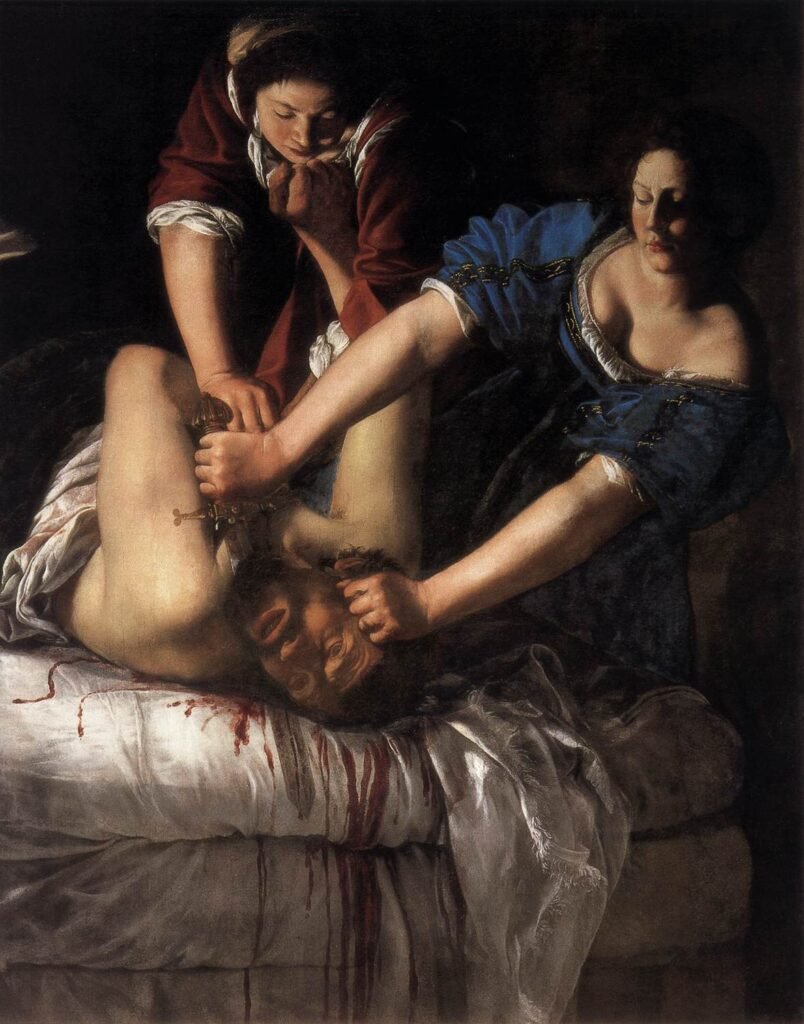
Judith Slaying Holofernes, Painting by Artemisia Gentileschi
While the room gathers a theatre hush and the canvas wakes under its own wick of light, the woman’s arm advances through that charged air with an assurance that bears prayer as a wrist bears pulse, so that the blade, meeting the sinew of a living neck, draws a yielding like a ferry rope eased from its mooring as a first trickle swells into a run while the maid tightens her grip since the bed seems to seek ballast.
As I cross from the Barberini’s measured dark—where Judith eases her arm away while a cool breath lifts from Holofernes’s throat—into the Uffizi’s steady glare, where Judith leans forward and gathers the whole weight of Bethulia into her shoulders, I feel a corridor open between the rooms as a passage I carry in my ribs, since Michelangelo Merisi keeps pace at one shoulder while Artemisia Gentileschi steadies the other, and their tempers steer my sight so that shadow learns law and colour learns bite.
While a coppery lamp steeps the Roman bed that receives Caravaggio’s general and wine rides the lips that had parted for praise before settling for sleep, a gasp slips into that wine as iron quickens the mouth, and I taste the change as a priest sips a drop at the rim since the picture serves a chalice where fear and obedience mingle. As Judith’s left hand pinches the folds of a coarse sheet as if justice were first weighed in cloth before steel, her right hand extends with a small sword that remembers sash and emblem more than battlefield while her brow gathers a furrow that binds disgust to duty in a clean braided cable. Since the old maid’s face carries knowledge the way a ledger carries sums, the jaw sets while the eyes narrow at the mouth of the wound and the pouch gathers for the head. Because the light behaves like a mind resolved, it cuts across a cheek while a wall settles into quiet, blessing the linen as it exposes gristle and writing across the blade a white signature that confirms act and aim. As that light comes from a city whose streets schooled appetite for faces and discipline for edges, where boys posed with fruit bowls while men with swords counted debts with their bodies, Caravaggio gathers those lessons in a fist and, as he spills them across panel and canvas, bishops and bankers tremble with pleasure and with fear.
An afternoon in the Contarelli Chapel offered a school for the wrist that traced Judith’s arm; the taxman rose at a finger’s point; the apostle’s conversion kicked dust that felt like gravel in the kneecap; saints fell while light rose like a verdict across a table. Rome in the last years of the sixteenth century walked with a confessor’s gravity and a swordsman’s swagger; a painter with a temper as hot as skillet oil carried a blade under his belt and a chip on his shoulder, and he lived by a code that prized presence over precedent. A studio in the Vicolo del Divino Amore filled with models whose eyes kept kitchen histories and street calendars; courtesans arrived with silks over bruises and left with an afterglow of sainthood; a boy with a sprig of vine sat for Bacchus and held his grin while the painter adjusted the lamp and the fleece. When Caravaggio turned to Judith, he already trusted the theatre of a single light and the eloquence of a face interrupted by thought; he already believed that the sacred could survive vinegar breath and dirty feet; he already knew that human hands carry doctrine when bishops hesitate.
He ground crimson and earth over a ground that bore little drawing, since his habit urged the brush to find contour as the eye finds a door in a dark corridor. He scratched a few incisions into wet priming with the stick-end of a brush as a sailor scratches a mark on a mast for a familiar wind, and then he pushed pigment until flesh rose from the void and linen gathered a nap you could almost pinch. The blade’s silver came from bone-white dragged thin and then glazed with a grey that remembered pewter more than moonlight. He placed the scene at the instant when a choice has flowed into action and action has begun to register on skin; no prelude, no epilogue, only the compressed thunderclap from which the thunder spreads through the room of the beholder. A woman’s disgust cohabits with her obedience; a general’s surprise carries a choked roar; a servant’s focus folds a century of kitchen work into a single helpful squint. A viewer steps close and senses that the distance between righteousness and nausea equals the breadth of a sword’s flat.
Across the mountains and a decade, a Florentine room answers with a heavier blade and a doubled pressure; Artemisia’s Judith arrives without any creep of hesitation, since the maid’s arm seals the man’s neck to the sheet while Judith’s wrist saws cleanly through a history of siege-craft and swagger. Here blood advances like a braided rope thrown from a parapet, each twist distinct, each droplet given its own arc and weight. Abra—the maid who in some scriptures walked like a shadow behind her mistress—presses forearm to jaw with the authority of a midwife who has turned a child at the last moment and saved both lives; Judith’s elbows tuck in with a pugilist’s economy; the sword enters at an angle taught by experience rather than aria. The bed shakes under that duplex intent; fabric creases like a storm-front; faces hold a wind of effort. If the Roman picture chooses theatre at the instant of recognition, the Florentine picture chooses labour at the instant of completion. Paint learns sweat.
The scene receives its cadence from a life that learned paint in a father’s workshop and learned courage under a tribunal’s lamp. Orazio Gentileschi trained a daughter whose brush memorised the grammar of light that Rome had taught to his own wrist; a decade of apprenticeships and commissions gave her the muscle-memory for drapery and the patience for flesh, yet a year of depositions sealed in her hand a knowledge of what an oath costs. When the Governor’s clerk recorded each answer and each oath in 1612, the hand that would later sharpen Judith’s sword endured a cord bound around the fingers and tightened until bones sang; the court called that device sibille and treated it as a herald of truth, and the woman who would paint the strongest shoulders in Italy gritted her teeth and swore to her memory under that pressure, while a young man with a poet’s curls measured his own story against her account and watched the balance move toward sentence.¹ An art grows claws during years such as these; it learns to place a jaw at just that point where a turn of the blade bites; it builds an ethic from the body’s report.
She moved to Florence with a husband and a reputation that breathed both scandal and genius, and the city answered with doors that swung for Accademia membership and courts that seated Medici stewards; she received commissions that paid for lapis crushed to a night sky and for linens that swelled like sails, and she wrote letters that balanced pride with hunger in the crisp courtesies of the century. In that river city where goldsmiths chased saints into small frames and mathematicians weighed the sky with lenses, she pushed pigment into flesh with a knowledge of how grief sits behind the eyes and how purpose lives in the forearm. If Caravaggio blessed the face with a single lamp and coached disgust into divinity, Artemisia trained the shoulders to sing and coached resolve into grace; if his maid monitored a jugular as a clerk monitors a column of figures, her maid enforced the cut as a partner enforces a vow. The two pictures mount the same bed while presenting two moral architectures—one that admires the terrible purity of beginnings, and one that honours the faithful completion of work begun.
A traveler who threads both rooms across a single day with a train ticket in his pocket gathers a thesis in his bones before he pinches words for it. In Rome, Judith’s reluctance curls the lip, since the charge of innocence hangs over her head like a halo of scraped light; in Florence, Judith’s competence steadies the gaze, since the city has learned to love skill as a diary of virtue. Caravaggio’s arm extends as if the blade emerged from a recoiling wrist; Artemisia’s arm bends as if the blade were a tool from a chest she has opened often. Between those gestures a difference of fate declares itself. The Lombard who learned tavern light and noble patronage in equal measures and who fled Rome with a death on his conscience proved a specialist in moral lightning; his pictures love first impacts and hinge seconds. The Roman woman, shaped by a father’s loyalty and a courtroom’s cruelty and a lineage of parlor camaraderie that opened into court patronage, wrote a hymn to sustained purpose whenever a commission offered a scene of danger or devotion; her pictures love pressure distributed across bodies that cooperate.
The story that underwrites both scenes flows from a book whose scent carries cedar and old wine, since a community under siege prayed for aid and a widow answered with a plan that respected both heaven’s logic and a general’s appetite. Judith kneaded barley into cakes and poured wine into a skin, then combed hair, anointed skin, and entered a camp with a servant who lived under her roof and shared her bread; she proposed an offering that flattered the mind of a man who loved subjugation, then waited for his limbs to grow heavy under drink; once that heaviness dropped into sleep, she lifted the sword he kept at arm’s reach and offered him to the God of Israel with two strong strokes; she packed the head into a bag and walked back up the road to Bethulia where old men blessed her name and army scouts took courage from that canvas sack still damp with an enemy’s hair.² The paintings remember that liturgy of cunning and endurance through every fold and every tendon. The Roman picture cherishes the instant where the wine turns back into grape and the man into meat; the Florentine picture cherishes the contract between women whose bodies act in chorus.
A morning in Rome gives the Barberini its due. The guard yields silence like a sacristan, and a shaft descends from a high window to varnish the bed with a pour of amber; tourists queue for a saint on another floor while a scholar in a grey jacket counts brushmarks at the edge of Judith’s sleeve. He speaks softly because soft speech suits a crime witnessed with consent.
—A marvel of restraint,—he whispers, leaning so close that the varnish seems to warm his cheek.—He holds back a river.
A woman with a sketchbook nods and catches that furrow above Judith’s nose as a single wrinkle among many asking to be born; she measures the angle of the sword with a knitting needle she carries for proportion; her pencil writes a thought into pressure.
—A marvel of disgust,—she answers,—and a marvel of grace,—and her pencil writes grace as a curve just visible in the shoulder that pulls away from the wound.
Down on the Tiber, a bargeman sets his shoulder against a pole and feels the city move by a hair’s breadth, and that same breath of motion enters the room with a courier who slips along the wall with a envelope under his jacket and a catalogue print inside. The balance of Rome continues: debt and offering, oath and avoidance, shine and shadow.
An afternoon in Florence resets the meter of judgement. The Uffizi room presents Artemisia’s panel with a frankness that suits muscle and linen; a glare settles over skin where effort has clothed itself in sweat, and a tour group arrives with awe as loud as a kettle. A girl from Cork who learned about saints from storybooks raises a hand that carries a scar from kitchen work and points as if to say, féach an neart (look at the strength), and her mother nods. The blood arcs in a rope that a fisherman might throw to a friend on a pier; the rope reaches, holds, and pulls, and the general’s hand flails with the panic of a large animal discovering, too late, a superior focus of will. A curator clears his throat and gives the painting’s date and the path of its journey with a cadence that has learned to feed a crowd while arranging facts:
—Naples first and then Florence in a fuller mode,—he says,—and between those cities a woman’s season of great demand and great reward; a patron who paid in kind and coin; a letter that promised a picture better than any man’s hand could pledge; an admission to the Accademia that carried a mild astonishment in the mouths that read it.³
A student with a notebook asks for the measure between life and picture, and the curator smiles as one who knows a debate that carries fire:
—Some gather a reading that folds biography into every brushmark,—he says,—while others insist on patron and context, on taste at court and the armature of workshop practice.
The two positions touch through paint, since Artemisia’s picture provides a document of applied anatomy while Caravaggio’s supplies a document of theatre, and both answer a story whose authority depends on gesture—on the way a hand reaches for a sword and a mouth opens for a cry.
Evening binds the day with a thought that arrived first through the soles; fate may run in both cases as a current that carried a pair of boats into the same race. Caravaggio’s course pushed him from Lombardy down to Rome where a hunger for the real met patrons who wanted doctrine with appetite, and from there to Naples where knives worked with flour and sauce in alleys and with silence in side streets; a quarrel by a tennis court left a body cooling on Roman stone, and a sentence drove the painter into a season of galleys, cloisters, and island salt until a fever on the Maremma took him into the earth at Porto Ercole.⁴ That same sentence chiseled penitence into the brow of a later David who holds a giant’s head that wears the painter’s own face; paint made confession when confession required a cardinal’s favour, and art reached for pardon with a lament wrapped in brown tone.
Artemisia’s course pulled from Rome toward a river that counted bankers among its tributaries and then toward Naples where a Spaniard’s Viceroy counted victories, and finally toward London where a king who loved faces assembled a world on his walls; she wrote to patrons with a sweet steel in her voice; she sent a self-portrait as Allegory with a quiver of pride slung at her shoulder; she shared walls with her father in the Queen’s House at Greenwich and gave England’s ceiling the glow of Roman light.⁵ Years gathered children, contracts, and debts along with laurel; a season in Naples brought a network of painters who shared models and ground blue until the mortar turned sky; a later letter to Don Antonio Ruffo in Messina promised a canvas that would silence all rivals, and the phrase glowed like a stove in a winter kitchen: you shall see what a woman can do.⁶ Her hand never slackened; old age arrived with the dignity of one who never doubted the nobility of an earned wage.
A night-borne thesis takes its final shape as the train hums across the Tuscan dark and the day’s two rooms marry inside the head. Both pictures stage the same rite—the passage of a people’s fear through the channel of two women’s courage—and yet they stage it under different star-charts. Caravaggio’s work trusts singularity; he loves the instant where grace breaks like surf, and he paints as if the world did not exist one heartbeat earlier and will exist only more intensely one heartbeat later. Artemisia’s work trusts continuity; she loves the moment where strength endures its own labour, and she paints as if a life had trained an arm across years and that arm can now finish what a prayer began. Each picture teaches a virtue; each picture leaves in a beholder the taste of iron and the breath of linen.
One could argue, with the zeal of a partizan, that Artemisia answers Caravaggio as a daughter might answer a father and then surpass him; one could argue, with equal conviction, that she answers the Book rather than the man, since scripture gave her a sisterhood that workshop gossip could never offer, and court letters proved that patrons admired her nerve without measuring it against a Lombard’s myth. One could stand in Rome and praise the delicacy of that small sword, which cuts like a syllable pressed through clenched teeth; one could stand in Florence and praise the honesty of that gush, which declares itself as a consequence of physics and will. A complete allegiance can yield to the grace of a true comparison; each picture consecrates courage with the materials within reach—lamp oil and angle in one case, mass and momentum in the other.
Little facts, carried as if in an apron pocket, enrich the walk. Caravaggio likely cast Fillide Melandroni, a celebrated Roman courtesan, as a series of women both repentant and proud; the Judith’s face carries a likeness that visits other canvases where hair and gaze share a genealogy of street poise and private dignity, and the old maid may carry real age from a neighbour’s kitchen.⁷ X-rays tease a ghostly second hand on Judith’s forearm where the painter adjusted the grip until the muscle learned to hold both revulsion and obedience; incisions at the edge of Holofernes’s shoulder confirm that the painter guided contour with the back end of a brush when speed and conviction demanded it. Artemisia’s Naples version of the subject deploys a slightly different gesture in the maid’s wrist and a different spill in the blood; she returned to the scene as if to write a second stanza with deeper breath.⁸ Her membership in the Accademia del Disegno arrived with fanfare because a woman’s name at the head of a guild book announced a world shifting under its own weight; her friendship with Galileo, preserved in letters that smell of ink and care, revealed a mind that delighted in lenses and in the way a drop of oil behaves on brass.⁹
A visitor who learned the story young will taste its salt anew upon reading that the servant’s name appears as Abra in the old Latin and that Judith’s prayer fills a chapter with cadences that rise from the throat like chant before battle; a reader of trial records will feel a sting at the word sibille and recognise in those tight cords the very pressure that Artemisia’s near wrist sends into Holofernes’s jaw. The Roman painter, himself a veteran of blades and alleyways, endowed his general with a handsome terror—dark curls, a strong chest, a bellow curtailed by surprise—since he knew that sin often arrives as a fair companion and leaves as a butchered beast. The Roman woman, a veteran of oaths and salons, endowed her heroine with the steadiness of a baker turning dough twice and then a third time to find the elasticity that will hold a loaf; work repeats, work perfects, and work saves. The two combine into a single counsel: courage chooses both arrival and completion.
When morning returns and a parish bell sets the city to rights, an argument that began in pigment assembles a final form in breath. Fate guided both lives toward a bed where a people’s survival required a woman’s resolve; both lives learned their lessons from Rome’s theatre of light, yet each life subjected that light to a temperament. Caravaggio carried the glamour and peril of a man who lived among blades and goblets and who sought absolution through paint, and the Barberini picture sinks a hook into a beholder’s throat because the painter understood exactly how a conscience rebels while performing obedience. Artemisia carried the appetite and restraint of a woman who earned doors, filled rooms, raised a household, and wrote letters that asked for the measure of respect proportionate to her labour, and the Uffizi picture plants a flag in a beholder’s chest because the painter understood exactly how strength behaves when it has travelled far and arrived home.
Through such scenes, a thesis takes life: sacred violence on a Caravaggesque bed becomes either the revelation of a chosen instant or the consequence of a long apprenticeship in courage. Both truths hold; each truth gleams when viewed beside its sibling. A day given to these two canvases offers the rare grace of learning courage from light. The blade that enters the general’s throat carves a path through myth toward a city’s gate, and that path continues across centuries toward rooms where bodies learn to stand upright under the sight of paint. A visitor leaves each room with a small private vow, which he can mutter in Irish if he pleases—i bhfianaise na fírinne, seasfaidh mé (in the face of truth, I will stand)—and the vow warms the lungs as the street takes him back.
Notes:
¹ Le Vite de’ Pittori, Scultori et Architetti, Giovanni Baglione, Andrea Fei, Rome, 1642, pp. 136–142; Considerazioni sulla pittura, Giulio Mancini, Quaderni di “Storia dell’Arte,” Rome, 1956 (ed. Adriana Marucchi), pp. 75–82; I processi del Governatore di Roma: Causa Gentileschi–Tassi (1612), Archivio di Stato di Roma (transcriptions in Mary D. Garrard, Artemisia Gentileschi, Princeton University Press, Princeton, 1989, pp. 371–418).
² Biblia Sacra Vulgata: Liber Iudith, ed. Robert Weber, Deutsche Bibelgesellschaft, Stuttgart, 1969, pp. 486–510; The Book of Judith, in Septuaginta, ed. Alfred Rahlfs, Deutsche Bibelgesellschaft, Stuttgart, 1935, pp. 410–435.
³ Lettere di Artemisia Gentileschi, ed. Francesco Solinas, Silvana Editoriale, Cinisello Balsamo, 2011, pp. 35–49; L’Accademia del Disegno di Firenze: Statuti e Atti, ed. Paola Barocchi, Olschki, Florence, 1975, pp. 212–214.
⁴ Le vite de’ pittori, scultori et architetti moderni, Giovanni Pietro Bellori, Mascardi, Rome, 1672, pp. 197–214; I documenti di Caravaggio, ed. Stefania Macioce, Ugo Bozzi, Rome, 2003, pp. 61–89.
⁵ Orazio and Artemisia Gentileschi, Keith Christiansen and Judith W. Mann, The Metropolitan Museum of Art / Yale University Press, New York / New Haven, 2001, pp. 259–285; The King’s Pictures: The Formation and Dispersal of the Collections of Charles I and His Courtiers, Francis Haskell, Yale University Press, New Haven, 2013, pp. 112–118.
⁶ Lettere d’artisti a Don Antonio Ruffo, ed. Maria Accascina, Sikania, Messina, 1955, pp. 45–47.
⁷ Caravaggio, Roberto Longhi, Sansoni, Florence, 1952, pp. 85–93; Caravaggio and His Followers, Alfred Moir, Princeton University Press, Princeton, 1976, pp. 54–59.
⁸ Artemisia Gentileschi e il suo tempo, ed. Nicola Spinosa, Electa, Naples, 1991, pp. 102–109; Artemisia, Alexandra Lapierre (trans. Liz Heron), Vintage, London, 2001, pp. 188–197.
⁹ Lettere di Artemisia Gentileschi, ed. Francesco Solinas, Silvana Editoriale, Cinisello Balsamo, 2011, pp. 119–124; Galileo: Selected Writings, trans. William R. Shea, Oxford University Press, Oxford, 2012, pp. 264–267.