
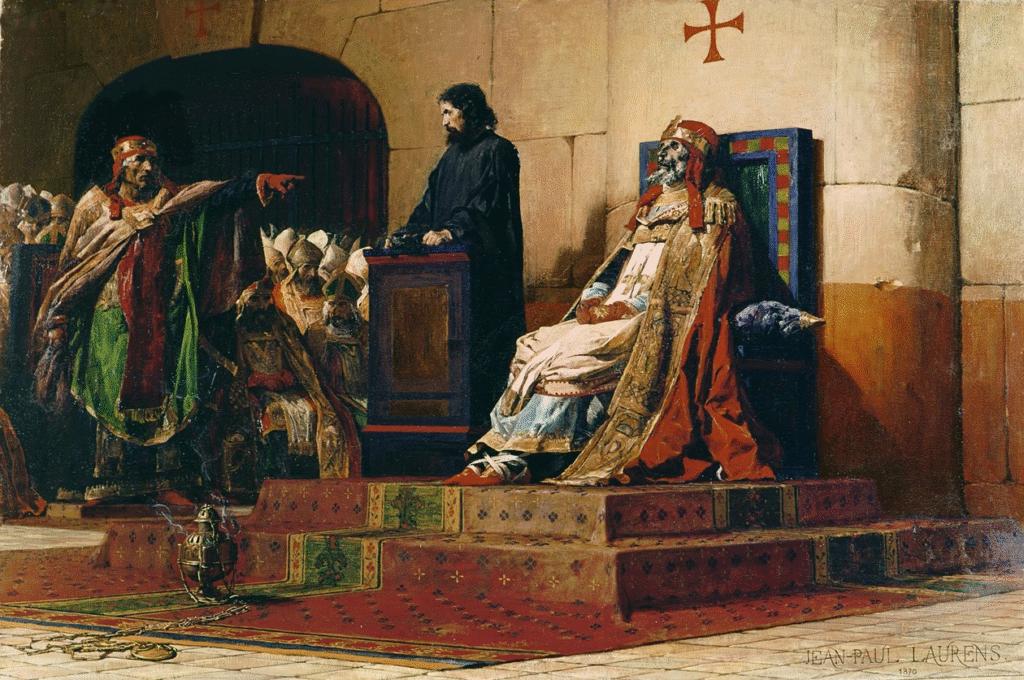
Before sunrise a sluice of river-breath found Rome, and the Lateran hall gathered its own weather under a roof that kept the dawn at arm’s length, since candles ruled the air with beeswax sweetness and a sour note from the censer chain that had carried a hundred Thursdays of penance and a hundred Easters of relief; beneath the apse, where the mosaic carried deep blues that taught the eyes to keep silence, bearers lifted a lid with the care of men who carried grammar, a responsibility that eclipsed mere cargo, while a deacon steadied the taper that burned low by his register and measured speech against flame. Cloth met bone and whispered; a sleeve cuff rasped on wood; a clerk inhaled chalk-dust as a stylus began its march. At the centre, a chair with the weight of a hill waited for a presence that had already yielded to earth, so that the body—seated and shored by cushions and sash—offered a hush that sharpened Latin into steel and made every footfall ring across tesserae as though the floor itself served as witness. Faces leaned in. Iron keys swung at a sacristan’s belt. At the margin, an annalist from the north framed the hour in a line with the clean chill of a river knife, since he trusted the kind of sentence that survives weather and ruins.¹
A path toward that throne had gathered its force across a decade of fealty and fear, since the Carolingian lattice that once held Italy in an orderly web had loosened until proud houses moved like weather fronts across the plain, and since the Spoletan name rose from the Appennine foothills with a queen’s will in Ageltrude and a princely promise in Lambert, whose ceremony shone with an imperial glaze that required assent and sought it in Rome. Porto’s bishop, Formosus, whose hands had learned the measure of far embassies—Bulgarian audiences under an eave darkened by smoke and old grease, Constantinopolitan parlours where diplomats tasted cinnamon and watched a patriarch pour wine with a learned wrist, Frankish halls that smelled of horse and charcoal—began a campaign that worked through allies beyond any bridge the Spoletans paid to guard. In February 896, inside Saint Peter’s, where marble cooled the breath and where banners hung like the memory of former victories, he set a diadem on Arnulf of Carinthia and inscribed allegiance in oil and chant, since anointing functions as a pledge that binds more firmly than a seal. Choirboys tasted ash on their tongues from the previous evening’s palms; courtiers weighed every nod; a German entourage breathed leather and iron into the basilica’s chill. Lambert’s programme shivered without outward complaint; Ageltrude hardened. When illness ran through Arnulf’s camp with the sudden caprice of a winter fever and when horses carried him away from the city with reins slack and jaw tied back against pain, Rome altered its gait with the quick obedience of a trained hound pivoting at a whistle. Within weeks Formosus lay in the earth; within weeks the Spoletan party shaped the election that lifted Stephen VI onto Peter’s chair, and within weeks the court prepared a theatre that claimed the name of law with a voice that filled the nave.
Inside the hall, a rule that every canonist knew by heart supplied a fulcrum, since Nicaea had taught the Church to read movement with suspicion when movement damaged flocks: neither bishop nor presbyter nor deacon would pass from city to city like a contractor shopping wages, and any hand that sought another seat without grave cause and common assent would erode the bonds that kept cures stable and kept marriages, baptisms, and burials within an economy of trust.² The dossier revived penalties once voiced by John VIII when he measured Formosus as a man whose zeal outpaced prudence, then tempered by reconciliation when Porto’s bishop returned to his river harbour and served with sufficient steadiness to ready him for an election that many received as a grace upon a city hungry for administrative competence. The charge therefore arrived with a double weight: perjury concerning vows made under duress and illicit translation that violated a maxim designed to guard communities from shepherds who loved promotion more than care. Stephen’s party formed a syllogism any student could repeat under pressure: since an oath binds and since a canon forbids translation, a translated bishop falls out of right order, so that acts flowing from a disordered seat carry no authority. A deacon in the hall raised his chin and spoke the taunt preserved by a Lombard historian, since the line performs as theatre even as it claims method: when you were bishop of Porto, why did you usurp the Roman See?³ A question addressed to a corpse cut twice: once across the dead face, once across a city that prized wit and understood humiliation as a currency that purchases quick applause and slow regret.
A choreography advanced that paired saintly garments with clerkly arithmetic, since ministers laced vestments around bones to assert identity, and since the throne conferred a semblance of presence while a living voice answered for the seated body so that decorum yielded substance through a curious exchange: a deacon’s lungs loaned breath to a pontiff’s cause, and law absorbed the breath as if speech could anchor essence. Charges descended in stages with a patience that suited a city trained by ritual: perjury first, translation next, annulment thereafter. When cutters took the three fingers that had traced benediction—thumb, index, middle—the hall learned a hard exegesis of touch, since ordination travels by hand and chrism through skin, and since a lineage takes hold under a palm that presses oil into hair and bone, so that the hand itself carries a history that a knife can threaten. Bearers carried the remains to the river; Rome completed the sentence by water; fishermen muttered about currents and eddies that answer to no praetor; boys leaned over parapets; women prayed without fuss. The hand that had blessed lay severed, and clerks scrawled the decree that voided ordinations and judgments, since the verdict sought to cauterise an artery that fed an entire generation of ministers who had knelt beneath Formosus’s palm.
Within that river-light moved a counter-poise rooted in the kind of anthropology that sacramental life teaches to craftsmen, midwives, and choristers, since grace behaves as a promise that enters matter without losing lordship and since the Church patrols that promise with a vigilance that owes allegiance first to Christ’s intention and then to an officer’s virtue. Auxilius in a southern scriptorium sharpened a quill and drew breath before he set a line that argued with the weight of cupboards stacked with vessels and linens, since he wrote that orders conferred by a compromised minister endure when the Church receives the rite with her full body, which includes parishioners on stone floors, women standing by doors with infants on hips, men with plaster dust on cuffs kneeling with hands that tremble from labour.⁴ Eugenius Vulgarius, whose pen moved with a heat that melted wax at a pace that worried his amanuensis, reinforced the claim with invective and hymn, since he understood that his readers required fire as much as proof.⁵ Through those pages, the defenders shifted attention from personality toward rite, so that parish life resumed with confidence while nobles traded silence in porticoes where daggers leaned within reach. A curate in Trastevere who worried about baptisms breathed easier when a paragraph gathered him into a community that prized reception and promise above factional memory; a newly ordained priest in the Sabine hills kissed his chalice with a calm born of pages, a quietude that owed nothing to patronage. The defenders’ logic trained nerves, and trained nerves rescued households from anxiety that spoils bread and curdles milk.
While pens moved in Italy’s south, the deacon in the Lateran leaned into his charge with the courage of a man who carried a city’s conscience for the duration of a morning, since he stood by the arm of the chair and tasted incense and chalk-dry dust while he measured the distance between Stephen’s stare and the shrouded mouth. He remembered a season when Formosus lifted his hand over an empty pantry in the river quarter and made a gesture that settled panic into patience; he remembered petitioners with rents and quarrels and dowry disputes; he measured law against those afternoons and found that the maxim about translation allowed a gate for grave necessity with common consent, which canonists had long made room for when plague, war, or ruin altered a diocese’s capacity to breathe. He answered the taunt about usurpation with appeals to synods that recorded such exceptions with more care than the Spoletan party admitted, and he did so with a diction that belonged to a sacristy, lacking the forum’s posture, since his cadence offered service, a quality that eclipsed swagger. A murmur ran along the nave, the kind of sound that shifts when a populace senses that a voice has begun to carry a weight beyond the man who owns it, as though advocacy itself entered the sacramental economy and learned to function as a rite.
Beyond the hall, Ageltrude advanced through ceremonies with the bearing of a woman who had learned a queen’s grammar: brief nods to abbesses who held estates with skill, a measured smile for envoys who squeezed details from every rumour about Arnulf’s fever, a glance for Lambert that reminded a son that youth grants radiance without granting wisdom. She heard gossip that praised the cadaver trial as a device that clears a ledger swiftly; she heard counter-speech that warned about rites that reach beyond the grave and teach a city to flinch when girders groan under spectacle. In Ravenna, where mosaics make saints look like neighbours who never age, Lambert later received annulment of the trial’s acta under John IX with a face that signalled courtesy, a bearing that excluded triumph, since a court at ease with reversal exhibits confidence that many rulers envy.⁶ The sequel in Rome moved with similar speed: Theodore II gathered bishops in December 897 and lifted Formosus with honour that tasted of practical mercy, since priests required calm more urgently than party victory; John IX repeated the work across Rome and Ravenna with orders that future prelates avoid trials of the dead and that records of the macabre session receive treatment suitable to errors that injure the living when left within reach of every clerk who loves acrimony.⁷ A later pontiff, Sergius III, kindled fresh condemnation that warmed fighters and chilled householders, since every revival of the quarrel drained energy from a city that needed grain, water, and reliable adjudication.
While councils set their seals, a different theatre began to gather over the Tiber’s sheen, a stage built in dark rooms and rehearsal halls where voices search for pitches that hold crowds. Joseph Dispenza’s three-act rendering laid fear, loyalty, and punitive zeal upon a table with knives and cups and papers, so that actors carried weight through measured turns and choked pauses, and so that audiences saw themselves arrange motives under pressure. Decades later, a New York production set microphones along a catwalk and taught the episode to move like a catechism strapped to a drum kit, since charisma and costume and wattage can perform a critique more shrewdly than any pamphlet tucked beneath a wiper blade. Stagehands threw blue gels across faces that wore mitres and mail, while a young deacon held a quiet centre that invited reason to raise its head above the beat. The theatre argued by excess that appetite reveals itself through pageant, and that bodies pressed by volume develop their own judgment from within the ribcage. Through those evenings the synod moved from archive to muscle and breath, and a rehearsal room learned to function as a laboratory for civic ethics.
Across the Channel and forward in years, an elderly pontiff, allowed to speak by a poet who loved moral counterpoint, placed the corpse-trial inside a ledger that measured men by what they built inside their chests. Browning’s lines carried a bell-metal rumble that suited a century that prized conscience and feared show when show forgot equity; he gathered reversals like stones laid in a pocket for memory’s sake and reminded readers that mob rage and swift rehabilitations teach a rhythm through which institutions repair themselves through candid accounting. He named fishermen who drew a body out of the river and made that image serve as proof that grace learns roads back toward dignity when cities tire of humiliation.⁸ A reader in Dublin, warmed by peat and kettle and a window that watched a rain-line sweep toward the canal, heard that English thunder and found an Irish echo, since an island hardened by famine and flight carries a practiced suspicion toward theatre that feeds on human shame.
In a scriptorium where cactus spines served as pens for tight marginalia and where sheets dried on a rack fashioned from ash-wood that had smelled of a kitchen before it learned of ink, a hand copied Nicene canon fifteen into a reader’s book with a care that children only half understand when they hear the phrase city to city and picture a bishop as a man with a satchel and a thirst for novelty. A monk lifted his eyes at the verb translated and imagined a shepherd who leaves a flock the way an ambitious artisan leaves a guild for higher wages, and he set his o to sit round and open, since generosity ought to accompany curses when curses run quick in a reformer’s blood. Lateran ministers who held the rule before the hall recognized that their maxim protected laity from wandering stars whose charisma raised crowds and left ruins in alleys; they also sensed that law functions like a sail, a power for transit, lacking an anchor’s dead-weight fixity, since circumstance and consent can fill it with a wind that carries a community across a shoal that would otherwise grind keels into splinters. The deacon’s argument therefore arrived with ammunition supplied by councils that consented to movement under pressure—devastated dioceses, captured shepherds, plagues that erased clerical ranks, cities that required the hand of a man already consecrated elsewhere. The court had gathered a syllogism; the advocate supplied the clause that grants exceptions when the common body breathes together in need.
In the markets off the Tiber, where barrels stood like short soldiers and where the fish tables learned to shine like wet altars after a boy rinsed them with a pail thrown from the shoulder, women spoke about the trial with the sobriety that permanent provisioning teaches: a papal election teaches a city to stand straighter when it presents dignity; the corpse-chair taught children to tighten their grips on their mothers’ sleeves. A broad-shouldered porter who had carried amphorae up the same steps for twenty years offered the kind of remark that fixes itself to history with more strength than any motto, since he said that he would trust a hand that blessed potatoes over a voice that loved spectacle, and since the adjective that touches bread often wins against any premise that floats far above stew. Through such speech one hears the thesis that governs this inquiry: authority survives through touch that the community receives as service, and any polity that pursues display at the expense of custody discovers that theatre purchases a gasp and loses a parish.
A scholar who sifted charters in a Ravenna archive where sea-light entered sideways across a table of scars reconsidered Lambert’s role with a patience that disliked caricature; he read a strand of evidence that placed the young ruler within the halls where John IX annulled the earlier synod and warned against judging the dead, and he found that presence persuasive as a sign that Spoletan will permits a gentler account than the early picture of revenge engineered from a prince’s wounded pride.⁹ The refinement matters less for reputations than for a city’s education, since subtlety trains the conscience that crowns of laurel or steel alone rarely discipline. Rome learned slowly through outrage and repair, through edicts that banned corpses from chairs and through a tidy insistence that translation requires discernment from a whole body, an integrity that a party caucus could not possess. Canonists sharpened their entries concerning oaths extracted under pressure; they framed rules that guarded parish economies from collapse when high office sprouted thorns. Chroniclers learned to anchor narrative to documents; curates learned to pour water with assurance, since baptisms require steadiness more than victory.
An image remains that captures the movement of hands across generations: a palm pressing oil into a skull-bone softened by fontwater; a thumb tracing a cross in the air above a man whose back shows the white line where a soldier’s belt once scraped skin to leather; a bishop folding a diadem’s weight toward a kneeling brow with an exhale that allows the muscles in the lower back to relax; a deacon lifting a taper so that a clerk’s line can proceed without shadows that confuse letters. Stephen’s knife, which kissed the fingers that had sent a blessing into crowds and kitchens and sickrooms, confessed an uncomfortable truth at the very instant it disfigured: hands convey a polity more faithfully than charters. Auxilius answered with a quill whose strokes restored trust where trust keeps stoves lit; his logic propped weary men and women at vesper when winter demanded courage from households; his treatise yielded a peace that resisted the next wave of clever arguments. Eugenius wrote with the kind of fury that a city sometimes requires to wake; his pages built a fence around parish life and dared the ambitious to climb. Browning taught a later age to read ledgers alongside epiphanies, since conscience learns by sums as well as by sudden light. Stages in our time, pulsing with glare and laughter, warned that zeal feeds on humiliation until communities pull the plug and watch the wires cool. The Tiber flows through these scenes with companionship rather than indifference; memory lays silt across law books and sermons and plays; a reader picks through layers and gathers a thesis for the long view: mercy prospers when hands serve rites before they serve camps.
A return to the hall offers one more figure whose breath decorates the morning: the young clerk by the sconce who absorbs everything with the alertness of someone who carries hopes that rely upon the next hire and who yet finds space to mark a margin with a note shaped like a seed. He watches ministers strip the dead vestments from bone and hears the scrape of metal; he shifts his weight as cutters sever the digits; he watches bearers move steadily toward the doors; he draws a line beside the entry that he will remember for decades. Years later, when Theodore’s synod restores Formosus and orders the Cadaver Synod’s records destroyed, he opens his older volume and touches the small mark that survived the purge. He objected neither to annulment nor to the ban on corpse-trials; he welcomed both. He preserved the seed because seeds teach fields how to carry weather as well as feasts, and because outrage, once disciplined into memory, trains prudence that future bishops will require when illness, faction, and foreign arms again arrive.
On a quayside, toward evening, a fisherman who helped salvage a body from the river stands by a mooring post with hemp under his fingernails and resin on his cuff. He saw the papal hand with missing fingers; he helped lift the weight with companions who kept jokes short because grief occupied their mouths; he tied the last knot with an extra turn that signals blessing among his peers. He says to the boy who stands with him that the city breathes through hands, and the boy, who has learned to set a hook and splice a line and carry a basket without spilling from the rim, nods with the kind of comprehension that owes little to syllogism and much to shore. A woman at a window watches both figures and turns back to a pot that simmers with a loaned bone; she salts with care; she remembers a blessing delivered years earlier by the very hand that the river gave back with harm; she raises a spoon; she breathes; she finishes the work.
From scene to scene, argument arrives through pressure and touch: councils weigh translation under grave necessity with consent; deacons learn to lend a voice that gathers sacramental dignity; poets build ledgers that cohabit with visions; actors stage appetite to reveal motive without sermon; archivists refine blame and release crude portraits; porters and bakers teach cities to prefer hands that steady over tongues that sting. When one reads the Cadaver Synod through those movements, one discovers a polity that survives through rites that know their work and through people who protect those rites from humiliation. Law finds its centre as servant of grace; power finds its discipline as servant of households; spectacle finds its limit when kitchens turn away. The city that once propped a mummified pontiff on a throne receives a harder counsel now: lift the living; steady their hands; answer ambition with service that prolongs mercy; tend rites with a patience that refuses frenzy; shape councils that breathe with the whole body and that remember that authority, when exercised with reverence for matter as well as soul, confers a form of peace that even a river loves.
The argument accepts counter-pressure, since Stephen’s court held a duty to protect flocks from translated ambition and from oaths betrayed under colour of sanctity, and since parties that governed a city through tempests learned to prefer clear rules to the vagaries of personal reputation; the court therefore sought a demonstration that law holds beyond death and that perjured men fail to shelter their acts behind the veil of a funeral. The counterargument answers with palms and oil and a presence that abides within a rite carried by a whole body, since the Church never entrusts its future to a single wrist and since the sacramental economy distributes weight across countless hands. Each pressure shapes the other until a habit of equilibrium emerges: Rome learned a cadence of reform that included annulment of the acta, bans on corpse-trials, and careful attention to movement between sees; curias learned to temper zeal for punishment with a labour that heals, since a city that trusts its rites frees energy for bread, roads, and marriage contracts; Europe stored the synod as emblem and warning, a figure used by jurists who teach caution with an image that shames vanity, and by poets who teach hope with fishermen who return honour to a body that once bore a city’s vows. When dawn reaches the hall again in memory, the candles burn with a smaller flame, as though bees learned new hymns; the censer chain gleams with a subdued pride; the deacon folds his register; the clerk blows his taper, then pinches the wick; the apse absorbs another morning into glass and gold; and the river, pressed against its banks by arches and stones and the echo of a sentence long since reversed, continues with the easy dignity of a witness who never required a chair.
Notes:
¹ Antapodosis (Retribution), Liudprand of Cremona, trans. Paolo Squatriti, Broadview Press, Peterborough, 2007, pp. 125–131.
² The Canons of the Council of Nicaea (First Council of Nicaea), in Sacrorum Conciliorum nova et amplissima collectio, ed. Giovanni Domenico Mansi, Vol. II, H. Welter, Paris, 1901, pp. 671–673.
³ Antapodosis, Liudprand of Cremona, trans. Paolo Squatriti, Broadview Press, Peterborough, 2007, pp. 128–129.
⁴ Libellus de ordinationibus a Formoso papa factis, Auxilius of Naples, in Patrologia Latina, Vol. 129, ed. J.-P. Migne, Garnier, Paris, 1880, pp. 1241–1268.
⁵ De causa Formosiana, Eugenius Vulgarius, in Patrologia Latina, Vol. 132, ed. J.-P. Migne, Garnier, Paris, 1880, pp. 1261–1284.
⁶ Acta Concilii Ravennatis sub Ioanne IX, in Sacrorum Conciliorum nova et amplissima collectio, ed. Giovanni Domenico Mansi, Vol. XVIII, H. Welter, Paris, 1903, pp. 169–176.
⁷ Synodus Romana sub Theodoro II (December 897) and Synodi Romanae sub Ioanne IX, in Sacrorum Conciliorum nova et amplissima collectio, ed. Giovanni Domenico Mansi, Vol. XVIII, H. Welter, Paris, 1903, pp. 153–168, 177–183.
⁸ The Ring and the Book, Robert Browning, Smith, Elder & Co., London, 1868–69, Book X, pp. 150–155.
⁹ Joseph Duhr’s revisionary account appears in summary within the apparatus to Mansi XVIII; see also the discussion in Liber Pontificalis, ed. Louis Duchesne, Vol. II, E. Thorin, Paris, 1892, pp. 234–242.