
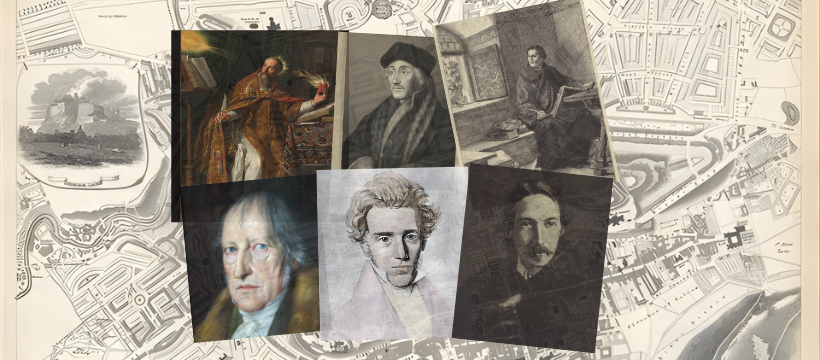
(On Saint Augustine, Martin Luther, Erasmus of Rotterdam, Georg Wilhelm Friedrich Hegel, Søren Kierkegaard, and Robert Louis Stevenson’s Double Portrait of Edinburgh)
A red light hovered on the desk while the painted blackbird behind us leaned into thick-brushed flight, and the table between the microphones gathered a small parliament of objects—a clay pot, a blue glass, a wooden box with a lipped promise, a stack of green-and-white spines of my own books,, and a square of cardboard that waited like an unopened argument—while the tricolour settled into the backdrop and the guitars along the wall angled like sentries; opposite me James Byrne listened with a host’s patience, and the room, kind as a kitchen in rain, urged the talk forward. We spoke for hours about writing as a house that invites weather, and about the rash courage that attends a bright thought at its first breath, and my mouth named Martin Luther with his nails and turned toward Erasmus with his polished leaves, and afterward circled Augustine’s duae civitates with their mingled loves, while Hegel’s high stair drew a glance that found a lean Dane waiting with a raised finger. Edinburgh entered as well, since Stevenson’s doctor brewed a clean potion and his shadow walked the wynds with a sovereign gait, and from that shared weather a conviction gathered weight: every luminous proposal in the West calls forth its twin from its own penumbra, and the twin arrives as judge and midwife together, since a thought ripens through the pressure that meets it at the door.
A scriptorium breathes in Basel while Erasmus lifts his eyes from a marginal gloss and hears Johann Froben’s presses rumble like a distant mill, and in that space a creed forms with the calm of fine joinery, since the scholar trusts that language cured of barnacles will heal the wound in the Church’s speech; he fingers a leaf of the Novum Instrumentum omne—Basel, 1516—and the ink sits upon the page with a modest shine, and the Greek offers its grain to the fingertips the way oak offers its rings to a blade, and the Latin beside it walks with a spare elegance that urges bishops and friars toward a gentler discipline. He imagines clerics who read the Gospel with the steadiness that accurate words invite and princes who listen when counsel rises from sources that have shed the soot of centuries. A republic of letters conducts itself like a senate when courtesy rules the house, and the phrase philosophia Christi spreads its wings without trumpet or drum, since a gospel carried by civility gathers authority through patience. He writes as if language itself could mend quarrels through clarity, and he lays before Europe a text that asks for slow eyes and a willing heart.¹
A hammer answers from Wittenberg, and a door grows voice under iron, and an Augustinian who sweats through the night hours feels his ribs as a cage that belongs to dread and to a sudden mercy together. The word Anfechtung—a torment that sweetens into birth—inscribes itself into his marrow, and the cell becomes a furnace where Scripture yields a blaze, and a conscience that had counted merits like a clerk learns to count by grace. When Erasmus, with a careful hand, affirms a will that cooperates with grace like a boy who rows along a current that carries him anyway, Martin Luther replies with a storm that roars through the sluices and lifts boat and oarsman alike, since in his vision sin binds the wrist and only a thunderbolt looses the chain; he anchors his boldness in Paul and Augustine, and he writes with a music that insists upon gift. The pamphlets fly, presses drink oil through the night, and congregations chant in words learned at a mother’s tongue; yet each syllable, though homely, rides a steeper air because it has crossed a Greek that Erasmus had set in order. In that irony the world smiles with a dark amusement, since the balm supplies the blade, and the blade, once free, carves a path that village choirs and city councils follow with breathless energy. From the Ninety-Five Theses of 1517 the quarrel deepens toward freedom and bondage, and when De libero arbitrio diatribe sive collatio appears in 1524 with seasoned moderation, De servo arbitrio answers in 1525 with a river’s force, since Luther grants to grace an almighty reach that leaves human power with a single office—reception.²
From their exchange a structure emerges that guides more than a single century, because a logos that seeks the entire field summons within itself a singular voice that resists absorption, and the resistance teaches the field its measure. Erasmus trims language until meaning tightens like a well-knotted net, and Luther fishes with a storm at his back, and the catch, though heavy, carries scales that gleam with the same light. The West receives from their contest a habit of argument where philology and testimony test each other with tenacity that grows fierce and fruitful at once; scholarship discovers sanctity’s need for grammar, and sanctity discovers scholarship’s need for awe. The quarrel writes the lineaments of a modern conscience, because each side grants the other a dignity neither would yield during the heat of speech.
With the ink scarcely dry, the Weltgeist turns toward a larger synthesis, and Berlin furnishes an architect who shapes entire wings for that house. Georg Wilhelm Friedrich Hegel, schooled by Greek tragedy and by Kant’s sharp instruments, offers a map that seeks the whole terrain and prints it on sheets so ample that a student can fold them into a tent, since the wind along the Spree persuades him that spirit works through contraries and lifts them into a calmer view where each wound gains a scar that glows with instruction. The Phänomenologie des Geistes—1807—leads a reader through consciousness, self-consciousness, reason, and spirit toward an absolute that recognizes itself through history, and the movements of thesis and antithesis ascend through Aufhebung, that word with triple motion—cancel, preserve, lift—that turns into the very syntax of the age. He arranges art, religion, and philosophy as chambers on a single corridor, and he grants to rebellion the dignity of a courier who carries the king’s secret unawares, since revolt advances the march by which reason enters its kingdom; he supplies to the modern state a philosophical charter and locates freedom within a law that citizens recognize as their own mind written large.³
A young man in Copenhagen receives the map and tastes chalk; he studies the cadence with admiration that carries a seed for quarrel, and he steps into air that bites with salt, because the Øresund sends weather into the lungs with an authority that matters. Søren Kierkegaard names the solitary person hin Enkelte, that single one who stands before God as Abraham stood with a knife above a beloved boy, and he insists that faith grows teeth only when a person accepts terror as the price of any embrace that reaches beyond ethical calculation. He grants to the state a tidy greatness and to the university a wry affection, yet he places his desk at an angle to both, since the leap that concerns him springs from a precipice where maps offer companionship while command arrives only through summons; Frygt og Bæven—1843—handles the Isaac story with a daring tenderness that reveres the absurd, and the pseudonymous authors who shelter his thought conduct a masquerade that directs attention from authority toward inward passion. Afsluttende uvidenskabelig Efterskrift—1846—pursues subjectivity with a blade so fine that systems feel their skin prickle; he refuses mediation where only a wound will speak, and he entrusts thought to prayer without surrendering reason.⁴
Through Hegel and Kierkegaard the earlier pattern sharpens: a universal structure that claims to honor every difference yields, when tested by a single anguish, to a cry that rejects classification, and the refusal guards a sanctum where obedience forms beneath the eye of the Eternal. The universal learns humility and therefore acquires authority, and the single one learns patience and therefore acquires a sentence the world can bear. A civic house rises from that exchange, since institutions set a chapel within their courts and chapels set a bench where neighbors ask questions without menace.
A soul learns through streets as well as through treatises, and Edinburgh supplies a theatre equal to Basel and Berlin together. Daylight lays its grid across the New Town with Georgian confidence, while dusk gathers in the Old Town like peat smoke that lingers in close rooms, and a respectable physician conducts a courteous life measured by decanters and visits, yet he mixes a draught that promises a scoured conscience and a polished public face. The liquid tastes of scientific hope and of the Enlightenment’s rapture before a clean surface, and the doctor, who longs for unspotted benevolence, separates appetite into a second creature with a compact gait and an unanswerable hunger for narrow lanes. The city’s map models the partition, since Charlotte Square and Canongate press foreheads together each night, and each whisper feeds its counterpart. The potion succeeds, and therefore the streets suffer, since the cure concentrates the very element it seeks to expel, and that element returns sovereign; the laboratory engenders the alley, and the good doctor’s desk furnishes tinder for a fire that learns the address of every respectable door. Stevenson’s Strange Case of Dr Jekyll and Mr Hyde—1886—binds moral psychology to civic topography and teaches Europe a caution that reaches beyond Victorian scruples toward a philosophy of mixed natures.⁵
From Stevenson the lesson passes to kirk and to academy together: a household that prunes only the garden breeds a thicket behind the shed, and a household that celebrates thickets grows nettles in the parlour, so prudence grants a seat to both gardener and hedge. The Enlightenment’s confidence sends clean avenues across heath, and the Gothic memory that houses banshees and ancestral debts reminds the avenues where their stones came from; together they sustain a city with pulse and conscience. Edinburgh’s talent for double aspect—Deacon Brodie at his cabinet and at his lockpick—mirrors an anthropology with teeth, since a person carries double allegiance without escape, and law gains wisdom when it accepts appetite as a housemate while it teaches appetite to eat with fork and to leave the plate clean.⁶
All paths return toward Augustine when empires begin to cough, and the bishop’s table receives quarrels with bread and salt. After Alaric and the Visigoths enter Rome in 410, Augustine hears panic and glee—pagans who blame the Christians for civic weakness and Christians who crave instant vindication—and De civitate Dei begins in 413 and continues until 426 with a patient breadth that schools princes and monks together; two loves conduct the drama—amor sui that builds by its own light and amor Dei that lays its head upon mercy—and the cities formed by those loves mingle during our days—permixtae—until a separation that arrives through judgment alone.⁷ He honors craft, ordinance, and harvest, since each belongs to pilgrimage; he rails against pride where pride dresses as piety; he carries Rome’s law books into the vestry and blesses their discipline while he refuses them priestly vestments. A Christian polity under Augustine’s eye serves the weak and restrains the violent through positive statute, yet it keeps its hope in a country beyond statute; the difference secures freedom from apocalyptic frenzy and from civic idolatry at once.
From these stations—a Basel press, a Wittenberg door, a Berlin system, a Copenhagen study, an Edinburgh alley, and a North African bishop’s desk—a single law rises with the seriousness of bread: logos generates its own contrary from within, since reason that seeks total reach converts the singular into a remainder, and the remainder acquires the energy of a revenant until welcomed. A philosophy that summarizes passion inside a concept tucks a human cry into a margin, and the cry gains a sovereign tone through neglect, and soon a counter-system appears that drinks from the same spring while pouring the water upon different ground; a moral project that promises a cleansed life invents a substance that concentrates appetite and grants it boots; a theology that lingers over grammar awakens a hymn with thunder in its throat, and a theology with thunder borrows grammar’s lamp, because lamp and thunder together guide travelers through weather. The law carries bite across fields, since science, economics, and art conduct themselves with the same tragic fertility, where a general architecture gives birth to a singular protest that alters the ground on which the architecture had stood.
Laboratories confirm the rhythm, since every theory that dreams of finality invites an experiment that exposes a boundary case; classical mechanics measures planets with clockwork poise and then receives quantum events that behave like courteous ghosts, and a physics that embraces chance reintroduces law through statistics. Mathematics, that spare republic, prints a theorem through Kurt Gödel’s hand that says with crystalline mercy that any formal system rich enough for arithmetic shelters true statements that elude derivation within the system, and the hallmark returns: the bright machine prints its own limit upon its casing, and the limit acts less as a gag than as a choir stall reserved for a future singer.⁸ The laboratory hence contributes to a larger asceticism: confidence walks with humility, and humility guards confidence from collapse.
Economies rehearse the pattern as well, since a thinker in Trier studies Hegel’s grammar and inverts the furniture with the decisiveness of a bailiff—capital, labor, class, surplus—while promising emancipation through a plan that writes production into political fate; from that promise emerges a party that treats persons as cogs upon a ledger, and in the hour of triumph a dissident raises a palm to warn that planning without conscience manufactures a new serfdom. The revolt carries the same dialectical taste, since a universal that aims for justice births a counter-move trained by sorrow, and the counter-move, while it shrinks the map, rescues the human face; the marketplace that honors price alone summons prophets who plead for craft and for guild, and those prophets then save exchange from devouring its own seed. History therefore presents a wheel that advances through corrections that grow from the hub itself.⁹
The law, though rigorous, carries mercy, since it grants to any architect a rule for building that prevents collapse: a universal that dreams of peace must set within its court a chapel where a solitary may kneel without interrogation, and a solitary that claims an unsayable vision must place a bench outside the chapel where neighbors share bread and ask questions. Erasmus required Luther’s severity to keep polish from hardening into vanity; Luther required Erasmus’s suavity to keep the hammer from turning into a cudgel for every case. Hegel required Kierkegaard’s pastoral alarm to keep method from explaining away tears; Kierkegaard required Hegel’s respect for labor to keep the solitary from curdling into theatre. Stevenson’s doctor required a council of neighbors who drink tea in the back room and confess their dreams before they grant themselves medicine; Hyde required policemen who respect confession more than spectacle, since confession alone unties that knot.
In the ethical life of a people, education acts as the city’s conscience and trade as the city’s hands, with law as its joints and faith as its breath; the exchanges among them follow a rhythm of thesis and counter-thesis moving toward durable peace through acknowledged limitation. A university that magnifies method alone chills its own genius and soon invites a poet who warms the lecture hall with a lamp; a parish that magnifies ecstasy forgets widows’ rent and soon invites a deacon with a ledger; a parliament that magnifies urgency loses memory and soon invites a historian to open the minutes from a previous century; a guild that magnifies tradition grows sleepy and soon invites an apprentice who brings a tool for speed that saves wrists and time together. The law of inner opposition therefore serves as a pedagogue, since it whispers into every ear: welcome your transformer early, since early welcome turns a duel into a dance and converts catastrophe into reform.
Augustine again supplies the measure that keeps zeal from cruelty. When he speaks of the two loves, he never assigns a citizen to one camp and leaves him there, since he hears in every prayer a mixed chord; amor Dei warms bread with gratitude that trusts the Giver more than the hand that sliced the loaf, and speech about God gains steadiness that welcomes strangers and washes feet, while amor sui drives the cook to promise a feast that abolishes hunger forever by recipe alone, and kitchens then spill grease that reaches the curtains. He offers the medicine with Roman sinew and African music: serve the city through works of mercy and through law; refuse imperial claims upon the soul; expect discipline from rulers and repentance from saints; look for final healing from beyond magistrates and museums. The permixtae condition—cities interlaced until the end—frees a people from utopian fever and from cynicism alike, since it teaches patience with partial justice and eagerness for judgment that arrives as gift.
From Augustine’s frame, Erasmus and Luther acquire a shared dignity that equals their quarrel, since the one rescued Word from accretions and the other rescued conscience from terror, and Church and Europe together learned to carry grammar and grace as matched provisions. From the same frame, Hegel and Kierkegaard appear as custodians who serve one house with separate keys: the one kept corridors straight and doors numbered for public access; the other secured an oratory where a person cries and hears. Stevenson’s city then enters as a parable that walks: plan your squares with light and your lanes with serious watchfulness; invite appetite to the table and give it manners; honor the New Town’s rhythm and the Old Town’s memory, since each grants ballast to the other. In each case the cure grows from friendship between a system and its necessary rival.
The air in James Byrne’s studio carried tea and the entire palette of oil colours waiting for the next painting in line, while the blackbird’s wings along the wall steadied their angle the way a thought steadies once it finds its counterweight. Out of that weather a closing image gathers: a hinge in the hand, oiled well, pin straight, plates aligned. A door that bears families through winter and summer swings upon such a thing, and the hinge, when right, sings a little as it works.
We love the light that promises release, and we love the wound that refuses the lie; we build a City of Letters and feel the alley breathe against the neck; we confess both loves and ask mercy for the scale that wobbles between them. And as a last vow—quiet, firm, free of fanfare—we agree to welcome the hammer at the door, since the blow that lands, when received with humility, saves the house from fire by teaching its beams the art of bending without break.
Notes:
1 Novum Instrumentum omne, Desiderius Erasmus, printed by Johann Froben, Basel, 1516; revised as Novum Testamentum in later editions. Primary witnesses include Froben’s ledgers and Erasmus’s Basel correspondence.
2 Martin Luther, Disputatio pro declaratione virtutis indulgentiarum (1517); Desiderius Erasmus, De libero arbitrio diatribe sive collatio (1524); Martin Luther, De servo arbitrio (1525). Standard sequences in Heiko A. Oberman, Luther: Man Between God and the Devil, tr. Eileen Walliser-Schwarzbart, Yale, 1989.
3 G. W. F. Hegel, Phänomenologie des Geistes (1807); Grundlinien der Philosophie des Rechts (Elements of the Philosophy of Right, 1820/1821). For the triune sense of Aufhebung, see the Enzyklopädie der philosophischen Wissenschaften (1830).
4 Søren Kierkegaard, Frygt og Bæven (1843), as by Johannes de silentio; Afsluttende uvidenskabelig Efterskrift (1846), as by Johannes Climacus. On hin Enkelte and the polemic with system, see Sylvia Walsh, Living Christianly: Kierkegaard’s Dialectic of Christian Existence, Penn State, 2005.
5 Robert Louis Stevenson, Strange Case of Dr Jekyll and Mr Hyde, Longmans, Green, 1886. On Edinburgh’s dual topography and its moral cartography, see Jenni Calder, RLS: A Life Study, Hamish Hamilton, 1980.
6 Deacon William Brodie (1741–1788), cabinet-maker and Edinburgh councillor, hanged 1788; his double life informs Edinburgh’s legendarium that feeds Stevenson’s figure. Contemporary accounts appear in The Trial of William Brodie (1788).
7 Augustine of Hippo, De civitate Dei, begun 413, completed 426; on amor Dei and amor sui as formative loves, see Books XIV and XIX. English reference: Henry Bettenson (tr.), The City of God, Penguin, 1972.
8 Kurt Gödel, “Über formal unentscheidbare Sätze der Principia Mathematica und verwandter Systeme I,” Monatshefte für Mathematik und Physik 38 (1931). For a bridge to scientific method and limits, see Torkel Franzén, Gödel’s Theorem: An Incomplete Guide, A K Peters, 2005.
9 Karl Marx, Zur Kritik der politischen Ökonomie (1859); Das Kapital, Vol. I (1867). For a counter-voice regarding planning and conscience, see F. A. Hayek, The Road to Serfdom, Routledge, 1944. The dialectical pattern across economy and polity receives a lucid synthesis in Charles Taylor, Hegel, Cambridge, 1975, ch. 23.