
A freezer hum carried the hour like a low drone that suited the streets outside, where delivery trucks shuffled cases of tea and canned corn beneath a Tokyo moon, while inside the FamilyMart across from the station a woman in a pale apron adjusted a pyramid of onigiri with a care that suggested both stagecraft and sacrament, and since the aisles breathed fluorescent weather and the clock above the register measured three in the morning, the ritual of shelving and straightening acquired the gravity of a rite. A commuter with a loosened tie lifted a rice ball, weighed it as if it held a tide, and changed his mind, while the clerk—her posture clean, her motions metronomic—returned a stray bottle of barley tea to its exact berth, and because the plastic clicked against plastic with a sound like a line drawn under a sentence, the scene declared a thesis without raising its voice: a shop could teach form. When the receipt curled from the printer like a white ribbon, the clerk’s glance flicked toward the door and then toward the watch she did not wear, as if the beat of the room itself supplied a pulse, and although a convenience store promises anonymity, the choreography yields character, and character yields story, and story bends toward philosophy as a willow bends toward water.¹
Far south of that humming glass box, a different weather gathered along the stone balustrades of Chacarita, where a guide carried a slim torch and a folder stuffed with clippings, and where the marble faces of angels shone with the polish of rain, and where a writer with a black coat and an amused, exasperated gaze named names the way a parish priest names parishioners during funerals that stretch until evening. Because the city laid its bones in avenues and niches, and because the dictatorship carved empty chairs into family kitchens that still remember their missing occupants, the tour carried both gossip and indictment, while a stray dog trotted at heel like a herald who understands ceremony. The guide paused before a plaque, and a joke about fame’s brief leasehold drew a brief laugh, which carried a barb that found its target, since laughter that passes among tombs always carries a ledger: the living account for their share.²
Between the FamilyMart and Chacarita, a bridge spans more than distance, since Sayaka Murata and Mariana Enriquez traffic in the surface where ordinary rooms breed unruly feeling, and since both write with steady hands about bodies that accept scripts pressed upon them by family, market, and state, while both shift those scripts with a single, surgical incision that yields a gasp followed by recognition. Murata’s clerk learns a pageant of greetings and angles of bow, and because the hierarchy of shelf and tray rewards exact mimicry, the body accepts choreography as identity; Enriquez’s mourners, rebels, and children accept household and street as stages filled with whispering corners, and because the urban grid carries a second map written in vanished names, the living walk through currents that tug ankles as firmly as floodwater. Genre labels protest and fuss—comedy, horror, social novel—yet the pages behave like kin that quarrel in public and cook for each other at home, since each writer steeps a single question in different teas: who receives permission to feel hunger, and who receives punishment for feeding it.
Inside that bright Tokyo cube, where a plastic bag whispers against a sleeve and a price scanner beeps like a tiny woodpecker, Murata builds a prose that trims ornament and seeks calibration, and because the clause often bows before the next clause as a trainee bows before a senior, the effect produces a gait that suits ritual. Grammar clicks like the tablet behind the counter, where stock arrives in quiet floods, and sentences file past with a smile that performs good citizenship while it also smuggles mischief, and a reader who trusts surface learns that surface carries a trapdoor. A purchase acquires the moral pitch of a vow. A uniform confers shelter as effectively as a shrine’s eaves. The joke lands with grace because the register tape, which tallies units and yen without bias, has already confessed an ontology: a person can become a system, and a system can develop a conscience when a clerk—who loves the hum that others dread—chooses the night shift because the night feels honest. Murata’s later stories test the ethics of appetite with a brisk, poker-faced hospitality that ushers the reader toward a table where custom and taboo exchange glances; a banquet proceeds with etiquette so exact that shock and grace shake hands across the plates, while the hostess explains the rules with cheerful clarity, and a society that worships clean counters realises that purity arrives with a bill.³
Under the Argentine moon, Enriquez writes a bassline into the page, and the hand holds the sentence until the sentence begins to growl, which suits neighborhoods that carry graffiti like scars and neighborhoods that shine with new money that smells of disinfectant, since both kinds of street breed bargains with shadow. A girl with a crush listens to a local legend that behaves like a rumor and a sacrament at once, and because desire walks with fear as a pair of friends who share cigarettes, a candle in a kitchen becomes a lighthouse and a trap. A boy seeks a voice that does not belong to him and receives a choir that refuses to accept silence, and the choir moves furniture and breaks locks until the house learns a new grammar. Enriquez salts her pages with newsprint dates and coordinates, while she tunes her horror to civic pitch, so that a figure glimpsed in a mirror carries a badge, and a bruise carries a geolocation which a reader from anywhere can learn, since the Latin American city trains the skin to count steps and to trust alley wisdom over official maps. The joke arrives late and sharp, because gallows humor in Buenos Aires wears eyeliner and carries great playlists, and because a line about a ghost’s taste in cigarettes can collapse a page of theory into a shrug that saves the day.⁴
A bridge between the two begins with work, since both writers sing the ritual in labor that many people dismiss as background noise, while both receive inspiration from rooms where money passes hand to hand without poetry and where poetry enters anyway through accuracy and repetition. Murata’s clerk locates dignity in arrangement—where the triangle of onigiri corners faces the light—while Enriquez’s journalists, council workers, and teens locate dignity in stubborn investigation and solidarities that blossom in stairwells at three in the morning, when a friend needs a couch and a reason to get up tomorrow. Yet the bridge extends beyond dignity into metaphysics, as each builds a moral laboratory where appetite functions as test reagent: Murata dilates the boundaries of kinship with a clinical smile that suggests a surgeon who also loves stand-up; Enriquez heats the residue of history until it releases fumes that thicken into apparitions that demand both care and debt service. Because a family meal can sanctify or devour, and because a state can crown grief with medals or sell it as a tourist experience, both writers study how ceremonies save or spoil us.
The page invites a few souvenirs for a travelling mind, since Murata reportedly kept her part-time job for many years after significant recognition, as if to remain fluent in the hourly music that her fiction respects; a man in a suit once asked her which shelf held the warm croquettes, and the answer entered literature with a grin that hid teeth.⁵ Enriquez spent seasons visiting cemeteries as though they formed a second passport office, and the stamps accumulated in a small, morbid ledger that sparkles with affection and curiosity, which means her ghosts carry fragrances that a real caretaker would recognize: furniture polish, rain on hot pavement, the faint medicinal sweetness of carnations bought at a corner stand.⁶ Each writer cultivates a public image that seats humor beside severity—Murata with interviews that combine unblinking calm with impish premises; Enriquez with a stage presence that tolerates a little theatre because theatre serves truth when truth wears a mask that the regime once forbade—and because audiences sometimes misread playfulness as surrender, both writers answer with work that gives the lie to lazy reading through structure and aim.
Style, that old scandal, offers another bridge. Murata cares for diction that behaves like store lighting—even, exact, polite—while she threads a glimmer into the margin that the attentive eye will catch, and once seen, the glimmer refuses to fade, since design acquires radiance under scruple. Enriquez favors cadences that march and sway like a crowd that begins as a queue and ends as a demonstration, and the sentence grows a bullhorn near its close, while a parenthesis drops a family secret with the timing of an aunt who has waited for dessert to land the necessary blow. Both temper lyric with ledger: images work because figures balance; ecstasy earns its keep because evidence arrives with dates, brands, neighborhoods, and tariffs.
Because an essay that plays fair should mark the edges of difference even while it searches for crossings, a word about temperament: Murata writes as a choreographer of affect under retail light, where compliance blooms into ecstatic discipline, while Enriquez writes as a cantor in a sanctuary that the city built out of absence, where elegy retools itself into a blade with a rubber handle, since hands must grip without slipping when heat rises. Yet the handshake between them receives warmth from a shared pact with courage, which each delivers through form. The laugh, when it comes, carries blessing and bite; the kiss, when it arrives, carries salt and an aftertaste of iron; the final image refuses to behave like a courtroom verdict and behaves instead like a key left under a mat, which a reader may lift on a night of need.
Back under FamilyMart’s bright sky, the clerk tidies a shelf where one sandwich leans out of formation like a daydreamer during drill, and the hand corrects it with the same patience that a teacher uses for chalk dust, while the doors hiss open for a woman with paint on her cuffs, and the register sings. Back along Chacarita’s avenues, rain loosens dust, and names assemble across stone like a choir that waits for a cue, while the guide folds a map with a practiced snap. Two cities present different altars and feed different gods, yet the worshippers share a habit that saves them: they pay attention. Reading these two writers refines that habit until small gestures—how a plastic lid clicks, how a votive falters in a draft—begin to declare a polity. A nation of gestures builds from such details, and fiction, when it behaves, mutters its oath of office across the counter and across the grave. The hum continues in both places, since electricity loves duty. A single receipt curls from the mouth of a machine, while a single leaf, loosened by weather, decides a direction, and the world accepts both records with grace.
notes:
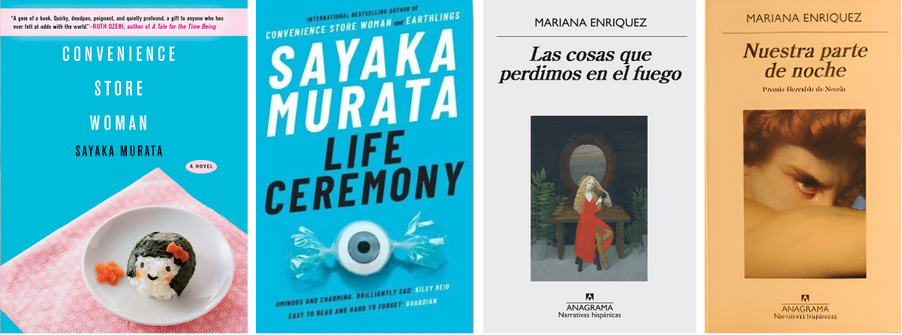
¹ Sayaka Murata received the Akutagawa Prize for Convenience Store Woman (Konbini Ningen, 2016), a novel born from years spent working in convenience stores, whose routines informed both setting and ethos.
² Mariana Enriquez wrote Alguien camina sobre tu tumba (Someone Walks Over Your Grave, 2013), a chronicle of cemetery visits that mingles social history, urban lore, and mordant humor; her journalism with Página/12 sharpened her civic ear.
³ Murata’s story collection Life Ceremony examines custom and appetite with ceremonial framing that treats taboo as a social design problem, which her prose interrogates through cheerful severity.
⁴ Enriquez’s collections Los peligros de fumar en la cama and Las cosas que perdimos en el fuego braid urban marginality with the country’s haunted political memory, while her novel Nuestra parte de noche extends that inquiry through a dynastic cult entwined with state terror.
⁵ Interviews after her Akutagawa recognition frequently mention that Murata retained her part-time post for an extended period, in order to remain close to the rhythms that animate her work.
⁶ Enriquez’s cemetery book ranges from Recoleta and Chacarita to less photogenic grounds, where caretakers’ talk and rain-varnished marble supply a field method for her later fiction.